Dr. Megan Collins adjusted her glasses, her eyes fixed on the 1862 photograph. As a senior restoration specialist at the Atlanta Institute of Conservation, she had worked on countless historical images, but something about this one made her pause. The photograph showed the Blackwell family, prominent Georgia planters, posed for their annual portrait. “Just another stereotypical pre-Civil War image,” she muttered, wiping the surface to begin digital restoration.
In the background, barely noticeable, a Black man in servant’s livery held a tray. Megan zoomed in on his face. Unlike the neutral or solemn expressions typical of 19th-century photography, especially for enslaved people, the man wore a faint, almost imperceptible smile. A smile that sent a chill down her spine.
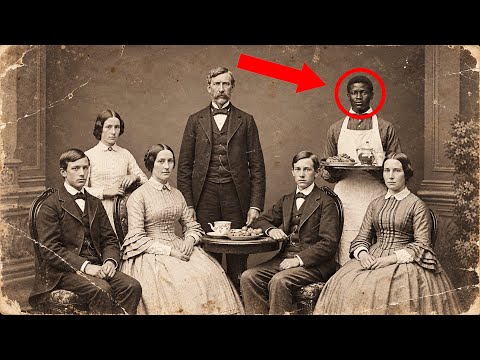
That night, Megan couldn’t shake the image from her mind. The next morning, she delved into historical records at the Wilkes County library. “Tragedy strikes Blackwell family. Richard Blackwell, his wife Victoria, and their four children found dead. Suspected food poisoning,” read a newspaper article from March 1862.
Beside her, archivist Dr. Henry Johnson watched with growing interest. “You’re suggesting it wasn’t an accident,” he said, his eyes narrowing as he examined the enlarged photo. He disappeared between the shelves, returning with a leather-bound journal. “These are the diaries of the local doctor, Dr. Thomas Harrington. He was called to examine the bodies.”
In the yellowed pages, Megan found a detailed entry: “Called to Blackwell plantation. Entire family deceased. Symptoms consistent with acute poisoning. Dilated pupils, foaming at the mouth, convulsions. The household servant, Samuel, was not found on the property.”
Samuel. The name echoed in Megan’s mind as she stared again at the smiling man in the photograph. The diaries contained more: a search party was organized, but Samuel was never caught. The authorities assumed his guilt due to his flight, but without conclusive evidence beyond circumstantial, the case was eventually closed as an unexplained tragedy.
At the Atlanta African American History Museum, Dr. Eliza Washington, senior curator and specialist in Georgia slavery history, examined the photo with a grave expression. “This is fascinating, Megan. What have you discovered about this man?” she asked, studying the magnified face.
“Only his first name, Samuel, and that he disappeared after the deaths,” Megan replied. “The authorities assumed his guilt, but they never found him.”
Eliza typed some information into her computer. “Let’s check our database of former slave narratives collected by the Federal Writers’ Project in the 1930s. Many who escaped changed their names, but they often kept details of their stories.”
After an hour of searching digital records, they found a transcript of an interview with a 97-year-old man named Samuel Freeman, recorded in 1933 in Chicago. “When they sold my wife Esther and our two small children to Louisiana, something broke inside me. The master had promised he would never separate families, but he broke that promise when he needed money after gambling losses. That’s when I realized justice would not be served by white man’s laws.”
Megan felt a chill. “Is there any way to confirm this is the same Samuel?”
“Possibly,” Eliza said, scrolling to another section. “Here he mentions working as a house servant for a family on a Georgia plantation and that he made his way north via the Underground Railroad after an incident in 1862. He never specified what the incident was, and the interviewer didn’t press him.”
Reading further, they found another revealing passage: “There was a photographer there that day. I remember thinking at the time that it was fitting to have a record, that everything would be documented for history to judge.”
Megan and Eliza exchanged sharp glances. The connection was undeniable.
“Is there anything about what happened to him afterward?” Megan asked.
“According to this document, he settled in Chicago, remarried, had three children, and became a respected carpenter and community activist. He died in 1935, never returning to the South.” Eliza paused. “He never explicitly confessed to any crime in these interviews, but reading between the lines…”
The pieces were falling into place, forming a disturbing picture as clear as the photograph itself. A man who had lost everything was systematically planning revenge on those who had destroyed his family.
Professor Wallace, an expert in historical toxicology at the University of Georgia, analyzed the symptom descriptions recorded by Dr. Harrington. “Based on these accounts, we’re most likely dealing with a plant-based poison,” he explained, tapping a yellowed botanical illustration. “Dilated pupils, convulsions, rapid death—these point to a strong alkaloid compound, perhaps belladonna or datura, both of which grew wild across the South.”
“Would it have been easy to access?” Megan asked, taking notes.
“Absolutely. Knowledge of medicinal and toxic plants was common in the 19th century. Many enslaved people brought extensive botanical knowledge from Africa. They were often responsible for the plantation’s medicinal gardens.” He opened an antique herbology book. “Datura was known among enslaved communities as the ‘rebel slave’s herb.’ There are documented cases of it being used to poison overseers and masters.”
“Could it be hidden in food?”
“If prepared properly, the extract can be relatively undetectable, especially in the heavily spiced dishes common in Southern cuisine. With a sufficient dose, symptoms appear within an hour, death within a few hours.”
Megan connected the timeline: the celebratory dinner, the photograph taken just before, the deaths discovered later that night. “This explains the interval between the meal and the deaths.”
“Is there any way to confirm this? Were the bodies exhumed?”
Wallace shook his head. “Unfortunately, no. The family was buried quickly due to the heat. No formal autopsy was performed beyond Harrington’s external examination. Common practice at the time, especially for wealthy white families wishing to avoid scandal.”
A search of the Atlanta Historical Archive revealed the photographer responsible for the Blackwell portrait was named Edward Wilson, an itinerant professional who traveled the South documenting wealthy families. Fortunately, Wilson kept meticulous journals, now preserved in a private collector’s collection.
After a series of emails and a convincing video call, the collector, Mr. Jamison, agreed to share the relevant pages digitally. The high-resolution scans arrived the next day.
March 17, 1862. Contracted to photograph the Blackwell family for their wedding anniversary. Arrival scheduled for four o’clock, before the celebratory dinner. Weather cooperative, good lighting in the main parlor.
So far, nothing they didn’t already know. But the entry continued.
The session proceeded normally, though I noticed an unusual tension. The house servant, a man of usually grave countenance, seemed strangely calm today according to Mrs. Blackwell. I commented on this privately to Mr. Blackwell, who mentioned a recent discipline that had apparently corrected his rebellious attitude. I finished the portrait as they prepared for dinner. I declined their invitation to join them, citing another appointment in Madison.
That last line sent a chill through Megan. The photographer had declined to partake in the very meal that would kill the entire family.
The entry from the following day was even more revealing.
March 18. Shocking news about the Blackwell family. Found dead this morning. Authorities suggest tainted food, but there are whispers about the missing servant. I clearly remember his eyes as he served dinner. There was something unsettling in his calmness. Perhaps this is imagination fueled by events, but it seems important now. I declined to discuss my observations with the sheriff as they seem too subjective for an official investigation.
Wilson had noticed Samuel’s demeanor but hadn’t realized its significance until too late. A final note added: “The Blackwell photograph shall remain undelivered. I consider it inappropriate to present it to distant relatives under these circumstances. Instead, I have kept it within my personal collection.”
That explained how the photograph survived. Detached from the family’s collections, it eventually made its way to the collector who donated it to the Atlanta Institute of Conservation over 160 years later.
“He saved it,” Megan whispered. “He must have realized later what he had captured through his lens.”
In the conference room of the Conservation Institute, the timeline lay spread across the table. Megan had assembled a detailed board connecting every element of the story. Professor Wallace and Dr. Washington joined her to review the full case, each contributing their expertise.
“Let’s summarize,” Megan said, using a laser pointer to highlight key documents. “The Blackwells purchased Samuel and Esther, an enslaved couple, in 1855. They had two children over the next few years. In October 1861, Esther and the children were sold without warning, despite a previous promise to keep families together. This happened shortly after Richard Blackwell suffered gambling losses.”
“A tragically common pattern,” Eliza observed. “Promises made to enslaved people were routinely broken when financial interests intervened. Family separation was one of the most brutal aspects of slavery, and one of the most effective means of control.”
Megan continued: “In December, Samuel was punished for reading a newspaper—perhaps trying to gather information about his family’s whereabouts or about the ongoing Civil War. Then he appeared to submit, becoming exemplary in the weeks before the family’s death.”
“Classic behavior of someone planning escape or revenge,” Wallace noted. “Feigned compliance to lower the captor’s guard. They would have interpreted his obedience as successful breaking of his will.”
“Then came the anniversary dinner in March 1862. Samuel prepared and served the food, likely laced with a toxic plant extract. The photographer captured the moment, including Samuel’s hidden smile. Hours later, the entire family was dead, and Samuel had vanished.”
Eliza examined the magnified photograph once more. “This isn’t a smile of joy. It’s the smile of resolve—of a man who finally controlled his own destiny, whatever the cost.”
Megan nodded, the weight of Eliza’s words settling over the room. “And decades later, a man named Samuel Freeman recounted fragments of his story to an interviewer, carefully omitting specifics but mentioning an incident in 1862 and the presence of a photographer.” A story of personal justice, revenge, and the heavy price of freedom—all captured in a single photograph.
“What’s particularly striking,” Eliza added, “is that Samuel chose a method that allowed him to be present at their deaths, then escape before being caught. He wanted to witness the consequences of his actions, to see justice served by his own hand.”
Megan now faced a profound ethical dilemma. How to present this discovery? The photograph technically documented the moment before a crime—an act of revenge, understandable in the context of slavery’s horrors, yet resulting in six deaths, including four children.
She met with the Institute’s leadership. The wood-paneled conference room felt especially solemn as they grappled with the implications. “We have conflicting responsibilities,” explained Director Dr. Marcus Reed. “On one hand, historical truth; on the other, concerns about interpretation in today’s political climate.”
Dr. Patricia Sullivan, ethics committee chair, added, “We’re essentially revealing an unsolved murder, though all involved are long dead.”
Eliza, invited as a consultant, advocated for a direct approach. “This photograph represents a vital counter-narrative to the sanitized history of slavery that has dominated for too long. It shows the will of an enslaved man confronting unspeakable injustice. To hide it would be to perpetuate erasure.”
“I agree,” Megan said firmly. “We’re not glorifying violence but contextualizing an act of extreme resistance against a system that was itself brutally violent. Samuel’s entire family was taken from him for profit. His humanity was systematically denied at every turn.”
After hours of deliberation, they reached a consensus. They would exhibit the photograph and their findings as a comprehensive historical case study, with all necessary context about the realities of slavery, family disintegration, and the limited options available to enslaved people seeking justice.
“We’ll present it as a complex document of resistance,” Dr. Reed concluded. “Not to celebrate the act itself nor to judge it by contemporary standards, but to understand it within the brutal realities of that time and place.”
Six months later, the exhibition “Documented Resistance: The Blackwell Photograph” opened at the Atlanta African American History Museum. The central display featured an enlarged, restored version of the photograph, with special lighting highlighting Samuel in the background. His smile was now unmistakable.
On opening night, an elderly woman approached Megan. “My name is Ruth Freeman,” she said quietly. “Samuel was my great-grandfather.”
Megan was speechless for a moment. “Did you know about this?”
Ruth shook her head. “Not the details, but family stories about how he escaped Georgia during the war, and how he never spoke of his first family.” She looked at the photograph. “But we always knew he carried great sorrow, and that he found his freedom through desperate means.” She touched the image gently. “I don’t judge what he did. I can’t imagine his pain.”
A year after the exhibition opened, Megan sat in her office reviewing its impact. The Blackwell photograph had become a case study in universities nationwide, sparking heated debates about slavery resistance, historical justice, and how communities remember violence on both sides of oppressive systems.
Most importantly, Samuel Freeman’s descendants came forward—not just Ruth, but dozens of others. They shared family stories, photographs, and documents that filled gaps in the narrative of his later life in Chicago. Samuel had become an active member of the Black community, an advocate for Black children’s education, and eventually participated in the nascent civil rights struggle.
On Megan’s desk was a recent article from the Journal of American History analyzing the case. Its title captured the essence of her discovery: “Samuel’s Smile: Will, Resistance, and the Enduring Power of a Single Image.”
The final page published another photograph—Samuel Freeman at seventy, surrounded by his second family in Chicago, 1910. His face, aged and weathered, was calm. Yet his eyes still held the weight of all he had lived and lost.
A message had arrived yesterday from the Smithsonian requesting the Blackwell photograph for an upcoming major exhibition on resistance narratives across American history. It would be displayed alongside other documented acts of resistance, from slave revolts to civil disobedience.
For Megan, the two images together told a story beyond words—of unimaginable pain, impossible choices, and the eternal human quest for freedom and justice, whatever the cost.
The article closed gently: “Some historical secrets, once revealed, cannot be forgotten—nor should they be.” Samuel’s silent act of resistance, forever held in that enigmatic smile, had finally found its place in the complex tapestry of American history—not as a simple story of heroes and villains, but as a testament to the full, complicated humanity of those the system tried to reduce to mere property.
What do you think—was Samuel’s act of vengeance a justified response to the horrors of slavery, or does the killing of children cross a moral line that cannot be excused?
Report this article
Select a reason for reporting:






