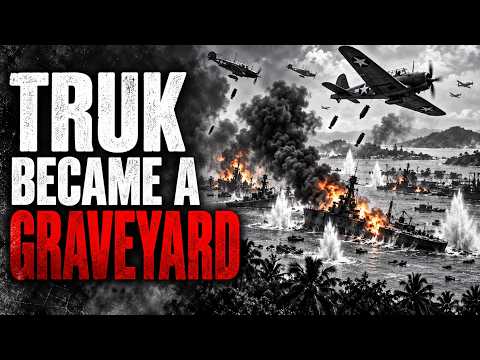
In the predawn darkness of February 17, 1944, a fighter sweep of 72 Hellcats roared off the decks of nine American carriers, their engines a rising thunder across the black water. Below them lay Truk Lagoon—Japan’s great fortified anchorage, the base the Western press had spent a decade calling the Gibraltar of the Pacific. It was the hinge on which the entire Japanese Pacific campaign turned, a lagoon ringed by coral and bristling with airfields, repair shops, and coastal guns. No outsider had seen inside its reef in twenty years. And now, American pilots were about to tear it apart.
But the most decisive blow had already been struck—not by bombs or torpedoes, but by a fleet of unarmed auxiliaries that never fired a shot in anger. The United States Navy had built a mobile base out of ships, a floating city that could move with the fleet and turn any sheltered patch of water into a fully functioning naval base. They called it Service Squadron 10. And with it, the entire logic of Pacific warfare was about to be turned upside down.
The Japanese had spent twenty years preparing for the decisive battle. Their strategy, Zengen Sakusen—interceptive attrition—assumed the American fleet would have to cross 3,000 miles of open ocean, wearing itself down on submarines, land-based aircraft, and night torpedo attacks before the Japanese battle line finished it off. Every weapon they built, from the Long Lance torpedo to the Yamato, existed to serve that vision. The mandate islands, handed to Japan after World War I, sat astride every sea route from Hawaii to the Philippines. Truk was the keystone: a lagoon forty miles across, deep enough for battleships, protected by a barrier reef with only a few narrow passes. It was, by any measure, the perfect anchorage.
And that was exactly the problem. The Japanese had built a fortress for a war that was already obsolete. They assumed the Americans would have to come to them, that any advance across the Pacific required capturing Truk and its harbor. But the Americans had found a way to bring their own harbor with them.
In November 1943, Service Squadron 10 was commissioned at Pearl Harbor under Commodore Worrall Reed Carter. It was a floating naval base: fleet oilers, ammunition ships, repair ships, destroyer tenders, salvage vessels, and—most remarkably—floating dry docks built in sections that could be towed across the ocean and bolted together at anchor. The largest of these could lift a 45,000-ton battleship clear of the water. Alongside this, the fleet perfected underway replenishment, refueling and resupplying warships at sea so they never had to return to port. The consequence was revolutionary: a carrier task force could stay at sea for weeks, striking and resupplying on station. The fleet no longer needed the enemy’s harbor—it could make its own.
By early 1944, the Americans had also embraced a new doctrine: bypassing. Instead of assaulting heavily fortified islands like Truk, they would seize weakly held atolls behind them, build airfields, and use air power to neutralize the strong points. Leave the garrisons isolated and irrelevant. Move on. The Marshalls campaign in early 1944 proved the concept: Majuro was taken undefended and became a fleet anchorage within days. Heavily fortified islands like Wotje and Maloelap were simply skipped, their airfields bombed flat, their garrisons left to starve.
Now it was Truk’s turn. Admiral Mineichi Koga, commander of the Combined Fleet, saw the warning. On February 4, 1944, Marine reconnaissance aircraft photographed the lagoon. Koga correctly concluded that Truk could no longer be defended against a carrier force of that size. He withdrew the battleships, carriers, and heavy cruisers to Palau, saving the fleet but admitting that the great central anchorage was no longer safe. Truk had already ceased to be a fortress before a single American bomb fell.
What remained on the morning of February 17 was still a massive concentration: light cruisers, destroyers, submarine tenders, oilers, and some 30 to 40 merchant ships and auxiliaries, defended by roughly 350 aircraft—half of them operational. Task Force 58, under Vice Admiral Marc Mitscher and Admiral Raymond Spruance, launched its first strike at 0450 from 90 miles out. The fighter sweep caught the Japanese defenders by surprise. Hellcats strafed parked aircraft and shot down fighters taking off piecemeal. Within hours, Japanese air defense over Truk had effectively ceased to exist.
Then the slaughter began. Wave after wave of Avengers, Helldivers, and Hellcats worked the lagoon. Ships trying to escape through the narrow passes were sitting ducks—unable to maneuver, unable to make speed, unable to choose a heading. The light cruiser Naka was caught and sunk. Destroyers were sunk in and around the passes. Tankers burned, and the oil burned on the water. Spruance even detached a surface group built around the battleships New Jersey and Iowa to hunt down escaping ships, catching the training cruiser Katori and the destroyer Maikaze in open water. That night, Avengers from Enterprise flew the first radar-directed night bombing attack from a carrier, scoring remarkable hits on a target set that had assumed darkness meant safety.
The Japanese struck back where they could. A torpedo aircraft found Task Force 58 in the dark and put a torpedo into the carrier Intrepid, killing 11 men and jamming her rudder. She got clear under emergency steering, rigging a makeshift sail from canvas and hatch covers, and reached Pearl Harbor. But it was a small consolation. By the time Task Force 58 withdrew, roughly 40 ships—some 200,000 tons of shipping—had been sunk, along with about 250 aircraft, fuel stocks, and much of the repair and support infrastructure ashore. American losses were 25 aircraft and around 40 men.
Truk was left to rot. The garrison of roughly 38,000 Japanese servicemen remained, but they were bypassed, bombed periodically, and cut off from resupply. They starved for eighteen months, surrendering in September 1945, having played no part in the war after February 1944. The Gibraltar of the Pacific had been erased in two days—not by invasion, but by irrelevance.
The implications were profound. Japan’s entire strategic conception had rested on the assumption that the Americans would have to fight for the Central Pacific. But the Americans had changed the terms. By making their base mobile, they had destroyed the value of every fixed base Japan possessed. Rabal, Truk, Wotje, Maloelap—all were fortified at enormous expense, defended by large garrisons, and rendered worthless without a shot being fired at them. The Japanese Navy, fragmented and unable to train together, would go on to fight the Battle of the Philippine Sea and Leyte Gulf at a crippling disadvantage.
And the American fleet moved on, its floating base moving with it. Ulithi Atoll, occupied in September 1944, became the largest naval base in the world—a lagoon full of ships, with no city, no runways, just anchored oilers, ammunition ships, repair ships, and floating dry docks. On one day in October 1944, the anchorage held 617 vessels. That was the base.
But the story of Truk did not end with the raid. The wrecks still lie on the bottom of the lagoon, a ghost fleet frozen in time. And the men who survived the attack—both American and Japanese—would carry the memory of that February morning for the rest of their lives. The question that remained, as the fleet sailed west, was what would happen when Japan realized that its greatest weapon—distance—had been turned against it. The answer would come in the waters off the Marianas, where the Japanese fleet would make its last stand.
The Marianas campaign that followed in June 1944 was the direct inheritance of everything Truk had taught. Saipan, Tinian, and Guam were not chosen because they were weakly held—they were chosen because they sat within range of the Japanese home islands and because their capture would give the Americans airfields from which B-29s could reach Tokyo. The lesson of Truk was not that fortified islands should be avoided, but that they should be avoided unless they offered something the fleet could use. Saipan offered airfields. Truk offered nothing but a harbor the Americans no longer needed.
When the assault on Saipan began on June 15, the Japanese fleet came out to fight—exactly as their doctrine had always promised. Admiral Jisaburo Ozawa brought nine carriers and the battleship Yamato’s sister, Musashi, into the Philippine Sea, determined to catch the American invasion force and destroy it. It was the decisive battle the Japanese had planned for twenty years. But it was fought on American terms.
The Battle of the Philippine Sea, on June 19 and 20, was not a contest between equal fleets. It was a demonstration of what happens when one side’s entire strategic assumption has been invalidated. Ozawa’s plan depended on land-based aircraft from Guam and the surrounding islands striking the American carriers before his own planes arrived. But the American carrier groups had been hammering those airfields for weeks. The land-based aircraft were largely destroyed on the ground. Ozawa’s carefully constructed trap had no bait.
What followed was later called the Great Marianas Turkey Shoot. American Hellcats, flown by pilots who had been trained in the new doctrine of fighter direction and radar control, met the Japanese strike groups at altitude and tore them apart. Over 300 Japanese aircraft were destroyed in a single day. The carrier Taiho, Ozawa’s flagship, was sunk by a single torpedo from the submarine Albacore—a strike that ignited fumes from a poorly designed fuel system. The carrier Shokaku, a veteran of Pearl Harbor, was sunk by the submarine Cavalla. The fleet that had once anchored at Truk was now being hunted in open water, unable to replace its losses.
There is a detail from the Philippine Sea that connects directly back to Truk, and it is easy to miss. The American fleet that fought that battle had sailed from Majuro and Eniwetok—anchorage that had been Japanese territory months earlier. It had been fueled and rearmed at sea by Service Squadron 10. It had repaired its damaged ships in floating dry docks towed across the Pacific. Not a single American warship had returned to Pearl Harbor between the Truk raid and the Philippine Sea. The fleet had stayed at sea for months, striking and resupplying on station, exactly as the mobile base concept had promised.
The Japanese fleet, by contrast, had been forced to scatter. The carriers trained in home waters. The battleships operated from Lingga Roads near Singapore, close to the oil fields. They had not trained together. They had not rehearsed the complex coordination that carrier warfare demanded. When Ozawa finally brought them together for the Philippine Sea, many of his pilots had fewer than three months of training. The disparity was not in courage or seamanship. It was in the arithmetic of a fleet that had lost its base.
After the Philippine Sea, the Japanese carrier force ceased to exist as a meaningful striking arm. The remaining carriers would be used as decoys at Leyte Gulf in October, sacrificed to draw Halsey’s fast battleships away from the invasion beaches. It was a desperate gamble, and it nearly worked. But that is another story, and it belongs to the record of Leyte, not Truk.
What belongs here is the final accounting. The raid on Truk had lasted two days. It had cost the Americans 25 aircraft and about 40 men. It had cost the Japanese roughly 40 ships, 250 aircraft, and the central anchorage that had held their fleet together for eighteen months. But the deeper cost was not measured in tonnage or aircraft. It was measured in the shape of the war that followed. Every Japanese operation after February 1944 was fought by a navy that had lost the ability to concentrate, to train, and to repair. The Battle of the Philippine Sea was lost before it began, in a lagoon that had been abandoned by the fleet it was built to protect.
And the men left behind on Truk—the 38,000 who had been bypassed—continued to starve. They fished and farmed and watched the American planes fly overhead, mapping and photographing, occasionally bombing. They received no supplies, no reinforcements, no orders that mattered. By the time they surrendered in September 1945, several thousand had died of malnutrition and disease. They had been defeated not by assault but by irrelevance, which is the most complete form of defeat a garrison can suffer.
The lagoon itself became something else entirely. In the decades after the war, the wrecks of Truk became a destination for divers—a ghost fleet preserved in warm coral water, the ships still holding their cargo, the aircraft still resting where they fell. It is one of the most visited wreck diving sites in the world. Every week, people descend into an anchorage that stopped being a naval base on a Thursday morning in February 1944 and never became one again.
But the strategic lesson of Truk was not confined to the Pacific. It echoed forward into every subsequent American war, where the ability to project power without depending on fixed bases became the defining advantage. The mobile base, the fleet oiler, the floating dry dock—these were not just tools of one campaign. They were the beginning of a revolution in how navies operate. The Japanese had built a fortress for a war that required harbors. The Americans had built a fleet that required nothing but open water.
And as the American fleet sailed west from the Marianas, toward the Philippines and eventually toward Japan itself, the men who had planned the raid on Truk understood something that their Japanese counterparts never fully grasped. The war in the Pacific was not decided by the battles that were fought. It was decided by the battles that were never fought—by the fortresses that were never assaulted, by the garrisons that were never engaged, by the harbors that were never needed. The greatest weapon in the Pacific was not a ship or a plane or a bomb. It was the decision to bring your own base and leave the enemy’s to rot.
The fleet moved on. The lagoon fell silent. And somewhere in the Coral Sea, a Japanese staff officer who had spent twenty years planning the decisive battle began to understand that the war he had prepared for would never be fought—and that the war he was fighting had already been lost.
That officer’s realization was the war’s true verdict. Japan had spent two decades building fortresses for a fight that never came, while America built a fleet that needed no fortress at all. The lesson outlived the guns: power no longer belonged to whoever held the ground, but to whoever could move without it.
Today the same logic governs carriers, drones, and logistics ships that never fire a shot. The strongest position is the one the enemy cannot find, cannot bomb, and no longer needs to take.
So here is the question worth carrying forward: if your greatest advantage could be made irrelevant overnight, would you even know it had happened? What do you think—is distance still a weapon, or has mobility finally killed it?
Report this article
Select a reason for reporting:






