April 1945. The Third Reich is crumbling. Soviet guns thunder at the gates of Berlin, and the Western Allies have crossed the Rhine. Defeat is certain. Yet, in a bunker near the Oder front, General Busse, commander of the German 9th Army, reveals his plan to General Heinrici: “My intention is to resist on the Oder front long enough until the Americans reach Berlin.” Heinrici, stunned, asks if Busse has heard of the Eclipse Plan. Busse hasn’t. Heinrici explains: the Allies have already carved up Germany’s future. No matter how long they hold the Soviets back, half of Germany will fall under Soviet control. The revelation is chilling—but it only hardens their resolve. If Germany is doomed to be divided, then every hour of resistance might mean more of it saved from Stalin’s grip.
This was just one of the seven reasons that drove the Wehrmacht to fight with a ferocity never seen before, even after all hope of victory had vanished. From the delusion of a collapsing enemy coalition to the primal instinct to protect their families, the German soldier’s motivation was a complex mix of propaganda, fear, and duty. Understanding why they continued to fight—and die—in the face of annihilation is key to comprehending the war’s brutal final chapter.
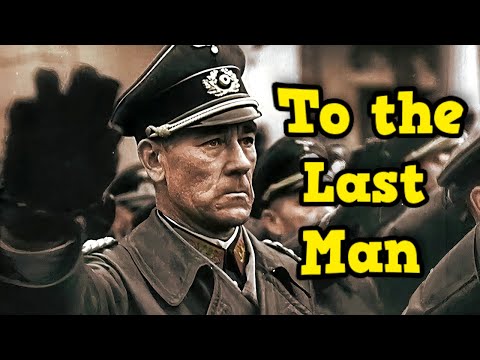
The first reason was the desperate hope that the Allied coalition would fracture. German propaganda insisted that the unnatural alliance between the capitalist West and the communist East was on the verge of collapse. The death of President Roosevelt on April 12, 1945, seemed to confirm this. Soldiers were told that the Americans and British would soon turn on the Soviets, and that a separate peace could be negotiated. This illusion was reinforced by a bizarre incident: on the night of April 23, American aircraft dropped no bombs on Berlin. The regime quickly spun this as a sign that the Western Allies were about to join forces with Germany against the Red Army. Even after Hitler’s suicide, many clung to the fantasy of an “SS Europe” division that would fight alongside the Americans. The reality—unconditional surrender and occupation—was too grim to accept.
By September 1944, with Germany expelled from France and the Soviets in Warsaw, it was clear the war was lost. But the Allies’ demand for unconditional surrender, reiterated by Roosevelt in 1943, left no room for negotiation. German propaganda exploited this masterfully. “I would rather die on the battlefield defending my country than spend the rest of my life cutting down trees in Canada or Siberia,” became a common refrain among soldiers. They were cornered, like a wounded animal with no escape. The choice was simple: fight to the death or face a lifetime of slavery in the East. This fear was so potent that even Soviet attempts to promise humane treatment for prisoners fell on deaf ears. The Germans had seen the atrocities committed by both sides; they knew what awaited them if they surrendered.
Then there were the “miracle weapons.” Propaganda promised jet fighters that would sweep the skies, monstrous tanks that would crush any offensive, and V-rockets that would devastate London and bring Britain to its knees. These Wunderwaffen were always just around the corner, fueling a desperate hope that a radical turn of events could still snatch victory from the jaws of defeat. Soldiers were told to hold on just a little longer, until the new weapons could be deployed en masse. Of course, most of these weapons were either too few, too late, or simply ineffective. But the promise alone was enough to keep men fighting.
The fifth reason was the belief that the enemy was also on the verge of collapse. German soldiers had witnessed the enormous Soviet casualties and the seemingly endless material expenditure of the Americans. They convinced themselves that the Allies could not sustain such losses for much longer. Propaganda fed them tales of enemy exhaustion, of strikes and unrest in Allied countries. When German prisoners were captured in France, they were shocked to learn that New York was not in ruins, as their propaganda had claimed. But by then, it was too late—the seed of doubt had already done its work.
Perhaps the most powerful motivation of all was the instinct to protect their families. By early 1945, the fighting had reached German soil. The horrors of Soviet revenge—real and exaggerated—were broadcast to the troops. Women and children were said to be raped, murdered, or sent to Siberia. Hitler’s last proclamation to the Eastern Front on April 16, 1945, screamed: “The old people and children will be killed, the women and girls will be turned into camp prostitutes!” Whether they believed every word or not, the fear for their loved ones was visceral. They fought not for Hitler, not for the Reich, but for their mothers, wives, and daughters.
Finally, there was the simple, unshakeable sense of duty. When captured, many German soldiers gave the same answer: “It is my duty as a soldier to continue fighting until my superiors tell me otherwise.” This obedience, ingrained through years of military training and Nazi indoctrination, kept the war machine grinding on long after its purpose had vanished. They fought because they were told to, because to do otherwise would be betrayal, and because the alternative—surrender—seemed worse than death.
These seven reasons—the hope of Allied disintegration, the fear of unconditional surrender, the promise of miracle weapons, the illusion of enemy collapse, the desperate defense of family, and the iron grip of duty—combined to create a ferocity that stunned the world. The Wehrmacht fought on, not for victory, but for survival, for honor, and for the faint hope that something might yet be saved from the ruins. But the end was inevitable, and the cost would be catastrophic.
Nowhere was this lethal combination of motives more visible than in the chaos of the final weeks. Consider the case of a single Volksgrenadier battalion defending a village on the approaches to the Oder. Its commander, a decorated veteran of Stalingrad, knew the war was lost. Yet he also knew that behind his line lay a road crowded with refugees—women, children, old men—fleeing the very fate his propaganda had warned them about. He did not need a political commissar to remind him what was at stake. He had seen the reports from Nemmersdorf, the firsthand accounts of what happened when Soviet troops entered East Prussian villages. Whether those reports were exaggerated or not mattered little; the terror they inspired was real.
And so the battalion fought. Not for a plan, not for a Führer who had already retreated to his bunker, but for the columns of civilians who needed just one more day, one more hour, to escape westward. This was the grim arithmetic of the war’s final months: every minute of resistance bought another meter of survival for someone’s family.
Yet the same soldiers who fought with such ferocity for their loved ones were also capable of shocking naivety. In the last days of April, as Soviet shells rained down on Berlin, rumors swept through the bunkers beneath the Chancellery. The Americans were coming. A relief army was on its way. Some soldiers genuinely believed that the Western Allies would arrive at the last moment and push the Soviets back. This was the power of propaganda—it had so thoroughly shaped their worldview that even as their city burned around them, they clung to fantasies that defied all military logic.
When the end finally came, it came not with a single dramatic surrender but with a million small, desperate decisions. Some units dissolved into the countryside, hoping to reach the American lines before the Soviets caught them. Others fought on to the bitter end, obeying orders that had lost all meaning. And a few, like the men of the SS Nordland division, chose to make their last stand in the streets of Berlin itself, fighting for a regime that had already betrayed them.
The story of why they fought is ultimately a story about the human capacity for hope in the face of hopelessness—and the terrible price of that hope. It is also a story about the power of fear, and how a regime built on terror could use the fear of its own people to keep them fighting long after the cause was lost. The soldiers of the Wehrmacht were not mindless automatons, nor were they all fanatics. They were men trapped between the hammer and the anvil of history, fighting for survival in a war that had already been decided.
As the guns finally fell silent in May 1945, the survivors faced the reality they had so desperately tried to avoid. Millions would spend years in prisoner-of-war camps, from the frozen wastes of Siberia to the fields of France. Many would never return. The unconditional surrender they had feared so much became their reality. And yet, in the decades that followed, a new question would emerge: how much of what they had been told was true, and how much was a lie designed to keep them fighting? The answer, as with so many things in war, lay somewhere in between—in the gray zone where propaganda, fear, and genuine conviction became impossible to separate.
The final battles of 1945 were not just a military conflict; they were a window into the darkest recesses of the human psyche. They showed what people will do when cornered, what they will believe when the truth is too terrible to accept, and what they will sacrifice when everything they love is threatened. The men who fought and died in those last months were not heroes in the traditional sense, nor were they simply villains. They were human beings, caught in a catastrophe of their own making, fighting for reasons that were as complex and contradictory as the war itself.
And as the world began to count the cost—the millions dead, the cities in ruins, the continent divided—a new struggle was already beginning. The alliance that had held together just long enough to defeat Hitler was already fracturing. The very scenario German propaganda had promised—a war between East and West—was now a real possibility. In the ruins of Berlin, the seeds of the Cold War were being sown, and the soldiers who had fought so desperately to prevent the Soviet occupation of Germany would soon find themselves on the front lines of a new conflict, this time with former enemies as allies and former allies as enemies.
The soldiers who survived the war’s end would carry those final weeks with them forever. Some found that the nightmare did not end with surrender. In Soviet captivity, many faced forced labor, hunger, and death. Those who surrendered to the Western Allies fared better, but the fear that had driven them to fight—the fear of Siberia, of slave labor, of never seeing home again—had been real enough to shape their choices.
Historians still debate whether the ferocity of the Wehrmacht’s final stand prolonged the war unnecessarily or saved countless German civilians from a worse fate. The truth, as always, is buried in the chaos of those final days. What is certain is that the men who fought on the Oder, in the Ruhr, and in the ruins of Berlin were driven by a complex web of motives that defied simple judgment.
When the guns finally fell silent, the world that emerged was not the one any of them had imagined. The Reich was gone, divided between victors. The soldiers who had fought for family, for duty, for honor—they returned to a homeland in ruins, their sacrifices remembered by some, condemned by others.
The final chapter of the war in Europe closed not with triumph or tragedy alone, but with a bitter truth: the men who fought to the last were neither monsters nor martyrs, but humans trapped in history’s darkest hour.
Do you believe the war would have ended sooner if the Allies had offered terms other than unconditional surrender? Share your thoughts below.
Report this article
Select a reason for reporting:






