He was 71 years old when he earned an Academy Award nomination for Best Supporting Actor. Before that, he had spent six decades living an ordinary working man’s life—hauling freight on the docks of Vancouver, felling timber in logging camps, and driving a school bus to keep his family fed. By every measure the industry used, he was invisible. The world passed him by without a thought. And then something shifted.
At an age when most men have already collected their pension and retreated from public life, he walked into Hollywood carrying a lifetime of quiet endurance. He didn’t just get a role. He stopped the room. His name was Chief Dan George. And the journey that led him to that moment began not with triumph, but with a small boy being stripped of everything he was.
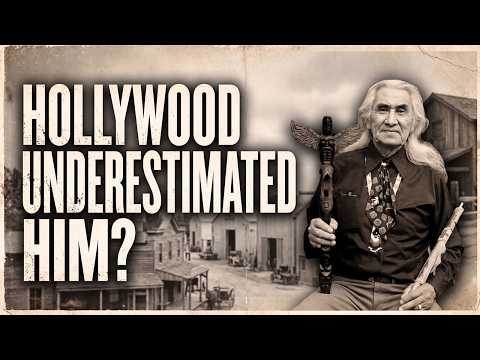
He was 5 years old when the government took his language from him. 5 years old when they told him his name was wrong, his words were wrong, his people were wrong. He would spend the next 66 years holding all of that inside. And when he finally answered, it wasn’t with fury. It wasn’t with bitterness. It was with something those who tried to erase him never expected. He answered with dignity.
There is a line he made famous, a prayer spoken flat on his back in the dirt, dressed as a man preparing for his own death: “My heart soars like a hawk.” Hold on to that line. By the time this story reaches its end, you’ll know exactly what it cost him to speak those words and exactly why they moved a nation to tears.
This is the story of a man who was told to disappear and simply refused to. He was born on the 24th of July, 1899, on Burrard Reserve Number Three on the north shore of the inlet near Vancouver. His people knew him as Geswanouth Slahoot. His father was a chief. His world was the water, the old-growth forest pressing in from every side, and a language that had been alive on that land for thousands of years before a single European ship ever appeared on the horizon. It was a full world, a rich one.
Then just after his fifth birthday, they came for him. In 1904, the boy was sent to St. Paul’s Mission School, and the eraser began on the very first day. The school told him his name, Geswanouth Slahoot, no longer existed. He would be called George, taken from his father’s imposed English name. A 5-year-old sitting in an unfamiliar building, suddenly carrying a stranger’s name. Just like that, the self he had been given at birth was gone.
It didn’t stop there. Inside those walls, the children were forbidden to speak their own languages, forbidden to observe the ceremonies and beliefs their grandparents had passed down across generations. If a child slipped and let the old words come out, punishment followed. Think about what that means for a moment. A small boy punished for instinctively speaking the only language his mother had ever used with him—punished for the sound of home.
And yet the pull of home never died. Every two weeks, young George would catch the streetcar to the end of its line, step off into the dark, and then walk seven miles through the night to reach his family for a single Friday evening. Seven miles in the dark just for a few hours of being himself again. That detail alone tells you everything about the kind of man he was becoming.
His son spoke about it openly years later, and the words were hard to hear. The damage that experience left behind wasn’t something Dan George ever fully shook. It lived in him. Hold that image for a moment—a boy made to feel that everything natural about him was a problem. Because one day that same boy, with that same voice they tried to silence, would stand before 32,000 people and stop them cold.
But before any of that, there was a much longer road. How does a child who was taught to be ashamed of who he is grow into the man who speaks for an entire people? It didn’t happen overnight. It didn’t happen in a classroom or on a stage. It happened on the docks, in the forest, and through decades of hard, quiet labor.
After he left the mission school around the age of 17, there was no clear path waiting for him. No opportunities lined up, no one rolling out a welcome mat. He went straight into the forest and picked up an axe, cutting timber for three years. It was relentless physical work, the kind that leaves marks on a man’s body and shapes the way he carries himself for the rest of his life.
Then in 1923, a door opened through family connection. His father-in-law arranged for him to get one of the most sought-after positions a working man on the waterfront could hope for. Dan George became a longshoreman on the docks of Vancouver. And he didn’t just pass through—he stayed. Not for a year, not for five. He worked those docks on and off for 27 years.
Think about what those 27 years actually held. He was there through the great labor strikes of the 1920s, when workers pushed back against impossible conditions and fought for something better. He was still there when the Depression hit in the 1930s and the dock work dried up almost entirely. During those lean years, he kept his family fed by hunting and cutting lumber, doing whatever the land and his own hands could provide.
That kind of resourcefulness doesn’t come from ambition alone. It comes from necessity, and from character. He had married a Squamish woman named Amy when he was still young, barely past boyhood himself, and together they built a life and raised their children through all of those difficult decades.
There was nothing glamorous about it. No recognition, no applause, no one taking note of what it cost him day after day. He was invisible in the way that working people often are, laboring hard while the wider world looked straight through them. He lifted, he hauled, he showed up, and he never once made a public complaint about the weight of it.
For most men, that life—the work, the family, the quiet endurance—would be the whole story. A working man who gave his best years to hard labor and then eased into old age without much fanfare. For the first 50 years of his life, that’s exactly the arc everyone around Dan George expected to see.
So what happens to a man like that when the work that defined him is suddenly taken away?
The year was 1947. Dan George was 48 years old, still on the Vancouver waterfront, still doing what he had always done. Then a swing load of timber moved the wrong way. One moment, one violent, unpredictable shift of weight, and everything changed. He described it himself, and no screenwriter would dare try to improve on his words.
“No bones were broken,” he said. “But my leg and hip muscles were smashed to hamburger.”
Smashed to hamburger. That phrase lands like the accident itself. Blunt, painful, and impossible to dress up. That was it for the docks. The 27 years were over. The strongest chapter of his working life closed in a single instant—not with a retirement party or a handshake, but with a swing load of wood and a body that couldn’t take what it absorbed.
A man who had anchored his entire sense of self in the strength and reliability of his own body now had to figure out who he was without it. That’s not a small reckoning. That’s the kind of moment that either breaks a person completely or quietly redirects them toward something none of them saw coming.
By most measures, a man approaching 50 with a shattered body and a family depending on him had every reason to give up. No savings, no safety net. A lifetime of hard physical work had left him with almost nothing to show for it except the injuries.
But Dan George didn’t fold. He got back on his feet, took whatever work was available, and kept moving forward the way men of his generation did—without complaint and without ceremony. That meant construction sites. It meant crane work, the kind of job that demands both strength and focus, neither of which came easy after what his body had been through.
And eventually, it meant climbing behind the wheel of a school bus and driving children through the streets of North Vancouver every single day. Steady work. Honest work. The kind most people never think twice about.
Stop for a moment and consider what that looked like. A future Academy Award nominee, a man who would one day earn the praise of Hollywood’s finest directors, picking up a route, checking his mirrors, and easing a bus full of kids through morning traffic. Not one of those children had any idea who was driving them. They saw a bus driver. Nothing more, nothing less.
And in a way, neither did he. Not yet. But that accident, as brutal and as costly as it was, had done something unexpected. By stripping away his ability to rely on his body, it had quietly opened a door he never knew existed. A man who can no longer haul lumber, who can no longer depend on his physical strength to carry him through life, has to find another way to matter. Another way to be heard.
What came next would catch almost everyone off guard—including Dan George himself.
In 1951, leadership arrived not as an opportunity, but as a duty. Dan George’s father had served as chief of the Burrard Band, the people known today as the Tsleil-Waututh Nation, a Coast Salish community rooted along the shores of Burrard Inlet. When the time came for that responsibility to pass, it passed to his son. No fanfare, no campaign. That was simply how it worked.
For the next 12 years, Dan George led his people—not from comfort, not from any position of wealth or political influence. He led them from within the community itself, the way his father had and his father’s father before that. He absorbed the weight of their struggles. He sat with their sorrows. He represented them in a world that more often than not had very little interest in hearing what they had to say.
And here is why this matters so much to everything that follows. Every role he would later play on screen—every elder radiating quiet authority, every chief carrying the dignity of a people on his shoulders—none of it required him to reach for something he didn’t already know. He had lived those years. He had held that weight in his actual hands. The performance was already inside him, built through experience, not craft school.
He put it plainly himself, with that characteristic ease that never left him. “I was an Indian chief for 12 years,” he told a reporter, a slight smile behind the words. “So I really didn’t have to do much acting.”
Only a man fully at peace with who he is can say something that quietly funny about a gift that serious. There’s no pretension in it. No false modesty either. Just a man telling the truth.
By 1963, his time as chief had run its course. He was 63 years old. Decades of labor, loss, and leadership had left their mark on him physically. By any conventional reading of a man’s biography, this was the closing chapter—the long middle stretch of a life well lived, winding down toward a quiet finish.
That’s how most stories end. Dan George’s story had other plans. Something was about to happen that almost never happens in real life. Not a second act. A full restart. A man in his seventh decade—a former chief and retired school bus driver—was about to discover that his most consequential years hadn’t happened yet. That the world hadn’t actually seen him. Not really.
There was no audition, no agent, no carefully timed pivot. The CBC was producing a series called Cariboo Country, and the actor playing Old Antoine fell ill. Someone suggested the old chief who drove the school bus in North Vancouver. He had no training, no desire to stand before a camera—and he got the part.
Critics called his work “ultimate perfection.” Playwright George Ryga rewrote an entire play around him, saying the father in The Ecstasy of Rita Joe “was Dan George.” Everything the mission school tried to destroy had become the source of his power.
Then came July 1, 1967—Canada’s centennial, 32,000 people in Empire Stadium. They expected a blessing. Instead, he delivered a lament. “When I fought to protect my land and my home, I was called a savage.” The stadium went still. Then he turned: “I shall rise again out of the sea… I shall build my race into the proudest segment of your society.” Thirty-two thousand people rose to their feet.
Three legends—Brando, Olivier, Scofield—had passed on Old Lodge Skins in Little Big Man. Dan George took it and tore apart fifty years of Hollywood stereotype. Lying in the grass, waiting for death that never came, he shrugged: “Sometimes the magic works, sometimes it doesn’t.” The audience laughed, then wept.
At 71, he became the first Indigenous North American ever nominated for an acting Oscar. “I don’t want the Indians called second-class people anymore,” he said. That same year, Amy—his wife of fifty years—died before she could stand beside him at the top. His son said he died of a broken heart.
He passed in 1981, and the rain fell over Vancouver—the same rain that once fell on Old Lodge Skins. His heart, he wrote, soars like a hawk. Present tense. It never stopped.
They took his name, his language, his voice—and he answered with dignity. So tell me: what would you have done with a second chance at seventy? Drop his name below and carry Chief Dan George to someone who’s never heard of him.
Report this article
Select a reason for reporting:






