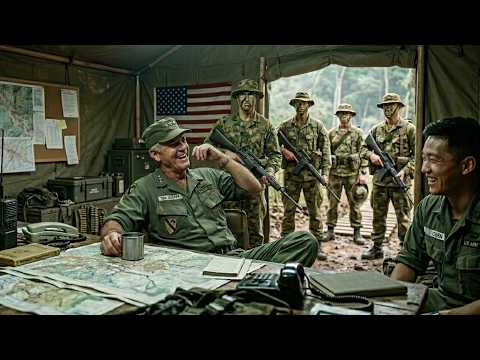
The laughter started at the back of the room and rolled forward like a slow wave. It was the kind of laughter men allow themselves when they are certain they are right. General Frederick Weyand sat at the head of the operations table and let them laugh, watching his staff officers exchange glances and shake their heads with the comfortable amusement of professionals who had just heard something they considered professionally absurd.
On the table in front of him was a single printed sheet: an offer from the Australian Task Force at Nui Dat. Sixty men. Four weeks of “full operational independence.” No request for American artillery support. No airstrikes. No quick reaction force on standby. Just 60 soldiers, their weapons, and four weeks in a jungle that had already swallowed three US operations at divisional level and spat out the bones.
Weyand raised his hand and the laughter stopped. He had held command at every level the US Army offered, from rifle platoon to corps. He had learned long ago that the moment before a decision is the most important moment, because it is the last moment before you become responsible for it. He looked at the paper again. He thought of Cedar Falls, Junction City, Manhattan. Thirty thousand men, then 25,000, then 10,000. Body counts that looked right in reports sent to Saigon. Tonnage figures that looked impressive in Pentagon briefings. Temporary disruption every time. Then within weeks, the enemy forces returned to the same ground, the same trails, the same tunnels, operating with the same confidence they had shown before the Americans arrived.
He thought about all of that, then looked at the offer on the table and said three words. “Let them try.”
What the staff officers heard in those three words was diplomatic tolerance. But what Weyand meant was something closer to exhaustion than contempt. He did not believe 60 Australians would succeed where 60,000 Americans had achieved only temporary results. But he had run out of certainty about what success in War Zone D actually required. And uncertainty, in his experience, was at least honest.
His operations officer suggested assigning the Australians to preliminary reconnaissance while American infantry brigades prepared the main effort. Weyand nodded his approval, the meeting moved on, and the Australian offer was filed as a minor administrative note in a much larger document. No one in that room believed the filing would matter. They were wrong in a way that would take years to fully understand. And when that understanding came, it would not come gently.
To know why that laughter happened, you have to know what had already been tried. Operation Cedar Falls was the embodiment of everything American military doctrine prescribed. Thirty thousand troops drawn from multiple divisions. Coordinated helicopter assaults, artillery batteries firing around the clock. Arc Light strikes by B-52 bombers that turned vast stretches into cratered moonscapes. The operation lasted three weeks in January 1967. By the time it ended, American commanders were writing reports describing it as a success. Estimates of 750 Viet Cong killed. Hundreds of bunkers and tunnel complexes destroyed. The elimination of key enemy infrastructure in the Iron Triangle and surrounding areas.
The reports were accurate. And within six weeks, intelligence observed enemy forces returning to the same ground, using the same trails, rebuilding what had been destroyed. The infrastructure returned. The logistics network returned. The command structure returned. Cedar Falls had happened, and then virtually nothing had happened, except that 72 Americans did not come home from it.
Junction City was larger. Twenty-five thousand troops, better coordination, an attempt to isolate the area of operations and prevent enemy withdrawal before the main attack. Two hundred eighty-two Americans were killed in that operation. Thousands more were wounded. The enemy took heavy losses, and within two months they were back. Same areas, same supply routes, same levels of activity. They had absorbed the blow and returned to their baseline, exactly as a body of water absorbs a thrown stone and then closes over it.
Operation Manhattan in April was smaller and more focused. Ten thousand men with better intelligence and more precise targeting, and the results were marginally better, but structurally identical. Temporary disruption, enemy reorganization, and a return to previous capability. The pattern was clear to anyone willing to see it clearly, which meant it was almost invisible to nearly everyone; because seeing it clearly required acknowledging that the basic assumptions of American operational doctrine were not producing strategic results in this environment.
The Viet Cong and the North Vietnamese Army were not fighting the war American doctrine was designed to win. They were fighting an infrastructure and patience war, where losing a battle meant nothing as long as the system supporting operations remained intact. American forces could seize ground and hold it temporarily. They could destroy individual positions with devastating precision. They could kill enemy soldiers at a rate that seemed mathematically unsustainable. But the enemy absorbed all of it, withdrew slightly, waited, and returned because the soldiers and the bunkers and even the individual commanders were not the target. The system was the target. The network of supply routes, ammunition caches, communication nodes, medical facilities, and training areas that made organized military activity possible in the jungle. American operations repeatedly destroyed individual nodes in that network and reported success. The network recovered and the reports became lies without anyone having lied.
That was the legacy Major Peter Daw brought with him when he entered that long briefing room three days after we agreed to the Australian offer. He was not the man the assembled American staff expected. He was short, quiet, with a methodical way of moving that suggested a man who had learned long ago that energy spent on display is energy wasted. He wore standard Australian uniform without modification, carried a map case and a notebook, and looked, as one American officer later described him in a personal letter home, like the sort of man you would not notice sitting next to you on a train.
What the American officers could not see was that Daw had spent three years in Malaya hunting communist insurgents through jungle terrain nearly identical to what awaited them in War Zone D. That he had led more successful long-range patrols than any man in that room, possibly more than all of them combined. That he had developed a fighting philosophy through accumulated operational experience rather than institutional doctrine. A philosophy of war so different from the American model that the two approaches barely shared a common vocabulary.
He thanked the Americans for the opportunity briefly and without fuss, then explained what his 60 men intended to do. Twelve patrols of five men would enter an area of operations 40 kilometers wide on a single dark night, dispersed across an area twice the size of what American intelligence had designated as the enemy’s main base. Phase one would be seven days of deep reconnaissance. The patrols would not seek engagement. They would not request strikes on targets of opportunity. They would move slowly through the jungle, perhaps two kilometers a day, spending far more time observing than moving, and they would build a complete picture of the enemy network from bottom to top.
Phase two would be three days of preparation. The patrols would reposition to attack points, pre-position demolition charges, and establish ambush sites along the routes the enemy would predictably use when responding to the coming strikes. Phase three would be four days of systematic destruction. Every designated target would be struck in a coordinated sequence designed to blind, isolate, and collapse the network as a functioning system rather than merely reducing its individual components.
The American staff’s questions came fast and confident. Each one was formulated from what the questioner already believed. How would 60 men attack multiple sites simultaneously? How would they maintain operations for two weeks without resupply? How would they avoid detection by an enemy force estimated in the thousands? Daw answered each question in the same quiet tone without visible impatience, which was itself a kind of answer. The patrols would be self-sufficient. They carried enough and knew how to find enough. Avoidance of detection worked because Australian training treated stealth as a core tactical skill, not an afterthought. Coordination without radio worked because detailed planning made communication during execution unnecessary.
Then Daw’s operations officer, Captain Roy Harker, spread a map on the table and began explaining the patrol insertion plan, and the room went quiet with a different kind of silence than polite attention. Harker was a lean man from Broken Hill, accustomed to explaining complex things with the simple clarity of a man describing weather. He pointed to 12 insertion points distributed across an area the Americans had treated as a single target, and explained that each patrol had its own sector, its own specific surveillance priorities, its own communication windows measured in seconds not minutes, and its own set of phase three targets selected on operational logic rather than available firepower.
The American operations officer bent over the map to study it, then looked at Daw and asked the question that summarized the entire staff’s assessment. “You’re planning all this without artillery support, without airstrikes, without a quick reaction force. How do you expect to survive, let alone succeed?”
Daw looked at him for a moment before answering: “We don’t need support. We just need to be left to work.”
The room absorbed this in silence. It was not arrogance in the American sense, nor was it manufactured confidence from men trying to convince others of their capabilities. It was a statement of operational philosophy so foreign to American military culture that the officers could not find a category to place it in. American doctrine was built on combined arms. The integration of infantry, artillery, armor, and air power into a single coordinated system that overwhelmed enemy capability with mass and weight. The idea that soldiers would deliberately request isolation from that system, and consider the absence of support an advantage rather than a weakness, was outside the familiar that every man in that room had trained on his entire career.
Daw made one final request. No American operations in the sector during the four-week window. No patrols, no airstrikes, no artillery fire, nothing that might disturb the jungle and alert the enemy that something unusual was approaching. Weyand agreed without hesitation, considering it the last rope the Australians needed to hang themselves.
The briefing ended with the formal courtesies that military men exchange across national boundaries regardless of what they actually believe. Daw walked out of Long Binh knowing exactly what they thought of him. He had known before he entered. He did not need their faith. He needed their absence.
The insertions began at 2100 on a night so dark that Corporal Danny Murchison could not see the man in front of him at two meters from the helicopter door. Murchison was 23, the son of a sheep farmer from outside Dubbo. He had spent four years in the Australian Special Air Service, which meant he had spent a significant portion of his adult life training to do exactly what he was about to do, and yet he felt that cold weight in his stomach that precedes every insertion. Not quite fear, but a heightened awareness of the gap between what had been planned and what would actually happen.
He was the patrol corporal for the team with the call sign November 4, one of twelve teams entering the area of operations. His mission for the next seven days was to find things without being found, the most difficult mental task he had ever learned to do, and one he was exceptionally good at by any objective assessment.
The helicopter touched down in a small clearing for perhaps three seconds. Murchison and his four men rolled into the darkness, and the aircraft was gone before they could hear their own breathing stabilize. They lay flat on the grass at the edge of the clearing for two full minutes, listening. Then Sergeant Frank Akafar, the patrol commander, moved first with a hand signal invisible to anyone but the man directly next to him, and November 4 faded into the jungle.
Akafar was from Cairns, 31 years old, the son of a Papuan father and an Australian mother. He moved through the jungle with a quality Murchison had never found an accurate word for. Not exactly silence, because silence suggests the absence of something that should be there. It was more like a kind of belonging, as if the jungle did not consider Akafar a disturbance in its fabric. He had learned to read terrain the way a skilled mechanic reads an engine, through small sounds and simple signs that accumulated into understanding. And in three years of working with him, Murchison had learned to trust that reading with absolute faith. When Akafar stopped, Murchison stopped. When Akafar changed direction without explanation, Murchison followed without question. And every time the explanation became clear within hours.
November 4 covered 1,100 meters on the first night, moving with the extreme deliberation that Australian long-range patrol doctrine required. Two kilometers a day was considered a reasonable pace for continuous reconnaissance, because moving faster meant seeing less, and seeing less meant missing things that were not clearly visible. By the morning of the second day, Murchison had already identified three road junctions that did not appear on any map in the American intelligence package Daw had received at Long Binh. The trails were narrow and heavily used, extending in directions that suggested a logistics network far more extensive than American estimates had indicated. He recorded everything in his notebook in the compressed shorthand that patrols use, noting times, movement volumes, cargo weights, and travel directions. The kind of information that seems precise and boring on its own becomes structurally significant when combined with what eleven other patrols were recording across the same area of operations.
At midday on the third day, Murchison was alone in a hide two meters from a trail the enemy was using as a supply route when he saw something that required a decision. A single enemy soldier, young, perhaps seventeen, walking alone with a light pack and moving with the comfortable confidence of a person in familiar ground. In American military doctrine, this would have been a relatively straightforward calculation: engage or avoid. The enemy was alone and vulnerable, and eliminating him would reduce enemy capability by one individual and might provide intelligence.
Murchison stayed perfectly still and watched the soldier pass close enough that he could see the wear pattern on the man’s sandal. He did not move. The soldier was not the target. The trail was the target. The trail led somewhere, and the destination was worth more than the soldier. And that calculation, that discipline of prioritizing intelligence over impulse, was what distinguished what the Australians were doing from what the Americans had been doing for most of the year.
Meanwhile, at American headquarters, the absence of radio traffic from the Australian area of operations was being logged as a possible equipment malfunction. Monitoring stations had detected the helicopter insertions, then nothing. No communications, no contact reports, no requests for support. The American operations officer recorded in the log that the Australian force appeared to have lost communications within hours of insertion, and that rescue plans should remain on standby. It did not occur to the staff that the silence was deliberate, because deliberate silence on the scale the Australians were maintaining was simply not part of how American units operated. In the American system, communication was evidence of operational control. Absence of communication meant loss of control. The Australians had inverted this entirely, treating silence as the primary indicator that control was still intact.
The intelligence picture that accumulated over the first seven days was not what anyone at American command might have expected, including the officers who had dismissed the Australian offer as diplomatic theater. The Americans believed the enemy maintained approximately eight significant sites in the War Zone D sector. By the end of the seventh day, the twelve Australian patrols had collectively documented 47 separate sites: command centers, ammunition depots, training areas, medical facilities, communication stations, supply caches, and underground workshops for weapon repair and equipment maintenance.
The 47 sites were not randomly distributed. They formed a system, a distributed network with deliberate redundancy built into every function, designed specifically to survive the kind of large-scale attacks American operations had repeatedly mounted. Destroy one ammunition depot and stocks would disperse from three others. Kill one commander and another would assume the role within hours. Cut one supply route and shipments would shift to alternate routes the American maps had never recorded. The network was not merely a collection of targets. It was a living organism.
On the sixth day, Sergeant Akafar’s patrol observed a convoy of 40 porters moving along a road junction that American intelligence had classified as a secondary route with no logistical value. Each porter carried significant weights of rice and ammunition, moving with the confidence of men who believed they were unobserved, following a route that had never appeared in any American targeting plan. American doctrine would have called for an immediate airstrike, to inflict maximum enemy casualties, disrupt supply lines, and record a clean entry in the operations log. Akafar watched the convoy pass without taking action, then followed it from a safe distance to see where the supplies were going.
Four hours later, the convoy arrived at an underground ammunition complex of a size that had no equivalent in American intelligence assessments of the sector. A massive, highly developed logistics center hidden and sophisticated enough to supply enemy operations for months, while American reconnaissance aircraft flew overhead and saw nothing. Because American reconnaissance aircraft were looking for what American doctrine had taught them to look for, and this was not among those things. Akafar sent the coordinates during the designated 30-second communication window. Three seconds of compressed symbols that provided the location and a descriptive note, then silence again.
At Australian headquarters, the intelligence officer added the site to the growing map. The map was becoming something that no previous understanding of War Zone D had produced. A complete three-dimensional picture of how the enemy actually operated. Not where they were, but how they moved, how they communicated, how they sustained themselves, how they responded when attacked. The picture revealed the structural vulnerabilities that three American divisional-level operations had never identified, because three American divisional-level operations had never looked for them.
On the evening of the seventh day, the twelve patrols sent their complete intelligence in a coordinated burst that took no more than 30 seconds in total. At Australian headquarters, officers worked through the night compiling the data, cross-referencing patrol reports, and building the target sequence that phase three required. When the American intelligence summary reached Long Binh the next morning, the reaction was immediate and automatic. The officer who read the report compared the Australian claim of 47 significant enemy sites with the American estimate of only eight, and concluded that the Australians were exaggerating the numbers, either through analytical incompetence or deliberate overstatement to justify an operation that would not deliver results. He recorded a note to that effect in the log and moved on to other matters.
Weyand read the same summary and his reaction was different. He had been in combat long enough to know the difference between numbers assembled to support a predetermined conclusion and numbers assembled from direct observation by people who knew the ground. Looking at the Australian report, he found specific coordinates, detailed movement patterns, timing data, and cross-referenced notes from multiple patrol locations. It was a precise intelligence structure, not a sketch from aerial reconnaissance. He told his team to let the Australians continue their work and to prepare verification assets for the period after phase three was complete. Then he sat with the summary for a long time and thought about what it meant that eleven months of American intelligence work in this sector had produced eight sites, while seven days of Australian ground reconnaissance had produced 47.
The preparation phase was where Corporal Danny Murchison encountered a particular kind of waiting that he would spend the rest of his life struggling to describe to people who had not experienced it. Four targets had been designated for November 4 in phase three: two ammunition supply points and two command communication nodes. In the three days between the end of reconnaissance and the start of the attack, the patrol’s work was to pre-position explosives, establish ambush positions along the routes the enemy would use when the strikes began, and rehearse the timing until the sequence became automatic. They did all of this without speaking above a whisper, and often without speaking at all. They communicated through hand signals and through that kind of silent operational understanding that develops between men who have trained together long enough to know each other’s decisions before they are made.
At midday on the ninth day, Murchison was placing a demolition charge on a wooden support beam inside an ammunition storage bunker the enemy used daily and would use the next morning with no knowledge that anything had changed, when he realized, with a certainty that had nothing to do with thought and everything to do with the body, that there was someone outside the bunker entrance. He froze completely. Beside him, Private Lee Satler, nineteen years old and six months out of training, went equally still. They stayed that way for forty seconds that felt structurally different from ordinary time. Each second carried a weight and texture that normal seconds did not possess. Then the sounds outside faded, moved away from the entrance until they diminished entirely and disappeared. Murchison exhaled very carefully and finished placing the charge, then they withdrew from the bunker the way they had entered, leaving behind only a timer set for 45 hours on day eleven.
The American observers at this stage had updated their assessment of the Australian operation. The continued radio silence suggested the patrols had been detected and were hiding, or had recognized enemy superiority and were preparing to withdraw. The quick reaction force remained on standby. Extraction plans were reviewed. The operations officer noted privately that the Australians had been brave in their attempt, and that they should be given appropriate credit when they requested extraction, which he expected within the next 24 to 48 hours.
At 2200 on day ten, Major Daw sent a single encrypted message. Execute phase three at 0400 for six hours, then silence. The American monitoring station intercepted the transmission, could not decrypt it, and logged it as a possible signal for withdrawal coordination. No one at Long Binh slept any worse because of it.
The jungle at 3:55 on day eleven was dark enough to be tangible; not merely an absence of light, but a presence of darkness, something that touched the skin and filled the lungs with the smell of wet earth and old wood and the distinctive sweetness of plants that had never known sun. In a hide three meters from the canvas-covered entrance of an enemy command bunker, Sergeant Frank Akafar lay perfectly still and listened to the sounds that told him the three senior officers inside were still present and awake, continuing the situation review before dawn that his patrol had watched them conduct every morning for three days. Beside him, Private Tommy Viera, twenty-two, from Rockhampton, had his hand on the trigger of a Claymore mine they had placed on the road 200 meters east, the road that bunker security elements would use when they heard gunfire and moved to respond.
Akafar did not look at his watch. He knew the time the way the body knows things it has trained on deeply enough. At 0400, he moved. Two elements entered through the bunker’s rear entrance that the enemy did not know had been discovered. The engagement took eight seconds. Suppressed rifles, thermite grenades on communication equipment, burning silently, turning electronics into wreckage without noise that might travel through the jungle and warn adjacent sites. Akafar’s patrol was outside and moving toward its second target within 30 seconds of the first shot. And as they moved through 40 kilometers of jungle, the same scene was repeating at three separate command centers simultaneously. The enemy command structure was removed before it could send a single warning. The nervous system of the network was cut before it could send a signal to the muscles.
By 4:15, every enemy commander in the sector capable of coordinating a response had been killed. Every communication system capable of sending a warning had been destroyed. The network was leaderless, blind, and had no means of knowing it.
American sensor systems detected brief engagements at multiple locations, then silence. The operations officer who received the report assumed the Australians had engaged main force units and were in serious trouble. Weyand ordered reconnaissance flights at first light and placed the quick reaction force on standby for what he expected would be an emergency extraction.
At 4:30, phase two began. Eight patrols moved simultaneously toward pre-selected ammunition depots, supply caches, and logistics nodes identified during reconnaissance and carefully monitored during preparation. This phase was not quiet. It was not designed to be. Demolition charges placed over three days of preparation detonated on timers, with a coordination that only detailed planning makes possible. And at 4:45, the jungle erupted across a 40-kilometer radius in eight simultaneous explosions that triggered secondary detonations as ammunition cooked off and fuel stores ignited. Fires burning hot enough to be visible from aircraft 30 kilometers away, and the ground shaking with the distinctive rhythm of a system being destroyed entirely at once rather than piece by piece.
Danny Murchison was 400 meters from his first target when it exploded. Even at that distance, he felt the concussion through the soles of his boots. He was already moving toward his second target, reviewing the timeline in his mind, knowing that enemy infantry units that had lost their commanders would now move according to doctrine, following pre-planned routes toward the source of the explosions. Moving with the urgency of soldiers responding to an emergency, and moving fast enough that they would not be careful about what they were moving toward.
The Claymore on the eastern road detonated 40 minutes later when the first elements of an enemy relief column entered the kill zone. Murchison heard the engagement from 300 meters away, the sharp crack of the mine and then automatic weapons fire for perhaps 45 seconds, then silence. By then he had already reached his second target, adjusting the timer on the demolition charge he had placed two days earlier. And when he withdrew this time, he did not need to maintain the extreme quiet, because the noise in the jungle was enough to cover the sound of five men moving carefully through the brush.
By 06:00, the enemy situation in War Zone D had shifted from organized military activity to something resembling chaos. Command centers destroyed, communications severed, ammunition depots burning, supply caches flattened. Infantry units attempted to respond but walked into ambushes prepared in advance on routes they had used for months without ever finding a single Australian soldier waiting for them in the dark. Enemy forces that survived those ambushes reported “ghost” attacks. Simultaneous strikes from positions that seemed to appear suddenly and then vanish. Attacks that left no trace of the attackers, no pattern to exploit. No helicopters, no artillery, no mass infantry advance. Nothing resembling the American operations they had learned to expect and maneuver around. The psychological effect was generating something that material damage alone could not achieve. A devastating uncertainty about whether any position in the jungle was actually safe, which was exactly what Daw had intended when he designed the target sequence.
By 08:00, American reconnaissance flights were reporting massive fires in the area of operations and widespread destruction visible from the air, with no friendly forces visually identifiable. The American operations officer told Weyand that something significant was happening in the Australian sector, but he could not determine who was fighting whom or what the status of friendly forces was. Weyand ordered more reconnaissance and kept the quick reaction force on standby, trying to form a picture from the fragmentary sensor and aerial observation data of what was actually happening 40 kilometers away in jungle too dense to see through.
The Australian operation continued through the morning according to the precise schedule Daw had designed. After the command strikes, logistics destruction, and ambushes of responding infantry units, the patrols moved to the final category of targets. Medical stations where the enemy could treat their wounded, weapon repair workshops, food and equipment storage areas, and training facilities; every element of the supporting infrastructure that made sustained military activity possible in this sector. They were destroyed systematically in a sequence that produced maximum cascading effect. The patrols were not hunting soldiers. Hunting soldiers was a means to produce impressive body counts in reports and temporary disruption that lasted no more than six weeks. The patrols were dismantling the infrastructure that made those soldiers militarily valuable. And when that infrastructure was gone, it no longer mattered how many soldiers remained, because soldiers without command, without supply, without communications, without medical support, and without training infrastructure are not a military force. They are just men in a jungle, which is a much simpler problem.
By midday on day eleven, all 47 sites had been struck. The damage assessment prepared later recorded 300 enemy casualties, most in the first two hours when command centers were hit and infantry units walked into prepared ambushes. Surviving enemy forces scattered, unable to coordinate, focused on individual survival in a way that prevented any form of organized military activity.
As the twelve Australian patrols withdrew on foot through the same jungle they had spent ten days studying, moving slowly, carrying their wounded, they left behind destruction on a scale that three American divisional-level operations had failed to achieve over seven months. Zero Australian fatalities in combat. Three wounded, all injuries minor enough that they walked out.
When the first patrols entered the Australian base area on day twelve, they looked exactly as Murchison had expected: a mess. Dirty uniforms, cracked hands, weight loss visible on their faces. That hollow, exhausted look in the eyes of men who had worked for a long time beyond normal human endurance limits. The American observers who saw them on arrival noted that the Australians looked like they had been through a hard time in the jungle, and were probably relieved to have returned safely. The observers were not wrong about the hard time. But they were completely wrong about the relief, which was not the relief of men who had survived something uncertain. It was the satisfaction of men who had accomplished a task precisely as planned.
Daw submitted his report to command that evening in the same tone he had used in all previous communications. Mission complete. All objectives achieved. 47 sites destroyed. Estimated 300 enemy casualties. Australian casualties: zero killed, three wounded, all minor. Full intelligence documentation attached.
Weyand ordered American reconnaissance to verify every claim before he responded. He had already been wrong once in his assessment of this operation, and he was not going to be wrong again by accepting results he had not confirmed. The American verification teams spent three days examining the area of operations and returned with findings that matched the Australian report at every point. 47 sites destroyed with a precision that indicated prior knowledge of every target. Explosives placed for maximum structural effect. Thermite used in command bunkers, destroying everything inside without causing external structural damage that might alert nearby sites before the strikes began. Enemy casualty patterns consistent with coordinated ambushes along pre-planned routes. The intelligence documentation the Australians had prepared mapped the entire enemy network with a level of detail that exceeded everything American intelligence had produced over eleven months of operations in this sector.
The numbers were not open to interpretation: Cedar Falls used 30,000 troops, resulted in 72 American killed, and achieved temporary disruption. Junction City used 25,000 troops, resulted in 282 American killed, and achieved temporary disruption. Manhattan used 10,000 troops, resulted in heavy casualties, and achieved partial, temporary success. The Australian operation used 60 soldiers, resulted in zero killed and three minor wounds, and achieved permanent destruction of the enemy’s military infrastructure in the sector. The sector that had required three American divisional-level operations to disrupt had been neutralized by a single Australian squadron, and enemy activity never returned to previous levels.
The enemy’s own after-action report, captured weeks later, described the attacks as appearing without warning, striking with coordinated precision across 40 locations simultaneously, and concluded specifically that this was not an American attack because it lacked the helicopters, artillery, and predictable patterns the enemy had learned to expect and counter. The report used the term “ghosts of the jungle.” It was not flattery in any traditional military sense. It was acknowledgment.
Daw was called in for a classified assessment. No staff. The two men sat in Weyand’s office, and Weyand asked the question directly. In the way a man asks a question when he already suspects the answer will require him to revise something fundamental. How did 60 men accomplish what three divisions could not?
Daw’s answer was the same answer his patrol commanders had been operating on for 14 days, expressed in language so simple that it required no institutional translation. “We didn’t try to kill every enemy soldier, General. We destroyed the system that supported them.”
American operations focused on destroying enemy forces, because in conventional war, destroying the enemy army is your means to victory. But the Viet Cong and the North Vietnamese Army were not fighting a conventional war. They were fighting an infrastructure and patience war. Kill their soldiers and replacements would come from the North. Destroy their bunkers and they would rebuild them. The soldiers inside the bunkers were not the important thing. What mattered was the system that allowed them to operate. The command structure, the logistics network, the communication systems, the medical infrastructure. Destroy that system and the combat soldiers become militarily irrelevant. They cannot fight effectively without support. They are still dangerous as individuals. But they are not dangerous as an army.
Weyand absorbed this and asked the second question. Why had American intelligence failed to identify what you found in seven days?
Daw’s answer was more critical than the first. “American reconnaissance looks for what it expects to find. Large concentrations, main bases, clear targets that justify the use of massive firepower. We looked for the system instead of the targets. We spent days watching trails to see where they led instead of reporting them as obstacles. We recorded patterns instead of positions. We built a picture of how the enemy operates instead of where they are at a single moment in time. American intelligence is designed to support conventional operations. It does that well, but this is not a conventional war. Intelligence designed for a different war will find the wrong things even when it finds them correctly.”
The classified memo Weyand wrote in October 1967 and distributed to Military Assistance Command and the Pentagon began with a sentence no general wanted to write because it represented an institutional admission of a certain kind of failure. “We have fundamentally misunderstood what special operations can achieve.” The memo recommended an immediate review of special operations doctrine, increased resources for unconventional warfare capabilities, and a serious institutional examination of whether large conventional operations were achieving strategic results proportionate to their cost in lives and material. The memo was not well received by commanders who had built their careers on conventional doctrine, but Weyand’s position gave it a weight that could not be easily ignored. And over the following years, the changes it recommended made their way into American special operations thinking in ways that were rarely attributed directly to one Australian squadron operating for 14 days in War Zone D in 1967.
Danny Murchison returned home to New South Wales in early 1968 and did not talk about what happened in War Zone D for a long time. Partly because operational security made it impractical, and partly because he found the experience impossible to compress into the kind of narrative that civilian conversation could absorb. It was not a story about courage, which was the category most people tried to put it in. It was a story about seeing something clearly, and then having the discipline to act on what you saw rather than what doctrine told you to expect.
Frank Akafar stayed in the army for another 12 years and spent much of that time teaching long-range patrol doctrine to soldiers who had never heard of War Zone D and would never know that some of what they were learning had been tested and proven in a jungle. Their instructors were not authorized to describe it in detail.
Lee Satler, the nineteen-year-old who had stayed perfectly still in his hide while an enemy soldier passed close enough to touch, became a teacher in Queensland and coached the local football team for 30 years, and never told anyone that he had been one of 60 men who achieved what 60,000 could not.
In 1976, at his retirement ceremony, Frederick Weyand included in his speech a passage that would be quoted in American special forces training for decades, usually without its original context, and usually without mentioning the name of the operation or the nationality of the soldiers who conducted it. “In 1967, I learned that 60 exceptional soldiers can achieve more than 6,000 ordinary ones. That lesson cost us American lives because we dismissed allies who did not meet our expectations of what professional soldiers should look like. We judged them by appearance rather than capability. That miscalculation is the most expensive mistake a commander can make.”
He was right. He was. And the soldiers who proved it never needed his faith to do it. They only needed four weeks, a jungle, and the professional confidence to be left alone to work.
The jungle did not forget. But it did not tell anyone either. Daw’s report went into the archives, and the archives went into the long silence of institutions that survive by forgetting what threatens them.
Years later, a young American officer at Fort Bragg would read a sanitized version of the War Zone D operation. He would ask his instructor why the lesson was not taught more widely. The instructor would pause, then say: “Because it works only if you trust the men on the ground more than the doctrine in your hand.”
The officer would nod, write it down, and wonder if he would ever have that kind of courage.
What would you have done, standing in that briefing room in 1967, watching sixty Australians ask to be left alone?
Report this article
Select a reason for reporting:






