Lieutenant Colonel William Hammond had seen the worst of war, but nothing prepared him for the four handwritten letters on his desk that Valentine’s Day morning in 1946. Each was a formal request from a German woman prisoner to delay her repatriation—not for asylum, not for work, but for love. They had fallen in love with their American guards.
The most troubling letter came from Margarete Klene, a 24-year-old former radio operator from Munich. Her words were painfully honest: “I know what I am asking is against all regulations and all reason… But in 15 months of captivity, I have discovered something I never expected to find.” Colonel Hammond read it twice, searching for manipulation. He found only raw vulnerability.
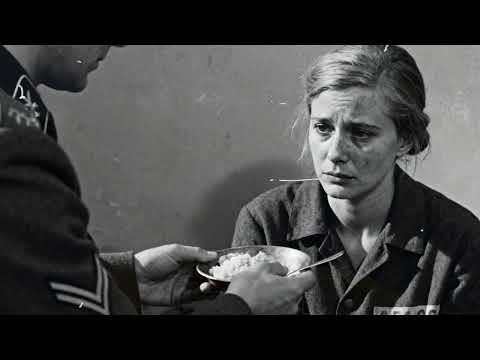
He summoned Captain Patricia Morrison, the female officer overseeing the German women. She didn’t flinch. “I’ve been expecting something like this for months,” she admitted. She had watched the relationships develop and said nothing. “These aren’t cases of prisoners manipulating guards. What’s happened here is more human than our regulations anticipated.”
The story began 15 months earlier, on a cold November morning in 1944, when Margarete stepped off a transport truck at Camp Crossville, Tennessee. Her dark blonde hair was pulled back, her gray uniform still bearing the insignia of a communication specialist. She carried herself with rigid military posture, but her green eyes held only defiance and exhaustion.
Corporal Thomas Bennett, 26, a farm boy from Kentucky with sandy hair and an easy smile, was among the guards processing the new arrivals. When their eyes met, he saw not hatred but profound sadness. She looked like someone who had lost everything and was simply going through the motions of survival.
During the processing, their hands touched briefly. Margarete flinched and whispered an automatic apology in German. Bennett didn’t speak the language, but he understood the tone. “It’s okay,” he said gently. Something in his voice made her look at him again—this time with confusion. His expression wasn’t hostile. If anything, he looked sympathetic.
Winter brought bitter cold to Tennessee. The barracks were poorly insulated, and Margarete developed a persistent cough she tried desperately to hide. Bennett noticed anyway. On December 6th, he requested permission to distribute extra blankets. “For you, for the cold,” he said when he found her shivering in the common area. She stared at the blanket as if it were dangerous. Accepting kindness from the enemy felt like betrayal. Yet she was so cold her fingers had gone numb. Slowly, she took it. “Danke,” she whispered.
Bennett noticed the newspaper and German-English dictionary on her lap. “You’re learning English?” he asked. She nodded, embarrassed. “If you want help, I could explain some of the words. During my evening rounds.” The offer hung between them, loaded with implications neither fully understood. She knew she should refuse. But the loneliness had been crushing, and the chance to engage her mind was desperately appealing. “I would like this,” she said carefully.
What began as practical language lessons evolved into something more. Three evenings a week, they met at the fence line. They worked through newspaper articles, but inevitably, lessons became conversations. By December 22nd, she had learned about his farm, his four sisters, his broken engagement. She was surprised by his openness—his willingness to share personal details with someone who was supposed to be his enemy.
Spring arrived with dogwood blossoms, but April 1945 brought news that shattered any illusion of normalcy. American forces had liberated concentration camps, and photographs of skeletal figures and mass graves appeared in newspapers. Captain Morrison allowed the German women access to these reports, believing they had a right to know.
Margarete sat in the common room, staring at images from Buchenwald and Bergen-Belsen. Her hands shook so badly she could barely hold the paper. “This cannot be real,” someone whispered. But Margarete knew better. The images explained things she had tried not to notice—whispered conversations, euphemistic references, the disappearance of Jewish neighbors from her street in Munich. She had told herself she didn’t know. Now she understood her ignorance had been a choice.
That evening, Bennett found her sitting alone behind the barracks, her face buried in her hands. “Margarete,” he said softly, using her first name for the first time. She looked up, tears streaming. “How can I be the same person who served that country?” she asked. “I chose comfort over courage, Thomas. I chose not to ask questions.” It was the first time she had used his first name.
Bennett sat beside her, maintaining a careful distance. “My grandmother used to say that what matters isn’t where you’ve been or what you’ve done in ignorance. What matters is what you do once you know the truth.” She turned to him, searching his face. “Why are you kind to me after everything?” He met her eyes. “Because you’re not your country. You’re a person who made mistakes, like we all do. And because somewhere along the way, I stopped seeing you as the enemy and started seeing you as just Margarete.”
May 8th, 1945—Victory in Europe Day—brought celebration across America, but at Camp Crossville the mood was complicated. For the German women, their country’s surrender meant the final collapse of everything they had once believed in. Margarete stood at the barracks window, watching the guards cheer, feeling utterly disconnected from both sides of the conflict. She was no longer German in the way she had been, but she certainly wasn’t American. She existed in a strange liminal space, belonging nowhere.
The weeks that followed brought unsettling news. Germany lay in ruins, millions displaced and starving. The women began receiving their first letters from home through Red Cross channels. Margarete’s arrived on May 28th. Her mother was alive, living in a basement in the Schwabing district, but her father had died in an Allied bombing raid on February 25th. Her two younger sisters, Greta and Hana, were missing—last seen fleeing toward the countryside on April 28th when Russian forces approached from the east.
The letter ended with a simple plea in her mother’s shaking handwriting: “Come home, Margarete. There is nothing left here, but I need you.” She read it three times, then carefully folded it into her prayer book. That evening at 19:30, she couldn’t bring herself to go to the English lesson. She lay in her bunk, paralyzed by competing obligations. Her mother needed her. Her broken country needed everyone who could rebuild it. Yet the thought of leaving—of leaving Thomas—filled her with a grief so profound she could barely breathe.
Bennett noticed her absence immediately. After the lesson ended, he approached Captain Morrison. “Permission to check on prisoner Klene, ma’am. She’s never missed a lesson before.” Morrison studied him carefully. She had watched the growing connection between them for months—how his face lit up when he saw her, how she smiled in his presence in a way she never did otherwise. She had documented nothing, violating her own duty to report fraternization, because what she had observed seemed genuine. “Ten minutes, Corporal,” she said. “And Bennett—be careful.”
He found Margarete sitting outside the barracks in the gathering dusk. When she heard his footsteps, she quickly wiped her eyes, but he had already seen the tears. “Your letter came,” he said, sitting beside her on the bench. It wasn’t a question. She nodded, unable to speak. Finally, she handed him the letter. He read it slowly, his expression growing more troubled with each line. When he finished, he folded it carefully and returned it to her. “You’ll go back,” he said quietly. “Of course you will. She’s your mother. Your family needs you.”
Margarete turned to face him, her green eyes reflecting the last light of sunset. “And what if I don’t want to go?” The words hung between them, dangerous and true. Bennett’s breath caught. “Margarete…”
“I know it is wrong,” she continued, speaking rapidly now as if afraid she’d lose courage if she stopped. “I know that I am prisoner and you are guard and we should not even be having this conversation. But Thomas, in this place I have found something I never had in Germany. I have found someone who sees me—truly sees who I am, not as a tool for the state or a symbol of anything, but just as myself.”
The morning of May 29th, Bennett reported for duty with dark circles under his eyes. He hadn’t slept, had instead spent the entire night wrestling with what had transpired between them. Military regulations were explicit: fraternization with enemy prisoners was strictly forbidden and could result in court-martial. More than that, he questioned his own motives. Was he taking advantage of someone vulnerable, someone whose freedom depended on the goodwill of her captors?
But when he honestly examined his feelings, he knew the truth was more complicated. Over the months of conversation, he had watched Margarete transform from a rigid, defensive prisoner into someone vibrant and curious, someone whose intelligence and dry humor he genuinely enjoyed. He looked forward to their evening lessons with an anticipation that had nothing to do with duty. He was in love with her.
That afternoon, Lieutenant Colonel Hammond summoned Bennett to his office. “Sergeant Collins filed a report this morning, expressing concern about your interactions with prisoner Klene. He suggests your relationship has exceeded appropriate boundaries.” Bennett’s stomach dropped, but he stood at attention. “I’m not looking for excuses or denials, Corporal. I’m looking for the truth. Have you developed a personal attachment to this prisoner?” The direct question left no room for evasion. “Yes, sir. I have.”
Hammond leaned back, rubbing his temples. “Do you understand that fraternization with enemy prisoners is a serious violation of military code?” “I understand, sir.” “And do you understand that this puts both you and prisoner Klene in an impossible position? She’s not free to reject your advances, Bennett. That makes any relationship between you inherently problematic.” The words struck him like a physical blow, because they articulated something he had been trying not to confront.
Hammond saw the impact and softened slightly. “I’m not trying to be cruel. I’m trying to make you think clearly about a situation that could destroy both your career and her future prospects.” He paused. “That said, I’ve observed Prisoner Klene myself. Captain Morrison has as well. We both believe her transformation is genuine. So I’m going to handle this differently than regulations require.” Bennett waited, hardly daring to breathe.
“Effective June 1st, I’m removing you from guard duty. You’ll be reassigned to administrative work where you’ll have no direct contact with the German prisoners. This removes the immediate ethical problem and tests whether these feelings survive separation and distance. If, after she’s repatriated and you’re no longer in a position of authority over her, you wish to correspond—that’s your business. But while she remains a prisoner, there will be no contact.”
The separation lasted three months. They saw each other only at a distance—a glance across the compound, a shared silence that said everything. Margarete carried her mother’s letter everywhere, the paper growing soft from handling.
Then came February 11th, 1946. Colonel Hammond assembled the 43 remaining women. “All German female prisoners are to be repatriated within eight weeks.” That night, Margarete and three friends sat in the dark, asking the question none dared voice: what were they willing to sacrifice for love?
The next morning, Margarete requested a meeting. She placed her letter on Hammond’s desk. “I wish to delay my repatriation. I have fallen in love with Corporal Thomas Bennett, and I cannot return without knowing if there might be a future for us.” Three other women soon followed.
The review board’s verdict arrived February 26th: reclassified as displaced persons, released from custody, free to build lives—or fail. Anna and Greta faltered. Maria’s lieutenant shipped to Japan. Only Margarete and Thomas remained.
On April 12th, 1946, he appeared on the Hendersons’ porch with wildflowers and his grandmother’s ring. “I’m asking you to take a chance on something that started in the strangest possible way, but feels more real than anything I’ve ever known.”
“Yes,” she said. “Yes, I’ll marry you.”
They wed that June. Three children, a farm, a life built from rubble. Years later, Margarete told an audience: “They were so kind to me when they had every reason not to be. That kindness changed everything.”
But tell me—could you have made her choice, or his?
Report this article
Select a reason for reporting:






