The pilot sat at the very tip of the wing, 60 feet from his navigator, with nothing but a thin steel spar between him and the void. Below, the German countryside rolled past like a green sea. He gripped the stick, feeling every shudder of turbulence—not through the fuselage, but through the wing itself, which flexed and twisted in ways no conventional aircraft ever had. This was not a dream. This was the Blohm & Voss P.163, one of the most radical aircraft ever conceived, and it was about to be tested in the most bizarre way imaginable.
World War II was a crucible of innovation, and nowhere was that more true than in Nazi Germany’s aviation industry. As aluminum supplies dwindled and Allied bombers pounded factories, designers like Richard Vogt dared to think the unthinkable. What if you could build a bomber out of steel—and mount the crew in gondolas on the wingtips? It sounded like madness. But in the desperate final years of the war, madness was often the only option left.
The P.163 was born from necessity. Aluminum was scarce, but steel was plentiful—if you could work around its weight. Vogt’s solution was as elegant as it was strange: use steel for the wings, and place the crew in two streamlined pods at the wingtips. Each gondola weighed about a ton, but Vogt predicted they would actually improve flight performance by reducing wing bending and turbulence. “The additional strength of steel might allow the wings to support a crew gondola at each wing tip,” he argued, freeing the fuselage for engines, fuel, and weapons.
In theory, the P.163 would be a high-speed bomber to rival the Junkers Ju 88. But unlike the Ju 88, which grouped its crew together for morale and communication, the P.163 would scatter them across 60 feet of sky. Two men in each gondola: a pilot with a spectacular view, a navigator/gunner facing rearward, and two more gunners covering the flanks. “At least in theory, this high speed bomber would have been very well protected,” one historian notes. But how would a pilot react to sitting at the very tip of an aircraft, rather than in its center?
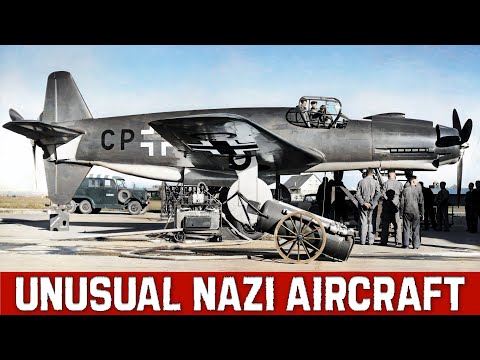
To find out, the Germans modified an existing asymmetric design—the Bv 141—and bolted an extra gondola to its port wingtip. The result was even more bizarre than the original, but it flew. “It served its purpose and apparently proved that the wingtip cockpit arrangement was workable,” the transcript reveals. But workable wasn’t enough. The P.163 was cancelled before a prototype was built. Its performance offered no major improvement over existing aircraft, and the war was going badly. Richard Vogt’s primary goal—substituting steel for aluminum—was rendered moot as all materials ran short.
Yet Vogt’s ideas would not die. After the war, he was invited to America, where his wingtip theories found new life. In 1949, the Northrop F-89 Scorpion was selected as the US Air Force’s mainstay interceptor. Its early models suffered wing structural problems, but the D model—with a strengthened wing and huge rocket pods on each wingtip—became the main production version. “Perhaps supported Vogt’s theory on wing bending and turbulence,” the transcript suggests. And a post-war B-17 test even mounted a cockpit on the right wingtip to study control from that position. One pilot who flew it recalled: “You could sit out there on that wing tip and jiggle the formation stick longitudinally and make the people in the airplane sick, and you were hardly moving.”
But the P.163 was not the only radical concept to emerge from Germany’s desperate innovation. The Dornier Do 335 Arrow, with its centerline thrust—one engine in the nose, another in the tail—was another bold attempt to cheat the laws of aerodynamics. And in the United States, Douglas Aircraft was developing its own centerline-thrust bomber, the XP-42 Mixed Master. Both aircraft were actually built and tested, and might have gone into production if the war had continued. “Both aircraft were finally made, and with testing so advanced, they probably would have gone into production if the war had continued,” the transcript notes.
As the war progressed, Germany’s situation worsened, and every new project was reappraised. The P.163, for all its ingenuity, simply didn’t offer enough. It was cancelled, and no armadas of wingtip-gondola bombers ever darkened the skies. But the story of unconventional aviation was far from over. The Bv 141 itself, with its asymmetric layout, had already proven surprisingly capable—and one British pilot would later stumble upon a surviving example in the Russian zone, leading to an impromptu test flight that revealed both its strengths and its fatal flaws.
That pilot’s account, and the fates of other oddities like the Focke-Wulf 189 and the Arado 234, would show that in aviation, radical ideas often fly—but not always to victory. The P.163 was a glimpse of a future that never came, a steel-winged phantom that existed only on paper and in the mind of a visionary. But its legacy would echo in the jet age, where wingtip pods and unconventional layouts became not just possible, but practical.
The British pilot who stumbled upon the surviving Bv 141 in the Russian occupation zone had already flown its competitor, the Focke-Wulf 189, and he was not impressed. “It certainly wasn’t an aircraft in the same category of handling as the Focke-Wulf 189,” he recalled. The asymmetric Blohm & Voss had its charms—it flew nicely in a straight line, even at an angle of bank of 90 degrees—but after two or three attempts at various speeds and heights, the engine began to falter and he had to return to base.
The Russian commissar had allowed the flight only on the condition that he stayed within sight of the airfield and used only the fuel on board. “It was due for destruction anyway,” the commissar had shrugged. The pilot suspected the German ground crewman who declared the aircraft flyable was hoping to be flown out of the Russian zone. That never happened. The 141 was left behind, another oddity swallowed by the chaos of capitulation.
By contrast, the Focke-Wulf 189 was everything the Bv 141 was not. Known as the Flying Eye, its completely glazed central nacelle, twin engines, and tail booms had once been considered too radical for conservative Luftwaffe officials. But performance won the day. “During combat operations, the Fw 189 surpassed all expectations,” the transcript notes. It flew low over the battlefield, absorbed tremendous punishment, and lived to fight another day.
Yet even the 189 had its critics. The same pilot who tested the 141 believed the elimination of the starboard half of the tailplane—the asymmetric offset that gave the rear gunner a clear field of fire—was a flaw rather than a virtue. “I think that killed it more than the theory that it gives the gunner a wonderful field of fire,” he said. It was a rare dissenting voice against an otherwise beloved aircraft.
Then there was the Arado 234, the jet-powered reconnaissance bomber that looked like a shark from another age. “It was a beautiful looking airplane, aesthetically very clean and dynamic aerodynamically,” the pilot remembered. The cockpit was a glass bubble right up in the nose—so far forward that climbing inside felt like sitting in a helicopter. Clear vision in every direction, but also “pretty close to the accident if it had to happen.”
His first meeting with the 234 was nearly his last. At Grove in Denmark, a German crew prepared one for his flight, since the British had no expertise with the type at that stage. He taxied out and revved to full power, ready to release the brakes, when the starboard engine exploded and disintegrated, tearing away most of the starboard wing. “Either the crew had sabotaged it, or it was an engine with 24 hours and 50 minutes on it,” he said. The Jumo 004 had a total scrap life of just 25 hours, and the Germans had been adept at destroying service records.
They never learned the cause. But the pilot went on to fly three to four hundred hours on the Jumo 004 in various airframes without another problem. When he finally flew the 234 properly, it handled beautifully—fast, clean, and capable of 474 miles per hour. It carried no guns, relying entirely on speed for survival. “It made a very good impression,” he concluded. A straight-winged jet that pointed toward the future, even as the Reich that built it crumbled into ash.
In the end, the story of German aviation in World War II is not one of failure, but of extraordinary ambition colliding with brutal reality. Richard Vogt’s P.163 never flew, yet its steel-winged ghost haunted the design rooms of the Cold War. The F-89 Scorpion’s wingtip rocket pods, the B-17’s outrigger cockpit, the centerline thrust of the Do 335—all were echoes of ideas born in a desperate, brilliant, doomed nation.
The pilots who tested these machines spoke of them with a mixture of awe and pragmatism. The Bv 141 flew, but not well enough. The Fw 189 fought and survived, beloved by its crews. The Arado 234 screamed through the sky at 474 miles per hour, a glimpse of the jet age before its time. “It handled beautifully,” the British pilot said of the 234. “It made a very good impression.” High praise for an aircraft built by the enemy.
What remains, then, is not a tally of victories or defeats, but a lesson in how innovation often outlives the cause that birthed it. Vogt went to America and kept designing. His wingtip theories were vindicated by aircraft that never dropped a bomb in anger. The war ended, but the ideas did not. They simply changed flags.
So here is the final question, the one that lingers like the hum of a Jumo 004: if the P.163 had been built, if the steel wings had held and the gondolas had flown—would we remember it as a masterpiece, or just another beautiful mistake? What do you think—was Richard Vogt a genius ahead of his time, or a dreamer chasing a shape that never quite fit the sky? Let us know in the comments below.
Report this article
Select a reason for reporting:






