You take the blind one, and I’ll take the one with the soybean. Stop that. The line was never in the script. It was never rehearsed. And it was never supposed to leave the set. But on a soundstage in 1974, Marty Feldman—the man with the permanently startled eyes and a mind that refused to follow any rulebook—delivered it with such deadpan mischief that Gene Wilder, a actor known for his iron discipline, simply broke. His shoulders shook. His face vanished somewhere between his knees and the floor. And a camera, always running, captured the exact second Dr. Frederick Frankenstein ceased to exist and Gene Wilder, human being, took his place.
That photograph has circulated among film buffs for decades. At first glance, it looks like a standard behind-the-scenes shot: two actors, a gothic laboratory, a crew hovering in the background. But look closer. Nobody is acting. Nobody is performing. This is two men completely losing their minds with laughter, and the camera happened to catch every second of it. The image has never been digitally altered, staged for publicity, or artificially enhanced. What you see is exactly what happened—and behind that single frozen moment lies a much bigger story.
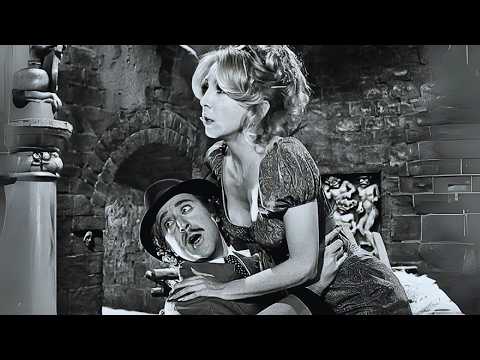
Released in 1974, Young Frankenstein was Mel Brooks’ loving parody of the classic Universal monster movies. Shot entirely in black and white, it starred Wilder as the uptight Dr. Frederick Frankenstein, Feldman as the mischievous Igor, Teri Garr as the bubbly lab assistant Inga, Madeline Kahn as the overdressed fiancée Elizabeth, and Peter Boyle as a monster with surprisingly good taste in Broadway music. On paper, it was a tightly written parody—Wilder co-wrote the screenplay with Brooks. But the moment cameras rolled, the script became more of a suggestion than a rulebook.
Marty Feldman, in particular, seemed constitutionally incapable of delivering a line the same way twice. He would change his timing, shift his physicality, toss in words that were never written down, and generally behave as though the script was simply a starting point from which all truly interesting things eventually departed. Wilder, for all his discipline, found himself in a near-constant battle to hold his composure. And Brooks, watching from behind the camera, was frequently the first one to crack.
This was not a chaotic set in any negative sense. It was a set overflowing with genuine joy, and that joy left fingerprints all over the finished film. Brooks made a deliberate decision to embrace unpredictability rather than fight it. When Feldman decided one day to start moving Igor’s hump from shoulder to shoulder between scenes—not because anyone wrote it, but simply because he was curious whether anyone would notice—Brooks didn’t shut it down. He laughed. He let it run, and he built it into the fabric of the film. The moving hump, which audiences have quoted for 50 years, was never in any draft of the script. It was born entirely from one actor’s playful mischief and one director’s willingness to say yes to the unexpected.
The same principle applied across the board. When the sound department accidentally triggered a horse whinny at the wrong moment during a scene involving a certain character’s name, Brooks amplified the mistake, turning a technical error into one of the film’s most beloved running gags. When a massive laboratory door refused to cooperate during a take, jamming halfway and leaving Wilder stranded mid-scene, Brooks kept rolling. Wilder’s visible frustration—entirely real and entirely unscripted—turned a technical failure into a perfectly timed comedic beat.
Of everyone on set, Feldman was the single greatest agent of productive chaos. His improvised pronunciation of the word sedative, twisted into something that barely resembled the original, was not planned. It burst out of him during a take, and Wilder’s visible struggle to maintain seriousness in the aftermath became one of the most quoted exchanges in the entire film. Every time Feldman went off-script, Wilder faced the same impossible challenge: stay in character as a serious, professionally frustrated scientist while standing directly next to a human hurricane. He failed frequently. He succeeded often enough—and the tension between those two outcomes gave the film a quality that no amount of polished scripting could have manufactured.
You can feel that the performances are real because the struggle to maintain them was real. Gene Wilder was, by all accounts, an extraordinarily disciplined actor. He prepared meticulously. He genuinely believed in the emotional truth of even the most absurd characters he played. Dr. Frederick Frankenstein was not, to Wilder, simply a comedy vehicle. He was a man with real neuroses, real ambitions, and a real psychological inheritance from his infamous grandfather—a character worth playing with full commitment. And yet, on this particular set, that commitment became a source of comedy in itself. The harder Wilder tried to hold his composure, the funnier the moments when it slipped away became.
The photograph captures one of those rare moments when the edge gave way entirely. No discipline left. No Dr. Frankenstein present on the set. Just Gene Wilder, a human being, laughing at something Marty Feldman did, completely unable to stop. It is tempting to look at all this improvisation and conclude that Young Frankenstein was somehow undirected—that it simply happened around Mel Brooks while he watched. The opposite is true. Brooks was making active, intelligent decisions constantly. The choice to keep a failed take. The choice to encourage Feldman’s mischief rather than rein it in. The choice to look at that photograph of two actors in hysterics and see, not a problem, but a perfect summary of everything the film was trying to be.
Real comedy, Brooks has said, cannot be manufactured entirely in advance. You can write the architecture. You can build the set. You can rehearse the timing. But the actual spark—the thing that makes an audience laugh until their sides hurt—often arrives uninvited. His job as a director was not to control every moment, but to recognize the good ones when they showed up and make sure they stayed in the film. That instinct is what separates Young Frankenstein from its many imitators. It is not just a well-written parody. It is a film that genuinely surprised itself during production. And that surprise is still visible in every frame.
But the story of that photograph—and the blooper that caused it—goes deeper than a single moment of uncontrollable laughter. To understand why it matters, you have to understand what happened in the minutes before the camera clicked, and why Gene Wilder, a man who prided himself on control, was so completely defenseless against the chaos Marty Feldman unleashed that day.
The scene was a small one, almost forgettable on paper. Dr. Frankenstein and Igor were supposed to be preparing for a procedure, exchanging a few functional lines of exposition while moving around the laboratory. Nothing about it was designed to be funny. The humor was meant to come later, from the monster, from the machinery, from the grand operatic absurdity of the whole enterprise. This was just connective tissue, a moment to move the plot from one room to the next.
But Feldman had other ideas. Between takes, he had been experimenting with Igor’s physical vocabulary—the way he stood, the way he gestured, the way he seemed to be listening to a completely different conversation than everyone else in the room. He had started muttering things under his breath, little fragments that were never meant to be heard. And on this particular take, something clicked. He turned to Wilder with that wide, unblinking stare and delivered a line that made no sense in any context, scripted or otherwise.
Wilder’s face went through a visible sequence of emotions. First, confusion. Then, recognition—the dawning awareness that Feldman had just abandoned the script entirely. Then, the desperate attempt to salvage the scene. His jaw tightened. His eyes widened slightly. He drew a breath to continue with his next line.
And then Feldman did it again. A different nonsensical phrase, delivered with the same earnest commitment, as though it were the most natural thing in the world. Wilder’s breath caught. His shoulders began to tremble. He tried to turn away, to hide his face, to buy himself a second to recover.
It was too late. The laughter came out of him in a rush, unstoppable, the kind of laugh that starts somewhere deep in the chest and takes over the entire body. He doubled over. His hands went to his knees. The take was dead, and Wilder was gone—not just from the scene, but from the entire professional discipline that had defined his career.
Feldman, for his part, did not laugh. That was the cruelest part. He stood there with the serene satisfaction of a man who had accomplished exactly what he set out to do, watching his co-star dissolve in front of him. The crew, who had seen this dynamic play out dozens of times, began to laugh as well. Brooks, behind the camera, was already cackling.
What makes the photograph extraordinary is not just that it captured Wilder mid-collapse. It is that it captured Feldman in the immediate aftermath—that grin, that unmistakable expression of a man who knew precisely what he had done and was delighted by it. There is no guilt in that face. No apology. Just pure, mischievous triumph.
The camera kept rolling. It always kept rolling. And somewhere in that footage, preserved for decades, is the raw material of one of the most beloved comedies ever made. But the photograph itself—that single frame—became something more. It became proof. Proof that the laughter audiences felt in theaters was not manufactured. It was real, and it had been real on set, too.
Years later, when asked about that day, Wilder reportedly said he could not even remember what Feldman had said. The exact words were lost. What remained was the feeling—the absolute, helpless, joyful collapse of composure that no amount of rehearsal could have produced. That was the secret of Young Frankenstein. Not the jokes, but the joy behind them.
And yet, for all the laughter, there was a sadness lurking beneath the surface of that set—a sadness that would only become clear in the years that followed, as the people who made that magic began to leave the world one by one.
Marty Feldman died in 1982, far too young, and Gene Wilder followed decades later. But the laughter they made together refuses to fade. That photograph is not a relic. It is a living thing.
Film schools still study it. Comedians still cite it. Fans still pause their screens at specific moments, pointing at Wilder’s barely controlled expression or Feldman’s triumphant grin, saying, “Look at that. You can tell he was actually laughing.”
They are right. He was. They all were, most of the time. The photograph has become a symbol for what the film truly represents—not the polished product audiences see on screen, but the gloriously uncontrolled reality behind it. Two extraordinary performers, one gone far too soon, caught in a genuine human moment that no amount of editing could improve.
So the next time you watch Young Frankenstein, pay attention to the edges of every scene. The slight wobble in Wilder’s expression. The gleam in Feldman’s eye. The best jokes in that film were never written down. They just happened, and someone was lucky enough to be filming when they did.
That is why the film will never stop being funny. Not because it was perfect, but because it was alive. And that photograph—unscripted, unpolished, unforgettable—is the proof.
What is your favorite unscripted moment from Young Frankenstein? Tell us in the comments below.
Report this article
Select a reason for reporting:






