The Chinook ramp dropped, and hell opened up. Within seconds of landing near the town of Marzak, the entire company was under fire. Mortar rounds, heavy machine guns from the ridgelines, and rocket-propelled grenades streaked across the valley floor. The Al-Qaeda fighters were dug into a tunnel complex directly underneath the landing zone that nobody knew existed. The Chinooks banked hard and pulled away, and the men on the ground were alone.
Among the 80 American soldiers were two Australians who didn’t belong to any US unit—signalmen from the Special Air Service Regiment, Australia’s most elite special forces. One of them was 32-year-old Martin “Jock” Wallace, a communications specialist from Tamworth, New South Wales. His job was to maintain the radio link between the men on the ground and the commanders at Bagram Air Base. That radio link was about to become the only thing keeping 80 people alive.
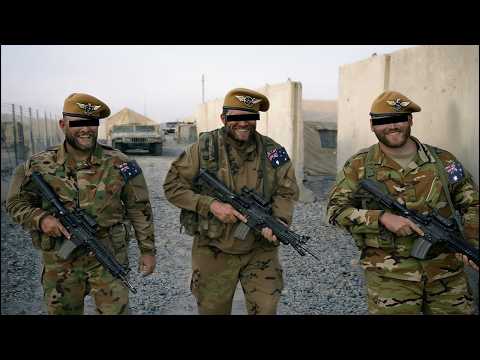
The creek bed where Jock and the Americans had taken cover would later earn a name from the young soldiers lying in it: Hell’s Halfpipe. Bullets tore into the dirt around them. Mortar rounds walked closer with every volley. Rocket-propelled grenades shrieked overhead and detonated against the far bank. The entire hillside above them was alive with muzzle flashes.
Apache attack helicopters were called in to try and break the siege. They came in low and fast over the ridgeline, and the entire mountainside opened up with small arms fire. The Apaches pulled away. Even the gunships could not suppress what was up there.
Jock kept his radio working. Without him, the men in that creek bed had no way to call for air support, and no way to tell anyone how bad things were. But Jock was not just talking into a handset. When a US mortar team took a direct hit, Jock left his cover, ran into the open, dragged wounded American soldiers into the creek bed, and dressed their wounds. Then, he went back to his radio and kept calling in coordinates for air strikes.
Hours passed. The fire did not stop. At one point, expecting his position to be overrun at any moment, Jock Wallace did something that the soldiers around him would never forget. He pulled out a hand grenade, armed it, and laid down on top of it. If the Al-Qaeda fighters reached his position and tried to take his body or his equipment, the grenade would detonate. He was booby-trapping himself.
He later said, in his typically understated way, that any bloke who tells you he is not scared when the bullets are flying is either lying or stupid.
The battle lasted 18 hours. Salvation finally came after dark when an AC-130 Spooky gunship arrived overhead and poured sustained fire into the enemy positions. Under its cover, helicopters came back in and pulled the survivors out. Jock Wallace walked back through the door of the Australian Tactical Headquarters covered in mud. The skin was ripped off both his hands from digging fighting positions with his bare fingers.
For his actions, he received the Medal for Gallantry, Australia’s third highest military honor. His courage that day helped save the lives of 80 American soldiers.
But Jock’s fight was only one part of what was happening in the Shah-i-Kot Valley. While he was pinned down on day one, a separate SASR patrol had already been inserted into the mountains days earlier. The small team, accompanied by a United States Air Force combat controller, had infiltrated the high ground on a long-range reconnaissance mission. They were about to become the only functioning eyes on one of the most chaotic rescue operations of the entire war.
The team had been lying concealed in their observation post for days, enduring bitter cold at altitude in the Afghan mountains. Several of the Australians were Queenslanders who had never seen snow before they deployed to Afghanistan. The novelty wore off after about 5 minutes.
On the second day of Anaconda, fog rolled into the valley and blinded the Predator surveillance drones that US commanders had been relying on to track the battle. At exactly the wrong moment, the Americans lost their eyes in the sky, and that’s when everything on Takur Ghar mountain went sideways.
A Navy SEAL named Neil Roberts fell from a damaged Chinook helicopter as it took heavy fire trying to land on the mountain’s peak. His teammates crash-landed in the valley below, regrouped, and flew back to the summit to rescue him. They landed directly into an Al-Qaeda strongpoint. A combat controller was killed. Multiple SEALs were wounded. They were forced off the peak.
A Ranger Quick Reaction Force was scrambled from Bagram, but the command structure was fracturing. Task Force 11 and CJTF Mountain were operating on parallel tracks with incomplete communication. A senior commander ordered satellite radio frequencies switched mid-battle, severing communication between multiple units on the ground. The Rangers were mistakenly directed to land directly on the hot summit. Their Chinook took RPG fire the moment it touched down. Three Rangers were killed in the opening moments. The survivors fought a desperate battle on the snowy peak for the rest of the day. Eight Americans dead by the time it was over.
And through all of this, the Australian SASR patrol sat hidden on a nearby ridge watching the disaster unfold. They could see the trapped Americans. They could see Al-Qaeda fighters closing in. And they could still communicate.
While US command argued over frequencies and jurisdictions, the Australians acted. They operated under their own national command authority through Canberra. The US could request their support. They could not order them to stand down. Working with the embedded combat controller, the SASR team began coordinating devastating air strikes on Al-Qaeda positions surrounding the downed helicopters. They directed bombs onto fighters closing in for the kill, calling in strike after strike from aircraft the blinded Predator drones could not guide.
Lieutenant General Hagenbeck later said plainly that he would not have wanted to run that operation without the Australian SAS on that ridgeline. The Australian Force Commander was awarded the US Bronze Star for his unit’s contribution, not for one action, for the entire operation.
But the story of Australian independence in Afghan combat did not end in 2002. Six years later, the same dynamic played out again under even worse circumstances.
On the 2nd of September, 2008, a combined patrol of Australian SASR operators, American Special Forces from the 7th Special Forces Group, and Afghan soldiers rolled out of the American Forward Operating Base Anaconda near Qalat-i-Ghilzai in Uruzgan Province. The mission was simple on paper: drive into a valley, set up ambush positions, and flush out Taliban fighters who had been organizing attacks against the base.
The first patrol had gone well. Australian snipers had spotted and neutralized a Taliban element, and the Americans had destroyed a vehicle carrying the Eastern Commander of the Taliban in the area. But the success drew attention. By the time the second mission launched into the Arghandab Valley the next day, the Taliban were ready.
The vehicle convoy, five Humvees with Americans and Afghans, moved into the valley at dawn because the Afghan troops did not have night vision equipment. SASR patrols had split off on foot to set up sniper positions in the surrounding hills. Everything was going according to plan. Then, the valley erupted.
Up to 200 Taliban fighters opened fire from positions across the ridgeline. Accurate mortar rounds landed around the vehicles. Small arms fire was so dense that one of the SASR patrol commanders, Sergeant Troy Simmons, later described it as being like rain on the surface of water.
The combined force tried to fight their way back through the valley. The SASR operators, many of them armed with long-range sniper rifles, dismounted from the vehicles and moved on foot to provide covering fire while the convoy crawled along at walking pace over rough terrain. One American soldier, Sergeant First Class Gregory Rodriguez, a military dog handler, was killed by enemy gunfire during the fighting.
And then came the moment that defines how coalition warfare can fail, and how individual courage can fill the gap. The Australians spotted two Dutch Apache attack helicopters escorting a Chinook transport helicopter nearby. They radioed the Dutch pilots and begged them to engage the Taliban positions with their Hellfire missiles and 30-mm cannons. The Apaches were built for exactly this kind of fight.
The Dutch refused. Their pilots would not drop below 5,000 meters. They would not fire. Their national caveats would not allow them to risk drawing fire. The Australians pleaded with them over the radio, telling them plainly that they were in a serious firefight and taking casualties. The Apaches had Hellfire missiles and 30-mm cannons. They could end this in minutes. The Dutch still would not engage.
The Australian soldier responsible for guiding air support on the ground eventually told the Dutch, in words that have since become legendary in Australian military circles, that if they were not going to engage then they might as well leave. And the Dutch helicopters did exactly that. They flew away. The Australians and Americans were on their own.
The battle raged for 9 hours. By the time the combined force finally fought their way out of the valley, nine Australian SASR operators had been wounded. Sergeant Simmons’ five-man patrol had only one man who was not hit.
But one act during that battle would earn the highest recognition the Australian nation can bestow. Trooper Mark Donaldson was part of the SASR element in the convoy. When an Afghan interpreter who had been working alongside the Australians was hit and went down in the open, exposed to direct enemy fire, Donaldson did not wait for orders. He did not radio for permission. He ran.
He sprinted across open ground under sustained Taliban fire, reached the wounded interpreter, and carried him back to cover. He did this while also deliberately exposing himself to draw fire away from other wounded Australians who were being treated in the open.
On the 16th of January 2009, Trooper Mark Donaldson was awarded the Victoria Cross for Australia, the nation’s highest award for gallantry. It was the first time the honor had been given since Australia created its own version of the medal. He had run into a kill zone to save someone who was not even Australian.
No US commander ordered that run. No coalition headquarters approved it. The decision was made by one soldier trained by a regiment that had been breeding that kind of independence since 1957. And that gets to the heart of why US command was forbidden from interfering with what the Australians did in Afghanistan.
It wasn’t animosity. It was structure. Australia deployed under Operation Slipper, their own national operation. The chain of command ran through Canberra, not the Pentagon. An American general could not order an Australian SASR patrol to stand down, could not change their mission, could not override their rules of engagement.
When the US command structure fractured at Anaconda, the Australians kept operating. When Jock Wallace saw wounded Americans, he did not need permission from a US colonel. When the reconnaissance team watched Takur Ghar falling apart, they did not wait for headquarters to sort itself out. And when Dutch allies flew away in 2008, the Australians fought their way out with whatever they had.
Australia’s war in Afghanistan lasted 20 years. 41 defense personnel were killed. The Special Air Service Regiment rotated through Uruzgan province more than 20 times. Not because they had the biggest budget, not because they had the most personnel, not because they had the fanciest equipment. Because when everything went wrong—when the radios went dead and the helicopters would not come and the intelligence was a lie—the Australians did what they have always done. Figured it out themselves.
Which raises the question: when the coalition fractures and the cavalry refuses to fire, is it better to obey the chain of command or to save the men beside you?
Report this article
Select a reason for reporting:






