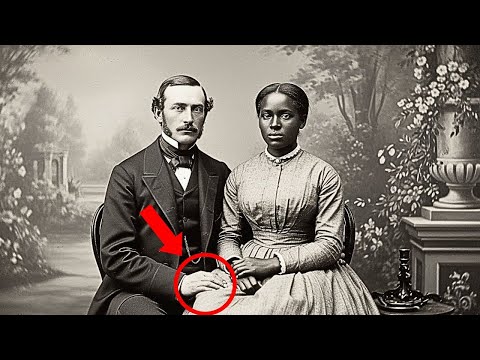
Dr. Michael Hayes had spent twenty-three years studying nineteenth-century American photography, and he thought he’d seen everything. But on a humid Tuesday morning in August, in the climate-controlled basement of the Charleston Historical Society, a single image would shatter that certainty. The air smelled of old paper and preservation chemicals—a scent he’d grown to love—as he methodically cataloged a recently donated collection of daguerreotypes and cabinet cards. Outside, the South Carolina heat shimmered off the streets, but down here, the temperature remained a constant 68 degrees. The photograph that would change everything appeared unremarkable at first: just another formal studio portrait from 1889.
A white man in his early thirties stood beside a black woman who looked to be in her mid-to-late twenties. Both were dressed formally—he in a dark suit with a high collar and watch chain, she in a simple but well-made dress with modest trim and a high neckline. The backdrop was typical of the era, a painted garden scene that probably adorned a thousand studios across the South. The photographer’s mark was barely visible in the corner: Fletcher and Sons, Charleston. Michael almost set it aside without a second glance. Studio portraits of this type were common, though interracial photographs were relatively rare for the period. He made a note in his catalog: Mixed-race studio portrait, circa 1889, Charleston area. Unknown subjects, Fletcher Studio.
His hand hovered over the next photograph in the stack, but something made him look again. The composition felt off somehow. The man’s posture was stiff, almost proprietary. He stood slightly behind the woman, his body angled toward her in a way that seemed to claim rather than accompany. And the woman’s face—there was something in her expression that didn’t match the formal neutrality typical of Victorian portraiture.
Michael reached for his magnifying glass, the same one his mentor had given him when he’d started graduate school three decades earlier. He leaned closer, studying the woman’s eyes first. Even through the grain of the albumen print, he could see tension in her features. Her jaw was set too tightly. Her eyes looked past the camera rather than at it, a slight downward cast that suggested she was trying to be anywhere but in that studio. There were shadows under her eyes, and her mouth was pressed into a thin line that could never be mistaken for a smile.
Then Michael’s gaze traveled down to where their bodies met in the frame. His breath caught in his throat. The man’s right hand rested on the woman’s left thigh—not casually beside her, but gripping it with clear possession. The fabric of her dress showed the slight bunching where his fingers pressed into her leg. Michael’s stomach tightened as he noticed how the woman’s left hand was clenched into a fist at her side, knuckles white even in the faded photograph. Her other hand gripped the arm of the chair she sat in, fingers digging into the upholstery.
This wasn’t a portrait of friends or even employer and employee. This was something much darker. Michael sat down his magnifying glass and removed his reading glasses, rubbing his eyes. In all his years studying these images, documenting the lives captured in old photographs, he’d never seen something quite like this. Evidence of coercion, of abuse, frozen in a formal studio portrait. Someone had paid good money to have this photograph taken. Someone had looked through the camera lens and pressed the shutter anyway.
He picked up the photograph again with gloved hands, turning it over carefully. On the back, in faded pencil, someone had written: JW and Claudia, March 1889. Just two names, a date, and a century of silence.
Michael couldn’t stop thinking about the photograph. That evening, he sat at his kitchen table in his Mount Pleasant apartment, the image scanned and displayed on his laptop screen. He’d enlarged it to examine every detail, and each new viewing made his stomach turn. The woman’s expression haunted him—that mixture of fear and resignation that spoke of something endured rather than chosen.
He opened a new document and began typing notes. JW could be dozens of men in Charleston in 1889. The city directories from that era were extensive but incomplete. Claudia’s last name wasn’t provided, which wasn’t unusual for black individuals in photographs from this period. Their identities were often considered less important. Their stories deemed unworthy of full documentation.
Michael picked up his phone and called his colleague, Dr. Patricia Marshall, who specialized in post-Reconstruction African-American history at the College of Charleston. She answered on the third ring, her voice warm but curious about the late call.
“Patricia, I found something today,” Michael said. “A photograph from 1889. I need your help understanding what I’m looking at.”
He described the image in detail—the hand placement, the woman’s expression, the formal studio setting. There was a long pause on the other end of the line.
“Send me the image,” Patricia said, her tone shifting to something more serious. “Michael, you might be looking at documentation of sexual abuse in 1889. A black woman working in a white household would have had virtually no legal recourse, no protection. If this man was her employer—”
“That’s what I’m afraid of,” Michael interrupted. “But why would someone photograph it? Why document it so explicitly?”
“Power,” Patricia said simply. “Possession. In that era, some white men didn’t just abuse black women—they flaunted it. It was a demonstration of complete control. The photograph itself might have been a form of psychological dominance, forcing her to participate in creating a permanent record of his ownership over her body.”
Michael felt sick. He looked at the image again—at Claudia’s clenched fists and averted eyes. “I need to find out who she was,” he said. “She deserves to have her story told, to have someone acknowledge what happened to her.”
“Then we start with the photographer,” Patricia replied. “Fletcher and Sons—studio photographers kept detailed records: appointment books, client ledgers. If we can find those archives, we might be able to identify JW and trace him to an address. From there, we can search census records, city directories, property deeds.”
Michael was already typing notes. “The Charleston Historical Society might have Fletcher’s business records. I’ll check first thing tomorrow morning.”
“I’ll meet you there,” Patricia said. “Michael, this is important work, but prepare yourself. What we find might be worse than what’s in that photograph.”
After they hung up, Michael sat in the quiet of his apartment, staring at the image. Claudia looked back at him across 135 years, her silent testimony waiting to finally be heard.
The next morning, Michael and Patricia stood in the archives room of the Charleston Historical Society, surrounded by leather-bound ledgers and boxes of business documents. The archivist, an elderly man named Robert Chen, had directed them to the Fletcher and Sons collection—three decades of studio records meticulously preserved by the photographer’s great-granddaughter before her death in 2003.
“March 1889,” Michael muttered, carefully turning the fragile pages of the appointment book. His cotton gloves made the work slow and delicate. Patricia stood beside him, photographing each page with her phone for their records. The entries were written in elegant cursive, each appointment noting the date, client name, type of photograph, and payment received.
Michael’s finger traced down the March entries. Family portraits, wedding photographs, memorial pictures of deceased children—a common and heartbreaking practice of the era. Then he found it. March 14th, 1889. Jay Whitmore, single portrait with household staff, cabinet card, two daughters, 50¢, paid in full.
“Jay Whitmore,” Patricia repeated, already pulling out her tablet. “And notice how it’s phrased—‘with household staff,’ not ‘and household staff.’ She wasn’t a co-subject. She was a prop.”
Michael felt anger rising in his chest. He photographed the entry, making sure every word was clearly captured. “Now we find out who Jay Whitmore was.”
Patricia was already searching the 1890 census records on her tablet. “Whitmore isn’t a common name in Charleston. There are only three Jay Whitmores listed in the city in 1890.” She scrolled through the entries. “James Whitmore, age 67, retired merchant. Joseph Whitmore, age 19, clerk. And—” she paused. “Jonathan Whitmore, age 31, listed as commission merchant, living on Meeting Street.”
“Age matches,” Michael said. “31 in 1890 means he’d have been 30 in 1889, when the photograph was taken.”
Patricia continued reading. “He’s listed as head of household. Wife Martha, aged 28, two children under five.” She looked up at Michael, her expression grim. “Three servants, all listed as black, all women. No names given—just ages 26, 34, and 52.”
“26 years old,” Michael said quietly. “Claudia would have been around 25 or 26 in that photograph.”
They spent the next hour pulling every record they could find on Jonathan Whitmore. City directories confirmed his address—a large townhouse on Meeting Street in what was then one of Charleston’s most prestigious neighborhoods. Tax records showed he owned considerable property. Newspaper archives revealed he was a cotton commission merchant, facilitating sales between plantations and Northern textile mills—a lucrative business built on the legacy of slavery.
“He was wealthy,” Patricia observed, reading through a society page from 1888 that mentioned a dinner party the Whitmores had hosted. “Well connected. His wife came from one of the old Charleston families.”
Michael found something else—a business advertisement from 1889. “Look at this. ‘Jay Whitmore and Associates, Commission Merchants. Honest dealings and fair prices.’ The hypocrisy is staggering.”
“That was the era,” Patricia said. “Men like Whitmore attended church on Sunday, presented themselves as pillars of the community, and brutalized the women who worked in their homes. And society protected them, not their victims.”
Michael turned back to the photograph on his laptop. Now he could put a full name to the man—Jonathan Whitmore, respected merchant, family man, abuser. But Claudia remained only a first name, one of three unnamed black women listed as servants in a census document.
“We need to find out who she really was,” Michael said. “Her full name, where she came from, what happened to her after this photograph was taken.”
Patricia nodded. “Church records. Black churches kept detailed membership rolls. If Claudia attended church in Charleston, there might be records. We should also check hospital records, property deeds—anything that might have her full name.”
They were giving a voice to someone history had tried to silence, and they were just beginning.
Three days later, Michael and Patricia sat in the small office of Emanuel AME Church on Calhoun Street, one of the oldest black churches in Charleston. Reverend David Thomas, a man in his sixties with kind eyes and graying hair, had welcomed them warmly and brought out boxes of century-old records stored in the church’s climate-controlled vault.
“We’ve maintained our membership records since 1865,” Reverend Thomas explained, carefully placing a leather-bound book on the table. “After emancipation, many formerly enslaved people came to our church seeking community and documentation of their freedom. We recorded births, deaths, marriages—all the life events that had never been officially recognized during slavery.”
Patricia opened the book carefully. The pages were filled with names, dates, and brief notations in various hands—some elegant, some barely legible. She turned to the entries from 1889 and began scanning the names. Michael watched over her shoulder, hoping to see Claudia appear somewhere on these pages.
“Here,” Patricia said suddenly, her finger stopping on an entry. “Claudia Freeman, baptized March 24th, 1889. Age given as 26. Former residence listed as Whitmore Household, Meeting Street.”
Michael felt his pulse quicken. “Ten days after the photograph was taken, she was baptized. Ten days later.”
Reverend Thomas leaned forward to look at the entry. “That’s significant. Baptism in our tradition represents a new beginning—a washing away of the past. For someone to seek baptism specifically after leaving an employer—” He trailed off, the implication clear.
“Is there anything else about her in the records?” Michael asked.
Patricia turned pages carefully, searching through the rest of 1889 and into 1890. Finally, she found another entry. “Marriage record, June 6th, 1889. Claudia Freeman married to Samuel Freeman. Both residing at—” She looked up, surprised. “The same address.”
“They had the same last name before marriage,” Michael noted. “Freeman was a common surname adopted by formerly enslaved people after emancipation.”
“It’s possible they were brother and sister or cousins who simply chose the same surname independently,” Reverend Thomas explained. “The marriage could have been a form of protection. A married woman had slightly more legal standing than an unmarried one, even if only marginally.”
Michael made notes frantically. “Do we have any record of Samuel Freeman? Anything about what he did, where he worked?”
They searched for another hour, finding scattered mentions of the Freemans in church records. Samuel Freeman appeared in a notation from 1890 as a carpenter working on repairs to the church building. Another entry from 1891 listed him as a member of the church’s mutual aid society—a group that helped black community members in times of need.
Then Patricia found something that made her pause. “Death record. Claudia Freeman died September 18th, 1895. Age 32. Cause of death—complications from childbirth.”
The room fell silent. Michael stared at the entry, calculating. She’d lived only six years after that photograph was taken. Six years after escaping Jonathan Whitmore’s household. She’d been only 32 years old.
“Is there a record of the child?” he asked quietly.
Patricia scanned the pages. “Yes. Daughter born September 17th, 1895. Name: Grace Freeman. There’s a note that she survived—placed in the care of her father and grandmother.”
“Grace would have been 130 years old now if she’d lived a full life,” Michael said. “But her descendants might still be in Charleston. If we can trace the Freeman family forward—”
Reverend Thomas nodded. “I know several Freeman families in our congregation. It’s a common name, as I mentioned, but I can ask around. If Grace Freeman married and had children, there could be great-great-grandchildren living in Charleston today who don’t even know their ancestor’s story.”
Michael looked at Patricia. “We need to find them. Claudia’s descendants deserve to know what she survived, what she escaped from. And they deserve to see that photograph—not as a document of shame, but as evidence of her courage in leaving.”
“I’ll start making inquiries,” Reverend Thomas said. “Give me a few days. Our community has long memories, and family stories get passed down, even if all the details are lost over time.”
As they left the church that afternoon, Michael felt both heartened and heartbroken. They’d found Claudia’s full name, traced her life after the photograph, and discovered she’d found some measure of freedom and love. But she died so young, and her suffering had been so invisibly woven into the fabric of Charleston’s history.
Michael finished typing the final sentence as dawn broke over Mount Pleasant. He saved the document—his account of Claudia Freeman’s journey from a photographer’s prop to a named, remembered woman—and closed his laptop. The silence of his apartment felt different now, less empty, as if the past had finally exhaled.
He thought of the locket, of Claudia smiling beside Samuel, and understood that history was never truly silent. It only waited for someone to lean closer and listen.
Months later, a graduate student in Virginia emailed him about an 1887 portrait she couldn’t stop thinking about—a young woman with clenched fists and averted eyes. Michael smiled and opened a new document.
What forgotten face in an old photograph will you look at twice?
Report this article
Select a reason for reporting:






