For over a century, the photograph sat in a university archive, untouched and unnoticed. It was just another portrait from a difficult era: three Black sisters in Montgomery County, Alabama, circa 1898. The label read simply, “Three sisters.” Historians catalogued it, preserved it, digitized it—and moved on. Nothing about it seemed unusual. Not the cotton dresses, not the solemn faces, not the backdrop of Jim Crow poverty.
Then, on a March afternoon in 2023, Dr. Patricia Hayes zoomed in on the youngest sister’s forearm. What she saw made her heart race. Beneath the thin cotton sleeve, the muscle was thick, dense, and unmistakable—a physique that today’s elite weightlifters would envy, on a 16-year-old girl who should have been malnourished.
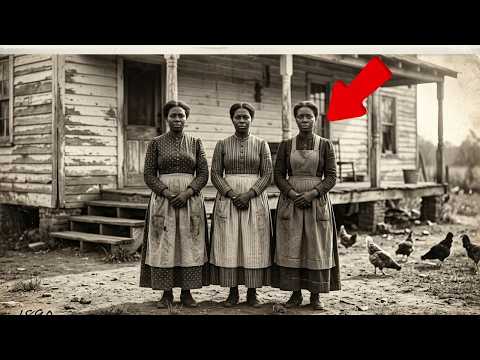
Dr. Hayes had spent years studying post-Reconstruction Black families. She knew hunger. She knew hard labor. But this was different. The girl’s shoulders were broad, her neck thick, her stance pillar-sturdy. The muscle definition was not the result of toil—it was the signature of a rare genetic condition that science would not officially identify until 1997. “This is textbook myostatin-related hypertrophy,” geneticist Dr. Marcus Freeman later confirmed. “No doubt.”
But the photo was dated 1898—99 years before the condition had a name. How was that possible? Dr. Hayes turned the original print over. Faint pencil handwriting, almost erased, revealed three names: Ruby, 18; Esther, 17; Grace, 16. Grace, the youngest, the one with the impossible strength.
Now they had names. Now they could search. Census records, county archives, birth and death certificates—piece by piece, the story emerged. The girls were the children of formerly enslaved people. Their parents, Mary and Elias, had been freed after the Civil War. They owned no land. They were sharecroppers, working from sunup to sundown. But in the Jim Crow South, freedom meant little. It meant you could be worked, underpaid, and discarded—and there was nothing you could do about it.
By 1898, their father was gone. The records don’t say how or when, only that he was not at home. The family depended entirely on Mary and her three daughters. They took in washing, worked the fields, scraped together pennies. And Grace—Grace was different. Neighbors remembered her. In the 1930s, a Federal Writers’ Project interview captured their words. “She was quiet, serious. She rarely complained, but she could do the work of two grown men.” She could lift a full bale of cotton alone. She carried buckets of water up hills that made grown women gasp. She wrung wet clothes so hard they seemed to fly from her hands.
Her strength was no circus act. It was not celebrated. It was survival. But that’s where the story turns dark. In a world that saw Black women only as labor, Grace’s extraordinary strength did not protect her—it targeted her. Neighbors in Lowndesboro learned what she could do, and they used it. Instead of lighter tasks, she was given the heaviest. Instead of rest, she was pushed harder. She filled two places. She did the work of three, yet was paid the same pittance that barely kept them fed.
She used her strength to keep her family alive. She carried the heaviest loads so her mother and sisters wouldn’t have to. She endured the hardest labor so they could rest. Her extraordinary, powerful, one-in-a-million body became a shield that put food on their table.
A diary page from her sister Esther, found in a descendant’s attic, read: “Grace never complains. She lifts things no one else dares touch. She says God gave her strength so we wouldn’t break. But at night I see her rubbing her back, her shoulders trembling. She gives us all the food. She eats last, and she eats least.”
Grace had not only extraordinary muscles. She had extraordinary courage. And she gave every ounce of it to the people she loved.
Dr. Hayes and Dr. Freeman kept digging, and every new document told the same story from a different angle. A cotton gin ledger from 1902 recorded that Grace had hauled more cotton than two workers combined. An employment register from 1904 listed her as specially hired for heavy lifting—and paid the same as the weakest hand, with no bonus, no extra ration, because her strength was never treated as her own property. It was something to be taken, used, and thrown away.
A church record noted she had helped carry timber for a new building, working alongside four men and keeping pace with all of them. “She was quiet, but when she got angry, nobody could stop her,” one descendant recalled, repeating a story passed down through generations. “They said she could lift a horse. She could carry a grown man on one shoulder.”
And the records showed one more thing. Grace never kept her strength for herself. She never bargained for better conditions. She never demanded fair wages. Instead, she worked longer hours, took the hardest duties, and handed nearly every penny she earned to her mother. A family ledger kept by her sister Ruby and passed down to descendants revealed that between 1901 and 1918, Grace’s earnings paid off almost all the family’s debts. She bought them land. She bought them good food. She bought them safety. She gave her body away piece by piece so they could live.
Then the records went quiet. Around 1929, Grace disappeared from public documents. There was no grand obituary, no scientific paper written about her in her lifetime, no monument. She was buried in a family plot in an unmarked grave, on land she had labored over her entire life.
Dr. Hayes and Dr. Freeman also found something else. The family’s descendants still live in Alabama today. When the researchers contacted them, the stories were already known—passed down generation after generation. “Great-aunt Grace was very strong,” they said. And most importantly, the trait had appeared again in later generations. Not as dramatically as in Grace, but unusual muscle, unusual strength, unusual build had shown up among her descendants. Living proof that Grace had carried something that passed through blood—a mutation, a gift, a burden, that science would not name until long after her death.
When the findings were published in late 2024, they caused a stir in medical circles. Researchers realized Grace’s photograph was the oldest visible documentation of this specific genetic condition anywhere in the world—not just in America, but anywhere. The previous record had belonged to a case from the 1960s. Grace pushed that timeline back by nearly seventy years. She changed medical history simply by existing, by being photographed, by waiting to be understood.
But perhaps the most beautiful part of the story is how it came full circle. When Ruby, Esther, and Grace’s descendants were shown the research, they didn’t talk about medical breakthroughs or scientific significance. They talked about family. “We always knew she was special,” they said. “We always knew there was something different about her. Now the rest of the world knows too.”
They took the new understanding of Grace back into their homes—to the place where she lived, the land she worked, the family she had sacrificed everything to keep safe. They did not see her as a medical curiosity. They saw her as their ancestor, their protector, their Grace.
But the story did not end with the publication of the findings. It began to move in ways no one could have predicted. A small historical society in Lowndes County reached out to Dr. Hayes with an unexpected request. They wanted to erect a marker—not in the archive, not in a university hall, but on the land where Grace had worked. The land itself had passed out of the family’s hands decades ago, sold off in pieces during the Great Depression. Yet the current owner, a farmer in his seventies, had heard the story on the news and agreed without hesitation.
“My grandfather always said this soil was worked by giants,” he told the local paper. “I reckon now we know he wasn’t lying.”
The dedication was set for a Saturday in early spring. The descendants gathered—dozens of them, some driving from as far as Chicago and Detroit. They brought photographs, old letters, and a quilt that Ruby had stitched in the 1930s, its pattern faded but intact. Dr. Hayes spoke briefly. Dr. Freeman spoke about the science. But it was Grace’s great-grandniece, a soft-spoken woman named Loretta, who brought the crowd to silence.
“They called her strong,” Loretta said, her voice steady. “But strength wasn’t what she gave us. What she gave us was time. Time to grow up. Time to learn to read. Time to leave the fields and go to school. She bought us time with her body, and we are still spending it.”
The marker itself was simple—a slab of Alabama granite with her name and two dates that no one could fully confirm: born about 1882, died about 1929. Below the dates, the family had chosen the inscription. It read: Grace. She carried what we could not.
After the ceremony, an elderly cousin pulled Dr. Hayes aside. She held a small tin box, rusted at the hinges. Inside was a lock of hair, braided and tied with a faded ribbon, and a single photograph no one had seen before. It showed Grace standing alone in a field, her sleeves rolled up, her arms bare. The image was blurry, but the silhouette was unmistakable—the same broad shoulders, the same thick neck, the same quiet, unyielding stance.
On the back, in the same faint pencil as the first photograph, someone had written a date: 1911. And beneath it, five words that stopped Dr. Hayes cold.
“She never told them why.”
Dr. Hayes turned the photograph over and over in her hands. She had spent years reconstructing Grace’s life from ledgers and census rolls, from the memories of neighbors long dead. But here was something new—a private moment, a field, a woman alone. No employer watching. No family to feed. Just Grace, standing in the light.
She realized then how much of Grace’s story had been told by other people. The ledger keepers. The employers. The neighbors. Even the researchers, herself included. But Grace had left almost nothing in her own hand. No diary, no letters, no recorded words. Only a body that spoke for her, and a photograph that had waited a century to be understood.
The tin box also held one more thing—a folded scrap of paper, so brittle it nearly crumbled at the touch. On it, in a careful, looping script, were a few lines of verse. Dr. Hayes recognized it as a hymn, one that enslaved people had sung in the fields, passed down through generations.
I asked the Lord to strengthen me,
to bear what must be borne.
He gave me hands to lift the weight,
and heart to face the scorn.
There was no signature. But the handwriting matched the pencil on the back of the first photograph. Grace had written it. Somewhere, in the middle of her impossible life, she had found a moment to put words on paper.
Dr. Hayes read the lines aloud to the descendants gathered around the tin box. For a long moment, no one spoke. Then Loretta laughed softly, shaking her head.
“She knew,” Loretta said. “She didn’t know about genes or mutations. But she knew she was given something. And she knew what it was for.”
The tin box passed from hand to hand that afternoon, each descendant touching the lock of hair, the brittle hymn, the photograph of Grace alone in the field. Dr. Hayes watched them and understood something she had not written in any paper: the science had explained Grace’s body, but her family had always understood her heart.
Later, back in her office, Dr. Hayes pulled up the original archive file one last time. She read the old label—Three sisters, Montgomery County, circa 1898—and then typed a new line beneath it. “Grace. The girl who proved science wrong before science knew her name.”
The cursor blinked. She saved the file and closed her laptop.
Outside, the Alabama sun was setting over fields that had once been worked by giants. And somewhere, in a quiet archive, a photograph waited—not to be studied, but simply to be seen.
What would you have asked Grace if you could sit beside her on that porch?
Report this article
Select a reason for reporting:






