October 15th, 1944. The transport truck rumbled through the pine forests of central Louisiana, carrying 43 German women toward an uncertain fate. Among them sat 22-year-old Margarite Fischer, her gray auxiliary uniform hanging loose on a frame that had lost 15 pounds during the voyage. She pressed a hand against her empty stomach, trying to ignore the gnawing hunger that had become her constant companion.
Through gaps in the canvas, she glimpsed a landscape so alien it might have been another planet—towering pines draped with strange gray moss, the air thick and humid, nothing like the crisp autumn of her native Munich. Beside her, 19-year-old Elsa Braun clutched a family photograph, her blue eyes red from crying. Across from them, 31-year-old Hilda Schneider sat with military stiffness, her jaw clenched in defiance despite the fear flickering behind her eyes.
These women had served as communications officers, clerks, and nurses for the Wehrmacht, believing they were defending their homeland from barbaric enemies. Now they were the prisoners, and terror whispered through their ranks about what awaited them. The propaganda they had been fed painted Americans as cruel and savage. Margarite expected beatings, starvation, perhaps worse.
What she did not expect was the smell that hit her as the truck finally rumbled through the gates of Camp Clayborn.
Someone was cooking.
The scent drifted through the humid Louisiana air, rich and savory, carrying notes of frying oil and spices Margarite couldn’t identify. Her stomach clenched painfully, and she heard several other women gasp softly at the unexpected aroma.
The truck jerked to a halt, and rough hands pulled back the canvas covering. Margarite squinted against the sudden brightness, her eyes adjusting to reveal a scene that contradicted everything she had been taught. The camp stretched before them, organized and clean, with neat rows of wooden barracks surrounded by wire fencing. American soldiers stood at attention, but there was no cruelty in their faces—only weary professionalism mixed with curiosity.
A tall officer with graying temples stepped forward. Captain William Green surveyed the women with an expression Margarite couldn’t quite read. Not hatred, not contempt, but something closer to sympathy.
Through a translator, he spoke words that seemed impossible. “You are prisoners of war under the protection of the Geneva Convention. You will be treated with dignity and respect. You will be housed, clothed, and fed. No one here will harm you.”
Then the kitchen door opened and an elderly black man emerged carrying a large covered pot. Samuel Washington moved with quiet dignity as he set the pot on a long wooden table. Other staff followed with plates and dishes. The smell intensified.
Captain Green spoke again. “You’ve had a long journey. You must be hungry. We’ll process your paperwork after you’ve had a chance to eat.”
The German women stood in an uncertain cluster as American soldiers guided them toward the long wooden tables. Margarite’s legs trembled from exhaustion and hunger, but she forced herself to maintain some dignity as she took her place on the rough bench. Around her, the other prisoners sat with the same rigid posture, their eyes darting between the covered dishes and the Americans who surrounded them. This had to be a trick, some cruel psychological game before the real punishment began.
Yet the smells emanating from those pots told a different story, one that made Margarite’s empty stomach twist with painful longing.
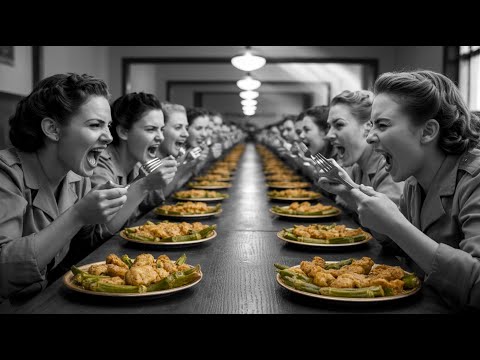
Samuel Washington moved among the tables with practiced ease, his dark hands lifting lids from steaming dishes. The first was filled with golden fried chicken, glistening with oil and spices. The second held fluffy white rice. The third contained something green that Margarite had never seen before, cut into small rounds and fried to a crispy perfection. The fourth dish held cornbread, its yellow surface dotted with butter that melted into tiny rivers. There were collard greens, black-eyed peas, sweet potatoes candied with brown sugar. It was a feast that would have been impressive even in peacetime Germany, let alone in a prison camp during war.
Private Mueller, the young translator, stood nearby and began explaining each dish as Samuel served it, but the women barely heard him. They were transfixed by the portions being placed on their plates. Not thin gruel, not meager rations. These were full plates heaping with food, more than Margarite had seen in a single meal in over a year.
Elsa began crying again, staring at her plate as if it might vanish if she blinked. Hilda’s military composure finally cracked completely, her hands shaking as she reached for her fork.
Samuel paused beside Margarite’s place, using tongs to add several pieces of the mysterious fried rounds to her already full plate. She looked up at him—this black man her propaganda had taught her to fear—and saw only kindness in his weathered face.
“That’s fried okra,” he said in English, his voice soft and warm. Private Mueller quickly translated, though the words meant nothing to her. Okra. She had never heard of such a vegetable. It looked almost like small green fingers breaded and fried until golden brown.
Captain Green stood at the head of the tables and spoke through the translator. “Please eat. There is plenty more if you want seconds.”
For a long moment, none of the women moved. They simply stared at their plates, overwhelmed by abundance they no longer knew how to process. Then Margarite picked up her fork with trembling fingers. She had been raised with proper German table manners, taught to eat with dignity and restraint, but hunger overrode years of conditioning. She speared one of the fried okra pieces and brought it to her lips.
The first bite exploded with flavor. The breading was crispy and seasoned, giving way to a tender interior unlike anything she had ever tasted—slightly sweet with a texture both soft and substantial. She closed her eyes and for a moment the war disappeared. There was only this taste, this moment of pure pleasure after months of deprivation.
Around her, other women were having similar revelations. The sound of crying mixed with the clink of forks as 43 enemy prisoners experienced something unexpected: satisfaction.
Margarite ate with a desperation that embarrassed her, but she couldn’t stop. Each bite of fried okra seemed to communicate something beyond mere sustenance. This was food prepared with care, seasoned with attention, served with an intention she couldn’t quite name. Around her, the other women were experiencing their own private revelations. Elsa had moved on to the cornbread, tears streaming down her face as she tasted the buttery sweetness. Hilda ate methodically, but Margarite noticed her hands had stopped shaking, replaced by something that looked almost like wonder.
Samuel Washington moved among the tables, refilling plates without being asked, offering seconds before anyone had the courage to request them. He spoke little, but his presence carried a weight of compassion that transcended language barriers. When he noticed Margarite staring at the empty spot on her plate where the fried okra had been, he smiled gently and added three more pieces without a word.
She looked up at him—this man she had been taught represented everything barbaric about America—and felt something crack open inside her chest. How could cruelty coexist with such kindness? How could the enemy feed prisoners like honored guests?
The questions began in whispers. German words passed between women who couldn’t reconcile what they were experiencing with what they had been told.
“Why are they doing this?” Elsa asked, her voice barely audible.
“Is it poison?” another woman suggested, though even she sounded doubtful.
Hilda, ever the pragmatist, shook her head. “If they wanted us dead, they wouldn’t waste this much food. This is something else.”
But what that something else might be, none of them could say. They had been trained to understand war in terms of strength and weakness, victory and defeat, friend and enemy. There was no training for this—no protocol for processing generosity from those you had been taught to hate.
Margarite picked up another piece of fried okra, examining it closely before taking a bite. The vegetable had become symbolic of her confusion. It was foreign, unknown, from a culture she had been raised to despise, yet it was delicious, nourishing, given freely. She thought about the meals she had eaten in Germany before the war, the rigid formality of her family’s dining table, the constant emphasis on propriety and restraint. There had been order there, structure, rules that everyone understood. But had there been this—this simple act of feeding someone without asking for anything in return?
As the meal continued, the tension in the compound began to shift, not disappearing entirely, but softening around the edges. Full stomachs have a way of making fear less sharp, suspicion less immediate. Several women actually smiled, hesitant and uncertain, but real.
Captain Green watched from a distance, his expression thoughtful. Samuel returned to the kitchen, already planning tomorrow’s menu. And Margarite sat with an empty plate and a full stomach, staring at the last crumbs of cornbread, and wondering if everything she had believed about the world had just been proven wrong by a single meal. The fried okra sat heavy in her stomach, but heavier still was the weight of a question she couldn’t answer: If the Americans could be this kind, what did that make her?
Twenty years later, on a quiet Wednesday afternoon, Samuel Washington shuffled through the restaurant door, his gnarled hands wrapped around a cane. Margarite had his table ready before he reached it—the one by the window, with the good light. She set down a plate of fried okra, golden and steaming, made exactly to his specifications.
He took a bite, chewed slowly, and nodded. “Still got the touch,” he said. “You learned it right.”
Margarite sat across from him, her gray hair pinned neatly, her accent softened but never gone. “I learned from the best,” she replied. “And I learned that a vegetable can carry a whole philosophy.”
Samuel chuckled, but his eyes were serious. “It was never about the okra, child. You know that.”
She did know. The okra was a doorway—a small, humble thing that had let her walk out of one world and into another. It had taught her that dignity could be breaded and fried, that kindness could be served on a chipped plate, that an enemy could become a friend over a shared meal.
Outside, the Baton Rouge afternoon hummed with traffic and conversation. Inside, the restaurant was full—black and white, young and old, locals and travelers—all sharing tables, all sharing food. Margarite watched them and thought of 1944, of 43 frightened women, of a pot of okra that had changed everything.
She reached across the table and squeezed Samuel’s hand. “Thank you,” she said. “For choosing different.”
Samuel smiled, his eyes glistening. “You chose it too. That’s the whole point.”
They sat together as the lunch crowd thinned, two unlikely friends bound by war and redeemed by a simple act of feeding. The fried okra sat between them, golden and perfect, a testament to what happens when someone decides to see a person instead of an enemy.
And somewhere in that quiet moment, Margarite understood that her story—their story—was never really about food at all. It was about the choice to love when hate was easier, to feed when starving seemed deserved, to see humanity where propaganda had planted only fear.
She looked at the framed photograph on the wall—1945, the women, the soldiers, Samuel in the center—and felt a swell of gratitude for the strange, impossible journey that had brought her here.
What would you have chosen, if you were Margarite—return to a broken homeland, or stay with the enemy who showed you kindness?
Report this article
Select a reason for reporting: