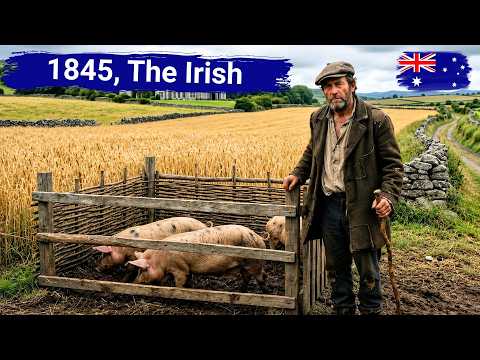
In 1845, Ireland stood on the edge of a cliff, though few could see it. Eight and a half million people lived on an island smaller than Victoria, most of them tenant farmers surviving on a single crop: the potato. It was a biological vulnerability waiting to be exploited—and the exploit arrived on the wind, a microscopic fungus that would turn the island’s fields black and its future darker still.
When the blight struck, it did not announce itself with fire or war. It came silently, rotting the tubers underground while the leaves above stayed green. By the time farmers pulled up their crop, it was too late. “The potatoes were black, rotting, and reeking of decay,” one witness recalled. Within days, the stench of a dying nation spread across parishes and counties.
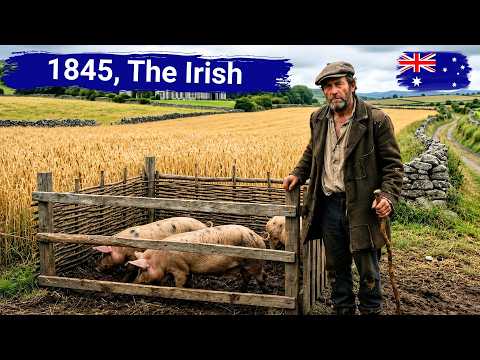
The first year, 1845, took half the crop. It was catastrophic, but not yet mass death. Families stretched what they had, and the British government imported Indian corn. But then 1846 arrived, and the blight returned with a vengeance. Three-quarters of the entire potato crop was destroyed in a single season. The stored reserves were gone. The relief infrastructure collapsed. And the worst was still to come.
In 1847—Black 47—the killing truly began. Soup kitchens fed three million people a day, but they could not keep up. Workhouses were overwhelmed, their gates locked against the desperate. “Families arrived at the workhouse gates only to find the buildings full,” and thousands died on the roadsides. Typhus and dysentery swept through the crowded institutions. In the west, entire townlands were emptied. By the time the famine ended, a million were dead and two million had fled.
Most went to North America, on coffin ships where mortality rates exceeded 30%. But a smaller, often overlooked group sailed in the opposite direction—south and east, toward a continent most could not have found on a map. They were not the first Irish to reach Australia. Since 1788, some 40,000 Irish convicts had been transported in chains, including veterans of the 1798 rebellion. In 1804, Philip Cunningham led 250 Irish convicts in the Castle Hill uprising, shouting “Death or liberty and a ship to take us home.” The rebellion was crushed, but it established a pattern of resistance that would echo through the century.
By the 1830s, free Irish settlers began arriving under assisted immigration schemes. Then came the famine, and with it a radical solution. In 1848, the British government devised a plan: send orphan girls from Irish workhouses to Australia, where women were scarce. “Select girls between 14 and 18, declare them orphans regardless of whether their parents were dead, and ship them to the colonies as domestic servants.” Between 1848 and 1850, 4,114 girls were sent. They came from the poorest counties, many speaking only Irish, clutching small wooden boxes with a prayer book and a change of clothes.
The ships were not coffin ships—they were government-chartered, with adequate rations and medical care. The Lady Kennaway arrived first, in September 1848, with 191 girls. The Pemberton followed, so heavy with passengers that the girls had to wade through mudflats to reach the shore. But when they landed, they were met with hostility. The Argus newspaper called them “worthless characters” and “degraded beings,” accusing them of bringing vice and lewdness to the colony. Anti-Irish and anti-Catholic sentiment ran deep.
Yet most of the girls did not fail. They married, raised families, and built lives. Sarah O’Malley, who walked through the mud at Williamstown, married the following year and raised seven children. Margaret White, from County Clare, arrived at 16 and became the mother of Joe Byrne, a member of the Kelly gang. The scheme was shut down in 1850, but the girls stayed—and their children would help shape a nation.
Then, in 1851, everything changed. Gold was discovered at Clunes, and the rush was on. Within three years, Victoria’s population exploded from 77,000 to over 300,000. Among the arrivals were tens of thousands of Irish, drawn by the promise of fortune. They came with strong backs, Catholic faith, and a deep suspicion of British authority. On the goldfields of Ballarat and Bendigo, they found a new battleground.
In 1854, Peter Lalor—born in County Laois, son of an Irish MP—led the miners’ rebellion at Eureka. “He chose the password Vinegar Hill,” the site of the 1798 Irish rebellion, and raised the Southern Cross flag. The stockade was stormed, 22 diggers were killed, and Lalor lost an arm. But he was acquitted, elected to parliament, and became a founding figure of Australian democracy. The Irish had not just arrived—they were now shaping the country’s future.
By 1891, 228,000 Ireland-born residents lived in Australia, but their true legacy was in their children. The Catholic Church, the labor movement, and the fight for Federation were all built on Irish shoulders. In 1929, James Scullin became the first Catholic Prime Minister, the son of Irish immigrants. Today, 2.5 million Australians claim Irish ancestry—the most Irish country on Earth outside Ireland itself.
But the story of how they got there—through famine, exile, and the hostile streets of a new land—is a tale of survival that begins with a single, silent fungus and a people who refused to disappear.
The girls who stepped off the Lady Kennaway and the Pemberton did not vanish into the Australian bush. They became visible in the most ordinary ways—in church registers, in birth notices, in the small ledgers of shopkeepers and the margins of census forms. Genealogists have spent decades tracing them, and what they found was not a story of degradation but of stubborn, unglamorous endurance.
Take the case of the Eliza Caroline, the last of the six ships, which docked in Adelaide in 1850. Its passengers were scattered almost immediately into the households of South Australian settlers. Within five years, more than half of them had married. Their husbands were shepherds, carpenters, ex-convicts, and gold prospectors—men who needed wives and did not much care where they came from.
Some of the girls wrote letters home, and a handful survive. They are heartbreaking in their plainness. One young woman from County Mayo, who signed herself only as Bridget, wrote to her sister in a workhouse that she had found a position in a house near Geelong and was learning to make bread the English way. “Tell Mother I have a bed to myself and meat twice a week,” she wrote. She never mentioned the loneliness.
But not every story ended in a kitchen or a marriage bed. A number of the orphans found their way to the goldfields, where the demand for cooks, laundresses, and storekeepers was insatiable. Some ran boarding houses in Ballarat and Bendigo. A few, remarkably, became property owners in their own right—a rare thing for women of any background in the 1850s.
It was on those goldfields that the Irish orphans and the Irish miners converged, and the collision produced something new. The girls who had been shipped out to relieve the workhouses were now the wives and mothers of the men who would raise the Southern Cross at Eureka. The orphan scheme, designed to solve a demographic problem, had inadvertently seeded a community.
Yet the hostility did not disappear. The Argus kept up its campaign for years, and the anti-Irish sentiment it stoked fed directly into the sectarian divisions that would scar Australian public life for generations. Catholic and Protestant, Irish and English—the fault lines were drawn early and deepened with every new shipload.
By the 1860s, the Irish in Australia were no longer a novelty. They were bushrangers and bishops, publicans and politicians. Ned Kelly, the most famous Australian outlaw, was the son of an Irish convict father and an Irish orphan mother—a lineage that seemed to concentrate every grievance and every defiance of the famine generation into a single, doomed figure.
When Kelly was hanged in Melbourne in 1880, the judge who sentenced him, Sir Redmond Barry, was also of Irish stock. The two men faced each other across the courtroom—one the product of poverty and transportation, the other of respectable colonial ambition—and in that moment the whole complicated history of the Irish in Australia seemed to meet itself.
The generation that followed moved inward, into the institutions of the new nation. They built the Catholic school system, founded hospitals, and organized trade unions. When the Commonwealth of Australia was proclaimed on the first of January 1901, the Irish were no longer strangers at the gate. They were inside the tent, writing the constitution, counting the votes, and burying their dead in cemeteries that would one day be heritage-listed.
And yet, the question of what the famine generation actually built has never been fully settled. Historians still argue over whether the Irish in Australia assimilated or resisted, whether they became good Australians or remained, in some quiet way, Irish first. The answer, as with most things, depends on which family you follow.
Follow the orphans and you find a story of absorption—of girls who learned the English way of baking bread and disappeared into the suburbs. Follow the miners and you find a story of defiance—of men who carried Vinegar Hill in their pockets and raised a flag that still flies on the Australian flag today. Both stories are true. Both are Irish.
The famine itself never really ended for those who left. It lived in the silence of parents who would not speak of the workhouse, in the way a family might refuse to waste a single potato, in the names of towns remembered but never revisited. “We are the children of those who survived,” one descendant wrote in a letter to a genealogist in 1998. “But we never knew what they survived.”
What they survived was not just hunger but erasure—the slow, grinding pressure to forget a language, a faith, a loyalty. In Australia, they rebuilt those things from scratch. The Catholic schools, the Hibernian societies, the St Patrick’s Day parades—all of it was scaffolding for a memory that refused to collapse.
Today, the descendants of the 4,114 orphan girls are scattered across every state and territory. They are farmers and teachers, judges and trade unionists. Some of them know the name of the ship their great-great-grandmother sailed on. Most do not. But the silence in the records is its own kind of testimony.
The fungus that destroyed the potato fields of Ireland in 1845 did not destroy the Irish. It scattered them—to Boston and New York, to Quebec and Liverpool, and to a continent on the far side of the world that most of them had never imagined. The ones who came to Australia arrived with nothing but a wooden box and a prayer book, and they built a country.
That is the story the census records can only partly tell. It is a story of survival, but also of transformation—of a people who lost a homeland and found, or made, another. The Irish in Australia are not a footnote to the famine. They are its living answer.
And the question that remains, for every Australian who claims Irish ancestry, is not whether they are Irish—but what they will do with that inheritance. Will they remember the workhouse gates, the coffin ships, the locked doors? Or will they let the silence finish what the blight began?
What do you think—has the Irish story in Australia been fully told, or is there a chapter still waiting to be written?
Report this article
Select a reason for reporting: