June 15th, 1961. Harlem. The morning air was thick with the smell of rain and secrets. Maybel Johnson walked into her daughter’s bedroom and froze. The bed was made. The window was open. And on the pillow, something that made her blood run cold.
Not a note. Something worse. A letter written in blood—dark red, still wet, staining the white pillowcase. Next to it, Ruthie’s yellow ribbon, the one she wore every day, soaked in fresh blood.
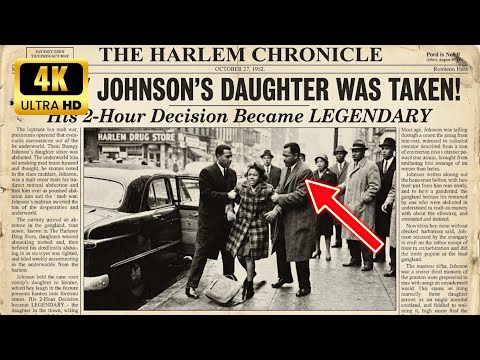
Maybel’s hands shook as she picked up the letter. The words were scrawled in thick, deliberate strokes: We have your daughter. $5 million. 10:07 this morning. No police, no games. And at the bottom, a line that made her knees buckle: Every 10 minutes late, one finger.
Her scream brought Bumpy running up the stairs three at a time. When he saw the letter, when he saw the blood-soaked ribbon, his face didn’t change. No panic, no tears—just a terrible cold stillness.
Maybel collapsed into his arms, sobbing. “Ellsworth, they took her. They took our baby.”
Bumpy didn’t speak. He walked to the bed, picked up the letter, brought it close to his face, touched the blood, rubbed it between his fingers. Then he did something strange. He smelled it. His eyes narrowed.
“Not hers.”
Maybel looked up, confused, terrified. “What?”
“This isn’t Ruthie’s blood. It’s animal blood. Pig, maybe cow. They’re playing mind games.”
“Ellsworth, we have to call the police.” Maybel grabbed his arm.
Bumpy turned to her, and for the first time she saw something terrifying in his eyes. Not fear. Calculation.
“No. Police show up, Ruthie dies in 30 minutes. These people know what they’re doing.”
The clock on Ruthie’s nightstand read 8:09. Two hours. They had two hours.
What happened next was what separated Bumpy Johnson from every other man in Harlem. 8:11 in the morning. Four minutes had passed since Maybel found the note. Bumpy stood completely still in the center of Ruthie’s room. Eyes closed, face drained of color. Ninety seconds of absolute silence.
Maybel watched him, not understanding. Inside Bumpy’s mind, images flashed like lightning. Three weeks ago, a black sedan parked across the street. Same car, three different days. He’d noticed but dismissed it. One week ago, Ruthie mentioned a man at the corner store asking which school she attended. Bumpy had warned her but thought nothing more of it. Three days ago, a photograph of his family at church arrived in the mail. The corner torn off. No message.
Bumpy’s eyes opened. His voice cut through the silence like a blade. “They’ve been watching us for three weeks. That means someone inside talked.”
“How do you know?” Maybel’s voice cracked.
“They know Ruthie leaves for school at 7:30. They know our exact schedule. They know when to strike.” He held up the bloody letter. “They’re demanding five million in two hours. That’s impossible to gather.”
“Then what?”
“They don’t want the money, Maybel. They want me panicking.” His jaw tightened. “Two hours isn’t enough time to collect five million. They know that. Which means Ruthie was never supposed to survive this.”
Maybel’s hand flew to her mouth. “No, Ellsworth, no.”
“I’m not letting that happen.” Bumpy walked toward the phone in the hallway. “But we do this my way.”
The call lasted ten seconds. 8:15 that morning. Bumpy dialed a number he only used for emergencies. Juny picked up on the first ring.
“Code red, Smalls. Eight minutes.”
“Boss, what’s happening?”
Bumpy hung up. No explanations, no discussions—just orders.
When he arrived at Smalls Paradise eight minutes later, seven men were already waiting in the back room. Not his usual crew of thirty-seven soldiers—just seven. The sharpest, deadliest, most loyal men in his organization. Men who wouldn’t ask questions. Men who’d walk into hell if Bumpy asked.
Bumpy entered and placed a watch on the table. The ticking filled the room like a countdown to execution. “One hour and forty-four minutes.” His voice was ice. “That’s how long my daughter has left to live.”
Every face in the room turned to stone.
“Someone kidnapped Ruthie this morning before 7:30. They’re demanding five million by 10:07. They won’t get it.” Bumpy looked each man in the eye. “Because I’m not paying. I’m taking her back. And whoever did this will regret the day they were born.”
He pointed at Juny. “Check every phone call that came to my house in the last three weeks. Someone on the inside talked. Find them.” Then Willie. “Find every truck capable of transporting a person out of Harlem between midnight and 7:30 this morning. Registrations, owner’s last known locations. I want addresses in thirty minutes.” Clarence. “Go to every one of Genovese’s men. Apply pressure. Break bones if you have to. Someone knows something.” Marcus. “Bank records. Anyone withdrawing large amounts of cash in the past month. These people needed money to plan this operation.”
The men stood and dispersed like smoke into the morning streets. Bumpy stayed behind, staring at the watch on the table. 8:26. One hour and forty-one minutes.
Then his phone rang.
8:39 that morning. Father Divine’s voice came through shaking.
“Bumpy, I need to tell you something.”
“Talk.”
“Two men—Italians—were at my church last week. They were asking about Ruthie, what school she goes to, what time she leaves home. They weren’t quiet about it either.”
Bumpy’s grip on the phone tightened. “Who were they?”
“I don’t know their names, but Bumpy—” Father Divine paused. “They wanted me to hear them. They made sure I’d tell you. They wanted you to know.”
The line went silent for three seconds. Then Bumpy understood.
“This is bait.”
“What?”
“They want me chasing Italians. They want me thinking this is Genovese.” Bumpy’s mind moved like a chess master, seeing ten moves ahead. “While I’m breaking down doors in Little Italy, they’re hiding Ruthie somewhere I’d never look.”
He hung up and turned to the three men still in the room. His next decision would either save his daughter or cost him everything.
“Willie, take three men and follow the Italian lead. Make noise. Bang on doors. Let them think I’m coming that direction.”
Willie frowned. “And you?”
Bumpy’s eyes were cold fire. “I’m going the opposite way. If they want me looking at Genovese, the real answer is somewhere they think I’ll never search.”
The clock read 8:43. One hour and twenty-four minutes remained. The hunt had begun.
8:52 that morning. One hour and fifteen minutes left. Willie burst through the door of Smalls Paradise out of breath, sweat dripping down his face.
“Boss, found three trucks. All suspicious, all moved in and out of Harlem between midnight and dawn.”
Bumpy didn’t hesitate. “Split into three teams. Hit all locations simultaneously.”
Juny stepped forward. “Boss, if we’re wrong—”
“Then one of the three is right. Move now.”
The men scattered. Three teams, three addresses. Three chances to find Ruthie alive.
But finding the right location was only half the battle.
9:03 that morning. Willie kicked down the door of a warehouse in the Bronx, gun ready for a fight. The room was empty. No Ruthie, no kidnappers—just silence and shadows. But something wasn’t right. Willie touched the wall. Warm—not cold like an abandoned building should be.
He crouched low, ran his hand across the concrete floor, and there, caught between two cracks, a single strand of blonde hair. The exact color of Ruthie’s.
Willie grabbed his radio. “They were here twenty minutes ago, maybe less. They moved her.”
Bumpy’s voice crackled back. “Stay there. Search everything. They left that hair on purpose.”
Four minutes later, Bumpy’s phone rang.
9:07 that morning. The voice on the other end was distorted—mechanical, impossible to recognize.
“Bumpy Johnson. You’re fast. I’m impressed.”
Bumpy’s hand tightened around the phone. In the background, he heard it. A girl crying. “Baba, don’t give them money. They’re going to—” The sound cut off, muffled. Someone had covered her mouth.
“Let me talk to her.” Bumpy’s voice was controlled, but his knuckles were white.
“No.”
“What do you want? Money? I’ll bring it right now. Five million, ten million, whatever you want.”
The distorted voice laughed. Cold. Cruel. “No, Bumpy. You don’t get to write the rules anymore. You play by mine.”
What came next turned the entire hunt into something far more twisted than Bumpy had imagined.
The voice continued, calm and deliberate. “You have forty-five minutes. I’m going to send you to three locations. At each location, there’s a riddle. Answer correctly, I give you the next address. Answer wrong or arrive late, your daughter loses a finger. Simple.”
Bumpy’s jaw clenched. “This isn’t about money.”
“No, it never was.” The voice paused. “First location: McCallor’s Bar, Little Italy. You have fifteen minutes. Come alone. No bodyguards, no backup. I’ll know if you cheat.”
The line went dead.
Bumpy stood frozen for three seconds. Then he moved faster than he had in twenty years. Grabbed his coat, headed for the door. Juny tried to follow. Bumpy stopped him with a look.
“Stay here. Coordinate the teams. If I don’t call in thirty minutes, tear this city apart.”
9:12 that morning. Bumpy walked into McCallor’s Bar—empty, dark. The chairs were stacked on tables. No bartender, no customers. Just him and the silence.
On the bar counter sat a single envelope, white, unmarked. Inside was a photograph, black and white, faded, dated 1945. A younger Bumpy, fists raised, standing over a man bleeding on the ground. Beneath it, written in red ink: What was his name? You have sixty seconds.
Bumpy stared. 1945. Sixteen years ago. He’d hurt a lot of men that year. But this man—broken nose, scar over his left eye. Michael O’Brien. Michael the Hammer. Bumpy had beaten him unconscious in front of twenty witnesses.
He grabbed the phone on the bar and dialed the number on the back of the photo. “Michael O’Brien.”
Three seconds of silence. Then the distorted voice returned. “Correct. Next location: Pier 17, Brooklyn. You have eighteen minutes.”
The riddle game wasn’t just about finding Ruthie. It was about digging up ghosts Bumpy had buried long ago.
9:28 that morning. Pier 17 was deserted. Ships creaked in the water. On a wooden post sat a small metal box. Inside, something that made Bumpy’s blood run cold. A wedding ring. Gold. Worn. Engraved inside: H & E, 1940.
His hands started shaking. This was Helen’s ring. His first wife. The woman no one knew about. The woman who died eighteen years ago.
A piece of paper lay beneath it. Who killed her?
Helen Johnson died in 1943. Officially, a car accident. But Bumpy knew the truth. Salvatore Maranzano had her killed—a message to stay out of his business. Six months later, Maranzano was found in an alley with his throat cut. No witnesses. No arrests.
Bumpy picked up the phone attached to the box. “Salvatore Maranzano. And I killed him.”
The distorted voice came back—and this time there was something different in it. Satisfaction. “Good. Now you understand, Bumpy. This isn’t about money. This is about blood. Debts that never get paid. This is about justice.”
“Who are you?”
“You’ll find out soon enough. Final location: Red Hook. Warehouse 43. You have twenty-seven minutes. Don’t be late, Ellsworth. Your daughter’s counting on you.”
The line went dead. Bumpy closed his fist around Helen’s ring and ran.
9:42 that morning. Bumpy called Juny from a pay phone three blocks from Red Hook. “Warehouse 43, Red Hook. Get everyone there. Surround it now.”
“Boss, this is a trap. You know it’s a trap.”
“I know. But Ruthie’s in there. Get your men in position—but I go in alone.”
“Bumpy, you’ll die.”
“If Ruthie dies because I brought an army, I won’t be able to live with myself.”
9:48 that morning. The warehouse loomed in front of him. Three stories of brick and broken windows, dark, silent, deadly. Juny and Willie were positioned in the back with five men, guns ready.
Juny’s voice came through the radio. “We’re in position. Say the word and we storm the front.”
Bumpy clicked the radio off. He looked at the warehouse door, took a breath, and made a choice that could cost him everything. I’m going in alone.
9:51 that morning. The warehouse was black as death. Bumpy’s footsteps echoed on the concrete floor. Every step felt like walking toward his own grave. He could hear breathing—multiple people, somewhere in the dark.
Then, all at once, the lights blazed on.
Bumpy froze. In the center of the warehouse, tied to a chair, was Ruthie—alive, terrified, tears streaming down her face. Surrounding her were six men in black masks, each holding a gun pointed directly at Bumpy.
And behind Ruthie, standing in the shadows, was a man without a mask. Old, scarred, smiling. Bumpy’s face went white. Because he knew that face.
The old man stepped forward into the light. “Hello, Ellsworth. It’s been a long time.”
Antonio Maranzano. Son of the man Bumpy had killed seventeen years ago.
“You died in 1944. The fire. Everyone said you died.”
Antonio laughed. Cold. Bitter. “Died? No, Bumpy. I disappeared. I let the world think I was dead so I could watch you, study you, learn everything about you. Seventeen years, Ellsworth. Seventeen years waiting for this moment.”
He circled Ruthie’s chair slowly, like a predator savoring the kill. “1943. You killed my father because he killed your wife. An eye for an eye. Fair trade. Except it wasn’t fair. You got to rebuild. You got Maybel. You got Ruthie. You got happiness again. But me—I got seventeen years of pain. Seventeen years planning how to make you feel what I felt.”
Antonio pulled out a revolver. Chrome, polished. He pressed the barrel against the back of Ruthie’s head. “Now, Ellsworth, you’re going to understand what it means to lose everything.”
Ruthie’s voice cracked. “Baba—don’t listen to him.”
Bumpy took a step forward. “Stop. Whatever you want from me, I’ll do it. Anything. Everything. Just don’t hurt her.”
Antonio’s finger rested on the trigger. “Anything? Good.” He gestured to a table against the wall. On it sat two phones, black, identical. “I want you to choose.”
“Choose what?”
“Your future. Left phone: you call Vito Genovese. You tell him you’re surrendering Harlem. All of it. Every block, every business, every connection you’ve built for thirty years. You hand it over.” He tapped the right phone. “Right phone: you call your wife Maybel. You tell her the truth about how you made your fortune. Every person you hurt. Every dirty secret you’ve kept from her for three decades.”
Bumpy’s hands trembled. “If I choose one, you let Ruthie go?”
Antonio’s smile widened. “But the entire city will know. Left phone: everyone knows Bumpy Johnson surrendered like a coward. Right phone: everyone knows Bumpy Johnson is a monster who built his empire on innocent blood. Either way, the reputation you spent thirty years building dies in sixty seconds.”
The choice wasn’t about money. It was about destroying the man Bumpy had become.
10:02 that morning. Five minutes left. The warehouse was silent except for Ruthie’s quiet sobbing and the ticking of the clock.
“Choose, Bumpy.” Antonio’s voice was ice. “Or I choose for you.”
Ruthie shook her head. “Baba, don’t—don’t do anything. Let them—”
Bumpy looked at his daughter, sixteen years old, terrified, tied to a chair with a gun to her head. Then he looked at the two phones. Both paths led to ruin.
Then, slowly, calmly, Bumpy sat down on the floor. Antonio frowned. “What are you doing?”
Bumpy crossed his legs, leaned back, and started laughing. Quiet at first, then louder. The sound echoed through the warehouse like breaking glass.
Antonio’s finger tightened on the trigger. “Have you lost your mind?”
Bumpy’s laughter stopped. His face went cold. Stone. “Antonio, you think you’ve won, don’t you?”
“I have won.”
“No. You lost the moment you started this.”
Bumpy stood up slowly. “Seventeen years. You watched me, followed me, learned how I think, how I operate, how I react under pressure. But you forgot one thing, Antonio. I was watching you, too.”
Antonio’s gun hand shook. “You didn’t know I existed.”
“Didn’t I? Three weeks ago—black sedan outside my house. Same car, three different days. You think I didn’t notice? I noticed. And I let you keep watching. One week ago—man at the corner store asking Ruthie about her school. You think I didn’t know that was your man? I knew. And I let him ask.”
Bumpy took another step forward. “This morning, when you took Ruthie, when you left that blood-written note—you think I panicked? I didn’t. Because I knew exactly what you’d do. You’re predictable, Antonio. You’ve always been predictable.”
“You’re lying.”
“Am I? If I’m lying, how did I know you’d have six men in this room? How did I know you’d send me to three locations before bringing me here? How did I know you’d want me to come alone?”
The gun in Antonio’s hand dropped an inch. “You—you couldn’t have.”
Bumpy clapped his hands twice. Sharp, loud. The lights went out.
Ten seconds of total darkness. Chaos. Shouting. The sound of bodies hitting the floor. Gunfire—three shots, four. Then silence.
When the lights came back on, the scene had transformed completely. Juny stood behind two of the masked men, guns to their heads. Willie had disarmed another three. The sixth lay unconscious on the ground. Antonio’s revolver was on the floor, kicked ten feet away. And Antonio himself was on his knees, hands behind his head, surrounded.
Bumpy walked over, picked up Antonio’s gun, checked the chamber. Fully loaded. He looked down at the man who’d spent seventeen years planning this revenge.
“You were so focused on making me suffer, you forgot I’ve been surviving in this world longer than you’ve been alive.”
“How—”
“Juny and Willie were in the building before I arrived. Crawled through the ventilation system. Been hiding in the ceiling for twenty minutes. You gave me three locations. Three riddles. Forty-five minutes to solve them. You think that was for Ruthie’s safety? No. It was so I’d arrive here exactly when you wanted—alone, desperate, broken. But I turned your timeline against you. While you were busy playing puppet master, my men were getting into position.”
The clock read 10:05. Two minutes until the deadline.
Antonio’s voice shook. “You—you planned all this?”
“No. You kidnapped my daughter. That was real. But you assumed I’d be too panicked to think clearly. You assumed wrong.” Bumpy chambered a round. “That’s the difference between revenge and survival. Revenge makes you stupid. Survival makes you sharp.”
He pointed the gun at Antonio’s head. The moment stretched. Ruthie’s voice broke through. “Baba—”
Bumpy’s hand didn’t waver. Antonio closed his eyes. “Do it. Kill me like you killed my father.”
Silence. Five seconds. Ten. Fifteen.
Then Bumpy lowered the gun. Antonio’s eyes opened, confused, terrified. “Why? Why aren’t you—”
“Because if I kill you, I become you.” Bumpy’s voice was quiet. Final. “Seventeen years. That’s how long you spent living for this moment. Seventeen years of hate. Seventeen years of planning revenge. And where did it get you? On your knees, defeated. Humiliated.” He tossed the gun aside. “I’m not spending the next seventeen years becoming what you became.”
Bumpy walked to Ruthie, cut the ropes binding her wrists, pulled her into his arms. She collapsed against him, sobbing. “I’m sorry—I’m so sorry—”
“You have nothing to be sorry for, baby. Nothing. This wasn’t your fault.” He held her tight. “You’re safe now. That’s all that matters.”
Over Ruthie’s shoulder, Bumpy looked at Antonio, still on his knees, broken, destroyed—without a single bullet fired. “I’m not killing you, Antonio. But you’ll live with this shame. Every day, every hour, the entire underworld will know you spent seventeen years planning revenge against Bumpy Johnson—and you lost without me firing a single shot.”
Bumpy carried Ruthie toward the exit. Juny and Willie followed, weapons still trained on the six masked men. Behind them, Antonio Maranzano knelt in the center of the empty warehouse. Alone. The sound of his sobbing echoed off the concrete walls.
10:07 that morning, the deadline passed. But Ruthie Johnson was alive, safe in her father’s arms, walking out into the morning sun. And Antonio Maranzano learned what Bumpy had known for thirty years: real power isn’t about who you can destroy. It’s about who you can save—and what you’re willing to sacrifice to save them.
10:15 that morning. Bumpy walked through the front door of his house on 122nd Street, carrying Ruthie in his arms. Maybel ran down the stairs, grabbed her daughter, held her like she’d never let go. All three of them stood in the hallway crying, holding each other.
Bumpy sat down on the couch, exhausted, drained. Every muscle in his body felt like lead. Juny stood in the doorway, hesitant. “Boss, what do we do about Antonio?”
Bumpy didn’t look up. “Let him live.”
“But—”
“I said, let him live.” Bumpy’s voice was final.
But letting Antonio live wasn’t mercy. It was strategy. And by four o’clock that afternoon, the entire city would understand why.
Bumpy picked up the phone, dialed Frank Costello. “Frank, I need you to do something for me. Spread the word across every borough. Antonio Maranzano spent seventeen years planning revenge against me. I dismantled it in two hours without firing a single bullet.”
Frank was quiet for a moment. “You want to ruin his reputation?”
“No. I want to kill it. Blood washes away with blood. But reputation only dies with truth.”
The message went out that night. By morning, every mobster, every street soldier, every boss in New York knew the story. Antonio Maranzano had lost—not in a gunfight, not in a war, but in a battle of minds. And he’d been humiliated.
June 16th, 1961. Two in the afternoon. The Ravenite Social Club. Five men sat around a table—Frank Costello, Vito Genovese, Carlo Gambino, Tommy Lucchese, Joe Bonanno. The most powerful crime bosses in America.
Antonio Maranzano was dragged into the room by two guards. Handcuffed, face bruised, defeated. Genovese looked at Bumpy. “What do you want from this meeting?”
Bumpy stood slowly. His voice carried through the room like a judge delivering a sentence. “I want everyone here to understand one thing. Family is the red line. You cross it, you don’t fight one man. You fight a system.” He pointed at Antonio. “This man spent seventeen years planning the perfect revenge. Meticulous. Detailed. Flawless. But he forgot something. When you threaten what a man loves most, you don’t break him. You awaken something worse.”
Bumpy walked closer to Antonio. “I could have killed him yesterday. Put a bullet in his head. But I didn’t—because I want him to live. I want him to watch everything he built crumble. I want him to see his name become a warning.”
The room was silent. Every boss understood what Bumpy was really saying. This wasn’t just about Antonio. This was about setting a precedent.
Genovese spoke first. “Antonio, you violated the code. You know the penalty.”
Antonio said nothing. Just stared at the floor. Carlo Gambino leaned forward. “Exile. Permanent. You leave New York and never come back.”
Bumpy interrupted. “Not enough.”
Gambino frowned. “What else do you want?”
“Five million dollars.”
Antonio’s head snapped up. “I don’t have that kind of money.”
“Then sell. Sell your house. Sell your property. Sell everything. You wanted to make me suffer. Now it’s my turn.”
Genovese nodded slowly. “Five million. One month. If you don’t pay, we’ll take it ourselves.”
The gavel came down. Antonio Maranzano was finished.
After the meeting, Frank Costello pulled Bumpy aside. They stood alone in the hallway. Frank lit a cigarette. “You could have killed him. Why didn’t you?”
Bumpy looked out the window. “You know what hurts more than death, Frank? Living with failure. Waking up every day knowing you lost.” He turned to face him. “If I kill Antonio, he dies a martyr. His followers remember him as a hero. But if he lives as a broken man, nobody remembers him. That’s real revenge.”
Frank smiled. “You’re smarter than most people give you credit for.”
“I learned a long time ago. Violence is easy. Strategy is power.”
One month later, the money arrived. July 17th, 1961. A courier delivered a briefcase to Bumpy’s house. Inside was five million dollars. Every cent Antonio Maranzano owned. Bumpy opened it, counted it, closed it.
Maybel walked into the room. “Ellsworth, what are you going to do with all that money?”
Bumpy looked at Ruthie sitting on the couch, still recovering from the trauma. “You’ll see.”
Three days later, Bumpy held a press conference in Harlem. Reporters filled the room. Cameras flashed. He stood at a podium, calm, composed, and made an announcement that shocked everyone.
“I’m establishing the Ruthie Johnson Scholarship Fund. Five million dollars, to send children from Harlem to college. Every year, as many kids as the fund can support.”
A reporter raised his hand. “Mr. Johnson, why are you doing this?”
Bumpy glanced at Ruthie standing in the back of the room. “Because money can buy power. But education creates it. I want the children of Harlem to have choices I never had.”
The fund was signed and sealed. The first class of recipients was announced six months later. Twenty-three kids, all from Harlem, all heading to college.
Ruthie asked her father one night, sitting on the porch. “But why didn’t you keep the money?”
Bumpy looked at his daughter. “Because the best revenge isn’t in making your enemy suffer. It’s in proving they were wrong about you.”
Fourteen years passed. The fund grew. More children went to college. Hundreds of them. Each one carrying a piece of Bumpy’s legacy.
1975. Columbia University. Graduation day. A young woman named Grace Washington stood at the podium receiving her doctorate in medicine—the first person in her family to attend college, the first to become a doctor. In her speech, she said something that made the entire auditorium stand and applaud.
“I’m here today because of a man society called a criminal. But he taught me something no classroom ever could. Your past doesn’t define your future. He could have chosen revenge, but he chose to build.”
In the audience, Ruthie Johnson sat with tears streaming down her face. Thirty years old now. Married. Children of her own. But still, she remembered. June 15th, 1961. Two hours that changed everything.
After the ceremony, Grace found Ruthie. “You’re Ruthie Johnson. The scholarship is named after you.”
Ruthie nodded. “My father started it after something terrible happened to me. He wanted something good to come from it.”
Grace hugged her. “Your father saved my life. He saved hundreds of lives. Thank you.”
Ruthie smiled through her tears. “He would have been proud to hear you say that.”
But not everyone thrived after that day in June 1961. Some fell into darkness and never climbed out.
1968. A small house in New Jersey. Antonio Maranzano sat alone—bankrupt, forgotten. The news came on the radio. Bumpy Johnson had died. Heart attack. Surrounded by family.
Antonio didn’t feel relief. He felt shame. Seven years of exile. Seven years of poverty. Seven years of being a ghost. And now the man who’d beaten him was gone. And Antonio had nothing.
That night he wrote a letter to Ruthie. He never sent it. But he wrote it.
You don’t know me, but I know you. I wanted to kill you to hurt your father. But he taught me the cruelest lesson of all. Revenge doesn’t heal wounds. It creates new ones. I spent seventeen years planning. He destroyed it in two hours. And it took me my entire life to understand—he won from the beginning.
The letter stayed in a drawer. Unsent. Unread. Antonio died three years later—alone, forgotten, exactly as Bumpy had intended.
The funeral of Bumpy Johnson drew five thousand people. Among them, 347 college graduates—all funded by the Ruthie Johnson Scholarship. They didn’t know the full story. But they knew this man had given them a future.
Juny gave the eulogy. “Bumpy Johnson wasn’t a saint. He had blood on his hands. He made mistakes. But on June 15th, 1961, he made a choice. He chose to be a father instead of a gangster. He chose to build instead of destroy. And that choice changed 347 lives.”
After everyone left, Ruthie stood alone at her father’s grave. She spoke quietly, as if he could still hear her. “Baba, I never told you this. That day you saved me—I wasn’t afraid of dying. I was afraid you’d become a monster to save me.” She wiped her eyes. “But you didn’t. You won with your mind, not violence. You forgave with strength, not weakness. And you turned pain into hope.”
She turned and looked at the 347 graduates standing behind her, waiting. “You see, this isn’t the legacy of a gangster. This is the legacy of a father. A man who proved two hours can change everything. Not because of who you can destroy—but because of who you can save.”
The sun set over Harlem. The city moved on. But the story remained. June 15th, 1961. The day Bumpy Johnson saved his daughter—and in doing so, saved hundreds.
Now I’ll ask you: when the clock is ticking and everything you’ve built means nothing next to the people you love—what would you choose to become? Tell me in the comments below.
Report this article
Select a reason for reporting:






