The jungle was never silent. Even in the eerie calm before an ambush, the air hummed with insects, the rustle of leaves, and the distant crackle of static from a radio that had become both lifeline and death sentence. For the Marines of Company B, the radioman was the thread that tied them to the world beyond the tree line—and the enemy knew it.
“They didn’t aim for officers. They aimed for the guy with the antenna.” The words, spoken by a grizzled sergeant, hung in the humid air like smoke. It was a truth every radioman carried with him, a weight heavier than the PRC-25 on his back. The Viet Cong and North Vietnamese Army had learned to recognize the telltale whip antenna, the handset pressed to an ear, the hunched posture of a man calling in fire missions. To them, the radioman was the brain of the unit—and the brain was the first target.
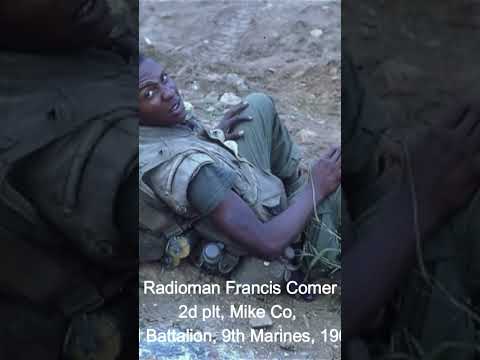
Private First Class Daniel “Danny” Reeves had been in-country for three weeks when he first heard the statistic. He’d laughed it off, a nervous bark that betrayed his fear. “Five to thirty seconds,” the platoon commander had said, matter-of-fact, as if reading a weather report. “That’s your life expectancy in a firefight if you’re on the radio.” Danny had looked at the handset in his grip, its black plastic worn smooth by the hands of previous radiomen—men who had rotated home or been carried out in body bags. He wondered which category he’d fall into.
The first time he came under fire, the world dissolved into chaos. Bullets snapped overhead like angry hornets, and the earth erupted in geysers of dirt and smoke. Danny’s training kicked in: he hit the ground, hugged the radio to his chest, and keyed the handset. “Bravo Six, this is Bravo Six Actual, requesting fire support, over!” His voice cracked, but the words were steady. The response was immediate—a calm, disembodied voice from the rear, directing death from above. But in that moment, Danny realized he wasn’t just a messenger; he was the enemy’s primary target.
Sergeant First Class Miguel “Mike” Torres had survived two tours as a radioman. He moved with the quiet confidence of a man who had beaten the odds, but his eyes held the ghosts of friends who hadn’t. “You learn to be small,” he told Danny one evening, as they cleaned their rifles. “You learn to keep the antenna low, to use cover like it’s your lover. And you never, ever stay in one place.” Mike had seen radiomen die in seconds—one moment calling in coordinates, the next a red mist. He had also seen them save entire platoons, their voices the only calm in the storm. “The radio is a weapon,” he said. “But it’s also a bullseye.”
Danny nodded, but the fear gnawed at him. That night, as he took his turn on watch, he stared at the radio’s dials, glowing faintly in the darkness. He thought about the statistic—five to thirty seconds. It wasn’t just a number; it was a countdown that started the moment the first shot rang out. He wondered how long he had left.
The next morning, the company moved out on patrol. The jungle swallowed them whole, green and indifferent. Danny walked point, the radio’s weight a constant reminder of his role. He kept the antenna bent low, just as Mike had taught him, and scanned the shadows for any sign of movement. “Stay sharp,” the lieutenant whispered. “Charlie’s out there.”
They didn’t have to wait long. The ambush came from the left—a shattering roar of AK-47s and the whistle of mortar rounds. Danny dove behind a fallen log, his heart hammering. He keyed the handset, but his voice caught in his throat. For a split second, he froze. Then Mike’s words echoed: “The radio is a weapon.” He forced himself to breathe, to speak. “Bravo Six, this is Bravo Six Actual, we are taking heavy fire, grid coordinates…” The numbers tumbled out, and the reply came: “Roger, fire mission inbound.”
As the first shells screamed overhead, Danny pressed himself into the dirt, the radio still clutched to his chest. The countdown had begun.
The seconds stretched into an eternity. Danny counted them in his head—one, two, three—each one a small victory against the statistic that had haunted him. Dirt rained down from the canopy above as the first artillery round walked through the tree line, shredding foliage and sending splintered trunks skyward. The volume of enemy fire faltered, then shifted, as if the jungle itself was holding its breath.
“Adjust fire, add one hundred, repeat!” Danny shouted into the handset, his voice steadier now, riding the rhythm of the chaos. Beside him, Mike Torres had taken a knee behind a termite mound, his rifle barking in controlled bursts. “You’re still alive, kid!” he yelled over the din, a wild grin splitting his soot-stained face. “Keep talking—talking is living!”
The fire mission broke the ambush. The Viet Cong, caught in the open by the sudden thunder of American artillery, melted back into the jungle as quickly as they had appeared. The shooting died down to sporadic pops, then silence—the heavy, ringing silence that always followed a firefight, broken only by the moans of the wounded and the crackle of Danny’s radio.
He lay there for a long moment, cheek pressed to the damp earth, the handset still in his white-knuckled grip. He had survived. The countdown had started, and he had outrun it—this time.
But the cost was written in the faces around him. Two Marines were dead, their bodies zipped into ponchos and laid in a row. A third, a young private named Kowalski, had taken a round through the thigh and was screaming for his mother while a corpsman worked to stop the bleeding. Danny watched, numb, as the lieutenant knelt beside the bodies, his lips moving in a silent prayer.
Mike found him afterward, sitting against a tree, the radio propped beside him like a sleeping child. “First one’s always the worst,” the older man said, offering a canteen. “You did good. You brought the guns in close. Too close, maybe—but close enough to save us.” Danny took the canteen, his hands still trembling. “I froze,” he admitted. “For a second, I just… froze.”
Mike crouched down, his voice dropping low. “Listen to me. Everyone freezes. The trick is what you do after. You keyed that handset and you called in the steel. That’s what matters.” He paused, then added, almost reluctantly, “But you gotta understand something. The statistic isn’t just about bullets. It’s about the radio itself. Charlie isn’t the only thing that can kill you out here.”
Danny frowned. “What do you mean?”
Mike glanced around, as if the trees themselves might be listening. “There’s a reason they call us the most dangerous job in the bush. It’s not just the enemy targeting us. It’s the weight of the thing, the way it tethers you to one spot. It’s the exhaustion of carrying it for miles, the way your back screams and your mind goes fuzzy. And sometimes…” He stopped, shook his head. “Sometimes the call comes from the wrong voice. A voice that knows your name, your unit, your position. Charlie’s good at that. They get on the radio, they mimic our procedures, and they call in fire on our own people.”
Danny felt a cold knot form in his stomach. “You’re saying the radio can betray us?”
Mike stood, his knees cracking. “I’m saying you can’t trust every voice that comes through that handset. Not even the ones that sound like home.” He turned and walked toward the perimeter, leaving Danny alone with the weight of the revelation and the radio that had suddenly become something far more sinister than a simple machine.
That night, as the company set up a defensive perimeter, Danny couldn’t shake the feeling that the jungle was watching him more closely than before. Every crackle of static, every distant bird call, every rustle of leaves seemed to carry a hidden meaning. He keyed the handset for a routine check-in, and the reply came back crisp and clear—a familiar voice from the rear. But as he listened, he found himself wondering: was it really who it claimed to be?
The question burrowed into him like a leech, refusing to let go. He began listening to the radio differently after that night—not just for orders, but for the small tells that separated a Marine from a mimic. The pause before a response. The way a voice clipped its vowels. The background noise that never quite matched the map.
Two days later, the company was ordered to sweep a village on the edge of the A Shau Valley. It was supposed to be routine—a show of force, a chance to gather intelligence. Danny walked behind the lieutenant, antenna bent low, his eyes moving constantly. The village was quiet, too quiet, the kind of stillness that made the hairs on his neck stand at attention.
Then the radio hissed. “Bravo Six Actual, this is Bravo Six, requesting sitrep, over.” Danny frowned. The voice was right—the call sign, the timbre, even the lazy drawl of the company commander. But something was off. The commander was standing ten feet away, his mouth closed, his eyes fixed on the tree line.
Danny keyed the handset, his thumb trembling. “Bravo Six, this is Bravo Six Actual. Say again your last, over.” A pause. Then the voice returned, sharper now, impatient. “I said, requesting sitrep. What is your position, over?”
The lieutenant turned, his brow furrowed. “Who’s that?” he whispered. Danny shook his head, a cold sweat breaking out along his spine. He pressed the handset to his ear and listened—really listened. Behind the voice, faint but unmistakable, was the low hum of a generator. No generator for miles. No American generator.
“Charlie’s on the net,” Danny breathed. The realization hit him like a punch to the gut. They were being probed, their position triangulated, their responses used to paint a target on their backs. He keyed the handset one last time. “Bravo Six, this is Bravo Six Actual. We are at grid…” He rattled off a set of coordinates—deliberately wrong, a grid square three klicks east, deep in the jungle. “…how copy, over?”
The voice on the other end acknowledged, satisfied. The radio went silent. Danny lowered the handset, his heart pounding. The lieutenant stared at him, understanding dawning. “You just sent them on a wild goose chase.”
“If they’re dumb enough to shoot at it,” Danny said, his voice flat, “maybe they’ll hit their own people.” It was a cruel hope, but it was the only weapon he had. Mike Torres, listening from a few paces away, gave him a slow, grim nod—the nod of a man who had just watched a student become a teacher.
That evening, the company pulled back to a landing zone to await extraction. Danny sat apart from the others, the radio cradled in his lap, its antenna coiled like a sleeping snake. He thought about the voice on the net, the way it had known their call signs, their procedures, their rhythm. It wasn’t just the bullets that made the radioman’s life a countdown. It was the knowledge that every transmission could be a lie, every voice a knife aimed at his back.
He keyed the handset for the evening check-in, and the reply came back crisp and clear. But this time, Danny didn’t relax. He listened for the generator, for the pause, for the tell. The countdown wasn’t just about seconds anymore. It was about trust—and trust, out here, was the rarest thing of all.
The extraction birds came at dusk, their rotors chopping the humid air into a roar that drowned out the jungle’s whispers. Danny climbed aboard last, the radio strapped to his back like a second spine. Mike Torres pulled him up by the arm, and for a moment they just looked at each other—two men who had walked through the same fire and come out the other side.
“You’re not the same kid who landed three weeks ago,” Mike said, his voice barely audible over the engines. Danny didn’t answer. He didn’t have to.
As the helicopter banked over the A Shau, the radio crackled one last time—a routine transmission, a voice from the rear confirming their return. Danny listened for the tell, found none, and finally allowed himself to breathe.
He had learned the hardest lesson the bush could teach: survival wasn’t just about outrunning the countdown. It was about learning to listen—to the jungle, to the static, to the silence between the words.
What would you have done if that voice on the radio had been your own?
Report this article
Select a reason for reporting:






