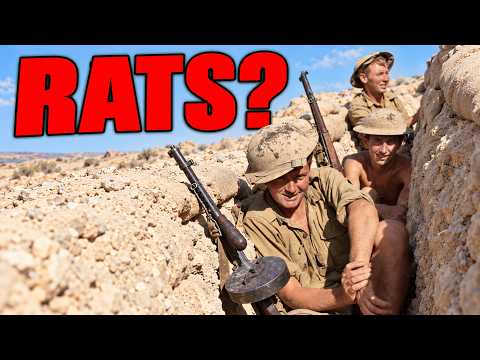
In the spring of 1941, a German lieutenant scribbled a begrudging tribute in his diary: “No trained attacking troops, but men with nerves and toughness, tireless, taking punishment with obstinacy, wonderful in defense.” He was writing about the Australians holding a Libyan harbor his commanders expected to crush in days. But from a Nazi radio microphone, another voice sneered a different description—“rats in underground dugouts.” That voice belonged to Lord Haw-Haw, and the insult was meant to sting.
The Australians kept it. They wore it, sang it, and hammered it into a medal. How did a slur become a title soldiers wanted carved on their graves? And why did the holes Berlin mocked become the exact place where Erwin Rommel’s tanks were finally made to turn around? The answers lie in a handful of documents—a German diary, a prisoner’s outburst, Rommel’s own notes, and a small medal made from the wreck of a German aircraft. Most who know the nickname have never heard the rest. The story begins with a retreat.
In February 1941, Rommel landed in North Africa with orders to steady a collapsing front. By April, his German and Italian columns were racing east across Cyrenaica, and the British and Australian units in front of him were falling back toward Egypt. One position did not fall back: Tobruk, a small port with a deep-water harbor and a ring of defenses the Italians had built before the war. Whoever held it could be supplied by sea. Whoever drove past it left an enemy force sitting on his only coast road.
On the 10th of April 1941, the siege began. Inside the perimeter: the 9th Australian Division, a brigade of the 7th, British artillery regiments, Indian troops—some 14,000 Australians in all. Outside: an army that had not yet been stopped in the desert. Their commander, Leslie Morshead, had already given his answer in words the men would quote for the rest of their lives: “If we should have to get out, we shall fight our way out. There is to be no surrender and no retreat.”
Morshead was 51, a school teacher before the First World War, a Gallipoli veteran who had run a shipping company between the wars. His soldiers called him Ming the Merciless because of the way he narrowed his eyes and stroked his chin while he thought. The name stuck because it fit the way he ran a defense. “We’re not here to take it, we’re here to give it,” he told the garrison. And then: “I determined we should make no man’s land our land.” Keep that sentence in mind. Almost everything the Germans later wrote about the Australians at night grew out of it.
The second man was much younger: John Hurst Edmondson, Jack, a farmer’s only son from near Liverpool, New South Wales. By April 1941, he was a 26-year-old corporal in a concrete post on the southern edge of Tobruk. The third man came from South Australia: Jack Weston, known as Tex, a tractor driver who could read the night sky. A Gallipoli veteran turned shipping manager, a farmer’s only son, a tractor driver who steered by the stars—these were the men who held the red line.
The red line was more than 45 kilometers of perimeter, curving through stony desert from sea to sea. Along it, the Italians had sunk a chain of concrete posts into the rock, each one a pit ringed with barbed wire. These posts were the holes Lord Haw-Haw mocked on the radio. For the men inside them, they were the only cover in a landscape without trees. Life shrank to the essentials: brackish water that was always warm, sand in their mouths and food and clothes, and the khamsin wind that turned the air brown so a man could not see the next post along the line.
Friday, the 11th of April 1941. Good Friday. Captain Harold Johnstone wrote in his diary: “Continuous air raids all day. Very heavy artillery barrage all afternoon. Tank battle 4 mi south. Saw our tanks on fire. We are now surrounded.” Two days later came Easter Sunday. In the afternoon of the 13th, German infantry—about 700 of them—worked their way to within 400 yards of the 2/13 Battalion. Around 70 tanks probed toward the sector held by the 2/17, Edmondson’s battalion. They were testing the wire, looking for a soft spot.
Night fell. At 11:00, near post R33, German infantry broke through the wire and dug in with machine guns, mortars, and two small field pieces. If they were still there at dawn, the tanks would use them. The officer in charge, Lieutenant Austin McKell, decided to clear them with the bayonet. His party was himself, Corporal Edmondson, and five privates. Seven men. They climbed out of the post and went toward the machine guns.
The Germans saw them and opened fire. Edmondson was hit in the neck, then in the stomach. He kept moving forward. One of the privates later described the charge: “There seemed to be bombs going off everywhere, and with a bloodcurdling shout, we tore into them.” Edmondson killed a German with his bayonet. A few yards away, McKell had driven his own bayonet into an enemy soldier who grabbed him around the legs. A second German came at him from behind. McKell called for help. Edmondson, bleeding from the neck and stomach, got to him and killed both men. The citation recorded it in a single dry line: “This action undoubtedly saved his officer’s life.”
The party made its way back to the post. The surviving Germans pulled back through the wire. Shortly afterward, Jack Edmondson died of his wounds. He was 26. He would become the first Australian of the Second World War to be awarded the Victoria Cross. Nobody in the post knew that yet. What they knew was that the wire was still theirs and that dawn was three or four hours away.
Half past two in the morning, the 14th of April. Around 200 German infantry broke through the wire near R33. Behind them, engines. By a quarter to six, 38 tanks of the 2nd Battalion of the 5th Panzer Regiment were formed up inside the perimeter. The German method had worked in Poland, France, and Belgium: the tanks break through, the defenders are cut off, they understand the battle is lost, and they give up. At Tobruk, the Australians in the forward posts let the tanks roll past. They stayed in their holes. They waited for whatever followed the armor—the infantry, the machine gunners, the men whose job was to occupy the ground the tanks had opened. Then the posts opened fire on them. Further in, the tanks drove straight onto the guns. British artillery and anti-tank crews, placed in depth behind the red line, fired over open sights. The Panzers were caught in a box: guns in front of them, and behind them no infantry, because their infantry was pinned down or dead among the posts that were supposed to have been bypassed. The tanks turned and went back out the way they came.
By the count in a later US Army study, the Germans lost about 150 dead and 250 prisoners that morning. The Australians lost 26 killed and 24 wounded. One German prisoner said something to his captors that the study preserved: “I cannot understand you Australians. In Poland, France and Belgium, once the tanks got through the soldiers took it for granted that they were beaten. But you were like demons.” Set that word beside the other one: demons, rats. Both came from the German side, and both described the same behavior from opposite ends—a soldier who stays in his hole when the tanks pass over him and is still there to fight the men who come after.
Rommel did not let it rest. Over the next two weeks, the bombers came back day after day. The garrison mended its wire at night, dug, waited. On the 27th of April, a senior officer arrived from Berlin: Major General Friedrich Paulus, sent by the Army High Command to find out what Rommel was doing in front of a harbor he could not take. Paulus at first refused to approve a new attack. On the 29th, he gave his consent.
The 30th of April, evening. Around 50 Stukas bombed the southwestern sector for an hour. Then came the heaviest artillery barrage the garrison had yet faced. The target was a low rise called Rass el Medawar, marked on German maps as Hill 209. Within 45 minutes, the Germans were through the wire. At 2:00 in the morning on the 1st of May, the German 104th Rifle Regiment attacked toward Hill 209. At first light, more than 60 Axis tanks could be seen on the rise. Seven Australian posts had already been overrun. By nightfall, the number would be 15. Most of these posts belonged to the 2/24 Battalion. By one detailed count, that battalion alone suffered more than 350 casualties in the fighting for the salient.
At half past four in the morning, a second armored thrust came in from the direction of Acroma. It ran into the minefields. By 9:00, around 20 tanks had been knocked out or disabled. Rommel watched this battle closely. In his own account, he wrote: “The Australians fought with remarkable tenacity. Even their wounded went on defending themselves with small-arms fire and stayed in the fight to their last breath.”
On the 2nd and 3rd of May, a dust storm swallowed the battlefield, and the Germans stopped to hold what they had taken. Morshead counterattacked on the 3rd. The hill stayed in German hands. When the line settled, the Germans held a bulge in the southwestern corner of the fortress, about 5.5 kilometers wide and 4 deep. They did not get any further. The cost of those five days is reported differently depending on the source. The Australian War Memorial puts it at nearly 1,000 German and Italian casualties against almost 800 for the garrison. Other tallies give 650 German and 500 Italian casualties. The exact figure cannot be settled from the records. What all of them show is a German attack that broke into the perimeter and could not break out of it.
Among the prisoners taken in the salient were Australians. Rommel looked at them closely, too. He described them as “immensely big and powerful men who without question represented an elite formation of the British Empire.” In Schorm’s diary, the older officers of his regiment, the ones who had fought in the First War, kept saying the same thing: “Yes, it was like that in 1916–18.”
After the salient, the siege turned into a long grind. Everything came in by sea at night. Royal Navy destroyers and small ships made the run from Egypt, unloaded in the dark, and left before dawn. Between April and December, 34 ships were lost on that route, and 33 were damaged, two hospital ships among them. Overhead, German and Italian aircraft flew around 3,000 sorties against the fortress in some 750 raids. Food was rationed. Water was rationed. Cigarettes were rationed. The men developed desert sores that would not heal. Dysentery went through the posts. And every night the Australians went out.
This is where Morshead’s sentence about no man’s land became a working routine. Patrols left the posts after dark—small groups, sometimes a handful of men, moving across the open ground to listen, to map the enemy wire, to take prisoners, or to attack a German or Italian position and be back before the light came up. Tex Weston was one of the men who went out most often. By the 31st of July, he had been on 23 patrols. He traveled long distances behind the enemy’s forward line, watching, and found his way back across featureless desert by the stars. He was awarded the Distinguished Conduct Medal and the Military Medal.
The Germans noticed. A German battalion commander, in an assessment quoted by American Army historians, wrote that the Australians were extraordinarily tough fighters, that they fought to the last with extreme cunning, that they were superior to the German soldier in use of individual weapons, especially as snipers, in use of ground camouflage, in observation and drawing correct conclusions. Those were not the qualities of animals cowering in holes. They were the reason the holes held.
And now the medal. Over those months, Lord Haw-Haw’s broadcasts reached the fortress. The garrison heard itself described as rats in dugouts, rats to be driven out of their holes. The garrison answered in its own way. A corporal from Queensland, Leslie Harold Dufton, service number QX1193, spent several nights at work on a piece of metal. It came from a German bomber that the defenders had shot down using captured German guns. Out of that wreckage he made a medal—unofficial, homemade. On its face, a rat.
That is the answer to the question in the title. The Germans called the Australians rats because they lived underground in the Italian-built posts of the red line. The broadcaster meant it as contempt, but the holes were the whole reason Rommel’s method had failed. The tanks could pass over the posts. They could not make the men inside them leave. In London, Winston Churchill sent Morshead a message: “The whole empire is watching your steadfast and spirited defense.” The men in the posts called themselves rats.
By late summer, the Australian government wanted its division out. The 9th had been under siege for months, and the men were worn down. Between August and October, the Royal Navy carried in the replacements on the same dangerous night runs: the Polish Carpathian Brigade, a Czechoslovak infantry battalion, then the British 70th Division. On the way back, the ships carried the Australians out. Not all of them left. Ship losses interrupted the final runs, and the 2/13 Battalion, with two companies of the 2/15th, stayed behind in Tobruk.
On the 18th of November, the British 8th Army launched Operation Crusader to break the siege from outside. Between the 29th of November and the 1st of December, the 2/13th fought on the Ed Duda Ridge east of the fortress and retook it with a bayonet attack at night. One of their men was Sergeant Jeff Hunt of the Pioneer Platoon, a rural worker from near Inverell in New South Wales, who had spent the siege laying wire and lifting mines. On the 30th of November at Ed Duda, he was killed by shrapnel.
On the 7th of December 1941, the siege ended. 242 days. The 9th Division and its supporting troops, between March and December, lost 832 men killed, 2,177 wounded, and 941 taken prisoner. Estimates for the siege as a whole vary between sources, but one widely cited tally puts Axis casualties at more than 12,000 against about 6,000 for the Allied garrison. There were no parades in the harbor when the Australians left. They climbed onto destroyers in the dark as quietly as their supplies had come in, and the ships slipped out before dawn.
The witnesses who were stunned by what they had seen were on the other side of the wire. A panzer lieutenant writing wonderful in defense. A prisoner shouting about demons. A German general calling his prisoners an elite. Jack Edmondson stayed in Tobruk. He is buried in the Tobruk War Cemetery, grave 3.J.8. On the 27th of September 1941, the Governor-General placed his Victoria Cross in the hands of his mother, Maud. In 1969, she gave his medals to the Australian War Memorial. In Liverpool, the town he left to enlist, a club still carries his name. Tex Weston survived Tobruk. In 1942, he was in action again at Tel el Eisa in Egypt and was again singled out. After the war, he went back to South Australia and managed hotels. He died in 1963. Geoff Hunt lies in the same cemetery as Edmondson.
Leslie Morshead went home to shipping. He became the Australian General Manager of the Orient Line and later president of the Bank of New South Wales. He died of cancer on the 26th of September 1959. He was 70. William Joyce, the voice that named them, was tried for treason after the war and hanged. Erwin Rommel finally took Tobruk on the 21st of June 1942, when its garrison was no longer Australian. Hitler made him a field marshal for it. On the 14th of October 1944, Rommel was forced to take his own life.
The siege fell out of the wider memory for reasons that are easy enough to trace. Seven months after the Australians sailed out, Tobruk surrendered. From then on, the name of the town meant two things, and the surrender often came first. The battles at El Alamein that autumn took over the story of the desert war. The British 7th Armoured Division, with its jerboa emblem, became famous as the Desert Rats, and the two names have been confused ever since.
The men who held the posts kept their own record. On the 22nd of March 1944, while the war was still going on, veterans of the siege formed the Rats of Tobruk Association in Sydney as the North Bondi sub-branch of the Returned and Services League. Its clubhouse became known as the Rat House. In Canberra, there is a memorial to the Rats of Tobruk. And in the collections of the Australian War Memorial sits a Victoria Cross given by a mother from a farm near Liverpool.
Go back now to the diary of Lieutenant Schorm. No trained attacking troops, but men with nerves and toughness, tireless, taking punishment with obstinacy, wonderful in defense. He was half right. They took punishment with obstinacy. They were wonderful in defense. But the men he saw as purely defensive were the same men who went out every night into the ground between the lines, who charged machine guns with seven men and bayonets, who retook Ed Duda in the dark. And the broadcaster in Berlin was half right, too. They did live in holes. That is the answer to the question this story began with. The insult held a true description. The Germans had never before faced an infantry that let the tanks pass and refused to accept that the battle was over. The Australians took the name Haw-Haw gave them because it described exactly how they had beaten his army. A rat hammered out of the metal of a German bomber. The enemy chose the name, and the garrison decided what it would mean.
That decision still echoes. The medal Dufton hammered from a downed German bomber became the badge of a brotherhood that outlived every man who wore it. The enemy chose the name, and the garrison decided what it would mean.
So the insult and the tribute were never opposites. They were two halves of the same truth: men who would not break, who would not leave their holes, who would not accept that the battle was over.
What name would you want the enemy to give you—and what would you make of it?
Report this article
Select a reason for reporting:






