In May 1942, the most feared man in Europe played the violin in a palace in Prague. The next day, a bomb was waiting for him on a bend in the road. That man was Reinhard Heydrich, the architect of the Nazi security apparatus, the bureaucratic mastermind behind the Holocaust, and the only figure in the Third Reich whose shadow fell even over Adolf Hitler. Within days, he would be dead, and the world would never be the same.
But who was this man, capable of bringing an audience to tears with a chamber quartet one evening and signing execution orders the next morning without his hand trembling? How did a disgraced naval officer become the most powerful and feared man in Nazi Germany? And what secrets did he take to his grave?
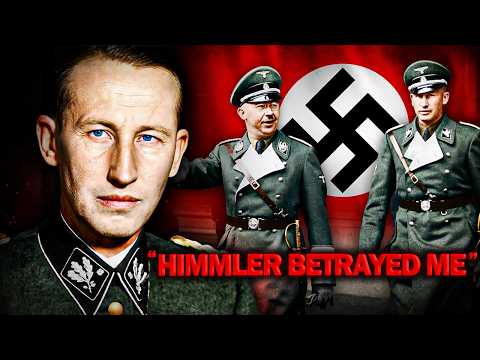
Heydrich’s story begins not in the corridors of power, but in the provincial city of Halle, where he was born in 1904 into a family of musicians. His father, Bruno, was a composer and opera tenor who never quite achieved the recognition he craved. His mother, Elisabeth, was a strict, devout Catholic who ran the household with iron discipline. Young Reinhard grew up surrounded by music, mastering the violin and piano before he could even read properly. But beneath the surface of this cultured upbringing, something darker was taking shape.
At school, he was taunted for his high-pitched voice and rumored Jewish ancestry—a rumor that would haunt him for the rest of his life. “White fish head,” they called him, and the humiliation cut deep. He learned early that the world was a place where weakness invited attack, and the best defense was to show none at all. He threw himself into competitive sports—fencing, swimming, the decathlon—not for joy, but for the relentless pursuit of victory. Winning was the only thing that mattered.
In 1922, Heydrich joined the Imperial Navy, and for a time, he seemed to have found his place. He excelled in fencing championships, played violin at officers’ soirées, and was admired by his superiors. But his arrogance and a scandalous love affair—he proposed to Lina von Osten after only four meetings—led to a dishonorable discharge in 1931. He returned home and cried for days. At 27, he had no career, no honor, and no future. The wound never healed; years later, he would look away at the sight of a naval uniform.
Then came the twist of fate that would change history. Through his mother’s connections, Heydrich was introduced to Heinrich Himmler, the head of the SS, who was looking for someone to build an intelligence service. In a case of mistaken identity—Himmler wanted a communications officer, Heydrich had been one—Heydrich seized the opportunity. In 20 minutes, he sketched out a plan that impressed Himmler enough to hire him on the spot. It was the beginning of a meteoric rise.
From a small office with cigar boxes for files, Heydrich built the Sicherheitsdienst (SD), the SS intelligence service that would become the nervous system of the Nazi state. By 1936, he controlled the Gestapo, the criminal police, and the SD—the supreme policeman of the Third Reich. His method was simple and devastating: create files on everyone, identify weaknesses, and use that information to manipulate and control. He was a technocrat of terror, a surgeon of the social body, and he did it all with cold, calculating efficiency.
But Heydrich’s ambitions went beyond intelligence. He was instrumental in the Night of the Long Knives, the Gleiwitz incident, and the Wannsee Conference, where he presided over the coordination of the Holocaust. He was the bureaucratic architect of genocide, organizing the Einsatzgruppen massacres and designing the machinery that would lead to the extermination camps. Yet, in private, he showed no hatred, only a chilling indifference. “Be harsh where you must be, and be kind where you can be,” he told his units—a phrase that summed up his pragmatic approach to mass murder.
In 1941, Hitler sent Heydrich to Prague as Deputy Reich Protector of Bohemia and Moravia. It was meant to be a demotion, a way to neutralize his growing power. Instead, Heydrich turned the protectorate into a model of occupation. He combined selective terror with social incentives, executing resistance leaders while increasing food rations for Czech workers. His approval ratings among the population were surprisingly high, and armaments production soared. He even planned to Germanize the entire region, conducting a racial census to determine who would be assimilated and who would be deported or killed.
But Heydrich’s reign of terror could not go unanswered. The Czechoslovak government-in-exile, with British support, launched Operation Anthropoid—a mission to assassinate him. On May 27, 1942, two paratroopers, Jan Kubiš and Jozef Gabčík, ambushed his open-top Mercedes in Prague. The grenade that tore into his side was laced with horsehair and leather from the car’s upholstery, and despite surgery, sepsis set in. He died nine days later, on June 4, 1942.
His death sent shockwaves through the Nazi leadership. Hitler, who had never publicly criticized Heydrich, was more affected by his death than by that of any other high-ranking official. “He had an iron heart,” Hitler said in his eulogy. The reprisals were brutal: the village of Lidice was erased from the earth, its men shot, its women deported, its children gassed. But the questions lingered. What secrets did Heydrich take with him? Why was a page torn from Himmler’s diary on the day of the assassination? And what would have happened if he had survived?
Heydrich was a man of contradictions: a violinist and a butcher, a technocrat and a fanatic, a loyal subordinate and a potential rival to Hitler himself. His story is one of ambition, terror, and the terrifying banality of evil. But it is also a story of mystery—of files that disappeared, of plans that were never fully revealed, and of a man whose true motivations may never be fully understood.
As we delve deeper into the life of Reinhard Heydrich, we will uncover the forces that shaped him, the crimes he committed, and the legacy he left behind. This is the story of the most feared man in the Gestapo and the SS—a man whose shadow still looms over history.
To understand how a disgraced naval officer transformed into the Reich’s most efficient killer, one must examine the peculiar alchemy of his early years. Heydrich’s childhood in Halle was not merely a backdrop of music and discipline; it was a crucible of humiliation and ambition. His father’s failed dreams of grandeur and his mother’s rigid piety created a volatile mix, and young Reinhard absorbed both the longing for recognition and the fear of inadequacy.
The taunts at school—“White fish head”—and the whispered rumors of Jewish blood were not forgotten. They festered, shaping a personality that craved control and despised vulnerability. He drove himself relentlessly in sports and music, not for pleasure but for dominance. Every victory was a rebuke to those who had mocked him. This competitive fury would later find its perfect outlet in the SS, where ruthlessness was rewarded and weakness exterminated.
When Heydrich joined the Navy, he believed he had escaped his provincial past. The uniform, the hierarchy, the camaraderie—it was everything he had longed for. He excelled in fencing and even caught the eye of Admiral Wilhelm Canaris, who would later become both friend and rival. But Heydrich’s arrogance and his habit of treating people as instruments would prove his undoing. The scandal that led to his dismissal was not just about a broken engagement; it was about his inability to conceal his contempt for those he deemed beneath him.
The Naval Court of Honor saw through his evasions. Dishonorably discharged, he returned to Halle a broken man. For days, he wept. The shame was unbearable. Yet, in that moment of despair, a door opened. His mother’s connections led him to Himmler, and the rest is history. But what if that door had never opened? What if Heydrich had remained a failed musician’s son, nursing his grievances in obscurity? The world might have been spared one of its most prolific architects of genocide.
Instead, he found in the SS a canvas for his darkest talents. Himmler, the chicken farmer with mystical delusions, needed someone to build an intelligence service. Heydrich, with his naval training and spy novels, provided the blueprint. Within months, he had transformed cigar boxes into a surveillance empire. His method was surgical: identify the enemy, catalog his weaknesses, and strike before he could react. This philosophy of preventive terror would become the hallmark of the Gestapo.
But Heydrich’s rise was not without obstacles. His relationship with Himmler was fraught with mutual distrust. Himmler feared Heydrich’s ambition, and Heydrich despised Himmler’s pseudoscientific obsessions. They were two predators circling each other, bound by necessity. Heydrich kept files on everyone, including Himmler, and everyone knew it. That knowledge was his insurance policy, a guarantee that no one would dare move against him.
The Night of the Long Knives in 1934 was a turning point. Heydrich provided the lists, coordinated the arrests, and watched as the SA leadership was butchered. He had proven his loyalty and his ruthlessness. The SS emerged as the dominant force in the Nazi state, and Heydrich was rewarded with control over the Gestapo. By 1936, he was the supreme policeman of the Reich, with the power of life and death over millions.
Yet power did not satisfy him. He craved more—more control, more recognition, more danger. He flew combat missions during the war, risking his life when he had no need to. It was as if he needed to prove that he was not just a bureaucrat, but a warrior. This compulsion for risk would eventually lead him to Prague, and to the bend in the road where a bomb was waiting.
That compulsion for risk was not a flaw in Heydrich’s character—it was the engine of it. The same man who built an empire of files and informants also flew combat missions over the Soviet Union, was shot down, and hid for hours behind enemy lines. He needed the thrill of the physical to counterbalance the horror of the administrative. It was a paradox his colleagues never fully understood, and perhaps he didn’t either.
In Prague, he found his final stage. The violin concert at Waldstein Palace, the chamber piece by his own father, the applause that followed—these were not mere distractions. They were the last remnants of a self he had long since buried under layers of ambition and terror. The next morning, he climbed into an open-top Mercedes without escort, convinced of his own invulnerability. It was the ultimate expression of his contempt for weakness, including his own.
The grenade that tore into his side carried fragments of horsehair and leather from the car’s upholstery. For nine days, he fought sepsis with the same iron discipline he had imposed on an entire continent. He refused to show pain, even as his organs failed. When he finally died on June 4, 1942, the Reich mourned a man it had never fully trusted—and feared a void it could never fill.
Hitler’s eulogy called him “the man with an iron heart,” but the phrase revealed more about the Führer than about Heydrich. The only man Hitler never mocked in private was dead, and with him went the files, the secrets, and the terrifying potential of a rival who might have been. The torn page from Himmler’s diary remains missing. The exact location of Heydrich’s grave was erased. The mysteries endure.
What remains is the unsettling truth: Reinhard Heydrich was not a monster from another world, but a product of this one—a violinist who became a butcher, a technocrat who perfected terror, a man whose ambition consumed millions. His story forces us to ask: how thin is the line between civilization and savagery?
Now it’s your turn. What do you think was Heydrich’s true motivation—ideology, ambition, or something far darker? Share your thoughts in the comments below.
Report this article
Select a reason for reporting:






