At 0:15 on July 5, 1943, the reconnaissance battalions of the 2nd SS Panzer Corps slipped into the darkness north of Belgorod. The air was heavy, the temperature a stifling 18°C, and storm clouds hid the stars. None of the scouts knew that at that very moment, Marshal Vasilevsky had received definitive confirmation of the German attack. The Soviet artillery counter-preparation would roar out at 2:10 AM, shattering the silence and catching German gunners in the open. “The ground shook,” one survivor recalled. “It was as if the earth itself was tearing apart.”
This was the opening salvo of Operation Citadel—Hitler’s last great gamble in the East. And at its spearhead stood the three divisions of the 2nd SS Panzer Corps: Leibstandarte, Das Reich, and Totenkopf. They were the most expensive, best-equipped force the Reich had ever assembled. Yet before them lay a Soviet defense of unprecedented depth: 300 kilometers of trenches, nearly a million mines, and a Red Army that had learned to stand and die.
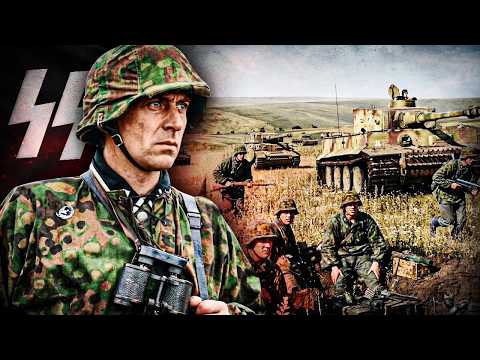
Three hours later than planned, Hoth’s Fourth Panzer Army finally attacked. SS-Brigadeführer Theodor Wisch launched the Leibstandarte’s regiments northward, supported by a full Nebelwerfer brigade. The rockets screamed, the ground vibrated, and a whitish smoke blended with the dawn. “We advanced with the confidence of men who had never known defeat,” a grenadier of the 2nd Regiment later wrote. But confidence was not enough.
Facing them was the 52nd Guards Rifle Division, 8,000 men who had spent months preparing kill zones down to the last meter. Lieutenant Colonel Kostenko’s 1008th Anti-Tank Regiment deployed in successive depth along the road to Bykovka. The 2nd Battery, under Senior Lieutenant Ratushnyak, destroyed six German tanks—three of them Tigers—before being overwhelmed. The 3rd Battery slowed Das Reich’s advance for hours. By nightfall, the regiment had destroyed 33 German tanks, 17 of them Tigers. The price was devastating: 21 of its 24 guns destroyed, more than half its men dead. The survivors fought as infantry in the final defense of Bykhovka.
At 16:10, Bykhovka fell to the 2nd SS Panzer Grenadier Regiment. Without stopping, the Leibstandarte’s two regiments advanced another 6 kilometers north, capturing Kozma Demyanovka. At 18:00, the division’s Panzer group pushed toward the road junction at Yakovlevo—and struck a new defensive line no one had expected: the vanguard of Katukov’s 1st Tank Army, ordered into the second belt by Vatutin that very afternoon. Wisch halted the advance and ordered a regrouping for dawn.
The first day’s balance was cruel: 97 dead, 522 wounded, 17 missing, and roughly 30 tanks lost. The 52nd Guards Rifle Division had been split in two. The Psel River—the objective for that night—still lay several kilometers to the north. Yet the nearly 20-kilometer penetration was the deepest achieved by any German unit on July 5th. “We had torn a hole in their line,” a Leibstandarte officer noted, “but the hole was filling with fresh troops faster than we could widen it.”
To the right, Walter Krüger’s Das Reich cut the Oboyan-Belgorod road as night fell, physically separating the 155th Guards Rifle Regiment from its parent division. The Soviet 96th Tank Corps counterattacked with surprising speed, preventing Totenkopf from enveloping the Soviet right flank. Hermann Priess’s Totenkopf took Gremuchi but was held before pushing further north along the Lipoviy Donets. And on the far right, Army Detachment Kempf’s attack stalled at the Mikhailovka bridgehead—a delay that would haunt the entire operation.
In the sky, the first day was equally brutal. Soviet bombers attacked in rigid patterns at 2,100 to 3,000 meters, easy prey for the Messerschmitts of the 8th Air Corps. The Luftwaffe claimed 432 Soviet aircraft destroyed for the loss of only 26 of its own—exaggerated, but the German air force survived intact and supported the ground attack as planned. As night fell, the 2nd SS Panzer Corps had achieved the deepest penetration on the entire Kursk front. Yet at the Voronezh Front command post, Vatutin was already issuing orders for a counterattack.
The days that followed—July 6th to 8th—became a grinding of steel and flesh. The Leibstandarte took Yakovlevo, shattering the Soviet 6th Guards Tank Corps with coordinated Stuka attacks. T-34s that tried to counterattack the flank came under Tiger fire at over 1,000 meters. At that range, the T-34’s armor was useless. Soviet crews learned a lesson that day: Tigers were deadly at long range. The only way was to close the distance at full speed, accept casualties, and strike the flanks or rear where the armor was thinner.
On July 7th, a crisis developed in the 48th Panzer Corps sector to the left of the SS. Grossdeutschland had become trapped in a minefield in the Berezovy Ravine, losing 36 tanks—including Panthers—in just a few hours. Constant threats to its left flank forced it to divide its forces, exactly what Vatutin wanted. The sister corps could never gather its full strength for the decisive push toward Oboyan and Kursk.
On July 8th, Vatutin ordered General Berkov’s 10th Tank Corps to launch a coordinated counterattack against the right flank of the 2nd SS Panzer Corps, while General Krivchenko’s 5th Guards Tank Brigade attacked from the east. It was meant to stop the SS. It failed. The 10th Corps committed its brigades piecemeal, in uncoordinated fragments. Totenkopf and Das Reich repelled them with anti-tank fire from prepared positions. Krivchenko’s Corps was rebuffed by two battalions of Das Reich’s Deutschland Regiment, dug in overnight at Yasnaya Polyana and Kalinin. General Badanov’s 5th Guards Tank Corps attempted an attack from the south, but four squadrons of Henschel Hs 129 aircraft, armed with 30mm cannons, intercepted the concentration and destroyed it from the air. It was the first time in the war that a tank attack had been stopped exclusively by aircraft. The 2nd Guards Corps lost 50 tanks in that episode.
That night, Hoth made a decision that would change the direction of the battle. Confronted with the reality that the 48th Panzer Corps could no longer concentrate for the main push toward Oboyan, he ordered the 2nd SS Panzer Corps to shift its axis northeast toward Prokhorovka. “The new orders reached the divisions that very night,” a corps staff officer recalled. “We were to advance with Leibstandarte on the right and Totenkopf on the left, both sides of the Psel, attack objective Prokhorovka.”
Hoth had his reasons. By attacking toward Prokhorovka, the still-powerful SS Corps could destroy the Soviet armored reserves massing there, unblock Kempf’s Third Panzer Corps, and open a new route toward Kursk. It was an ambitious and coherent plan. What Hoth could not know was that Rotmistrov and his 593 tanks, 37 self-propelled guns, and thousands of trucks were already on the move from concentration areas west of the Don, covering more than 200 kilometers overnight toward Prokhorovka. The trap was closing.
On July 9th, the SS Corps attacked northeast as ordered. Leibstandarte and Totenkopf advanced along both banks of the Psel while Das Reich and the 167th Infantry Division covered the extended right flank to the south. The 283 tanks and assault guns the Corps could muster that day swept through the rear areas of the already shattered Third Mechanized Corps and pushed Chernyakhovsky’s 31st Tank Corps back toward Kochetovka.
As evening fell, Totenkopf reached the banks of the Psel and, in a brief but intense fight, captured the village of Krasny Oktyabr from the remnants of the 52nd Guards Rifle Division and the 11th Motorized Rifle Brigade. To Totenkopf’s left, the Leibstandarte crossed the Solotinka River, occupied Sukho Solatino, linked up with the 11th Panzer Division, and was halted on the outskirts of Kochetovka only by the temporary intervention of the freshly reorganized Soviet 10th Tank Corps.
July 10th brought the decisive pivot toward Prokhorovka—and with it a new dimension of difficulty. Before dawn, Totenkopf’s 3rd Panzer Grenadier Regiment attacked across the Psel in an attempt to capture Hill 226.6 east of the village of Klyuchi. It was the dominant terrain of the northern sector, and its possession would open the flank of Prokhorovka’s defenses. The attack failed in the face of resistance from the Soviet Guards Rifle Divisions and the 11th Motorized Rifle Brigade. Hausser delayed the corps assault.
At 10:45, when the offensive was finally launched with the available forces, Totenkopf managed to establish a small bridgehead on the north bank of the Psel. The fight for Hill 226.6 continued all afternoon. By evening, the 3rd Panzer Regiment held the southern slopes and a narrow strip east of Klyuchi, but the summit remained unconquered.
Simultaneously, south of the river, the Leibstandarte made its most significant advance of the entire campaign up to that point. Its 2nd SS Panzer Grenadier Regiment, supported by the Tigers of the 13th Company, advanced from Hill 241.6 on both sides of the Prokhorovka Road, destroying the Soviet 169th Tank Brigade on the move and pushing forward more than 2 kilometers before being halted by extremely intense fire from the positions of the 26th Guards Airborne Rifle Brigade around Oktyabrsky State Farm and Hill 252.4.
At 9:05 on July 10th, after an artillery preparation and waves of Stuka attacks, the Leibstandarte resumed the offensive. The fight for Hill 252.4 lasted three hours when the divisional Panzer Group finally captured the blood-soaked summit at 13:10 and descended toward Oktyabrsky State Farm.
Every soldier of Colonel Sazanov’s 9th Guards Airborne Rifle Division arriving at their positions from the rear could hear the fighting drawing closer. The division had arrived overnight from the south, marching through the dusty streets of Prokhorovka with orders to halt the German advance while Rotmistrov completed his concentration. Sazanov deployed his 26th and 28th Guards Airborne Rifle Regiments in the front line south of Prokhorovka, covering the approaches from the southwest and south. He also had 21 KV heavy tanks from the 57th Army Heavy Tank Regiment and 24 guns from the 301st Army Anti-Tank Artillery Regiment. It was a considerable force, but it had arrived so late that many of its men had barely dug their trenches when the sound of combat began to grow from the south on the morning of July 11th.
July 11th was the day the Leibstandarte very nearly took Prokhorovka on its own. At 5:00 in the morning, the 1st and 2nd Battalions of the 2nd SS Panzer Grenadier Regiment advanced along the road eastward, destroying the tanks of the Soviet 169th Brigade in mobile contact. But at 9:50, they ran head-on into the 2nd Battalion of the 26th Guards Airborne Rifle Brigade entrenched around Oktyabrsky State Farm. The fighting was fierce. Paratroopers with grenades against tanks, anti-tank guns firing at 100 meters over open ground. Three hours.
At 13:10, the Leibstandarte’s Panzer Group captured the prize summit of Hill 252.2 and descended toward Oktyabrsky State Farm. But as the Leibstandarte advanced in the center, its flanks grew ever more exposed. Das Reich on the right had been unable to break through to Vinogradovka. The 26th Tank Brigade of the 2nd Tank Corps and the infantry of the 183rd Rifle Division prevented it, which left the Leibstandarte’s right flank uncovered. Totenkopf, north of the Psel, had failed to complete the capture of Hill 226.6, exposing the left flank.
At 17:00, Hausser and Standartenführer Ostendorff agreed by telephone that the Leibstandarte would halt its advance until Totenkopf resolved the Hill 226.6 problem. It was in those final hours of daylight on July 11th that Pavel Rotmistrov, carrying out a personal reconnaissance in his jeep alongside Marshal Vasilevsky north of Prokhorovka, saw something he did not expect to see. Dozens of German tanks in combat formation, firing as they advanced, crossing a field of ripe wheat toward the east. He raised his binoculars. The tanks belonged to the 1st SS Panzer Grenadier Regiment, the Leibstandarte’s left arm advancing northward.
Rotmistrov switched on his radio and ordered General Kirichenko of the 29th Tank Corps to move two brigades immediately to halt the advance. And he understood with the coldness he admired in himself that the jump-off positions he had chosen for his July 12th counteroffensive were now in the Leibstandarte’s hands. In 18 hours, he would have to rethink everything.
Dawn on July 12th came warm and humid. At 8:30, Rotmistrov’s radio operator transmitted the signal: “Steel, steel, steel.” Five hundred tanks surged forward from the outskirts of Prokhorovka. At that same instant, on the other side, the Leibstandarte was beginning its own attack. Rudolf von Ribbentrop, climbing a rise, raised his binoculars and counted. “It was too many to count,” he later recalled.
The two armies hurled themselves at each other in a narrow corridor between the Psel and the railway embankment. A platoon leader wrote: “They were around us, on top of us, and among us. It was hell.” By nightfall, Prokhorovka remained in Soviet hands. The Leibstandarte claimed 192 Soviet tanks destroyed.
On July 17th, the OKH issued the order: the 2nd SS Panzer Corps would be withdrawn. The three divisions reached the gates of Prokhorovka. And that was not enough. It never could have been.
What do you think was the decisive factor at Kursk—the Soviet defense in depth, or Hitler’s fatal decision to divert forces to Italy?
Report this article
Select a reason for reporting:






