At 11:15 PM on August 3, 1958, 400 feet beneath the Arctic ice cap, a steel cylinder 323 feet long glided silently through water that had never known human presence. Above it stretched an unbroken ceiling of ice, some 60 feet thick, extending for hundreds of miles in every direction. There was no way up, no way to surface, no way to call for help if something went wrong. Inside, 116 men held their breath as their navigator checked his instruments one final time. They had done it. Commander William Robert Anderson stepped to the intercom, his voice calm but carrying the weight of history: “For the world, our country, and the Navy—the North Pole.”
The men erupted in cheers. Some embraced. Others stood in stunned silence. They had sailed beneath the geographic North Pole, the first vessel in human history to reach 90° north latitude. They had crossed from the Pacific to the Atlantic through a route every expert had declared impossible—and they had done it without the Soviets detecting a single trace.
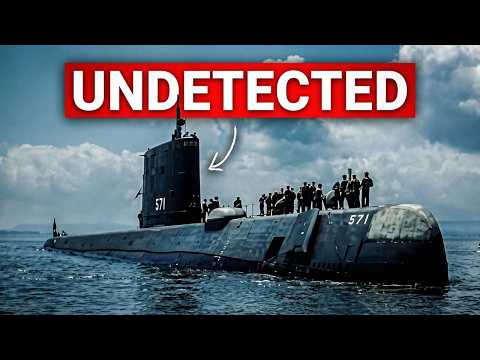
In Moscow, when the news broke five days later, Soviet admirals would realize that everything they believed about Arctic warfare had just become obsolete. The frozen roof of their homeland, which they had considered an impenetrable barrier, had been pierced by an American submarine traveling completely undetected.
This is the story of how one submarine and 116 men rewrote the rules of the Cold War.
The vessel was the USS Nautilus, hull number SSN 571, the world’s first nuclear-powered submarine. She was not merely an improvement over existing submarines. She was a revolution in naval warfare, a machine that rendered every diesel-powered submarine on Earth as outdated as sailing ships had become after the age of steam.
The story of Nautilus began not in a shipyard, but in the mind of one of the most difficult and brilliant officers in American naval history. Captain Hyman George Rickover was an engineering officer with an obsessive attention to detail and an abrasive personality that made enemies throughout the Navy establishment. He was repeatedly passed over for promotion. Senior admirals found him insubordinate and impossible to work with. But Rickover had a vision that would transform naval warfare forever.
Rickover understood that nuclear power could free submarines from their fundamental limitation. Diesel-electric submarines were essentially surface ships that could dive temporarily. They had to surface regularly to run their diesel engines, recharge their batteries, and take in fresh air for their crews. This made them vulnerable to detection and limited their operational range drastically. A nuclear-powered submarine would need no air. It would need no fuel from the surface. It could cruise submerged indefinitely, limited only by food supplies and crew endurance.
Rickover fought bureaucratic battles for years to bring this vision to reality. He cultivated congressional allies, manipulated Navy politics, and drove his engineering teams with relentless demands for perfection. The result was Nautilus. The submarine was built by the Electric Boat Company in Groton, Connecticut, under Rickover’s demanding supervision. President Harry Truman presided over her keel laying ceremony on June 14, 1952. First Lady Mamie Eisenhower sponsored her launch on January 21, 1954, smashing a bottle of champagne against her bow as the massive hull slid into the Thames River. She was commissioned into active service on September 30, 1954.
Her specifications were formidable. She displaced 3,533 tons on the surface and 4,092 tons submerged. She stretched 323 feet 9 inches in length with a beam of 27 feet 8 inches. She carried six forward torpedo tubes and could accommodate 105 officers and enlisted men under normal conditions, but her true power lay hidden deep within her hull.
The S2W pressurized water reactor, designed by the Westinghouse Bettis Atomic Power Laboratory, was unlike anything the world had ever seen. This reactor used enriched uranium to heat pressurized water in a primary loop. That superheated water passed through steam generators, creating high-pressure steam in a separate secondary loop. The steam drove turbines that generated approximately 13,400 shaft horsepower for propulsion and electricity for every system aboard.
The engineering was extraordinarily complex. The primary loop operated under tremendous pressure to keep the water from boiling despite temperatures far above the normal boiling point. Shielding protected the crew from radiation. Multiple redundant safety systems could shut down the reactor in an emergency. The entire system had to function reliably for months or years without maintenance in an environment where repairs were essentially impossible.
The reactor consumed no oxygen. It required no air intake. It produced no exhaust. For the first time in history, a submarine could operate completely independent of the atmosphere. On January 17, 1955, at 1100 hours, Commander Eugene Parks Wilkinson ordered the historic signal transmitted to the shore: “Underway on nuclear power.” Those four words announced the dawn of a new era in naval warfare.
The implications were staggering. A conventional diesel-electric submarine had to surface every few hours to run its engines and recharge its batteries. It was fast underwater, but only for short bursts before its batteries drained. It was essentially a surface ship that could dive temporarily to avoid detection or attack. Nautilus was different. She could cruise at more than 20 knots submerged indefinitely. Her endurance was limited only by the food supplies aboard and the stamina of her crew. Her first uranium core carried her 62,562 miles before requiring replacement. A conventional submarine would have needed more than 2 million gallons of diesel fuel to match that performance.
The submarine also carried equipment that generated breathable oxygen directly from seawater through electrolysis. Carbon dioxide scrubbers kept the air fresh. Air conditioning maintained comfortable temperatures despite the heat generated by the reactor and electronic equipment. The men aboard could survive beneath the waves for months at a time without ever approaching the surface.
This was the machine that would challenge the Arctic.
To understand why the polar transit mattered so much, one must understand the world of 1957 and 1958. The Cold War had reached a fever pitch. The United States and the Soviet Union stood locked in an existential struggle, each side convinced the other was preparing for nuclear annihilation. American and Soviet forces faced each other across the Iron Curtain in Europe. Proxy wars flared in Asia and the Middle East. Nuclear arsenals grew larger every year, each side seeking advantage in the terrible calculus of mutually assured destruction.
Then, on October 4, 1957, the Soviet Union shocked the world by launching Sputnik, the first artificial satellite. That small metal sphere, barely larger than a beach ball and weighing only 184 pounds, orbited the Earth every 98 minutes, passing over American cities and beeping a signal that every ham radio operator could receive. The message was clear. Soviet rockets were powerful enough to reach space. They were powerful enough to reach America.
The same boosters that had lofted Sputnik into orbit could carry nuclear warheads across continents. The American homeland, protected by two oceans for all of its history, was suddenly vulnerable. One month later, the Soviets launched Sputnik 2, carrying a dog named Laika into orbit. The animal died within hours from overheating, but the propaganda victory was immense. Soviet technology appeared unstoppable.
America’s response was humiliating. On December 6, 1957, the Vanguard rocket carrying America’s first satellite attempt rose four feet off the launchpad, lost thrust, collapsed back onto the pad, and exploded in a fireball broadcast live on national television. Newspapers called it Flopnik, Kaputnik, Stay Putnik. The entire world watched America fail in the most public way possible. The successful launch of Explorer 1 on January 31, 1958, partially restored American confidence, but the damage to national prestige was severe.
The so-called missile gap dominated political discourse. Many Americans genuinely believed the Soviet Union had surpassed the United States in rocket technology and would soon possess overwhelming nuclear superiority. Politicians demanded answers. The public demanded reassurance. Something had to be done to prove that American technology remained world-class. President Dwight David Eisenhower needed a dramatic technological triumph to restore American confidence and demonstrate that Soviet dominance was an illusion.
He found that triumph in an unexpected place—beneath the Arctic ice.
The strategic importance of the Arctic had been recognized since World War II. General Henry Harley Arnold, commander of the Army Air Forces, had warned that if World War III should come, its strategic center will be the North Pole. He was right. The shortest missile trajectories between the United States and the Soviet Union arc directly over the polar regions. A nuclear-armed submarine lurking beneath the Arctic ice would be perfectly positioned to strike Soviet targets. It would be hidden from detection by the ice canopy above. It would be immune to most anti-submarine warfare techniques that relied on surface ships and aircraft. It could wait silently for months, then launch its missiles without warning and disappear before any response could be mounted.
But there was a problem that seemed insurmountable. No submarine had ever successfully navigated beneath the permanent ice pack. The frozen ceiling extended down in massive pressure ridges and inverted mountains called ice keels. Some of these formations reached sixty feet or more below the surface. The ice shifted constantly, groaning and cracking, creating a maze of obstacles that could crush an unwary submarine against the seafloor or trap it against the frozen ceiling.
Navigation was equally impossible. Above 85° north latitude, magnetic compasses become useless because the magnetic field lines point nearly straight down rather than toward the horizon. Standard gyrocompasses lose accuracy in the extreme polar regions for similar reasons related to the mathematics of their spinning mechanisms. A submarine attempting the transit could easily find itself traveling in circles without any way to determine its true heading. The crew called this terrifying possibility longitude roulette.
There were no charts of the Arctic seafloor. No one knew the true depths. No one knew where underwater mountains might rise to crush a submarine against the ice above. The region was as unknown as the surface of the moon. Diesel submarines could not possibly attempt the journey. They would need to surface every few hours to run their engines, and there was no surface to reach beneath the ice. Even if a conventional submarine somehow entered the ice pack, it would be trapped, its batteries slowly draining until the crew suffocated in the darkness. The frozen ceiling would become a frozen tomb.
Only Nautilus could do it. Only a nuclear submarine could survive the journey.
The dream of submarine Arctic transit predated the Cold War by decades. In 1931, Australian explorer Sir Hubert Wilkins leased the decommissioned USS O-12 from the United States Navy for one dollar per year. He renamed her Nautilus in honor of Jules Verne’s fictional submarine from the novel 20,000 Leagues Under the Sea, and the famous author’s grandson attended the christening ceremony in New York. Wilkins was one of the great adventurers of his era. He had flown across the Arctic. He had explored Antarctica. He believed submarines offered the key to scientific exploration of the polar regions, areas where surface ships could not penetrate and aircraft could not land.
The expedition was cursed from the beginning. A crewman drowned while entering New York Harbor. Both engines failed in the Atlantic Ocean, requiring rescue by the battleship USS Wyoming. Storms carried away the bridge structure. The crew grew fearful and resentful as the voyage continued. When Wilkins finally reached the ice edge near Spitsbergen in August 1931, divers discovered catastrophic sabotage. Someone aboard had deliberately broken off the stern diving planes, the control surfaces essential for controlled descent and depth keeping.
Without diving planes, the submarine could not safely operate submerged. Wilkins suspected one or more crew members who had grown fearful of the voyage, but he never identified the saboteur. The culprit took his secret to the grave. The expedition had been deliberately crippled by men who valued their own survival over the mission’s success. Despite the damage, Wilkins managed a partial dive to thirty-seven feet and reached 82° 15 minutes north latitude, the farthest north any vessel had traveled under its own power at that time. He could go no further. The damaged submarine was eventually scuttled in Norway’s Byfjord on November 20, 1931.
Twenty-seven years later, the dream would finally be realized—not by an explorer, but by the United States Navy, operating under a misleading code name: Operation Sunshine.
The name suggested warm tropical waters, not the frozen Arctic. If Soviet intelligence intercepted communications mentioning Operation Sunshine, they would look in entirely the wrong direction. The deception was essential.
The polar transit did not succeed on the first attempt. In late August 1957, Nautilus pushed north to 87° north latitude, just 180 miles from the pole. But the Arctic fought back. She struck ice, bending both periscopes, and both gyrocompasses failed. The submarine retreated to assess damage.
The first formal Operation Sunshine attempt began on June 9, 1958. Nautilus departed Seattle with her hull numbers painted over and her crew forbidden from writing letters or making phone calls. Commander Anderson had scouted ice conditions in Alaska under an alias. What he found was discouraging. The Chukchi Sea averaged only 120 feet deep. Ice keels extended nearly 60 feet below the surface. That left barely 60 feet of clearance for a submarine that measured 52 feet from sail to keel.
Making matters worse, the engineering team discovered a seawater leak in the reactor’s condenser circulation system. The solution was unconventional to say the least. Crew members, dressed in civilian clothes, fanned out to service stations across Seattle and Everett. They purchased 140 quarts of Bars Leak, a commercial radiator sealant normally used to fix leaky car radiators. They poured it into the submarine systems and hoped for the best. It worked well enough to continue.
On June 19, facing impossible ice conditions, Anderson made the difficult decision to abort. Nautilus retreated to Pearl Harbor to await better summer ice conditions and install new equipment.
The second attempt launched on July 23, 1958. This time Nautilus carried 116 men, including four civilian scientists. Most crew members still did not know their true destination. The senior scientist was Dr. Waldo Lyon himself, the world’s foremost authority on sea ice. Lyon had developed a simple but ingenious navigation tool by mounting an upward-looking fathometer atop the submarine. This modified sonar, aimed at the ice instead of the sea floor, could map the underside of the ice canopy in real time.
Anderson had learned through intelligence channels that Commander James Calvert aboard USS Skate was planning his own polar attempt via the Atlantic route. Professional rivalry added urgency. Nautilus needed to reach the pole first.
The submarine threaded through the Bering Strait and surfaced briefly near Point Barrow, Alaska. On August 1, 1958, Nautilus took her final radar fix on Point Barrow and submerged. She turned due north along the 155th meridian west longitude and began the most dangerous voyage in submarine history. There would be no more contact with the surface, no more position fixes from external references.
The 96-hour transit was a masterpiece of navigation under demanding conditions. Lieutenant Shepherd Martin Jenks, the navigator, bore primary responsibility for guiding the vessel through waters where no charts existed. He relied on the N6A1 ship’s inertial navigation system, a top-secret device installed just months earlier. This system used sensitive accelerometers and gyroscopes to track the submarine’s position by measuring every acceleration and turn from a known starting point. Jenks supplemented the inertial system with a Sperry Mark 19 gyrocompass, dead reckoning calculations, and hourly cross-checks between all instruments. Four quartermasters worked in continuous rotation, verifying calculations and watching for any sign of navigational drift. A single error could send the submarine into an underwater mountain or beneath ice too thick to escape.
Above the submarine, the ice canopy presented an ever-changing obstacle course. Lyon’s upward-looking sonar painted a continuous picture of the frozen ceiling. The submarine threaded between these inverted mountains, sometimes with only a few feet of clearance overhead. The crew maintained their watch routines with methodical precision. Men not on duty tried to sleep, but rest came hard when everyone knew that a single miscalculation could end their lives.
Anderson had prepared contingency plans. If the reactor failed or the submarine suffered critical damage, the crew would attempt to locate a polynya, a patch of open water in the ice, and surface. If no polynya could be found, the torpedoes could potentially blast a hole through thinner ice sections. It was a desperate option, unlikely to succeed, but it was all they had. In truth, if something went seriously wrong beneath the polar ice, the 116 men aboard Nautilus would probably die. There would be no rescue. No help would come. The submarine’s presence was secret. Its location unknown to anyone on the surface. Communications were impossible. For 96 hours, Nautilus was completely cut off from the outside world.
On August 3, 1958 at 23:15 hours Eastern Daylight Time, Nautilus passed beneath the geographic North Pole. The fathometer recorded an ocean depth of 2,235 fathoms, which equals 13,410 feet. This was some 2,000 feet deeper than existing charts had predicted, proof of how little humanity knew about the Arctic Basin. Above the submarine, solid ice made surfacing impossible. Nautilus simply passed through the pole at approximately 20 knots and continued south toward the Atlantic.
Anderson’s announcement over the intercom sparked celebrations throughout the ship. Some men marked the occasion by walking from bow to stern, ceremonially crossing from one side of the world to the other. Others requested permission to walk around the periscope housing, technically circumnavigating the globe by walking around the pole. Photographs were taken. Handshakes exchanged. The tension of the previous days released in a wave of jubilation and relief.
But the mission was not yet complete. The submarine still had to navigate the remaining distance to open water, threading through ice formations that remained just as dangerous as those they had already passed. Anderson reminded his crew that celebrations could wait until they reached safety. The focus returned to the instruments and the ice.
The submarine continued south, navigating between Greenland and Spitsbergen toward open water. On August 5, 1958, Nautilus surfaced northeast of Greenland in ice-free waters. The crew felt sunlight and fresh air for the first time in days. The radio operators faced a new challenge. Arctic atmospheric conditions created havoc with radio propagation, and the first attempts at communication failed. After numerous tries, they finally raised a Navy radio station at Pearl Harbor. The coded message was brief, but historic: Nautilus 90 North.
The transmission was in Morse code, addressed to Chief of Naval Operations Admiral Arleigh Albert Burke, who immediately relayed the news to President Eisenhower. The mission had succeeded.
Nautilus proceeded to Reykjavik, Iceland, arriving on August 7. A helicopter waited to airlift Commander Anderson directly to Washington for a meeting with the President. On August 8, 1958, at 13:45 hours, President Eisenhower stood before reporters at the White House. The news he announced electrified the nation. The President revealed that Nautilus had accomplished what had been considered impossible. An American submarine had sailed beneath the North Pole, transiting from the Pacific to the Atlantic through a route that opened new possibilities for naval operations and scientific research.
Eisenhower presented Anderson with the Legion of Merit, and awarded Nautilus the first peacetime presidential unit citation in American history. Every man who had served aboard during the polar transit received recognition. The administration carefully crafted its messaging. Officials spoke of peaceful applications, scientific research, the possibility of future commercial shipping through Arctic waters, and the Atoms for Peace program that Eisenhower had championed. But the military implications were impossible to miss.
American submarines could now transit between the Pacific and Atlantic fleets without using the Panama Canal, cutting thousands of miles from deployment routes. More importantly, American submarines could approach the Soviet Union from an entirely unexpected direction. The entire 3,000-mile northern coastline of Russia, previously considered invulnerable to naval attack, was suddenly exposed. A 1958 analysis in the United States Naval Institute Proceedings spelled out the strategic implications with chilling precision. From the ice pack east of Spitsbergen, it measured approximately 400 miles to Murmansk, 880 miles to Arkhangelsk, 1,180 miles to Leningrad, and 1,420 miles to Moscow. A missile-launching submarine could reach and maintain position in the ice pack without its presence being known. It was virtually immune to detection.
The Arctic Ocean had transformed from an impenetrable barrier into a strategic highway. The roof of the Soviet Union was no longer a defense. It was a vulnerability.
The international reaction to the Nautilus announcement was immediate and dramatic. Allied nations celebrated the achievement as a triumph of Western technology. Newspapers around the world carried front-page stories about the polar transit. Scientists praised the expedition as opening new frontiers for oceanographic research. The peaceful rhetoric of scientific exploration provided diplomatic cover for what everyone understood was primarily a military demonstration.
In Washington, the success provided exactly the morale boost that Eisenhower had sought. The humiliation of Sputnik began to fade as Americans celebrated their own technological triumph. Editorial writers proclaimed that America had proven its superiority in the technologies that truly mattered for national defense. The missile gap fears did not disappear entirely, but they were tempered by the knowledge that American ingenuity remained world-class.
On August 27, 1958, Nautilus received a hero’s welcome in New York City. A ticker-tape parade down Broadway drew crowds estimated at 250,000 people. Admiral Rickover, Commander Anderson, and the crew rode through canyons of cheering spectators while confetti rained from skyscraper windows. The crew lunched atop the Empire State Building, honored as American heroes. A special golden N clasp was authorized for every crew member’s service ribbon, a permanent recognition of their achievement that they could wear for the rest of their naval careers.
The Soviet reaction to the Nautilus achievement remains partially obscured by the secrecy that characterized the Cold War era. Soviet state media routinely suppressed or minimized Western technological achievements. Acknowledging American success would undermine the narrative of inevitable Soviet victory that the Communist Party promoted constantly. The Kremlin’s public approach was almost certainly to ignore or downplay the voyage, rather than acknowledge American superiority in submarine technology.
But the private Soviet response tells a very different story. Soviet naval leadership understood immediately what Nautilus had demonstrated. The Arctic was no longer a barrier protecting the Soviet homeland. American submarines could operate freely beneath the ice, undetected by any existing Soviet technology. They could approach Soviet territory from the north, launch missile attacks, and disappear without trace. The strategic implications were terrifying for Soviet military planners.
This realization sent shock waves through Soviet military planning. Admiral Sergeyevich Gorshkov, who had become commander in chief of the Soviet Navy in January 1956, recognized that the Nautilus achievement demanded a fundamental reassessment of Soviet naval strategy. Everything the Soviet Navy had built for coastal defense was now potentially obsolete. Gorshkov was already transforming the Soviet Navy from a coastal defense force into an ocean-going fleet capable of challenging American power globally. The Nautilus transit accelerated this transformation dramatically. Resources were redirected from traditional surface combatants to submarines and missiles. The race to match American underwater capabilities became a matter of national survival.
The Soviet nuclear submarine program had actually begun before Nautilus completed her construction. On September 9, 1952, Soviet leader Joseph Stalin signed a decree authorizing Object 627, the Soviet Union’s first nuclear submarine project. The program was a direct response to intelligence about Nautilus being under construction in America. More than 135 Soviet organizations participated in the crash program. 20 design bureaus, 35 research institutes, and 80 factories contributed to the effort. The scale of resources committed demonstrated how seriously Soviet leadership viewed the nuclear submarine threat.
The resulting submarine, designated K-3, was laid down on September 24, 1955. She was launched on August 9, 1957. On July 4, 1958, exactly one month before Nautilus crossed the Pole, K-3 went underway on nuclear power for the first time. Admiral Gorshkov and Defense Minister Dmitri Fyodorovich Ustinov personally attended the reactor startup trials. K-3 was a November class attack submarine, the first nuclear-powered submarine built by the Soviet Union. She was larger than Nautilus, displacing over 4,000 tons submerged, and capable of similar underwater speeds. But she had been rushed into service, and reliability problems plagued her early operations.
The Soviets achieved their own polar submarine transit nearly four years after Nautilus. On July 17, 1962, at 06:50 Moscow time, K-3 crossed beneath the geographic North Pole. The submarine was commanded by Captain Second Rank Lev Mikhailovich Zhiltsov, operating under the overall direction of Rear Admiral A. I. Petelin. K-3 had departed her Arctic base at Zapadnaya Litsa on July 11. During the voyage, the submarine surfaced to plant a Soviet flag on the ice, then continued toward the Pole. K-3 spent 178 hours traveling 1,294 miles underwater. Unlike Nautilus, which could not surface at the Pole due to solid ice coverage, K-3 managed to find polynyas, patches of open water, and surfaced at the Pole three times.
When K-3 returned to her home port, Soviet Premier Nikita Sergeyevich Khrushchev and Defense Minister Marshal Rodion Yakovlevich Malinovsky were waiting at the Murmansk base to greet the crew. The command staff received the title Hero of the Soviet Union, the highest honor the Soviet state could bestow. On October 9, 1962, K-3 was renamed Leninsky Komsomol, honoring the Young Communist League.
Soviet analysts later assessed the achievement in frank strategic terms. Soviet submariners had confirmed that Arctic ice would not be an obstacle for nuclear missile submarines. A missile strike could be launched from beneath the polar ice, significantly increasing the missile strike range, and making detection virtually impossible. The Arctic had become a battleground. Both superpowers now possessed submarines capable of lurking beneath the ice, carrying nuclear missiles that could devastate enemy cities with virtually no warning. The Cold War had entered a new and more dangerous phase.
USS Skate followed Nautilus to the pole just eight days later on August 11, 1958. However, Skate could not surface due to the heavy ice coverage at that time. She returned the following March, and on March 17, 1959, became the first submarine to surface at the geographic North Pole, breaking through the ice in conditions of extreme cold and maximum ice thickness. It was during this surfacing that Skate’s crew scattered the ashes of Sir Hubert Wilkins, fulfilling his lifelong dream of reaching the pole.
Nautilus continued her distinguished career for another two decades. In October 1962, she participated in the naval blockade during the Cuban Missile Crisis, helping enforce the quarantine that prevented Soviet ships from delivering additional offensive weapons to Cuba. Over her operational lifetime, she logged more than 500,000 nautical miles, equivalent to circling the earth approximately 20 times.
Admiral Rickover himself viewed the polar transit as vindication of everything he had fought for. The demanding engineer, who had been repeatedly passed over for promotion, who had made enemies throughout the Navy bureaucracy, had been proven right. Nuclear propulsion had accomplished what no conventional technology could achieve. The submarine he had driven his teams to build, insisting on perfection at every step, had rewritten the rules of naval warfare. Rickover would continue to dominate the nuclear navy for decades, eventually serving longer than any other officer in American naval history. His demanding standards became legendary. Officers who served under his command remembered interviews where he deliberately humiliated candidates to test their composure. He insisted that every component of a nuclear submarine be built to the highest possible specifications. He personally approved every officer who would serve on nuclear-powered vessels. His methods were controversial, but his results were undeniable. The nuclear submarines he built operated safely for decades without a single reactor accident.
The submarine was decommissioned on March 3, 1980, at Mare Island Naval Shipyard in California. On May 20, 1982, she was designated a national historic landmark, recognizing her unique place in American history. On April 11, 1986, Nautilus opened as a museum ship at the Submarine Force Library and Museum in Groton, Connecticut, returning to the shipyard where she had been built more than three decades earlier. Today, Nautilus receives approximately 250,000 visitors annually. In 2021, she underwent a $36 million preservation project to ensure that future generations can walk her decks and understand what her crew accomplished beneath the Arctic ice.
The men who served aboard Nautilus during Operation Sunshine have largely passed into history themselves. Commander William Anderson was promoted to captain and later served as a United States Congressman from Tennessee. He died on February 25, 2007. Dr. Waldo Lyon continued his Arctic research for decades, becoming the world’s leading authority on submarine operations beneath ice. Lieutenant Shepherd Jenks, the navigator who guided Nautilus through uncharted waters using instruments that barely existed, rose to the rank of captain before his retirement.
The legacy of their voyage extends far beyond the headlines of 1958. The polar transit proved that nuclear submarines could operate anywhere in the world’s oceans, transforming naval strategy permanently. Today, nuclear ballistic missile submarines patrol beneath the Arctic ice as part of the nuclear deterrent forces of multiple nations, a direct continuation of the capabilities Nautilus first demonstrated. The voyage also revealed how rapidly the technological balance could shift during the Cold War. The Soviet Union, caught off guard by American capabilities they had not anticipated, was forced into a crash program that consumed enormous resources. The underwater arms race that followed produced ever more capable submarines on both sides, submarines that still form the backbone of nuclear deterrents today.
What Soviet admirals truly said when they learned of the Nautilus achievement may never be fully known. The archives of that era remain partially classified in both nations, but their actions spoke louder than any words could. The frantic acceleration of Soviet submarine development, the redirection of naval priorities, the urgent effort to match American under-ice capabilities, all demonstrated that they understood precisely what had happened. An American submarine had sailed beneath the North Pole completely undetected. It had passed through waters that Soviet strategists considered secure. It had demonstrated that the Soviet homeland was vulnerable from a direction they had never seriously considered. And it had done all of this while the Soviet Navy remained completely unaware.
The 96 hours that Nautilus spent beneath the ice changed the geometry of nuclear deterrence forever. Before August 3, 1958, the Arctic Ocean was a frozen barrier, an impenetrable shield protecting northern approaches. After that date, it became a highway, a patrol zone, a hiding place for submarines carrying weapons that could end civilization. Commander Anderson and his 116 men did not fire a shot. They did not engage an enemy. They simply sailed their submarine through waters that no one believed could be navigated. In doing so, they accomplished something that all the missiles and bombers and armies of the Cold War could not. They fundamentally changed how both superpowers understood their own vulnerability.
Today, visitors to the Submarine Force Library and Museum in Groton, Connecticut, can walk through the compartments where the crew lived and worked during their historic voyage. They can see the navigation instruments that guided the submarine through uncharted waters. They can stand in the control room where Commander Anderson made decisions that would reshape military strategy for generations. The submarine herself sits quietly at her pier, her reactor long since removed, and her days of active service decades in the past. But the achievement she represents remains as significant as ever.
During those four days beneath the ice, Nautilus proved that human ingenuity could overcome any barrier. She proved that nuclear technology, properly harnessed, could accomplish what had seemed beyond reach. She proved that in the struggle between superpowers, technological superiority could shift the balance more effectively than any weapon. The world’s first nuclear submarine had demonstrated that the frozen roof of the Arctic was no longer a barrier. The oceans belonged to those with the technology to master them. And in the silent depths beneath the pole, a new dimension of warfare had opened that continues to shape international relations to this day.
Nautilus 90 North—three words that changed the world.
What do you think was the most decisive technological achievement of the Cold War—and could today’s Arctic tensions have been avoided if Nautilus had never sailed beneath the pole?
Report this article
Select a reason for reporting:






