November 3, 1943. Bougainville Island, Solomon Islands. 0347 hours. Captain James “Doc” Donnelly stood in the darkness, listening to a sound that made every Marine’s blood run cold: thousands of Japanese voices chanting in unison, “Banzai! Banzai! Tenno! Banzai!” The roar rolled across the jungle like thunder, growing louder with each second. Behind him, his hastily constructed perimeter held exactly 217 combat-effective troops. His intelligence officer estimated 3,000 Japanese soldiers were about to hit their position in less than ten minutes.
What Captain Donnelly didn’t know—what nobody in the entire Pacific theater knew yet—was that the solution to surviving this night didn’t lie with his trained Marines. It lay with 43 men currently sitting in the makeshift brig 300 yards behind the front line. Murderers, thieves, deserters, brawlers—the worst disciplinary cases in the Third Marine Division. Men who’d been locked away because the Corps decided they were too dangerous, too unstable, too broken to trust with a rifle.
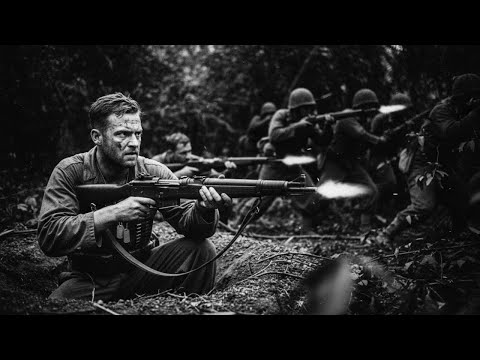
The mathematics were brutally simple. At 0357 hours, 3,000 screaming Japanese soldiers would crash into Donnelly’s perimeter like a human tidal wave. Standard defensive doctrine gave his undermanned position a 12% survival probability. The official Marine Corps field manual had 47 pages dedicated to defensive tactics against banzai charges. Not one of those pages mentioned what Donnelly was about to do.
What he didn’t know, as he made a decision that would either save his company or get him court-martialed, was that within 72 hours, every Marine commander in the Pacific would be demanding copies of his after-action report. Within six months, his tactic—if you can call desperate improvisation a tactic—would be secretly incorporated into training protocols at Camp Pendleton, Camp Lejeune, and Quantico. And within a year, variations of what happened in the next four hours would save an estimated 4,000 American lives across nine different Pacific Island battles.
But right now, at 0349 hours on November 3, 1943, all Captain Donnelly knew was that he was about to walk into that brig and offer 43 convicted criminals something they hadn’t had in months: a chance to die as Marines instead of prisoners.
To understand why Donnelly was about to break every regulation in the manual, you need to understand what the Marines were facing by late 1943. The Japanese banzai charge wasn’t just a tactic. It was a philosophy written in blood and fanaticism. Since the beginning of the Pacific campaign, American forces had encountered these terrifying mass assaults 27 documented times. The largest—at Guadalcanal on October 24, 1942—saw 900 Japanese soldiers charge American positions along the Matanika River. Only 30 survived, but they killed or wounded 204 Marines in the process.
The pattern was always the same. Japanese forces facing imminent defeat would launch a final desperate attack designed not to win, but to take as many Americans with them as possible. They’d attack at night in overwhelming numbers, often drug-enhanced with sake and methamphetamine, screaming “Banzai!” until their voices gave out or they died trying.
The Marine Corps had tried everything to improve defensive survival rates. They’d experimented with different weapons configurations—more machine guns, more automatic rifles, more grenades. They’d tested various perimeter designs: concentric rings, diamond formations, interlocking fields of fire. They’d analyzed sight lines, ammunition expenditure rates, optimal spacing between fighting positions. Nothing worked well enough.
The fundamental problem was mathematical. A defending force needed roughly a 3:1 numerical advantage to reliably stop a banzai charge. When defenders were outnumbered—which happened frequently in the fluid, chaotic Pacific Island campaigns—casualties became catastrophic. At Tarawa, a banzai charge on the night of November 22, 1943, overran two defensive positions and killed 38 Marines before being stopped. At Saipan, the largest banzai charge of the war would kill 406 soldiers from the Army’s 105th Infantry Regiment in 12 hours.
The Corps’ official solution was simple: Don’t get outnumbered. Maintain overwhelming force at all times. Never allow enemy forces to mass for an attack. Except on Bougainville in November 1943, maintaining overwhelming force was impossible.
The Third Marine Division had landed on November 1, just two days earlier, establishing a beachhead at Cape Torokina. The operation was supposed to be a limited offensive: seize a perimeter, build an airfield, hold the position. But Japanese General Harukichi Hyakutake had other plans. He’d massed the Japanese 6th Division—14,000 troops—with orders to drive the Americans into the sea.
Captain Donnelly’s company, part of the 21st Marines, held the southern approach to the perimeter. On the afternoon of November 2, his intelligence section captured a wounded Japanese officer who, before dying, revealed that a full regiment—over 3,000 men—was massing for a night assault on Donnelly’s exact position.
Donnelly requested reinforcements. Division headquarters, stretched thin across multiple defensive positions, sent him 37 additional riflemen. His requests for additional machine guns were denied—other units had priority. His suggestion to withdraw to a more defensible position was rejected—giving up ground was unacceptable.
At 2100 hours on November 2, Donnelly gathered his platoon commanders and laid out their situation with brutal honesty. They had 217 effective troops. They were about to be hit by 3,000 Japanese soldiers in a banzai charge. Their defensive perimeter had gaps—unavoidable given their numbers. When the charge came, those gaps would become death funnels.
His executive officer, First Lieutenant Robert Chen, said what everyone was thinking: “Sir, we don’t have enough bodies. Even if every Marine is John Basilone, we can’t cover the perimeter.”
That’s when Donnelly remembered the brig.
The Third Marine Division’s temporary stockade held 43 prisoners awaiting court-martial for offenses ranging from drunk and disorderly to assault to desertion under fire. They were kept under guard 300 yards behind the front lines in a bamboo enclosure that represented the largest concentration of able-bodied men not currently assigned to defensive positions. 43 convicted criminals. 43 rifles currently locked in an evidence cage. 43 bodies that could fill gaps in his perimeter.
Lieutenant Chen looked at Donnelly like he’d lost his mind. “Sir, that’s—that’s against regulations. Article 15, Section 7. Prisoners awaiting court-martial cannot be armed or assigned combat duties.”
Donnelly pulled out a map and pointed to the gaps in their defensive line. “When those 3,000 Japanese come through here, regulations won’t matter because we’ll all be dead.”
Captain James Donnelly wasn’t supposed to be the kind of officer who breaks rules. Born in Terre Haute, Indiana, in 1916, he’d enlisted in the Marines in 1938—before the war, before anyone thought America would need warriors. He’d gone through Officer Candidate School at Quantico with mediocre grades. His fitness reports described him as “competent but unimaginative, follows orders precisely, unlikely to innovate under pressure.”
He’d earned his nickname “Doc” not through any medical training, but because he’d once spent an entire liberty helping a Navy corpsman carry wounded from a bus accident in San Diego. While other Marines hit the bars, Donnelly held compresses on wounds and kept pressure on arteries. The corpsman said he’d never seen anyone so calm around blood. The nickname stuck.
By November 1943, Donnelly was 37 years old—ancient by Marine infantry standards. Most company commanders were in their mid-20s. Donnelly’s age made him an outlier, but it also gave him something younger officers lacked: he didn’t care about his career anymore. At 37, he wasn’t making major. He wasn’t getting a staff position. He was a captain who’d die a captain, which meant he had absolutely nothing to lose by doing what he thought was right instead of what regulations demanded.
His executive officer, Lieutenant Chen, was everything Donnelly wasn’t: young, ambitious, by the book. Chen had graduated top of his OCS class. He’d memorized entire sections of the Marine Corps manual. He believed in the system, in the regulations, in the chain of command. Which made what happened next even more remarkable.
At 2245 hours, Donnelly and Chen walked to the brig. The stockade guard, Sergeant Marcus Webb, snapped to attention. “Sir, prisoners secured as ordered.”
Donnelly looked past Webb at the 43 men sitting in the dirt behind bamboo poles. Some were sleeping, some were smoking. One was reading a water-damaged paperback by flickering lamplight. They looked like what they were: criminals, misfits, the men the Corps had given up on.
“Sergeant Webb, I need to speak with the prisoners.”
Webb shifted uncomfortably. “Sir, regulations state—”
“I know what regulations state, Sergeant. Open the gate.”
Webb opened the gate. Donnelly walked inside. 43 pairs of eyes tracked him with the suspicious hostility of men who’d learned that officers only brought bad news. Donnelly didn’t waste time with speeches.
“In about an hour, 3,000 Japanese are going to try to kill every Marine on this perimeter. We don’t have enough men to stop them. I’m here to offer you a choice.”
A corporal named Eddie Voss, in the brig for knocking out a staff sergeant’s teeth, spoke up. “What kind of choice?”
“You can stay here and hope the Japanese don’t overrun this position, or you can take a rifle, fill a spot on the line, and fight like Marines. If we survive, you go back to facing your court-martial. But at least you’ll face them knowing you fought instead of hid.”
Private First Class Raymond “Razor” Kowalski, awaiting trial for desertion during the Guadalcanal campaign, laughed bitterly. “So we can die for the same Corps that locked us up. That’s a hell of an offer, Captain.”
Donnelly met his eyes. “The Corps locked you up because you broke the rules. That doesn’t mean the Corps stopped being worth fighting for, and it doesn’t mean you stopped being Marines.”
The silence that followed lasted maybe ten seconds. Then Voss stood up. “Where’s my rifle?”
What happened over the next 47 minutes shouldn’t have worked. The prisoners—Donnelly refused to call them convicts or criminals anymore—were issued rifles from the evidence locker. Most hadn’t touched a weapon in weeks or months. Several had never fired the new M1 Garand that was replacing the old bolt-action Springfield. Donnelly’s armor, Gunnery Sergeant Pete Halverson, gave them a 60-second crash course. “Eight rounds in the clip. Semi-automatic fire. Squeeze, don’t pull. Aim low because you’ll be shooting downhill.”
Lieutenant Chen pulled Donnelly aside. His voice was urgent, almost pleading. “Sir, this is crazy. These men are undisciplined. Some are deserters. The moment the shooting starts, they’ll run.”
Donnelly was checking his own rifle. “Maybe. Or maybe they’ll fight like they’ve got something to prove.”
“Sir, I’m going to have to note this in my report. You’re violating Article 15, Section 7.”
“I know. Put it in your report. After we’re dead, some staff officer at Pearl Harbor can court-martial my corpse.”
Chen stared at him. Then, incredibly, he smiled. “Or after we survive, I’ll testify at your court-martial that you saved 200 lives.”
Donnelly nodded. “Either way, we’re committed now.”
The positioning was the crucial part—the tactic that would later get analyzed and debated and secretly incorporated into doctrine. Standard defensive positioning placed the most reliable troops on the front line with less experienced men in reserve. Donnelly did the opposite. He kept his trained Marines in their positions but pulled back some to create a second line. Then he placed the prisoners in the gaps—the weak points in the perimeter that couldn’t be fully covered.
But here’s what made it genius: he didn’t put them in traditional fighting positions. He positioned them in tight clusters of four to five men, each cluster slightly behind the main defensive line, positioned to create crossfire into the gaps.
Sergeant Webb, who’d been guarding these men just an hour earlier, understood first. “Sir, you’re using them as a backstop. When the Japanese break through the gaps, they’ll run straight into concentrated fire from defenders who can’t retreat because there’s nowhere to retreat to.”
It was brutal mathematics. Traditional doctrine said: Spread your forces evenly. Create interlocking fields of fire. Maintain defensive depth. Donnelly’s makeshift system created intentional weak points that would channel attacking forces into kill zones covered by men who had no fallback positions.
Private Kowalski, the deserter, grasped the implications immediately. “Captain, you’re putting us in positions where we can’t run even if we wanted to.”
Donnelly met his eyes. “I’m putting you in positions where you’ll kill more Japanese than you thought possible. Whether you run afterward is your business, but for the next few hours, you’re going to be the most dangerous Marines on this perimeter.”
At 0341 hours, Donnelly walked the line one final time. His Marines were ready—scared, but ready. And in the gaps, in those improvised killing positions, 43 convicted criminals checked their weapons and waited.
At 0344 hours, Gunnery Sergeant Halverson muttered what everyone was thinking: “This is either the craziest thing I’ve ever seen or the smartest. We’ll know in about ten minutes.”
November 3, 1943. 0347 hours. The chanting started.
The sound was inhuman—3,000 voices merging into a single roar that seemed to come from the jungle itself. Marines gripped their rifles tighter. In the prisoner positions, Eddie Voss whispered to the men around him, “Well, boys, at least it’ll be interesting.”
At 0352 hours, they came. The Japanese didn’t run—they flowed, a human tsunami pouring out of the jungle in endless waves. Donnelly’s Marines opened fire at 80 yards, and Japanese soldiers fell in dozens, then hundreds. But they kept coming. Killing the enemy didn’t stop them; it barely slowed them.
At 50 yards, the first wave hit the gaps. A cluster of 40 Japanese smashed through a weak point between platoons—and ran straight into Eddie Voss and nine other prisoners positioned 20 yards behind the line. Voss didn’t shout orders. There wasn’t time. He simply opened fire at point-blank range. Nine other rifles joined his. All 47 Japanese died in place.
Two hundred yards south, the same pattern repeated. Raymond Kowalski, the deserter, found himself trapped with no fallback. Years later he’d say, “I don’t remember being brave. I remember being trapped. And I remember being so angry that I just didn’t stop shooting.”
The banzai charge lasted 43 minutes. By 0435, it was over. When dawn broke, Donnelly’s Marines counted 2,114 enemy dead. American casualties: 41 killed, 97 wounded. Of the 43 prisoners, seven were dead, 14 wounded, 22 intact.
At 0630, Lieutenant Colonel Masters arrived and read Donnelly’s report in silence. “Captain, you violated Article 15, Section 7. You’re either going to be court-martialed or decorated, possibly both.”
Within a year, variations of Donnelly’s tactic would save an estimated 4,000 American lives across nine Pacific battles. The manual never mentioned prisoners—but the principle was pure Donnelly. He died in 1987, his obituary mentioning his service in one sentence. But at Quantico, every officer candidate still studies “Defense of Position Tango 7.”
Donnelly didn’t invent a revolutionary tactic. He simply remembered something the regulations had forgotten: the most important weapon in the Marine Corps arsenal isn’t the rifle—it’s the Marine who refuses to quit even when he has every reason to.
What would you have done, standing in that brig with 43 rifles and 3,000 screams in the dark? Let us know in the comments below.
Report this article
Select a reason for reporting:






