In the summer of 1941, a dusty warehouse on the edge of a Royal Air Force depot in North Africa held thousands of machine guns that nobody wanted. Each crate was stamped with a single, dismissive word: “Obsolete.” The British military had moved on, convinced these weapons belonged to a bygone era. And so they sat in the dark, oiled and forgotten, while outside, a war raged across the desert.
Nobody had told David Stirling about them yet. But when he found out, everything was about to change—and the fate of the North African campaign would hinge on a gun the RAF had already written off.
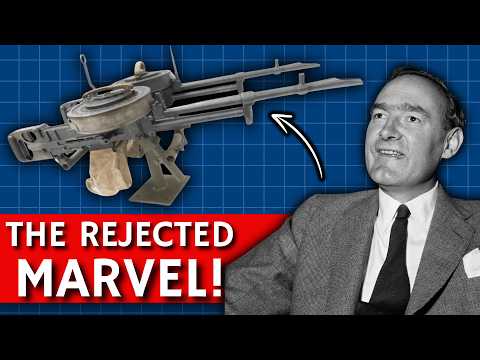
To understand how a discarded aircraft gun became one of the most feared weapons in the desert, you have to go back to where it was born—not in a military workshop, but in the quiet drawing offices of Vickers-Armstrongs. In the early 1930s, aircraft design was advancing so fast that weapons designers were scrambling to keep up. The era of the slow, fabric-covered biplane was ending. New bombers were faster, more agile, and far harder to defend. A rear gunner had perhaps half a second to put rounds into an attacking fighter. A standard infantry machine gun, cycling at three or four hundred rounds per minute, simply wasn’t enough.
The engineers at Vickers understood this with absolute clarity. They took the Vickers-Berthier light machine gun and began stripping away everything that made it heavy and slow. The key was the locking mechanism—it locked at the very last moment of forward travel, allowing the moving parts to be made lighter and cycle faster without overstressing the gun. They machined components to finer tolerances, reduced the mass of the bolt carrier, and tuned the gas system to cycle aggressively. The result was a weapon that could fire at a rate of between 900 and 1,200 rounds per minute—faster than the German MG 34, then considered one of the finest machine guns in the world.
They called it the Vickers gas-operated machine gun, or Vickers GO. Later, it became universally known simply as the Vickers K. It fired the standard .303 British cartridge from a distinctive flat circular pan magazine mounted on top of the receiver, holding up to 100 rounds. Air-cooled with radial fins machined into the barrel, the whole weapon was compact, relatively light, and built for a single purpose: to pour as much lead as possible into a narrow window of sky in the briefest possible moment.
When tested against the competing Browning machine gun in the mid-1930s, the Vickers K actually won. It was more reliable, and its rate of fire was extraordinary. The Royal Air Force adopted it for flexible defensive positions on bombers—rear turrets, nose positions, dorsal mountings. For a few years, it was the gun that guarded Britain’s bombers, riding in the turrets of the Bristol Blenheim, the Armstrong Whitworth Whitley, and the Handley Page Hampden. In the dark, cold observer positions of Britain’s early war bombers, the Vickers K was the last line of defense.
And then, almost overnight, it became unnecessary.
The problem wasn’t the gun. The gun was excellent. The problem was the direction of fighter design. The Spitfire and the Hurricane didn’t use flexible gun positions at all—their armament was fixed, batteries of machine guns built directly into the wings. Belt-fed Brownings were far better suited to this role, because they could be installed in tightly packed wing bays without the bulky circular drum magazine of the Vickers K sticking out above the receiver. The drum was the Vickers K’s great weakness for fixed installations. When the belt-fed Browning Mark II was selected as the standard fixed armament for RAF fighters, the Vickers K’s future was decided.
By 1940, the Royal Air Force was replacing the Vickers K across its bomber fleet wherever it could. Thousands were pulled from service, cleaned, greased, and packed into storage crates. The official designation stamped on the documentation was blunt and final: obsolete, surplus to requirements. They would sit in their crates until someone decided what to do with them. Nobody expected anything remarkable to follow.
In Cairo, in July of 1941, a tall, unusual officer was sitting in a hospital bed with a partially paralyzed back, writing notes on a scrap of paper. His name was David Stirling. He was 25 years old, a lieutenant in the Scots Guards who had volunteered for the commandos. He had injured himself during an unauthorized parachute jump and was furious—not about the injury, but about the wasted time. While he lay in hospital, he thought about what the British army was doing wrong. He thought about Rommel, about the long exposed supply lines and airfields that dotted the North African coast. He thought about how a small group of men—not hundreds, just four or five highly trained soldiers—could cause damage so disproportionate to their numbers that the entire strategic equation might shift.
When he was released, he did not take his ideas through the usual channels. He knew what they would say: “It’s irregular. It can’t be done.” So Stirling went straight to the top. He hobbled on crutches to the Middle East headquarters in Cairo, squeezed past perimeter security, and found himself in the office of the deputy commander, General Neil Ritchie. Ritchie read his notes. Three days later, Stirling was back with a formal pass, and he put his case to the commander-in-chief himself, General Sir Claude Auchinleck. Auchinleck approved the concept. Stirling was promoted to captain and given permission to recruit 66 men.
The new unit was named L Detachment, Special Air Service Brigade. The “brigade” part was a fiction—there was no brigade. The name was chosen to deceive Axis intelligence into thinking the British had a far larger airborne force than they actually did. What Stirling had created in reality was a raiding unit of extraordinary ambition and almost no resources. He had men. He had Jock Lewes, who invented a small combined incendiary and explosive device—the Lewes bomb—capable of destroying a parked aircraft with a single placement. He had Paddy Mayne, an Ulsterman of terrifying physical capability, who had reportedly been sitting under close arrest for knocking out his commanding officer when Stirling recruited him. And he had an idea, utterly simple in conception: get into the enemy’s airfields at night and destroy his aircraft on the ground where they couldn’t fight back.
The first operation, code-named Squatter, was a catastrophe. A severe desert storm scattered the five plane loads of men across the landscape. Equipment containers were lost. Only 22 of the original 65 men returned. Jock Lewes was killed during the withdrawal. It was a near-fatal blow. The army wanted to disband L Detachment, but the failure taught Stirling something irreplaceable: the parachute was the wrong tool for this terrain. What saved the survivors was the Long Range Desert Group, a specialist unit of navigators and desert drivers who knew the desert the way a sailor knows the sea. They had vehicles. They could reach the airfields by land in the dark with a precision that parachuting could not provide.
Stirling struck a working partnership with the Long Range Desert Group. They would drive the SAS in and out. The SAS would do the destruction. It worked from the very first attempt. On the night of the 14th of December, 1941, while Stirling’s own team attacked Sirte airfield and was driven off when he stepped on a sleeping Italian soldier, Paddy Mayne led his small team to Tamet airfield in Libya. What happened at Tamet became the stuff of SAS legend. Mayne kicked in the door of the officers’ mess, where German and Italian aircrew were eating and playing cards, and opened fire. His team then spread across the airfield in the darkness, placing Lewis bombs on parked aircraft and shooting up the instrument panels of the ones they couldn’t reach with explosives. When Mayne ran out of bombs but found one more aircraft, he reportedly tore the instrument panel out with his bare hands—a Herculean act his comrades never forgot. When the team slipped back into the desert and the night sky lit up with detonating aircraft, the count was 24 destroyed, along with fuel dumps, ammunition stores, and telegraph poles.
The SAS had proved it could work. L Detachment would survive. But there was a problem that every successful raid only made worse: the SAS was winning, and the Axis powers were taking notice. As the months of early 1942 passed and the raids multiplied, Axis commanders quietly began improving the defenses around their airfields. Sentries were posted beside individual aircraft. Guard towers went up. Perimeter patrols were doubled. The quiet, careful insertion that the SAS had relied upon—creeping onto an airfield in the dark, placing bombs without being heard, then walking away—was becoming impossible. The airfields were no longer sleeping when the SAS arrived.
Stirling saw this problem clearly. And his response was characteristically audacious. If they could no longer creep in undetected, they would drive in at full speed with so much firepower that the defenders couldn’t react before the damage was done. Speed and shock. He needed vehicles that could carry that firepower, and he needed weapons that could generate it. The American Willys Jeep was becoming available to British forces by the middle of 1942. It was a revelation—small, fast, extraordinarily capable in rough terrain, and simple enough to maintain in the field. Stirling began acquiring them and stripping them down immediately: windscreens removed, weight reduced, extra fuel and water canisters bolted to every surface. The whole vehicle converted into a mobile fighting platform. But the question of armament was still open. The Jeep needed firepower, and it needed a lot of it. A weapon that could pour out rounds fast enough to suppress an entire airfield defense in the few seconds before the attackers escaped back into the dark.
And that was when someone looked at those crates in the depot. The obsolete ones. The ones the RAF didn’t want anymore.
The Vickers K was not chosen by accident, and it was not chosen because it was the only option available. The SAS and Long Range Desert Group soldiers who first experimented with the weapon quickly discovered that it was, in nearly every way, exactly what they needed. The rate of fire—up to 1,200 rounds per minute—was almost beyond belief for a weapon of its size. A single Vickers K could put 20 rounds into a target in one second. Two of them, bolted side by side on a pivoting mount at the front of a Jeep, could deliver 40. The drum magazines meant no belt to snag in the wind or catch on the bodywork of a moving vehicle. The pan sat cleanly on top of the receiver, locked into place with a positive click, and could be swapped in seconds by a trained gunner, even in darkness and at speed. The gas-operated mechanism proved phenomenally resistant to sand and dust—a critical advantage in the Sahara, where a belt-fed weapon might jam from grit, but the Vickers K kept cycling. The gun’s original designers had built it for the sky, where reliability under extreme conditions was not optional. That same standard of mechanical integrity translated directly to the desert.
Soldiers who had experience with the gun were blunt in their assessment. It was not merely acceptable. It was, for this specific role, superior to every alternative they had tried. Stirling standardized the mounting. Each Jeep received twin Vickers K guns on a forward pintle mount, controlled by a single gunner in the front passenger position. A third Vickers K was often mounted on a rear pintle, giving each Jeep three guns and a combined rate of fire of over 3,000 rounds per minute. With a column of Jeeps all firing in coordination, the mathematics of violence became overwhelming. The tracer ammunition loaded into every third or fourth round of the drum served a dual function: it allowed the gunner to walk his rounds onto target in the dark, and it ignited aircraft fuel on contact. A short burst in the right place was enough to turn a 20,000-pound aircraft into a burning wreck in seconds.
On the night of the 26th of July, 1942, Stirling put the full capability of his armed Jeep force to its greatest test. The target was Sidi Haneish airfield in Egypt, 235 miles west of Cairo, a major Axis installation packed with bomber and transport aircraft. Intelligence suggested the airfield held a large number of Junkers Ju 52 transports—the workhorses of the Axis supply chain—as well as Stuka dive bombers and Messerschmitt Bf 109 fighters. As 18 Jeeps drove 50 miles through the desert from a hidden camp, navigating in total darkness without headlights, they approached the airfield—and the runway lights suddenly switched on. Not because they had been detected, but because a Luftwaffe bomber was coming in to land. Stirling had a split second to decide. He fired a green flare and ordered the column forward.
The Jeeps accelerated onto the airfield in two parallel columns, Stirling at the head. The Vickers K guns opened fire immediately, pouring tracer rounds into the lines of parked aircraft on both sides. The airfield erupted. Aircraft burst into flame. Explosions chased each other down the flight line as fuel tanks detonated in sequence. German ground crews ran in every direction. Anti-aircraft weapons opened up from the perimeter, but the Jeeps were moving too fast, the confusion was too total, and the volume of fire coming from the attackers was too intense for the defenders to organize an effective response. One Jeep was disabled. One man was killed. The raiders swept the airfield twice, turned, and drove back into the desert. Behind them, 37 Axis aircraft burned.
It was the single most destructive SAS raid of the entire North African campaign, and one of the most efficient uses of firepower in the history of special operations. The aircraft destroyed that night were transport planes that the Afrika Korps could not easily replace. Their loss tightened the supply stranglehold on Rommel’s forces at a moment when the desert war was approaching its decisive phase. What made it possible—technically, mechanically, operationally—was the Vickers K. The gun that the Royal Air Force had declared obsolete. The gun that sat in crates and depots, written off, forgotten, awaiting disposal.
The Axis commanders who survived that night at Sidi Haneish were reported to have been baffled by what had hit them. One account described the post-raid communications in which a garrison officer reported that he had been attacked simultaneously by naval commandos from the sea, airborne troops from the air, and armored vehicles from the land. In reality, it had been a handful of men in open Jeeps with surplus aircraft machine guns. The psychological effect of a weapon firing at 1,200 rounds per minute in absolute darkness, with tracer rounds arcing in every direction and aircraft exploding every few seconds, produced a level of confusion that multiplied the apparent size of the attacking force many times over.
This was not accidental. Stirling understood what military theorists call the force multiplier effect—the ability of speed, surprise, and overwhelming local firepower to produce effects far beyond what the raw numbers would suggest. The Vickers K was central to that multiplication. Its rate of fire meant that a single Jeep, driven at speed through an airfield, could engage targets across a 200-yard frontage in the same second. There was no gap in the fire, no moment when a defender could safely raise his head and organize a counterattack.
The effectiveness of the raids was not only measured in aircraft destroyed, though the numbers were staggering. By the time Stirling was captured in January of 1943—caught sleeping in a Tunisian valley—L Detachment and its successor formations had destroyed over 250 aircraft on the ground, along with dozens of supply dumps, rail lines, and hundreds of vehicles. The SAS across the full North African campaign was credited with more than 400 aircraft destroyed, a figure that exceeded the total number of Axis aircraft shot down in aerial combat by the entire Desert Air Force over the same period. Field Marshal Bernard Montgomery, who was not a man given to extravagant praise, said of Stirling: “The boy Stirling is quite mad, quite, quite mad. However, in a war, there is often a place for mad people.” The Germans had a different name for him. They called him the Phantom Major. And Rommel himself reportedly ordered that Stirling be captured as a priority target—a recognition that one man with the right idea and the right weapon was worth more strategically than several conventional units of far greater size.
After Stirling’s capture, command passed to Paddy Mayne, who proved an even more ferocious operational commander. Mayne’s personal tally of aircraft destroyed was estimated at over 100—a figure that made him, by any honest accounting, more destructive to Axis air power than any Allied fighter ace of the war. No pilot shooting down aircraft in aerial combat came close to that total. Mayne achieved it on the ground with Lewes bombs and Vickers K guns, moving through darkness in a Jeep. The National Army Museum later recognized his achievement with exactly that statement: that his personal count exceeded that of any other individual in the conflict when it came to the destruction of enemy aircraft.
The Vickers K’s reputation spread beyond the SAS. The Long Range Desert Group, which had originally served as the SAS’s transport, adopted the gun extensively for its own vehicles, mounting it in single and twin configurations on Chevrolet trucks. The locking design’s natural resistance to sand contamination made it uniquely suited to desert operations, where other weapons with tighter tolerances became unreliable after prolonged exposure to fine grit. The gas-operated cycle—drawing propellant gas from the barrel through a port beneath the muzzle and using it to drive the piston rearward—was a robust and forgiving design. In a theater of war where mechanical reliability was a survival requirement, this mattered enormously.
In the coastal forces of the Royal Navy, the Vickers K also found a second life, replacing the older Lewis gun on motor torpedo boats and motor launches from 1942 onward. The same qualities that made it valuable in the desert—fast fire, drum-fed reliability, compact mounting—translated perfectly to the cramped deck positions of small naval vessels. On a motor torpedo boat cutting through the Mediterranean at 40 knots, a gun that would not jam from salt spray was not a luxury. It was an operational necessity. The airborne forces also discovered it. During Operation Market Garden in September of 1944, the airborne reconnaissance squadron attached to the 1st Airborne Division in the fighting around Arnhem mounted Vickers K guns on their vehicles. From the North African sands to the narrow Dutch country roads, the gun adapted.
There’s a detail about the Vickers K that is easy to overlook, but that says something important about engineering and war. The gun was not designed for any of the uses that made it famous. It was designed for one specific role—high-rate defensive fire from bomber turrets in the 1930s. When that role disappeared, the gun should have disappeared with it. Instead, it found new roles that its designers had never imagined, in conditions they had never anticipated, operated by men who were doing things that had never been tried before. The engineers who built it had done their job so well—the mechanism so reliable, the rate of fire so high, the magazine feed so practical—that the weapon retained its value even when its original purpose became obsolete. Good engineering does not expire. The qualities that make a weapon or a machine excellent in one context often survive the context itself.
The Vickers K was built to protect bombers from fast-moving fighters, and it ended up destroying 400 aircraft on the ground in the North African desert, SAS riding in the back of a Jeep driven by a small team of men who refused to accept that something was finished simply because the institution that built it had moved on. The weapon was officially declared obsolete after the war. The last recorded operational use by the Royal Navy was by 812 Squadron, flying Barracuda aircraft on anti-piracy patrols off Hong Kong in October of 1945. When those patrols ended, the Vickers K went with them into museums, into collectors’ hands, into the photographs and regimental histories of units that had carried it to the furthest edges of what was possible in desert warfare.
The SAS that David Stirling founded with second-hand parachutes, pencil-written notes, and a pair of Jeeps became the template for special forces units across the world. Delta Force in the United States, the Australian Special Air Service Regiment, and special operations units in dozens of other nations all trace their doctrine in some form to what Stirling and Mayne worked out in the Libyan desert between 1941 and 1943. The principle of small teams, deep penetration, and disproportionate violence against high-value targets became the foundation of an entire military discipline. At the center of it, in those early years when the doctrine was being written in action rather than in manuals, was a gun that had been written off. A gun designed for the air, stripped from obsolete aircraft, bolted to a Jeep, and aimed at the ground. A gun that cycled at 1,200 rounds per minute and almost never jammed. A gun that the Royal Air Force had put in a crate and labeled surplus, and that a handful of extraordinary soldiers had taken back out and used to change the course of the desert war. The engineers who designed the Vickers K never knew what it would become. They built it for bombers. It became the weapon of a legend.
And yet, the legend had one final turn to make. In the decades after 1945, the Vickers K slipped quietly into the hands of collectors and museum curators, its barrels still gleaming with the same fine tolerances that had once cycled at 1,200 rounds a minute. Few who saw it behind glass understood that this was the gun that had turned the desert night into an inferno.
Then, in the 1960s and 70s, a curious thing happened. The same qualities that made the Vickers K indispensable in North Africa—simplicity, reliability, and a punishing rate of fire—earned it a strange second afterlife in the hands of filmmakers and historical reenactors. It became a star of the silver screen, roaring back to life in war films that introduced Stirling and Mayne to a new generation.
The engineers at Vickers-Armstrongs, who had only ever wanted to protect a bomber’s crew, could never have guessed their creation would outlive the empire that built it. It remains a testament to a simple truth: a thing declared obsolete is only ever waiting for the right hands to pick it up again.
So here is the question for you, reader: What other “obsolete” ideas or tools in your own life might just be waiting for the right moment to become legendary? Share your thoughts below.
Report this article
Select a reason for reporting:






