When Adolf Hitler became Chancellor in January 1933, Germany was a nation shackled by the Treaty of Versailles—its military reduced to a shadow of its former self, its pride wounded, its future uncertain. But beneath the surface of defeat, a storm was brewing. The seeds of a war that would engulf the world were already being sown, and the man at the center of it all was about to unleash a fury unlike anything history had ever seen.
In the months that followed, Hitler presented his rise as the dawn of a new era. Propaganda hammered the message: Germany had regained strong leadership, and the humiliation of the Great War would be avenged. Yet publicly, the regime maintained a facade of compliance with Versailles. Behind closed doors, however, rearmament began in earnest—hidden under the guise of public works and administrative reforms. The goal was clear: avoid direct confrontation with the Western powers while secretly preparing for the inevitable clash.
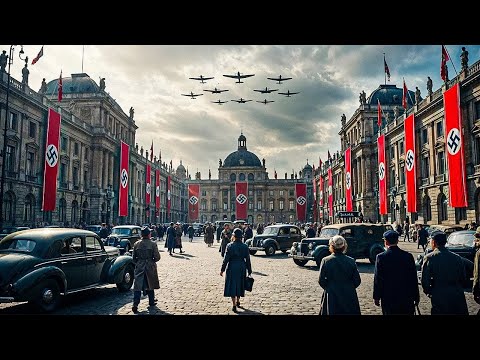
Clandestine rearmament was not entirely new. Since the Weimar Republic, secret links with the Soviet Union had allowed weapons testing on Russian soil, far from international scrutiny. Under Hitler, these practices expanded and were woven into a coherent plan linking economic reconstruction with war preparation. Job creation in arms factories was sold as social policy, but in reality, it was the foundation of an industrial war machine.
The turning point came in 1935 when Hitler openly announced compulsory military service, transforming the Reichswehr into the Wehrmacht. The army was reorganized into larger divisions, and armored and motorized units began to form. That same year, the Luftwaffe—already secretly developing—was officially established, and massive resources were poured into modern military aviation. The navy, though more limited, also began to expand, with new submarines and plans for a stronger surface fleet.
The army was the first to expand. From the 100,000 men permitted by Versailles, the force grew to several million in just a few years. Infantry, panzer, and motorized divisions were organized, giving the army flexibility and mobility unseen in the previous war. Officer schools were reactivated, and doctrines were developed to avoid the positional warfare that had defined 1914–1918. Instead, the idea of a quick war—where armored vehicles and aircraft played a central role—took hold.
The Luftwaffe, under Hermann Göring, became one of the most visible symbols of Germany’s new military power. Fighters like the Messerschmitt Bf 109, dive bombers like the Junkers Ju 87 Stuka, and medium bombers like the Heinkel He 111 were designed not just to match other powers but to shape a new style of warfare. Aviation would directly support ground forces, striking enemy concentrations and disrupting defenses. The Luftwaffe was not an independent strategic weapon but an integral part of the Blitzkrieg plan.
The navy faced greater limitations. Germany could not compete with the British Royal Navy in ship numbers, so it focused on U-boats. In 1935, a naval agreement with Great Britain theoretically set limits on the German fleet, but in practice, it was used to justify expansion. The ambitious Plan Z called for large battleships and aircraft carriers, though by the outbreak of war, only a fraction had been completed. Meanwhile, U-boats offered a tool of asymmetric warfare, capable of threatening enemy supply routes.
This military buildup was accompanied by a doctrinal framework that sought to avoid the mistakes of the previous war. The experience of the trenches had convinced German officers that the next conflict must be resolved quickly and with coordinated use of all means. Thus was born the idea of Blitzkrieg—lightning war—not a single plan codified in a manual, but a set of principles prioritizing surprise, speed, and coordination between forces. The army would penetrate enemy lines with tanks and motorized troops while the air force destroyed key points and disrupted rear areas. The infantry would follow to consolidate gains. This combination was intended to destabilize the enemy from the outset and prevent reorganization.
Blitzkrieg represented a break with attrition warfare. Instead of slowly wearing down the enemy, it aimed for a rapid collapse of their capacity to resist. This required meticulous planning, efficient logistics, and coordination between branches on an unprecedented scale. Although the Wehrmacht was still forming in the late 1930s and lacked many resources, the doctrine was consolidated as the basis for training officers and troops.
Politically, Hitler combined these measures with a public discourse of peace and a just revision of the international order while directing all state resources toward rearmament. Financial mechanisms like the Mefo bills—promissory notes issued by a fictitious company—allowed arms production to be financed without appearing in official budgets. This financial engineering concealed the real pace of rearmament, avoiding immediate economic collapse while enabling massive military expansion.
The economy was adjusted to military needs. Heavy industry, steel production, and research into synthetic fuels and materials were placed under state control. Agriculture was adapted for self-sufficiency, aiming to ensure food supplies in wartime. The Four-Year Plan, launched in 1936, was the clearest expression of this policy. Its goal was to prepare Germany for war in the short term, reducing import dependence and ensuring the capacity to sustain a prolonged conflict.
The military command, though occasionally reticent about Hitler’s pace, gradually aligned with these objectives. Generals who had experienced the First World War understood the risks of a premature conflict, but the regime’s authority and initial foreign policy successes reinforced confidence. The army, which had kept a low profile during the Weimar years, became the central pillar of a state that saw itself as a militarized community.
Internationally, these measures generated concern, but the policy of appeasement and the desire to avoid a new war allowed Germany to continue expanding its capabilities without immediate opposition. By 1939, the Wehrmacht had become a force of several million men, equipped with modern divisions, a large air force, and an expanding navy. What had begun as rearmament disguised as social programs had transformed into a war machine ready for deployment.
The Reich’s big lie—the pretext for invading Poland—was already taking shape. Since spring 1939, the German high command no longer discussed whether to attack Poland, but when. Planning began in April when Hitler issued instructions for swift and decisive action against the eastern neighbor. The objective was not solely military; it was about imposing a definitive solution to the Polish problem, both territorial and ideological. The guidelines were clear: eliminate Poland’s defensive capacity from day one, destroy its administrative structures, and make it clear that this was not a temporary campaign or partial occupation.
To achieve this, the army needed meticulous organization. By mid-year, plans were finalized for what would be the fastest campaign Europe had yet seen. Forces were concentrated at strategic border points. The Wehrmacht had overwhelming forces: around 1.5 million men, almost 2,500 tanks, and more than 2,000 aircraft. This mobilization included the army, Luftwaffe, and navy, though the latter played a limited role due to the land-based nature of the conflict.
Tactical preparations included strong coordination between ground and air forces. The concept of Blitzkrieg found its first practical application in this operation. Although not yet a formally established doctrine, the idea of combining rapid, deep, and well-synchronized attacks with intensive air support was key. Panzer divisions, supported by tactical aviation, would penetrate deep into the country, avoiding conventional defensive lines and sowing confusion in the enemy rear.
The regime also prepared the propaganda aspect. Weeks before the attack, a propaganda apparatus was deployed to justify the action. Messages portrayed Poland as a potential aggressor, and border incidents were exaggerated to create an atmosphere of imminent threat. One of the most notorious fabrications was the Gleiwitz incident—a covert operation by German forces disguised as Poles, simulating an attack on a German radio station. This was presented to the world as a Polish provocation and served as an immediate pretext for launching the offensive.
At 4:45 a.m. on September 1, 1939, the attack began. The Luftwaffe bombed strategic positions in the Polish interior, including airfields, communication centers, and military warehouses. Simultaneously, ground units crossed the border on multiple fronts with encircling movements. Panzer divisions advanced at high speed, flanked by motorized infantry. The attack was devastating. Within days, Polish defenses began to collapse. German forces did not pause at points of resistance but surrounded them and continued inland, leaving mopping-up to the rear guard. This strategy allowed a continuous advance without exhausting forces in protracted engagements.
Polish units, though offering resistance, were unable to coordinate effectively or establish a coherent defensive line. German air supremacy hampered any attempt at reorganization or counterattack. Meanwhile, propaganda within Germany spread the idea of a preemptive, necessary, and just operation. Alleged abuses against German minorities were highlighted, and the Reich was portrayed as a victim forced to defend itself. Hitler’s speeches repeated this narrative, asserting that all diplomatic avenues had been exhausted.
Coordination between the branches was fine-tuned in real time. Mobile divisions communicated their progress and requested air support when encountering resistance. The Luftwaffe responded swiftly, removing obstacles and allowing the advance to continue unabated. This breakneck pace surprised not only the Poles but also international observers. Within days, German forces were deep inside enemy territory, surrounding Warsaw and other key cities.
On the diplomatic front, Germany had ensured that the Soviet Union would not intervene on behalf of Poland. The Molotov-Ribbentrop Pact, signed in August, included secret clauses on the partition of Polish territory. With this agreement, Hitler eliminated the risk of a two-front war and could concentrate exclusively on the Eastern campaign. Furthermore, he was confident that France and Great Britain would not react strongly, as had happened in previous episodes. However, the diplomatic calculation was not entirely correct. On September 3, France and the United Kingdom declared war on Germany, fulfilling their commitments to Poland. Despite this, no immediate military action was taken by these powers. For weeks, the so-called Phoney War raged in the West with minimal defensive movements and no significant fighting. This allowed Germany to continue its offensive without worrying about a second front.
Within German territory, news of the war was received with a mixture of enthusiasm and resignation. Propaganda had prepared the ground, presenting the conflict as a just and necessary cause. Many citizens supported the action, convinced it was the only way to resolve outstanding problems with Poland. At the same time, censorship and information control measures were activated to ensure a single narrative and prevent dissenting voices. Values such as sacrifice, discipline, and national pride were promoted, while casualties were minimized and the harshest aspects of the conflict were hidden.
The campaign was brief but intense. On September 17, the Soviet Union invaded Eastern Poland, fulfilling its agreement with Germany. This further accelerated the disintegration of the Polish army, which was already in retreat. Warsaw held out until the end of the month but finally capitulated after a siege accompanied by constant bombardment. Polish resistance was valiant in many instances but completely overwhelmed by the enemy’s technical and organizational superiority.
By the end of September, the map of Europe had changed. Poland was divided between Germany and the Soviet Union, and the world had formally entered the war. For the Nazi regime, the campaign was a demonstration of military effectiveness, strategic planning, and political control. It confirmed that the rapid war model worked, reinforcing the high command’s confidence in future operations. Blitzkrieg was not yet a familiar word to the public, but its essence had been put into practice with brutal efficiency.
The experience in Poland became a model to follow. Generals studied every detail to fine-tune mechanisms for future campaigns. Political authorities highlighted the results as proof of the superiority of the German system. Parades were organized, victory bulletins were distributed, and the figure of the German soldier was glorified. The initial success reinforced the idea that the Reich had an inevitable and justified expansionist destiny and that obstacles would be overcome with the same speed and determination as in this first campaign.
Thus began, from the German perspective, a conflict that had not yet revealed its true colors but already showed the determination of a regime willing to use all its resources to achieve its ends. The invasion of Poland not only marked the beginning of the World War but also the starting point of a way of waging war where speed, surprise, and propaganda were as important as weapons.
In the end, Berlin was a city of rubble and silence. The Führer was dead, the Reich a smoldering memory, and the German people faced a future without direction or hope. The war that had promised glory had delivered only ruin.
Survivors emerged from cellars and bunkers, blinking in the harsh light of a defeated dawn. They searched for food, for loved ones, for any sign of normalcy. But there was none—only the acrid smell of smoke and the weight of collective guilt.
“We were told we were invincible,” an old soldier whispered, staring at the ashes of his homeland. “But we were only men, and we lost everything.”
The Nazi dream had ended in fire and blood. The world would remember the horrors, and Germany would carry the burden for generations. What remained was not victory, but the fragile chance to rebuild from the ruins.
What lessons can we draw from a nation that traded its soul for power, only to find destruction?
Report this article
Select a reason for reporting:






