The knock came at 11:47 p.m. on a Tuesday, and it was not a polite knock. It was the kind that said we already own what’s behind this door—we’re just letting you know. Sal, a thick-necked collector in the same gray coat every night, walked into the Blue Moon Club on 133rd Street without waiting to be seated. He placed a number on a matchbook: $300 a week. Cash. No receipts. Clarence Webb, who had run that club for eleven years without missing a single rent payment, looked at that number for a long time. The band played something slow and mournful. A woman laughed too loud. Normal sounds. Except for the matchbook—and Sal’s hands flat on the table like two slabs of butcher meat. You understand what this is? Sal said, not raising his voice. He never did.
Three blocks away, in a back booth of a restaurant that no longer exists, Bumpy Johnson was eating pork chops. He’d been told about Sal before Sal finished his second club. Harlem had eyes like that—a nervous system of whispers faster than any telephone wire. He listened without putting down his fork. Two questions: How much? And which clubs? Then he went back to his pork chops. The young runner who’d delivered the report waited for an order, a threat, a plan. Instead, Bumpy cut a slow piece of meat and said, “Watch where the money goes after Sal picks it up. Don’t follow Sal. Follow the car.”
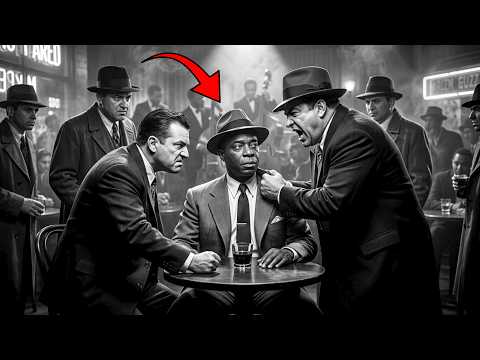
What Brooklyn couldn’t have known was that Bumpy Johnson had been the architecture of Harlem since the early 1930s. Not the loudest wall, not the most visible beam—the foundation. The thing under everything else that nobody thought about until it moved. He hadn’t survived by reacting. He’d survived by watching. By letting other men write the first line of the story, believing they were the author, not understanding they were the character. Anastasia sent six men into six clubs in one week and collected roughly $1,800. He thought that meant he owned something. What he’d actually done was walk into a darkened room and light a match—not realizing someone had been watching from the doorway the entire time, counting his steps, learning his habits, waiting for him to use up his light.
Every bartender noticed the collectors came in loud, counted bills at the bar, wanted to be seen. But the owners—Clarence Webb and the other five—none made a phone call Brooklyn could trace. They paid. They smiled. They said, “Thank you. See you next week.” And they went home and sent word to Ellis. By the end of that first week, without spending a dollar or making a threat, Bumpy had a complete picture of Sal’s route, his exact timing, the two men who drove him, and the address in Brooklyn where the money was delivered every Tuesday after midnight. He knew the building. He knew which night the cash went into the safe. He had not left his neighborhood to get any of it.
The old men of Harlem who lived through that autumn used the same word about Bumpy in those first days: unbothered. Like a man watching rain through glass. Like a man who already knew the storm was going somewhere else and was simply waiting for the puddles to confirm it. Brooklyn saw the silence and called it surrender. Bumpy saw Brooklyn seeing the silence and understood it was the most useful thing he had. Real power doesn’t announce itself at the door. It’s already sitting at the table, watching you knock.
By the third week, Sal had a schedule: Tuesday nights, 11:00, six clubs, same order, same gray coat, same rubber-banded ledger under his left arm like something precious. He moved through Harlem like a man who owned the night—unhurried, unworried, nodding at bartenders who had learned to nod back without showing anything behind their eyes. He thought the routine made him look established. It made him look like a clock. And Bumpy Johnson had always known how to read a clock.
The Velvet Cage was Sal’s second stop, and the most important one—not because of the money, but because of who ran it. Dorothy Price had owned that club since 1938, kept it breathing through the Depression and a fire and two wars against city inspectors. She was 51, with the posture of a woman who had never once been surprised by what men were capable of. She paid Sal the way you pay a toll—with full knowledge that the road belonged to someone else and full intention of building a different road when the time was right. What Sal didn’t understand, sitting at her bar with his free whiskey, was that Dorothy Price had been meeting Bumpy Johnson every Thursday morning for eleven years. Same diner. Same table. Coffee for her, tea for him. She told him everything.
The Thursday after Sal’s first visit, Dorothy sat across from Bumpy and gave him the exact amount, the exact time, the exact words. Bumpy stirred his tea. “Pay him. Smile when you do it. Give him slightly less than he expects. But not so little he gets angry. Tell him business is slow. Blame the weather. Blame the war. And keep a record—exact amounts, exact times—and get it to Ellis by Wednesday morning.” Dorothy wrote nothing down. She never did. She just looked at him across the coffee cups and said, “And the real money goes where it always went.” Bumpy said, “Just a different door.”
The money Sal collected was real. It crossed the bridge every Tuesday in a bag held by a driver named Carmine—reliable, punctual, and completely unaware that Ellis had identified his car by the second week and his route by the third. Not following directly. Two men, two separate nights, watching from distances that couldn’t be called surveillance. Pure geography. Pure patience. By week four, Bumpy knew the Tuesday money went to a social club in Carroll Gardens, arrived between 1:00 and 1:30 a.m., and that the safe was behind a painting of a ship in the back office. He knew the names of two of the three men usually inside. He hadn’t moved against a single one of them. He’d simply built a map while Brooklyn thought it was building an empire.
Meanwhile, the real economy of Harlem’s nightclub district was undergoing a quiet surgery. Not theft—nothing so crude. A restructuring. A careful separation of what Brooklyn could see from what Brooklyn could never see because it had never existed in any form Brooklyn knew how to read. The private gambling, the backroom card games, the bottle arrangements for parties that weren’t on any booking sheet, the cash payments to performers who never signed a contract—none of it had ever touched a ledger Sal reviewed. But now Bumpy tightened that invisibility further. New people handling internal collections. New timing. New locations for the drops. A layer of separation between the front operation and the real one so clean that a man could spend a week inside those clubs and leave knowing exactly nothing.
Dorothy told Ellis one Thursday that Sal had started asking questions after collection—standing at the bar with his free whiskey, asking how many people had come in the previous Saturday. Conversational. Curious. The way a man asks when he suspects the answers he’s getting and the answers he’s seeing don’t belong to the same story. Bumpy received this and let a moment of quiet settle over the table. “When a man starts asking questions, it means he already knows he doesn’t have the answer. He’s hoping you’ll hand it to him.” Ellis asked what they should do. “We keep handing him the same answer until he stops being curious and starts being confused. Then we hand him something a little different.”
Sal kept his schedule, kept his ledger, kept writing down his careful numbers every Tuesday night—building what he believed was a comprehensive picture of Harlem’s financial life. He was building a picture. That part was true. He just didn’t know someone else had painted it. When your enemy believes he is winning, you do not correct him. You furnish the room he’s standing in. You choose what light falls where. You decide what he sees when he looks at the walls—and you keep the real walls somewhere he has never been and will never think to look.
Anastasia was not a patient man. He had built everything on speed—the speed of a decision made before the other man finished his sentence. Patience, in his experience, was what losers called waiting. Winners moved. Winners pressed. Four weeks into the Harlem operation, the numbers were wrong. Not dramatically wrong. Not the kind that screamed sabotage. The kind that lives in the back of the throat—low and nagging, like a smell you can’t locate. The weekly collections Sal brought back were consistent and clean and roughly 40% of what they should have been. Anastasia said this to two men sitting across from him. Neither spoke. The correct response in that room was silence. “Someone’s lying,” Anastasia said. “Or Sal can’t find the money because he doesn’t know what money looks like. Send Enzo.”
Enzo was 53, had been doing this work since before Sal was born. Thin, gray-suited, the face of a retired schoolteacher—the kind of man who could sit across from you for an hour and make you feel like the most carefully heard person in the room. He was not there to threaten. He was there to understand. And the men who had made the mistake of believing those were two different things were no longer available to correct themselves. He arrived in Harlem on a Thursday evening and went directly to the Blue Moon. Clarence Webb watched him cross the room without hurry, without looking at anything except Clarence’s face, and felt something cold move through him. Not fear exactly—the specific sensation of knowing the game had just changed levels. “I’m here to look at your books,” Enzo said, not loud, not harsh—the way a doctor says he’s there to look at your chest. Professional. Inevitable. Already done in his mind before the words finished leaving his mouth.
Clarence said, “Of course. Whatever you need.” He returned with a ledger—green cover worn at the corners, pages dense with figures in three different hands. Eight weeks of revenue, itemized by night. Every number in it had been invented. Not carelessly—this was architecture. The work of Harold Reese, who had built false books for fifteen years and understood the difference between a number that was false and a number that was believable. Seasonal variations. A dip in early October that matched a rainstorm that had genuinely happened. Minor inconsistencies of real life. Harold had spent eleven days building those books. He charged Bumpy $300. It was the best $300 Bumpy ever spent.
The real accounts existed nowhere on paper. They lived in the memory of three people selected because they had demonstrated, over years, that certain information stayed behind their teeth regardless of pressure. Enzo sat with Clarence for two hours, asking sharp, specific questions designed to produce contradictions. Clarence answered with the ease of a man telling the truth—because in a technical sense, he was. He was telling the truth about the club that existed in the ledger, a club he had come to know almost as well as the real one.
What Enzo’s careful eyes never found: the door in the east wall of the storage room, opening onto a staircase to a basement where six nights a week a card game ran that on its worst night generated more than the club’s entire legitimate Saturday revenue. The two musicians paid from a strong box whose location changed every ten days. The Monday and Wednesday collections moving through a side entrance timed around the gaps in Sal’s Tuesday rounds. Enzo moved through all six clubs over three days. All six ledgers told the same story—consistent in aggregate, different in detail, each written in a different hand.
Bumpy received a full report each evening. Same question: Did he look satisfied? Each evening, Ellis said yes. Each evening, Bumpy said nothing for a moment. Then: “Good. Let him look satisfied. Satisfied men stop looking.” Enzo returned to Red Hook and told Anastasia the books were clean. Harlem was paying its proper share of a neighborhood simply not as profitable as projected. Anastasia listened, not fully satisfied—a man like that built his survival on never being fully satisfied—but he had no thread to pull. He told Sal to continue. He told Enzo to return in a month.
Bumpy received word by the following morning. He made one small adjustment to a Monday route Ellis had noted was slightly visible from a particular corner, then put on his jacket and walked out into the gray autumn light of 133rd Street. The most dangerous lie is not the one that contradicts the truth. It is the one that becomes the truth—so carefully constructed, so thoroughly lived in, that the men trying to find the lie end up furnishing evidence for the story you built around it.
Brooklyn sent an auditor into Harlem and got back exactly what Harlem wanted Brooklyn to believe. And somewhere below the streets, behind the door in the east wall, the cards were still being dealt. The wolf had come in October with its gray coat and its rubber-banded ledger. It left in December with nothing. And the dog that drove it off didn’t return to its corner and close its eyes. It moved to the door, learned the sound of every step on the block, and waited there in the cold and the quiet it had made and now maintained. Patient as architecture. Permanent as the street itself.
Bumpy had protected his neighborhood. He had also become something his neighborhood could never fully escape—the hand that held the door closed and the hand that held the key. Whether that made him a guardian or a warden depends entirely on which side of the door you were standing on. The old men of Harlem never answered that question directly. They just smiled and changed the subject.
So now we ask you: if you had been one of those six club owners in 1943, would you have trusted Bumpy Johnson? And do you think what he built to protect Harlem was worth the price Harlem paid to be protected? Tell us in the comments below.
Report this article
Select a reason for reporting:






