Somewhere on board HMS Hermes, on the night of May 15th, 1982, a senior United States Marine officer stood in a steel doorway and watched 45 very tired men in green wool caps walk past him with their rifles slung. Not one of them was wounded. They had been on a sheep farm in the dark for 30 minutes. They had destroyed 11 enemy aircraft, an ammunition dump, a fuel store, and a radar warning station. As the last of them disappeared down the corridor, the Marine turned to the officer next to him and said one sentence—a sentence that would, eight years later, end up in a classified after-action document at the United States Special Operations Command in Tampa, Florida. “They did it the old way.”
In 1982, the United States military had nuclear submarines, F-15 Eagles, and satellite reconnaissance. A British Marine watching 45 exhausted soldiers walk down a corridor and saying they did it the old way meant he had just watched a 40-year-old textbook execute itself.
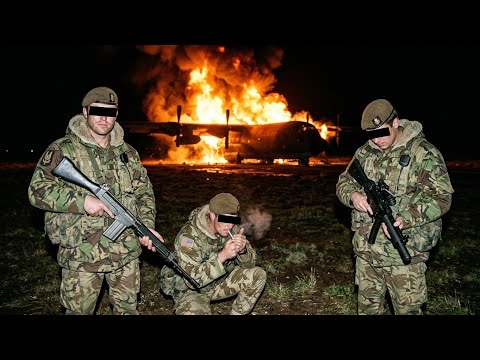
Think about that for a second. By the end of this story, you will know what the old way actually meant, who led these men, what happened to him four weeks later, why the worst single day in the history of the British Special Air Service happened five nights after this raid, and one detail the Argentines found on the airstrip that made their colonels briefly believe the United States Army had entered the war.
None of this was supposed to happen on a sheep farm.
Pebble Island, May 14th, 1982. Four miles across at its widest point, 40 square miles of peat, rock, and scrub. 25 civilians, 25,000 sheep. A short grass airstrip on the north side of West Falkland that in normal years was used about twice a month by a single Skyvan flying mail in from Port Stanley.
In April, the Argentines built an airbase there. Six FMAIA 58 Pucarás. Four T-34 Mentors. One Skyvan. Eleven aircraft total. The Pucará is the one you need to picture, because the Pucará is the reason every other thing in this story happens. Two 20-mm cannons, four machine guns, bombs, rockets, and napalm. Purpose-built for the kind of low-altitude attack run that turns a man into a casualty list. If you wanted to design a weapon to kill British infantry on a beach, you would design a Pucará.
The British were one week away from putting British infantry on a beach at San Carlos—the amphibious landings that would decide the war. If the Pucará squadron was still operational on the morning of those landings, the projected casualty figures would be measured by the company.
The British had two options: bomb the airfield or send men. Bombing was off the table because of the 25 civilians living in a settlement at the eastern end of the island. You cannot put a 500-lb bomb on an airstrip with farmers on the next ridge. That left men. It left the Special Air Service. And that decision to send men instead of bombs is the decision that, 43 years later, the Pentagon would still be studying.
A raid like this does not start with helicopters. It starts with the people who get there four days early and dig themselves into a hole.
Boat Troop, D Squadron, 22 SAS. On the night of May 10th, four collapsible kayaks called Kleppers were launched into the South Atlantic, four miles off the coast. They were designed in the 1950s in Germany. They were used by the SAS for the last 20 years because the modern alternative—the Gemini rigid-hull inflatable—would not start in the South Atlantic cold. So eight men paddled into the surf with their rifles strapped to the deck, onto a beach owned by an enemy with air patrols 20 miles away.
The modern stuff did not work. So they did it the old way. They cashed the canoes. They dug a scrape in the peat in a deep ferny valley, 1,500 meters from the airstrip. They stayed in that hole for four days. No fire. No daylight movement. No hot food. From inside that hole, they counted everything. The aircraft: 11. The garrison: approximately 150. They mapped the sentries, the fuel dump, the ammunition store, the radar warning post.
On the fourth day, they radioed back to Hermes one piece of information that changed the shape of the raid. The headwinds would cut the helicopter transit time from 90 minutes on target to 30. Thirty minutes to destroy 11 aircraft with 45 men in the dark on an island they had never set foot on. That is the kind of number that makes planners stop talking.
And the SAS made one decision. Aircraft first, garrison second. Hit, destroy, leave. Pay attention to that decision, because in about 10 minutes, you are going to find out the exact same decision was written down in 1941 by a 25-year-old British officer in a tent on a stretch of desert outside Cairo. And it has not changed since.
The night of May 14th, two Westland Sea King HC4 helicopters from 846 Naval Air Squadron lifted off Hermes into wind approaching hurricane force. The pilots were wearing newly issued passive night vision goggles—first operational combat use in Royal Navy aviation history. Forty-five men, D Squadron, 22 SAS, officer commanding Captain John Hamilton, 29 years old.
And before we go further, you need to know who Hamilton was, because this story ends with him. By May 14th, Hamilton had survived two helicopter crashes on Fortuna Glacier in South Georgia within 48 hours of each other. He then led the team that retook the whaling station at Grytviken. By the time he climbed onto a Sea King on the night of May 14th, he’d already been declared dead twice.
The Sea Kings flew low. The moon was bright enough that the pilots could see their own breath on the windshield. They landed at Phillips Cove, six kilometers from the airstrip. The men yomped it in the dark. While they walked, HMS Glamorgan, a County-class destroyer, was holding station in the black water south of the island. Captain Chris Brown of 148 Battery, Royal Artillery, was embedded with the SAS communications net to call those 4.5-inch naval gun shells onto the ammunition dump on Hamilton’s word.
One more thing about the equipment. The 45 men of D Squadron were carrying American M-16 rifles with M203 grenade launchers, 5.56 mm—the standard cartridge of the United States military. We will get to why in about six minutes. Every spent round they fired that night would land somewhere on the airstrip.
Five o’clock in the morning, May 15th. The first round out of Glamorgan’s guns landed on the ammunition dump. The dump went up. Twenty seconds later, the second salvo hit the fuel store. The fuel store went up. The night above Pebble Island briefly turned the color of a forge.
Under that light, 11 aircraft sat exposed on the airstrip. The SAS assault troop moved in pairs. The Pucará was taller than a man could reach. So one bloke gave the other a leg up onto the wing. Once up, he leaned down and hauled the other one up. Two men on the wing of a parked attack aircraft. One on the cockpit, one with the charges. They opened the cockpit. They placed plastic explosive thermite grenades wrapped in PE4 with four-second fuses. They closed the cockpit. They jumped off. They moved to the next one.
For 30 minutes, the airstrip was a sequence of small, methodical, controlled explosions. Cockpits filled with white-hot magnesium burning at 3,000 degrees. Control cables ripped out by hand. Fuel tanks punched through with rifle fire. Mortar bombs dropped on a steady rhythm.
The Argentine garrison—about 150 men—did not engage effectively for the first 15 minutes. They were in shelters. Glamorgan’s guns were landing every 20 seconds.
The SAS finished the 11 aircraft. They began to withdraw. And on the way out, one of the men stepped on a command-detonated mine. He was concussed, not killed. The Argentine commander who had detonated it gave away his position and was killed in the SAS return fire.
The Sea Kings lifted off before sunrise. All 45 men aboard. Two minor injuries. Zero killed. Six Pucará, four T-34 Mentor, one Skyvan. Eleven for eleven, plus the ammunition dump, the fuel store, and the radar warning post.
And on the airstrip behind them, scattered across the peat, were several hundred spent 5.56 mm casings. American casings. When the Argentine intelligence team walked onto the airstrip that morning, they called back to Stanley and reported they’d been hit by a battalion-sized formation. At least 400 men. Probably American special operations forces, given the brass. The actual number was 45. A US Army battalion is around 800 soldiers. The Argentines were off by a factor of 18.
No, I’m not making that up. That assessment was recovered from Argentine documents after the war.
If you’re getting something out of this, hit subscribe. The next video goes deep on the South Georgia operation—the one Hamilton had survived three weeks earlier.
While the SAS were lifting off Pebble Island on a different continent and 41 years in the past, a different group of men had done essentially the same thing. And they were the reason it worked.
Sidi Haneish, Egypt, the 26th of July, 1942. A 25-year-old British officer named David Stirling, founder of the Special Air Service, led 18 modified Willys Jeeps onto a Luftwaffe airfield, 235 miles west of Cairo. In about 15 minutes, they destroyed 37 German aircraft, mostly Junkers Ju 52 cargo planes. Those planes were the only thing keeping Rommel’s Africa Corps supplied with fuel. Look at the structure. Small team, defended airfield at night, aircraft are the priority. Garrison is secondary. Demolition charges with small arms fire. Withdrawal before dawn. That structure has a name in Hereford. The manual it came from was Stirling’s after-action report from Sidi Haneish.
Forty years, two continents, two enemies, same plan, same outcome. The commander of 22 SAS during the Falklands War was Lieutenant Colonel Mike Rose. Rose has gone on record confirming that in the planning phase for Pebble Island, his team pulled the CD Hainish after-action review out of the regimental archive and used it as a reference document. They read a 40-year-old document. They modeled the new operation on the old one. They did it the old way.
And here is where the American part begins. The US Army’s Delta Force, founded in 1977 by Colonel Charles Beckwith, was built to look directly on the British SAS model. Beckwith had served at Hereford in 1962 and spent 15 years convincing the US Army to build something like it. By 1982, Delta Force had not yet executed a successful airfield denial raid against a peer enemy. Then the British did Pebble Island. Forty-five men, 11 aircraft, 30 minutes, zero killed.
The US Marine officer attached to the task force watched the men come back aboard Hermes and, per internal Marine Corps after-action commentary, said the SAS had just executed the operation the United States special operations community had been writing manuals about for 40 years but had never actually performed. That phrase ended up at Fort Bragg.
Now this is the part I want you to pay attention to, because the raid does not end at sunrise on May 15th for the men who executed it. It ends five nights later.
The night of May 19th, 1982, a Westland Sea King HC4—the same squadron that had inserted the Pebble Island raid—was on a routine cross-deck personnel transfer between Hermes and Intrepid. The Sea King was carrying approximately 30 men, a large number of them SAS veterans of Pebble Island. The flight orbited Intrepid waiting for a clear deck. The helicopter encountered a flock of seabirds sucked into one or both engines. The Sea King fell into the South Atlantic. The water temperature was approximately 4°C. Of the 30 men on board, nine got out. Twenty-one men were killed. Eighteen of them were SAS. It is the worst single day by losses in the history of the 22 Special Air Service Regiment. Worse than any combat action before or since. Many of the dead were senior NCOs. Several of the men in that water had been on Pebble Island five nights earlier. They had climbed onto the wings of Argentine attack aircraft in the dark. They had placed four-second fuses inside cockpits. They had walked off the airstrip without a single one of them dying. They had survived a textbook raid. Then they died five nights later on the way to dinner.
That is what the cost looks like at this level. It is not always paid in combat. Sometimes it is paid in birds and engine intakes and 4° water.
Captain John Hamilton was not on the Sea King that crashed. He had survived a third potential death by being on a different aircraft. But Hamilton’s third escape lasted 22 more days.
On the 10th of June 1982, he was leading a four-man D Squadron observation patrol on the high ground above Port Howard, directing naval gunfire onto an Argentine garrison of approximately 800 men. His patrol was compromised. Argentine troops moved on his position.
Hamilton ordered the other three men to withdraw. He stayed behind alone with the radio to cover their escape. Two of his men got out. One was taken prisoner. Hamilton was killed in the firefight. He was 29 years old, posthumously awarded the Military Cross.
The Argentine officers who recovered his body recognized they had killed a soldier of exceptional caliber. They returned him for burial with full military honors. He is buried at the British Military Cemetery at San Carlos—the beachhead his raid on Pebble Island had made possible.
On May 21st, six days after Pebble Island, the British made their main landings at San Carlos. The Pucará squadron that would have been the primary ground attack threat did not exist. The beach was open. And an SAS trooper on the high ground, watching one of the few surviving Pucarás attempt an attack run, raised an American Stinger and pulled the trigger. The whole loop closed in one shot.
Within two years, Pebble Island was a case study at Fort Bragg. By 1985, it appeared by name in a Pentagon-funded study concluding that small-team raids using older doctrine produced results disproportionate to the resources committed. They did it the old way, and the old way worked.
On Pebble Island today, there is still wreckage on the ground. The partially preserved remains of at least three Pucarás and one T-34 Mentor, locked in place in the peat, open to the South Atlantic wind. The Falkland Islanders have declined to repatriate them. So the aircraft sit there exactly where the SAS left them on the morning of May 15th, 1982. Still on the ground. Still destroyed.
Forty-five men walked off that island. Within five days, 21 of their brothers were dead in the water. Same plan, same outcome, same cost. What endures on Pebble Island today is not a memorial. It is wreckage—and a single doctrine written in a tent in Egypt in 1941 that is still in use. The textbook still works.
Forty-five men on a sheep farm did it the old way. And the old way is the only one that has ever actually worked.
So here’s my question for you: if a 40-year-old after-action report can still outfight a satellite and a smart bomb, what are we quietly forgetting today that our grandchildren will have to rediscover the hard way? Tell me in the comments.
Report this article
Select a reason for reporting:






