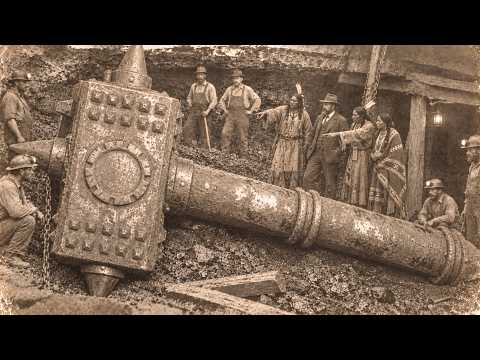
In the summer of 1888, deep beneath the hills of Erath County, Texas, a Scottish miner’s pick struck something that rang like a distant bell. What emerged from the solid coal seam was no ordinary rock—it was a hammer. But not one any human could wield. The handle was sixteen feet long, as thick as a man’s waist, and the head stood taller than a grown man. Its striking face bristled with rows of blunt spikes, and a strange round medallion adorned its side. Six men and two mules later tried to move it; the strongest could lift the handle only a hand’s width.
That same year, forty-five years before an elderly Comanche man would describe the object to an anthropologist, the hammer was sealed away in a forgotten side room. The miner who found it, Robert Mure, never forgot the cold—nor the warmth—of its metal. “The hand that swung this was not one of ours,” the shift foreman wrote in his log. And an old Comanche, who had never seen the mine or its records, would later say the same thing: “They laid it in the ground so that the earth might remember who first held it.”
The story begins not with the hammer itself, but with the land—a land that belonged to the Comanche long before coal companies and railroads. In the Cross Timbers, where oak and hickory cover the hills and the Brazos River winds through ancient valleys, the Comanche had wintered for generations. But there were hills they never camped on. A grandfather’s warning, passed down in a single sentence, would one day find its way into a notebook and collide with a foreman’s careful measurements.
In 1888, the Johnson brothers’ mine was a machine that fed the railroads. Hundreds of miners—Scots, Welsh, Irish, Italians—worked lying on their sides in thin coal seams, paid by the ton. On August 14, at the far end of the east entry, 120 feet below ground, Mure’s pick struck iron where only coal should be. There was no crack, no fissure, no sign that anything had entered the seam later. The coal above, below, and on both sides was solid. The sound traveled through the seam and reached two brothers working in the next room. They said it wasn’t the iron ringing—it was the entire seam.
Six days later, by lamplight, the hammer was fully exposed. Foreman Samuel Travale measured it with a tape and folding ruler: nineteen feet seven inches from tip to back, a head seven feet two inches tall, sixty-four spikes in eight rows, and a round medallion three feet across. It didn’t fit in the cage. The only way to the surface was a six-foot-wide shaft. The crew tried chains, mules, and the strongest man in the mine—a six-foot-four Welshman named Owen Maddock. He raised the handle a hand’s width, then let go. In the margin of his log, Travale wrote a line not found anywhere else: “The hand that swung this was not one of ours.”
An engineer, Charles Wearing, descended twice to survey the object. His notes were cold and numerical: the handle’s circumference, the uniform spacing of the spikes, the seven notches on the medallion—six close together, one apart. He tapped the medallion with a hand hammer; the ring lasted fourteen seconds, like a church bell. And he noticed something stranger still: beneath the rust, the iron handle bore thin parallel lines like tree rings, even knots—as if a wooden handle had been turned to iron, grain and all. Wearing’s final note read: “No one made this to be swung, not anyone like us.”
Johnson, the mine owner, made a practical decision. The hammer was dragged to an unused side room, forty feet away, in two days. The mules refused to enter the east entry again. Then he wrote to the state geologist in Austin, begging him to come and see. “I do not ask you to believe it. I ask you to come and see it.” But a strike, a sale, and a busy survey swallowed the letter. The side room was sealed with stone and brick, and on the company map, a single line: Old east entry closed.
Thirty-two years later, an engineer named Harlon Pierce cracked open that bulkhead to find a water leak. By lantern light, he saw a massive iron shape—nearly twenty feet long, with a spiked square mass and a round plate. He counted seven notches on the plate. Old planks and a broken chain lay on the floor, exactly as Travale had recorded them. Pierce’s report went to the general manager, who wrote one word in the margin: file. The bulkhead was repaired, and the east entry was sealed for the second time.
Forty-five years after the hammer was found, in the summer of 1933, an anthropologist named Edward Adamson Hobble sat in the shade of a tent in Oklahoma, interviewing a seventy-eight-year-old Comanche man who had never seen Thurber, never read English, never heard of Samuel Travale. The old man spoke of hills south of the Brazos where no camps were set. “The ancients’ war club,” he said through an interpreter. One side full of teeth. Three horns—above, below, and behind. A round symbol like a shield. Seven notches: six together, one alone. “They didn’t leave it to be used. A horse can’t pull it. A man can’t lift it. They laid it in the ground so that the earth might remember who first held it.” And in the margin, Hobble sketched the shape the old man had drawn in the air with his hands.
Two witnesses. No contact. The same impossible details. The same hand.
The question that hangs over all of this is not whether the hammer existed—the paper trail is too consistent, too quietly bureaucratic to be a hoax. The question is what the men who touched it understood. Robert Mure pressed his palm against the medallion and felt neither cold nor warmth, but the lingering sense of something just released. He walked to the old shaft every August until he died. His daughter never knew why. Perhaps he didn’t either.
And the Comanche elder, speaking in a language Hobble barely understood, offered no awe and no fear. Only a statement of fact, delivered the way one might describe a boundary stone. They laid it in the ground so that the earth might remember who first held it. Not a weapon. Not a relic. A marker.
There is a word the interpreter used that Hobble underlined twice in his notebook: remember. Not warn. Not honor. Remember. As if the earth itself were a ledger, and the hammer an entry that could not be erased.
What the old man described next has no counterpart in any company record. According to Hobble’s notes, the elder said the ancients did not vanish. They went west, beyond the mountains, and their hands remained. When Hobble asked what that meant, the interpreter hesitated. The old man repeated the phrase, then added a single sentence that Hobble wrote down and never explained: “The stone burned where they set it down, and it burns still.”
Hobble drew a question mark beside this line. Then, in different ink, he wrote a note to himself: Check coal seam fires, Palo Pinto. There is no evidence he ever did.
But the detail is not as strange as it first appears. Coal seams in the Cross Timbers did catch fire where they met the surface—lightning, brush fires, or simple exposure to air could set a seam smoldering for years. A hillside that smoked and turned black would be avoided by any people who knew the land. No hammer was needed to keep the Comanche from camping on those hills. A burning hillside was enough.
Yet the elder did not say the hills burned. He said the stone burned—where they set it down. The distinction matters. A coal fire is a natural phenomenon. A stone that burns because something was laid beneath it is something else entirely.
Hobble’s field notes from that summer contain dozens of interviews, most of them mundane. Camp layouts. Horse grazing. Which streams ran clear in drought. But the July 19 entry stands apart, not because of what the old man said, but because of what Hobble did with it. He did not include it in his published work. He did not cross it out. He simply placed it in an envelope marked not to be published and left it there for sixty years.
Why? The most ordinary answer is also the most likely. Hobble was a young anthropologist in 1933, working under Ralph Linton, trying to establish a career. A story about a giant iron hammer buried in coal, corroborated by a Scottish miner’s logbook and an engineer’s measurements, would not have advanced that career. It would have ended it. He filed it away and moved on.
But there is another possibility, one that Hobble himself may not have articulated. The old man’s account was not a legend. It was a memory—four generations deep, passed down with the precision of people who had no written records and therefore kept their histories exact. Six notches together, one alone. A detail that specific does not survive forty-five years of oral transmission unless someone, somewhere, made a point of remembering it.
The hammer was not a story the Comanche told to frighten children or explain the world. It was a fact they preserved. And facts, unlike stories, do not change in the telling. They are repeated until they are worn smooth, and then they are repeated again.
In the end, the records agree on something no historian can ignore. Three men—a foreman, an engineer, and an old Comanche—described the same object in the same way, and none of them ever met. The foreman measured it. The engineer mapped it. The elder remembered it. And all three, in their own language, said the same thing: this was not made by us.
Today the hills south of the Brazos are quiet. Cattle graze where the Comanche once wintered. The coal shafts are sealed and flooded, and the bulkhead at the old east entry, if it still stands, holds back dark water in a room no one has entered since 1920. The hammer, if it is there, lies where it was laid—beneath the stone, beneath the coal, beneath the hills that the Comanche never camped on.
And the question the old man left with Hobble, the one the anthropologist never answered, is the one that remains. They laid it in the ground so that the earth might remember who first held it. Not what first held it. Who. The distinction is small, but it is everything. A thing is remembered. A person is remembered. And the hand that swung the hammer, the hand that Travale said was not one of ours, belonged to someone.
Someone who was here before the Comanche. Someone whose arms were as long as spears. Someone who left a marker in the coal and a fire on the hill and a hammer too heavy for any living man to lift. The records do not say who they were. They only say that they were here, and that they wanted to be remembered.
The earth, if the old man was right, has not forgotten.
And if the earth remembers, it does so in the only language it has: through the weight of iron, the ring of a struck seam, the slow burn of a hillside that never quite goes out. Maybe that is what the Comanche meant by remember—not a story told, but a fact left in the ground, waiting for someone to measure it again.
Travale and the elder are both long dead. The drawings are lost, the letter misfiled, the bulkhead sealed. What remains is paper, pasture, and a red brick smokestack standing alone against the Texas sky. But paper is enough to ask a question that will not close.
If a thing can be buried so deep that only its dimensions survive—and if two strangers can describe the same impossible shape without ever meeting—then perhaps the hammer was never the mystery. The mystery is why we keep looking.
So here is what I want to know: if you stood at the base of that smokestack and the ground beneath you began to ring, would you dig—or would you listen?
Report this article
Select a reason for reporting:






