In the summer of 1888, deep beneath the hills of Erath County, Texas, a Scottish miner’s pick struck something that rang out like a distant bell. It wasn’t rock. It wasn’t pyrite. It was metal—and it was buried inside solid coal, 120 feet underground, with no crack or fissure to explain its presence. Six days later, by lamplight, the crew stared at a hammer no human could wield. The handle was 16 feet long, as thick as a man’s waist. The head stood taller than a grown man, its striking face covered in rows of blunt spikes. And beside it, carved into iron, was a round mark with seven notches—six together, one apart.
The strongest man on the team gripped the handle with both hands. He raised it a hand’s width. That was all. No human could swing that hammer. Yet a people who had never seen it already had a name for it: the Comanche.
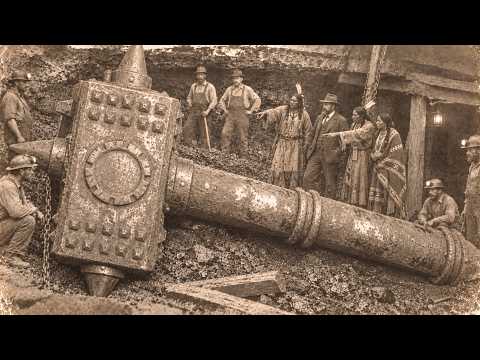
Forty-five years later, in a tent in Oklahoma, an elderly Comanche man would describe that hammer to an anthropologist—its spiked face, its three iron points, its round mark—and who had left it there. He had never been to Thurber. He couldn’t read English. He had never seen the foreman’s logbook or the engineer’s drawings. But his words matched them exactly.
This is where the story begins. But before we can understand what lies beneath the ground, we must understand the land itself.
Thurber is just a small dot on the map today, about 70 miles west of Fort Worth along Interstate 20. Few people live there. The only thing visible from a distance is a 128-foot red brick smokestack rising alone in the middle of flat land. But in 1888, these hills were the first part of a machine that set the heart of Texas in motion.
This region is called the Cross Timbers, a narrow, rugged belt stretching between the forests of East Texas and the open plains of the west. Beneath this land lies a thin, hard seam of coal left behind by an ancient swamp forest that sank approximately 300 million years ago during the Pennsylvanian period. Long before the coal, these lands belonged to a people.
The Comanche came down from the north in the early 18th century. They rode horses better than anyone else. For 150 years, they controlled a territory that spanned much of what is now Texas, Oklahoma, New Mexico, and Kansas. The Spaniards called this region Comanchería. The Cross Timbers formed the eastern edge of these lands. Comanche groups spent their winters in these sheltered valleys and ventured out into the plains in the spring to hunt bison.
But in Comanche law, not all these hills were the same. Camps were set up in some valleys for years, while others were merely passed through. The reason a place was not used was often conveyed in a single sentence passed down from a grandfather to his grandson. One of these sentences would find its way into an anthropologist’s notebook half a century later.
In 1875, the last Comanche groups were relocated to the Fort Sill reservation in Oklahoma. Eleven years later, the first coal shaft was opened on the hills that had once been their winter camp. In 1886, a land speculator from Michigan, William Whipple Johnson, began mining coal in Erath County with his brother Harvey. A year later, they signed a contract with the Texas and Pacific Railway. The railroad would purchase all the coal the Johnsons could extract.
The men who would mine the coal came from elsewhere. From the Lancashire coal field in Scotland, the southern valleys of Wales, the tin mines of Cornwall, Ireland, and the depleted mines of Pennsylvania and Illinois. By the summer of 1888, several hundred men were working at the Johnson’s mine. Most lived in wooden shacks along the muddy streets surrounding the mine.
Thurber’s coal was not easy to mine. The seam was thin, usually two to three feet thick. The men were lowered underground in cages through vertical shafts, then dispersed into low tunnels running along the seam. Most worked for hours lying on their sides, propped up on their elbows, their backs scraping against the ceiling. Each miner hung a small tin tag bearing his number on the cart he was digging and was paid for every ton weighed above ground. Nothing but coal was worth anything.
That’s why on the morning of August 14th, 1888, when the men came across something that wasn’t coal at the far end of the east entry, their first reaction was to dig it up and throw it away. But that was not the end of the story.
The first record of this story does not come from a newspaper, nor does it come from the memoirs of a treasure hunter. It comes from a foreman’s logbook.
Samuel Traval was a 44-year-old shift foreman from the town of Camborne in Cornwall. He had been working underground since he was 12—first in the tin and copper mines of Cornwall, then in Michigan, and now here. His job was to jot down the day’s entries in a thick clothbound logbook at the end of each shift. How many cars were shipped? In which room the ceiling cracked? Which mule was limping? Who didn’t show up for work? That logbook still survives. It is the only known shift logbook remaining from the Johnson’s short-lived operation.
Most of the entry dated August 14 is routine. 94 cars. Water in the west corridor. One mule replaced. Then at the bottom of the page, in a different ink, a single paragraph begins.
The gist of the paragraph is this: At 9 in the morning, at the far end of the east entry, a miner’s pick struck an iron object in the middle of the coal. There was solid coal above, below, and on both sides of the object. There were no cracks, fissures, or signs of water in the seam.
Robert Mure was a 31-year-old miner from Blantyre, Lanarkshire. Everyone knew Blantyre. In 1877, an explosion had occurred at a coal mine there, killing more than 200 men. Mure was 20 years old at the time and had been among the volunteers who recovered the bodies. He was not a man easily frightened.
According to Traval’s logbook, Mure struck the tip of his pick twice more and heard the same sound twice more. Then he set down the pick and called for the foreman.
That morning, five other men were working with Mure at the east entry. Traval had written all their names in his logbook. Two Irish brothers, Pat and Michael Keogh. Shot firer Tom Rudd. Loader Joseph Pew. And Owen Maddox.
According to company policy, the names of everyone present were recorded in the logbook whenever an unusual incident occurred. Accidents, cave-ins, deaths. Traval took this incident just as seriously as any accident.
There’s one more detail. According to Traval’s account, the Keogh brothers were working in the next room when they heard the sound. A thick column of coal separated them. The sound had traveled through that column and reached them. Michael Keogh said it wasn’t the iron itself that was ringing, but the entire seam.
For the next six days, at the end of each evening’s entry in the logbook, written in the same ink, there is one more short line. Day one: the edge was found. Day two: the surface continues with no end in sight. Day four: the roof rock is being cut. Day six: fully exposed. And in the entry for the seventh day, Traval writes for the first time what he saw in a single word: hammer.
The measurements Traval recorded on August 20 are a foreman’s measurements. They were taken with a measuring tape, a folding ruler, and a lamp. From the tip of the handle to the back of the head: 19 feet 7 inches. The height of the head: 7 feet 2 inches. Eight rows on the striking face, eight spikes in each row. Next to the head, a round carving approximately three feet in diameter. On three sides of the head, sharp iron points each approximately 20 inches long. And the final line: It doesn’t fit in the cage.
To understand what this line means, you have to picture a coal shaft. Men and coal cars were brought up from underground via a single route—a narrow cage that went up and down on a rope inside the shaft, just large enough to hold a cart. The cage in shaft number one was six feet wide. 120 feet below ground lay an iron hammer 19½ feet long, and there was no way to bring it to the surface.
The crew tried anyway. According to Traval’s entry for August 21st, six men and two mules tried to lift the head of the hammer using chains. One of the chains snapped. In another entry, it is written that the crew’s strongest man, the 6’4″ tall Welsh miner Owen Maddox, gripped the end of the handle with both hands. Maddox managed to raise it a hand’s width. Then he let go.
Below this line, Traval wrote something not found anywhere else in the notebook. A comment. The hand that swung this was not one of ours.
That same evening, the engineer was summoned.
Charles E. Whearing was a 29-year-old mining engineer raised in Pennsylvania. The Johnson brothers had hired him to map the veins and determine the locations of new shafts. He carried much more than just a foreman’s rope and measuring tape: a steel tape measure, a compass, a pocket scale, a magnifying glass, and a sketchbook. On August 22 and 23, 1888, Whearing descended into the east entry twice. He spent a total of 11 hours down there. He left behind a seven-page survey report and three pencil drawings.
The notes are those of an engineer. Brief, numerical, and uncommented. Total length: 19 feet 7 inches. Circumference of the handle measured at the center: 38 inches. At both ends of the handle and exactly at the center, there are ring-shaped bands two inches thick. The height of the head: 7 feet 2 inches. The width: 4 feet. Striking face: 64 spikes, eight rows, eight in each. Each spike is four inches across at the base and blunt at the tip. The spacing between them is uniform. Whearing measured the spacing between the spikes one by one and found no variation greater than 1/8 of an inch in any of them.
On the side of the head is a round medallion. Its diameter is 36 inches. Its surface is slightly raised like a shield. Along its edge at equal intervals are seven notches and three prongs. In Whearing’s notes, these three points are given their own paragraph: emerging from the top, bottom, and back of the head, each 20 inches long, thick conical iron points. Whearing writes that these were not cast together with the hammer. Each was attached to the head by a heavy riveted band. The rivet heads were irregular, as if hammered by hand. In other words, someone had once made this hammer and then added these points to it.
Later, Whearing does not discuss what this means. He merely writes: “The metal of the points is a different color from that of the head.”
Next comes the weight calculation. Whearing calculated the hammer’s volume piece by piece and multiplied it by the weight of cast iron. The result: if it were solid iron, it would weigh more than six tons. Six tons heavier than a set of locomotive wheels.
We know from his notes what Whearing’s three drawings show. The first is a full side view of the hammer scaled with a ruler. The second is a front view of the striking face with each of the 64 spikes marked individually. The third is the medallion itself with its seven notches drawn with a compass.
Whearing also conducted an experiment. He tapped the edge of the medallion lightly with a hand hammer and timed the sound with his pocket watch. The ringing lasted 14 seconds. Cast iron typically produces a short muffled sound. This sound, as he noted, was long and clear, like the sound of a church bell.
Whearing also noticed that the notches on the medallion were not evenly spaced. Six of the seven notches were close together, while one stood apart from the others. Whearing jotted this down on the margin of a drawing. He did not explain why it was important. We will return to this small detail.
At this point, we need to clarify something. Thurber’s coal is the remnant of a swamp forest that sank approximately 300 million years ago during the Pennsylvanian period. Coal forms slowly. Trees fall, sink into the water, are covered by mud. The mud turns to rock and the plants turn to coal. An object cannot enter this vein later on. If it does, it leaves a trace where it passed. A crack, a collapse, a fill. Traval’s notebook and Whearing’s notes both say the same thing: there was no such mark.
Whearing adds one more detail, perhaps the strangest of all. On the surface of the handle, beneath the rust, there were thin parallel lines resembling tree rings. Whearing had examined them with a magnifying glass. There were even knots, but the handle was not wood. It was iron from end to end. It was as if someone had transformed a handle that was once made of wood—grains and knots and all—into iron.
Whearing’s final note is a single line. No one made this to be swung, not anyone like us.
Below Whearing’s note, written in a different hand, is another date: August 24, and three words: Johnson down to be closed off.
This is where the official story begins. And to be fair, the official story has its own logic. William Whipple Johnson went down to the east entry on August 24. According to Traval’s log, he stayed for less than an hour. He walked around the hammer once, touched the spikes, and gazed at the medallion for a long time. Then he made two decisions.
First, the hammer would not be removed from its place. It wouldn’t fit in the cage. Widening the shaft would take weeks, and Johnson didn’t have a week to spare. The railroad was waiting for coal. Second, the hammer would be dragged out of the working corridor and moved to an old, unused side room at the east entry. According to Traval’s record, this task took four mules, three chains, and two days.
Both of these decisions were those of an operator. Not excessive, not secret, reasonable. Traval’s August 25 entry describes how the move was carried out. The men slid oak planks under the hammer. Four mules were tied with thick chains around the sharp tip at the back of the head. The hammer was dragged along the planks a few feet at a time all the way to the side room. The distance was only 40 feet. It took two days. Traval concludes this entry with a single line: The mules refused to enter the east entry again.
And Johnson did one more thing. On September 3rd, 1888, he wrote a letter to Austin. That year, 1888, Texas’s first state geological survey had been established. It was headed by a state geologist named Edwin Theodore Dumble. The survey’s mission was practical: to map Texas’s coal, iron, salt, and clay, and to guide the railroads and industry. Johnson’s coal was right in the middle of this effort.
A copy of Johnson’s letter remains among the papers of the company’s subsequent owners. The letter is two pages long. It describes the hammer with its measurements. It states that the coal around it was solid, and he requests that a geologist be sent from Austin. The letter’s final sentence is not one a businessman would typically use. Johnson concluded it this way: I do not ask you to believe it. I ask you to come and see it.
That year, the entire survey team, including the state geologist, consisted of six people. Its budget was too small to map the mines of an entire state. And its priority was the iron the railroads wanted, not coal. No one came. There’s no response in the survey’s records. No visit, not even a note.
It would be easy to interpret this as malice. But looking at the rest of that year, there’s a much more ordinary explanation for the silence. In September 1888, the Knights of Labor union went on strike at Johnson’s mine. The miners were protesting wage cuts and the prices at the company store. The mine shut down. That same month, a few months after the death of Johnson’s brother Harvey, the business went up for sale. In October 1888, the Johnsons sold all their coal properties to the newly formed Texas and Pacific Coal Company. The company’s president was a Scottish cattle rancher named Robert Dickey Hunter. One of his partners was H.K. Thurber from New York. The town would be named after him.
As its first act, the new company fired the strikers, fenced off the mine with barbed wire, and brought in new workers. The unfinished business of the old management—old ledgers, old letters, old grievances—was no one’s priority. In November 1888, that side room at the east entry was sealed off with a stone and brick wall, ostensibly for ventilation. A single line was written on the company’s map at that point: Old east entry closed.
This explanation may be correct. A strike, a sale, a new company, a busy survey. More than enough for a letter to go missing. But this explanation doesn’t account for one thing. The hammer itself.
The third record does not come from a mining company, nor does it come from a government agency. It comes from a notebook kept in the shade of a tent in Oklahoma.
In the summer of 1933, during the depths of the Great Depression, the Laboratory of Anthropology in Santa Fe sent six young researchers to the southwestern part of Oklahoma to the town of Lawton. They were led by anthropologist Ralph Linton from the University of Wisconsin. Their mission was to speak with the last generation who remembered the Comanche people’s life before the reservation. For six weeks they sat with 18 Comanche elders. They asked about family structure, law, war, hunting, ceremonies, and old campsites.
One of those students was 27-year-old Edward Adamson Hoebel. Hoebel would later write about Comanche law and 20 years later co-author with Ernest Wallace one of the most widely read books on the Comanche people, The Comanches: Lords of the South Plains. But that book did not cover everything.
In one of Hoebel’s field notebooks from the summer of 1933, there is an interview dated July 19. The interviewee is a 78-year-old Comanche man identified in the notebook only by his age and group. He was born around 1855. As a child before the reservation era, he had spent winters with his family along the tributaries of the Brazos River and on the oak-covered hills of the Cross Timbers. He did not speak English. His nephew served as the interpreter during the interview.
Much of the interview, like the others that summer, described the layout of a camp, who sat where, where the horses were grazed in the winter, and which streams provided drinking water. According to Hoebel’s notebook, the interview took place outside Lawton in the shade of a canvas tent the team had set up. The July heat had reached 110 degrees in Oklahoma that summer. The old man preferred to sit on the ground on a blanket rather than in a chair. His nephew sat beside him and Hoebel sat across from him. The interview began in the morning and lasted until the afternoon.
The old man’s own life story is also recorded in those pages. As a child, his family had migrated from the tributaries of the Brazos to the Red River and from there to the Wichita Mountains. He recounts that at the age of 19 in 1874, he and his family were removed from the plains and resettled at Fort Sill. He never saw the Cross Timbers again after that. So, the hills the old man knew were the hills of 1874, the hills from 12 years before coal was discovered.
Then, Hoebel asks about the old campsites, and the old man speaks of the hills south of the Brazos, the area we now call Palo Pinto and Erath counties. According to Hoebel’s note, the old man first gives a brief answer: No camps were set up on those hills.
Hoebel asks why, and the old man recounts what he heard from his grandfather. According to his grandfather, when the Comanches first came down from the north into these lands, the area was not empty. There were traces of those who had come before them: stone circles, abandoned trails. And on those hills, where the stone had turned black and burned, something of the ancients lay. The interpreter tries to find the word his grandfather used. Hoebel wrote the interpreter’s phrase in his notes: War club. The ancients’ war club.
Hoebel asks what it looks like. The old man spreads his hands to the sides. Then he holds one hand up and the other down. According to the interpreter’s account, one side is full of teeth. It has three horns, one above, one below, and one behind. And next to it is a round symbol like a shield.
Hoebel placed a question mark next to this sentence. Then he added: teeth. He probably meant sharp protrusions.
Hoebel asks another question. What was on the round mark? The old man’s answer comes through the interpreter’s mouth like this: Seven notches, six together, one alone.
Hoebel made no note next to this. Hoebel asks who left it there. The old man’s answer is a single line in Hoebel’s notebook: the ancients. Their arms were as long as spears.
And Hoebel asks why it was left there. In the notebook, the final lines of this passage from the old man read as follows: They didn’t leave it to be used. A horse can’t pull it. A man can’t lift it. They laid it in the ground so that the earth might remember who first held it. Then one more sentence: A stone covered it. It will remain there until the stone burns.
After the old man said this, according to Hoebel’s note, he said nothing else. The conversation returns to horses, streams, and winter camps, and neither in any of the notes published that summer, nor in the compilation of field notebooks published years later is this page to be found. That page remained among the notebooks Hoebel did not prepare for publication.
The old man listed his grandfather’s stories one after another as if in anaphora, each beginning with the same word. Hoebel wrote this down exactly as it was. They were here before us. They said they knew where the stone burned. They said they left that place, but their hands remained. They said—and according to Hoebel’s note, as the old man spoke this last sentence, he placed both hands on his knees and stared for a long time.
And in the margin of this page, drawn by Hoebel’s pen, there is a small sketch: a few quick lines, a square head, short lines on one side like teeth. Three short points above, below, and behind the head, and a small circle next to it. There is a single word beneath the drawing: his hands. So Hoebel had transferred the shape the old man had drawn in the air with his hands onto the paper exactly as he saw it—not his own interpretation, the old man’s hands.
In Hoebel’s notebook, there’s another note added later beneath this account, written in a different ink. No date, just two lines. I asked the interpreter, ‘Had his grandfather seen it?’ The answer, ‘No, his great-grandfather had seen it.’ So, this story stretched back four generations, from 1933 all the way to the years when the Comanches first moved south.
We need to pause here and state something clearly. By 1933, this old man had never been to Thurber. He had never gone down into the coal mine. He couldn’t read English. He hadn’t seen Samuel Traval’s notebook. He hadn’t seen Charles Whearing’s notes. He had never seen Johnson’s letter. None of these documents had been published up to that point. And in 1888, no newspaper had reported the hammer found in the east entry.
Now let’s place these two accounts side by side without adding anything. The company record states that the object was found inside the coal. The oral account states that the ancients’ thing lay where the stone had turned black and burned. The company record states that the object was located on the hills at the border of Palo Pinto and Erath counties south of the Brazos. The oral account points precisely to those hills where the Comanches did not camp. The company record states that there were 64 spikes on the striking face. The oral account states that one side was covered with teeth. The company record states that there are three sharp points attached above, below, and behind the head. The oral account mentions three horns, one above, one below, and one behind. The company record says there is a round medallion next to the head. The oral account says there is a round mark next to it like a shield. And in the company record, there is a note on the edge of an engineer’s drawing: seven notches, six are close together, one is separate. In the oral account, 45 years later, there is a statement from an elderly man: seven notches, six together, one alone.
The company record states that even the strongest man could raise the end of the handle only a hand’s width, and that it took four mules two days to move it. The oral account says a horse couldn’t pull it and a man couldn’t lift it. And in an unpublished line from the company record, Samuel Traval wrote this: The hand that swung this was not one of ours. 45 years later, 200 miles to the north, a man who had never seen that line said this: Their arms were as long as spears.
This does not mean the two records prove the same thing. They prove nothing. It merely shows that two witnesses who had never seen each other described an object on the same land in the same way. It’s not our place to decide what was described, but we know what the man who last came into contact with whatever was on those hills felt.
Robert Mure was there the day the hammer was moved to the side room at the east entry. According to his daughter, Jean, who recounted the story years later, after the mules had been led away and the chains gathered up, Mure remained alone for a while. He set his lamp down on the floor. He pressed his palm against the center of the medallion. The metal wasn’t cold, he told his daughter. Nor was it warm. It was as if someone had just let go of it.
Jean Mure told this story in 1958 at the age of 80 to a local historian who was collecting the memories of Erath County’s early settlers. The historian’s note sits among the papers of the county’s historical society. Jean said her father had died of pneumonia in 1911, but he never forgot that hammer. Every August, she said, her father would walk alone one evening to the old number one shaft, stand there for a while, and then return. He never said why he went.
The fourth record comes 32 years later, and this time from the other side of a sealed bulkhead.
After 1888, Thurber grew. The Texas and Pacific Coal Company expanded the Johnsons’ few shafts to more than 15. The town reached the largest size a company town could possibly achieve: around 10,000 people from 18 different nationalities. Italians, Poles, Mexicans, Welsh, and Irish. It had its own brick factory, its own opera house, its own churches, and its own hotels. Thurber’s bricks paved the roads of Texas. In 1903, the miners unionized, and Thurber became one of America’s first fully unionized company towns. But underground, the old east entry to shaft number one, behind the bulkhead built in 1888, remained a darkness that no one ever entered.
In 1917, everything changed. Oil was discovered in the town of Ranger, a few miles west of Thurber. Before long, one of Texas’s biggest oil booms began. Locomotives switched from coal to oil. In 1918, the company changed its name to the Texas Pacific Coal and Oil Company. Coal was now the company’s secondary business, and the old shafts began to fill with water.
In March 1920, the company sent a young electrical engineer named Harlon Pierce to install a new pump line in the lower galleries of shaft number one. Water was coming from the direction of the old east entry. Pierce’s task was to find where the water was seeping in. Pierce was 26 years old. He had studied electrical engineering at the University of Texas in Austin and had just returned from the war. When he arrived in Thurber, 10 shafts were still operating in town, but the company’s entire investment was going toward the oil wells to the west. The task assigned to Pierce was a cost-saving measure to stop the water in the cheapest way possible.
A copy of Pierce’s field report sits among the company’s correspondence from 1920. It’s an engineer’s report. Pipes, pressures, pump capacities. And on the third page, a single paragraph. Pierce discovered that water was seeping from the base of the bulkhead at the old east entry. The bulkhead had cracked from 32 years of moisture. Pierce and two workers removed a few stones from the upper corner of the bulkhead to see where the water was flowing. Pierce held his lantern into the opening. The sentence in his report reads as follows: Behind the bulkhead on the floor of the chamber lay a large cast iron machine part nearly 20 feet long with a spiked square mass at one end.
Pierce thought he saw a machine part. He didn’t know what it was part of. He wrote this down exactly as it was in the report. The next sentence in the report is even stranger. Pierce wrote that on the floor of the room, around the object, lay old planks and a broken chain. The planks pulled by mules in 1888, and the chain that broke, as recorded in Traval’s notebook, were still there 32 years later. The room had not been opened by anyone since the day it was sealed.
And Pierce noted one more thing. The air in the room was drier than the air in the hallway. Water was seeping from the bottom of the bulkhead, but it had not entered the room. But Pierce didn’t neglect to take measurements. He extended his lantern and folding ruler as far as he could through the opening. He recorded the height of the square block as approximately seven feet. He tried to count the spikes on one side and saw eight rows where the light from his lantern reached. And next to the block, a round bulging plate. And one more line: There were notches on the edge of the plate, seven of them.
Harlon Pierce had never seen Samuel Traval’s notebook. He had never seen Charles Whearing’s notes. He hadn’t even been born in 1888. But 32 years later, through a crack in the bulkhead, he counted the same seven notches.
The final line of Pierce’s report, however, was a decision: The bulkhead is to be repaired. Water to be pumped by another route. The bulkhead was repaired, and the old east entry to shaft number one was sealed for the second time.
The names of the two workers who were with Pierce that day are also in the report. One was Ignatio Fina, an Italian pump operator who had come from Piedmont in the 1890s. The other was Stanislaw Rubil, a Polish loader. Fina’s family recalled that when he returned home that evening, he spoke only one sentence: Someone had left something behind there and hadn’t come back.
Pierce’s report went to the company’s general manager, William Knox Gordon. Gordon was the man who had discovered oil at Ranger three years earlier. The future of the coal mines lay in his hands, and that future did not lie in old tunnels to be pumped dry. Gordon’s initials are in the margin of the report. Beneath them, a single word: file.
The fifth record does not come from Thurber, but it comes from the same coal belt. Thurber’s coal is part of a vast swamp belt that covered the interior of North America during the Pennsylvanian period. Coals from the same period stretched from Oklahoma to Kansas and from Illinois to Pennsylvania. And throughout this belt, from the late 19th century to the early 20th century, other objects found inside the coal were also recorded.
In June 1891, in the town of Morrisonville, Illinois, a woman named S.W. Culp was splitting coal for her stove when she saw a thin gold chain emerge from the center of a piece of coal. The chain was about 10 inches long. The local newspaper, the Morrisonville Times, reported this as a brief news item on June 11th, 1891. The report stated that both ends of the chain were still inside the coal and that the exact center of the chain was revealed when the coal was split in half. The chain was shown to a jeweler. After that, all trace of it was lost.
In 1912, in the town of Thomas, Oklahoma, two workers at the municipal power plant broke apart a large piece of coal to feed into the furnace. A small cast iron pot emerged from the center of the piece. The cavity left by the container in the coal was an exact mold of the container’s outer surface. The power plant’s coal came from mines in Wilburton, that is, from the same Pennsylvanian formation. The container sat in a worker’s home for years. Then it too disappeared.
And there is a third account, this time from across the ocean, from Robert Mure’s own homeland. In 1844, the Scottish physicist Sir David Brewster presented a brief paper at a meeting of the British Association. At the Kingoodie Quarry near Dundee, workers had broken open a block of sandstone nine inches thick and found inside it a rusted iron nail, its head embedded in the stone. One inch of the nail was embedded in the stone. The block had been cut from one of the quarry’s solid layers. Brewster offered no explanation. He merely recorded what he had seen. The nail was lost over the following decades as it passed from one collection to another. Lanarkshire is 100 miles from Kingoodie. Mure wasn’t even born in 1844, but the story of that nail was still circulating in the pubs of Scottish mining towns during his childhood.
Let’s pause for a moment. Wilburton is in Oklahoma, and in 1912, Oklahoma was the land where the Comanche had been settled in 1875. The town where the power plant in Thomas is located is only 100 miles from Lawton, where Hoebel spoke with the old man in 1933. This doesn’t prove a connection, but it shows that the same coal belt in the same years yielded objects of the same kind in the hands of people who were independent of one another. Objects that could not have been placed there without leaving a trace, right in the middle of the coal, and each one’s story ends in the same place: in a newspaper clipping, in a worker’s home, on a jeweler’s counter. None of them ever made it to a museum shelf.
The sixth and final record is perhaps the strangest of all, because this record refers not to an object but to a file.
The Texas Geological Survey, established in 1888, lasted six years. Edwin Dumble and his team systematically mapped Texas’s coal, iron, and clay for the first time. The survey’s annual reports were published and can still be read today. In the survey’s early reports, the coal seams in Erath and Palo Pinto counties are described in detail: their thickness, quality, and distribution. Not a single word about a hammer.
But the survey’s correspondence was kept separately. When the survey closed in 1894, the documents were transferred to the state archives, and there in the index of the correspondence, there is a single line entry dating from 1888: W.W. Johnson, Erath County. Iron object in coal. See Palo Pinto lignite. The file had been cataloged under the wrong county and the wrong subject. Palo Pinto County’s lignite file. Not a coal file, but a lignite file. Johnson’s mine, however, was in Erath County, and it produced bituminous coal, not lignite.
We don’t know who made this mistake. Probably a clerk. Probably on a busy day. Probably without any intention to do so. The date on the line in the index is September 19th, 1888, 12 days after Johnson’s letter reached Austin. That same week, the survey’s small team had left Austin to examine the iron deposits in East Texas. A clerk and a few hundred letters remained in the office, but the result remains the same. Palo Pinto’s lignite file sits in the archives today. Johnson’s letter is not in it.
And it is not just the letter that is missing. A copy of Charles Whearing’s seven-page memo along with the Texas Pacific Coal and Oil Company’s papers is now in the archives of the W.K. Gordon Center at Tarleton State University. The memos are there. All seven pages. But the three drawings are missing. On the cover of the file, in a different handwriting, there is a note: drawings 1920 to the engineering department Mr. Pierce not returned. After looking behind the bulkhead, Harlon Pierce had requested the 1888 drawings. He did not explain in his report why he wanted them, and after leaving Pierce’s desk, the drawings were never returned to any file.
What happened to Pierce afterward is also known. In 1921, as the last mine was closing, he left the company and began working for an electric company in Houston. He died in 1962. After his death, his daughter donated his papers to a church foundation in Houston. In the foundation’s catalog, there is a single line entry for Pierce’s box: engineering drawings, Thurber, 1888. Three items. The box itself was lost during the relocation of the foundation’s storage facility in the 1970s.
And the third document is a page from Hoebel’s notebook. Edward Adamson Hoebel died in 1993. Decades’ worth of his field notebooks, letters, and lecture notes were transferred to a university archive. The notebooks from the summer of 1933 are among them. But those notebooks are not in the same sequence as those included in the compilation of Comanche field notes published years later. In the archive’s catalog, there is a separate envelope inside the 1933 box. On it, in Hoebel’s handwriting: Comanche miscellaneous, not to be published. Inside that envelope lies a page dated July 19th, 1933, along with the drawing in the margin. A researcher might request it, but first they’d have to know it was there.
A letter was cataloged in the wrong county. Three drawings went missing from an engineer’s desk. A notebook page remained among an anthropologist’s unpublished notes. None of this was a secret. None of them were hidden. None of them were destroyed. It’s just that none of them were followed up on.
There’s also a version of this story where everything fits neatly into categories. And to be honest, that version carries considerable weight.
First, the machines. The Johnson’s mine in 1888 was no primitive excavation. There were steam cranes, water pumps, cast iron counterweights, and railroad workshops. The steam hammers of that era, the hammers of pile-driving machines, and pump shafts weighed tons. When Harlon Pierce looked behind the bulkhead in 1920, he described what he saw as a machine part. Perhaps that was exactly what it was: a broken piece of an old machine, once lowered down and forgotten.
Second, the rock itself. Thurber’s coal seams contain iron-rich nodules. Geologists call these siderite or clay iron nodules. Some are as big as a fist, others as large as a car. When they rust, they develop a dark crusty surface. Protrusions may form in regular rows across their surfaces. A spiky face in the lamplight might look like a carving to weary eyes.
Third, the timing. The hammer was found a few weeks before the Knights of Labor strike. The mine was about to change hands. A story, one that could boost a company’s value or divert a dispute, might have suited someone’s interests right before a sale. A joke, a game, or a worker’s tale might have become a recorded account over time.
And there’s also an oral aspect to this explanation. The spot where the old man’s grandfather said the rock burned might be something quite ordinary. Coal seams sometimes catch fire spontaneously where they come to the surface. Lightning, a brush fire, or simply contact with the air can smolder an exposed seam for years. A hillside that smokes, turns black, and reeks of sulfur would be considered an ominous place in any culture. No hammer was needed to keep the Comanche from camping on those hills. A burning hillside was enough.
Fourth, how the oral tradition endures. This is not a lack of respect for the oral tradition. It is its very nature. In the 45 years between 1888 and 1933, did the paths of Thurber’s miners and Oklahoma’s Comanche communities never cross? Traders, railroad workers, cowboys, soldiers. A story about a giant hammer in Thurber might have made its way as far as a tent in Lawton. And in an old man’s memory, it might have become intertwined with the tales his grandfather told.
Fifth, and perhaps most telling, is the notebook itself. Hoebel’s 1933 notes were not an audio recording. They were a translator’s words transcribed onto paper by a student’s hand. A tooth-filled face, three horns, a circular symbol. How much of this was the old man’s words, how much his nephew’s, and how much Hoebel’s, there’s no way to know.
And finally, the evidence itself. The hammer never saw the light of day. No metal analysis was ever performed. No geologist ever set foot in the room. The drawings are missing. The letter is in the wrong file. All we have is paper.
Each of these explanations is reasonable. Some taken on their own are quite convincing. But taken together, they struggle to account for the most stubborn detail of this story. A siderite lump wouldn’t have seven notches. A steam hammer’s head wouldn’t have three spikes riveted onto it later. And in 1933, in the shade of a tent, the shape drawn in the air by a man who couldn’t read English does not look like an incomplete copy of three unpublished engineering drawings.
This is not a weakness of the story. It is the story itself.
And one more detail, the smallest one, but perhaps the hardest to explain. On the edge of Whearing’s drawing, six of the seven notches were close together, one stood apart. 45 years later, an elderly man who had never seen that drawing said the same thing: six together, one alone. Could the position of a single notch be explained by a clerk’s filing error, a worker’s hearsay, or a translator’s choice of words?
Today, anyone heading to Thurber exits Interstate 20 and after a few hundred meters pulls up at the base of the red brick smokestack. The smokestack is the only remnant of the old power plant. Next to it are a small restaurant, a museum, and a cemetery for former miners. On the gravestones, Italian, Polish, and English names stand side by side. Robert Mure’s marker is there as well. 1911.
The site of shaft number one is now private pasture land. The shaft was closed in the late 1920s and its mouth was filled with dirt. The tunnels below, like all the Thurber shafts, have long been submerged. The twice-sealed bulkhead of the old east entry, if it is still standing, stands in dark still water.
Today, the small museum at the W.K. Gordon Center displays the Thurber miners’ picks, lamps, tin tokens, and photographs. On one of the walls is a map showing the locations of the old shafts. Next to shaft number one is a small inscription: Johnson Mine, 1886. The east entry is not shown on the map.
Thurber’s last mine closed in 1921. The miners went on strike and the company chose not to reopen the mines. In the late 1930s, the company moved its headquarters to Fort Worth and the town’s houses were sold off one by one and moved to other towns. Thurber, which once had a population of 10,000, was reduced within a few years to nothing more than a smokestack, a church, and a cemetery.
And beneath it all, if what these records describe is truly there, a 19½-foot-long iron hammer with its spiked face and three sharp points still lies beneath the hills where the Comanche never camped. No one brought it up. No one could lift it.
At the end of the summer of 1888, a Scottish miner drove his pick into the coal, and the tip rang out. That day, it was easy to think it was just a piece of ordinary scrap metal. But a shift foreman gave it its dimensions. An engineer gave it its shape. And an old Comanche man gave it a purpose. The three had never met.
The mine is real. The company is real. The survey is real. The summer of 1933 in Lawton is real. The unanswered questions begin only from that point on.
The old man’s grandfather had said that the hammer wasn’t left behind to be used. It was left so the earth would remember who first held it. Samuel Traval, however, had written something else in his notebook: The hand that swung this was not one of ours. A foreman and an elderly Comanche, unaware of each other, were both speaking of the same hand. One measured it, the other remembered it. Neither said to whom it belonged.
If this is true, does that ground still remember? And did the Comanche know who held those hills before them?
Report this article
Select a reason for reporting:






