Professor David Richardson had examined thousands of historical photographs, but the moment he saw the 1904 studio portrait of Adelaide Peton, something cold crawled up his spine. The girl sat in an ornate Victorian chair, her white dress immaculate, her dark ringlets perfectly arranged, her expression serene—almost angelic. Yet her eyes seemed to pierce through the sepia tones, holding a secret that refused to stay buried.
As he adjusted his magnifying glass over her hands, a tiny distortion in the left glove caught his eye—a subtle bulkiness, a faint discoloration near the wrist. “That’s odd,” he murmured. Under the lens, the imperfection became unmistakable: the glove seemed to strain over something beneath, something that didn’t belong.
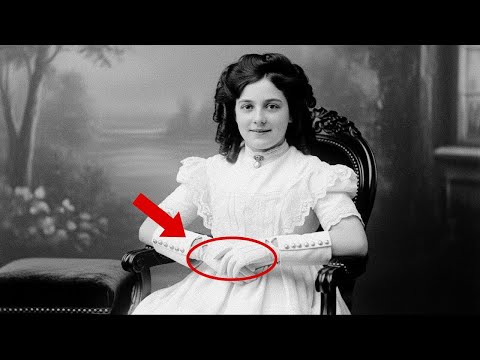
David’s pulse quickened. He reached for his macro camera, capturing the image at extreme resolution. The enhanced scan revealed what the naked eye could never see: a pattern of stains consistent with blood—partially cleaned, but forever etched into the fabric. “Blood,” he whispered. “And bandaging underneath.”
He turned the photograph over. The inscription read: Adelaide Peton, age 12, October 15th, 1904. Our precious angel. But the date aligned with something far darker. Three weeks earlier, Adelaide’s governess, Katherine Walsh, had died after a fatal fall down the mansion’s marble staircase. The death was ruled an accident.
David’s research unearthed a string of suspicious incidents: a neighbor’s dog poisoned, a young servant drowned, and letters from Katherine Walsh describing Adelaide’s chilling behavior. “She threatened me,” Katherine had written to her sister. “I fear for my safety.” Two days later, she was dead.
The photographer’s notes from that October session were equally unsettling: “Subject displayed unusual composure… insisted on wearing gloves despite recommendation… seemed to direct her own posing.” Adelaide had been concealing her injured hand—and the bloodstained evidence of her crime.
As David stared at the portrait, he realized the girl’s serene smile was a mask. The photograph, meant to project innocence, had instead preserved a chilling truth for over a century. And this was only the beginning.
David closed the archive folder and rubbed his eyes, but the image of those gloved hands refused to fade. He had spent twenty years separating fact from fiction in old photographs, and every instinct told him this was no mere curiosity. “Maria,” he said quietly, “I want everything we have on the Peton family—not just the clippings. Ledgers, court records, property deeds, anything.”
Maria raised an eyebrow. “You think there’s more?”
“There’s always more when a family spends that much money burying its tracks.”
It took three days to assemble the file. What David found in the Peton financial records made his stomach turn. Harrison Peton had made a series of payments to a private physician, Dr. Ephraim Locke, throughout the autumn of 1904—sums far too large for routine house calls. The doctor’s own ledger, preserved in a medical society collection, listed the visits simply as “consultation, household.” No names. No diagnoses.
But the timing was damning. The payments began four days after Katherine Walsh’s death and continued for six weeks—exactly the period when Adelaide’s hand would have been healing.
David tracked down Dr. Locke’s surviving correspondence and found a single letter that had slipped through the family’s careful net of suppression. It was addressed to a colleague in Philadelphia, dated November 1904, and it was written in a shaky, unsettled hand.
“I have attended to the child as requested, but I must confess I have never encountered a subject so composed under pain. She watched me stitch her palm without a flinch and asked, quite calmly, whether the scar would be visible in photographs. When I asked how she had come by the wound, she smiled and said she had caught it on a rosebush. There are no roses in October, and the cut was too deep and too straight for any thorn.”
David read the passage twice. Too straight for any thorn. A blade, then—or the edge of something she had gripped while pushing a woman down a staircase.
He cross-referenced the letter’s date with the studio session. The portrait had been taken on October 15th. Dr. Locke’s visit was logged for October 9th. Adelaide had been wounded six days before sitting for her angelic photograph, and she had worn gloves to hide the fresh stitches.
“She wasn’t just concealing blood,” David told Maria, spreading the documents across his desk. “She was concealing the wound itself. The photographer noted she directed her own posing. She knew exactly which hand to hide and how to fold her fingers so the bandage wouldn’t show.”
Maria leaned closer. “But why sit for the portrait at all? Why risk it?”
David tapped the mother’s diary entry he had photocopied earlier. We must ensure that her special nature is channeled appropriately. “Because her mother demanded it. Eleanor Peton wanted proof of her daughter’s innocence to wave in front of Boston society. And Adelaide—twelve years old—understood that the photograph was a weapon. She just didn’t realize it would cut both ways.”
He paused, staring at the girl’s face in the sepia image. The serene smile now looked less like innocence and more like triumph.
“There’s one more thing,” David said, reaching for a slim archival box he had requested that morning. “The Peton estate sale included a box of Adelaide’s personal effects. Most of it was children’s clothing and schoolbooks. But at the bottom, wrapped in oilcloth, there was this.”
He lifted the lid. Inside lay a small leather diary, its pages warped with age, its clasp still intact.
Maria’s eyes widened. “Is that hers?”
“It’s dated 1904,” David said. “And the first entry is October 16th—the day after the portrait was taken.”
David hesitated before opening it. A child’s diary from 1904 should have been filled with lessons, small grievances, dreams of ponies and parties. But he had learned that Adelaide Peton was no ordinary child, and the oilcloth wrapping suggested someone had wanted this book hidden—or destroyed.
He slipped the clasp and turned to the first page. The handwriting was neat, disciplined, far more controlled than a twelve-year-old’s hand had any right to be.
October 16th, 1904. The words were written in dark ink, pressed hard into the paper. Mother insists I record my thoughts as part of my education. I will record what pleases me and nothing more. Yesterday the photographer came. He smelled of chemicals and fear. He asked me to remove my gloves. I told him no. Mother said nothing, though she watched my hands the whole time. She knows. She has always known. That is why she looks at me the way she does—like a dog watching a door it cannot close.
David felt the breath leave him. He read on.
The stitches itch. Dr. Locke said the cut will heal clean if I do not pick at it. I told him I never pick at anything. He laughed, but his laugh was wrong. He knows too. They all know, and none of them will say it aloud. That is the power of a good name and a quiet face.
Maria had gone very still beside him. “She’s writing about it like it’s nothing. Like it’s—housekeeping.”
“That’s exactly what it is to her,” David said. “Katherine Walsh was an obstacle. You remove obstacles.” He turned the page carefully, the brittle paper crackling under his fingers.
The next entry was dated October 19th. Katherine is gone and the house is quieter. Mother cried in her room where she thinks no one hears. Father has not spoken of it at all, which is his way. I wore the gloves again at dinner. No one asked why. No one ever asks why.
David’s jaw tightened. “She’s documenting her own crime,” he said. “Not with guilt—with satisfaction. This is a trophy, Maria. Someone wrapped it in oilcloth because it was evidence, and they couldn’t bring themselves to burn it.”
“Or because they couldn’t bear to touch it,” Maria said softly. “Imagine being the maid who found this. Imagine reading it and knowing you could never speak of it.”
The diary continued for months, each entry a cold little ledger of grudges settled and threats neutralized. November 1904: The dog in the garden barked at me every morning. It does not bark now. December 1904: Thomas in the stables asked too many questions about the cat. He has stopped asking.
David closed the book and pressed his palms flat against the desk, steadying himself. He had spent his career chasing the truth through fogged lenses and faded ink, but he had never held a confession written in a child’s hand, page after page, without a single tremor of remorse.
“We need to call Detective Kelly,” he said. “And we need to find out what happened to the rest of this diary. This can’t be the only volume.”
He glanced once more at the portrait propped against his lamp. Adelaide Peton smiled back at him, hands folded neatly in her lap, gloves hiding everything—except what a century of patience had finally uncovered.
Detective Kelly arrived within the hour, and together they spread the diary’s pages across the table like a map of a small, terrible country. Kelly read in silence, then set the book down with the care of a man handling live ordnance. “This isn’t a confession,” he said. “It’s a schedule.” He was right—the entries continued past 1904, thinning but never stopping, a lifetime of quiet removals recorded in the same disciplined hand.
David traced one entry from 1911, written when Adelaide was nineteen: Mother is unwell. The doctor says her heart. I say it is time. Eleanor Peton died that spring. The cause was listed as natural. David felt the old chill return. “She didn’t just kill strangers,” he said. “She killed the one person who protected her.”
Kelly nodded slowly. “And then she married, twice, and outlived them both. We have a pattern that runs seventy years. The portrait was never the end of anything. It was the first page.”
The exhibition opened on a gray November morning, and Patricia Walsh stood before the photograph for a long time without speaking. When she finally turned, her eyes were wet but steady. “My family waited four generations for someone to believe us,” she said. “Thank you for looking closely.”
David thought of Katherine Walsh, twenty-three years old, writing letters to her sister, frightened but unwilling to abandon the other servants. She had been the first person to see Adelaide clearly—and the first to pay for it.
That evening, alone in his office, David studied the portrait one last time. The white dress, the ringlets, the folded hands. A century of visitors would pass before it and see only a precious angel. But beneath the left glove, the truth remained—patient, permanent, waiting for someone curious enough to look.
He switched off the lamp. The girl’s eyes followed him into the dark.
What would you have done, in 1904, if you had been the one to find this diary?
Report this article
Select a reason for reporting:






