In the glittering ballrooms of Fifth Avenue, Mrs. Astor reigned supreme, her name synonymous with old-money elegance and ironclad social rules. But behind the limestone facade and crystal chandeliers, a far darker truth lay buried—a truth that would unravel the very foundation of her empire. The fortune that built her mansion was not born of polite society rituals, but of opium shipped to China, a trade that devastated millions and lined the pockets of New York’s elite.
Caroline Schermerhorn Astor was born into a world where bloodline meant everything, but as new money flooded the city, she saw an opportunity to weaponize wealth. Marrying into the Astor family, she gained access to a fortune tainted by the opium trade—a fact she never questioned. With ruthless ambition, she commissioned a mansion at 34th Street and Fifth Avenue, a palace designed to enforce social hierarchy and exclude the unworthy. Every detail, from the ballroom that held exactly 400 guests to the imported silk wallpaper, was a declaration of power.
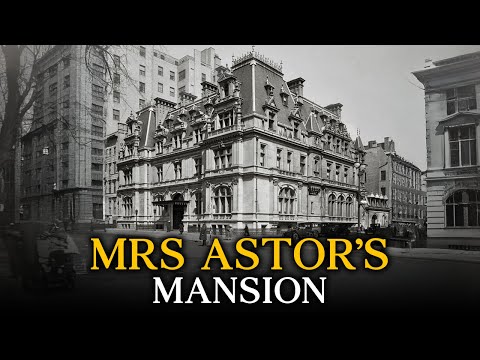
But the mansion was more than a home; it was a machine. Caroline and her social secretary, Ward McAllister, perfected the art of exclusion, turning invitations into weapons and guest lists into barriers. The 400 became legend, and Mrs. Astor became the gatekeeper of American aristocracy. Yet, the foundation of her power was built on suffering an ocean away—a truth that would eventually surface, challenging everything she had created.
As the Gilded Age roared on, new fortunes challenged the old order. The Vanderbilts and other industrialists built bigger, grander mansions, forcing Caroline to adapt or be left behind. The opera war, the rise of the hotel culture, and the death of her husband and daughters slowly eroded her control. By the time she died in 1908, the world had moved on, and her mansion was demolished within two years, replaced by the Waldorf Astoria. The legacy of Mrs. Astor’s mansion is a tale of ambition and denial, a reminder that behind every grand facade lies a story of what we choose to ignore.
But the story did not end with the demolition of the mansion. The opium trade that funded the Astor fortune left scars that would never fully heal, and as the 20th century unfolded, the truth began to seep through the cracks in the family’s carefully constructed narrative. The Astors, like many Gilded Age dynasties, had mastered the art of selective memory, but history has a way of demanding its due.
In the decades following Caroline’s death, the Astor name continued to command respect, but the source of their wealth remained a taboo subject. The family’s official histories focused on John Jacob Astor’s fur trading and real estate acumen, conveniently omitting the lucrative opium shipments that had provided the initial capital. It was a silence that echoed through generations, a willful blindness that allowed the Astors to maintain their status as American royalty.
Yet, as historians and journalists began to dig deeper into the archives, the evidence became impossible to ignore. The ledgers, the ship manifests, the correspondence—all pointed to a vast network of opium trafficking that had enriched not just the Astors but many of New York’s most prominent families. The China trade was the invisible backbone of Gilded Age wealth, and the Astors were among its most successful practitioners.
In the 1970s, a young historian named Dr. Eleanor Vance stumbled upon a cache of letters in the Astor family archives. They revealed in stark detail how John Jacob Astor had personally overseen the financing of opium voyages, instructing his captains to prioritize the drug above all other cargo. “The profit from a single chest of opium exceeds that of ten bales of silk,” he wrote in an 1823 letter. “We must expand our operations before our competitors do.” These words, cold and calculating, laid bare the ruthless logic that had built the Astor empire.
Dr. Vance’s research, published in a modest academic journal, initially attracted little attention. But as the 21st century dawned, a new generation of activists and scholars began to demand accountability. They argued that the Astor fortune, and countless others like it, was stained with the blood of millions of Chinese addicts. The call for reparations, though controversial, gained traction in academic circles and among Chinese-American communities.
The Astor family, now scattered and largely removed from the public eye, declined to comment. Their silence spoke volumes. The mansion was gone, but the money remained, invested in hedge funds and real estate, still generating wealth from a foundation laid in suffering. The family’s philanthropic efforts—donations to museums, universities, and hospitals—were seen by some as an attempt to whitewash their history, a way to buy respectability with tainted dollars.
Meanwhile, the site of Caroline’s mansion had become a bustling commercial hub. The Empire State Building, erected in 1931, drew millions of tourists each year, few of whom knew that the ground beneath their feet had once been the stage for one of America’s most audacious social experiments. The building’s observation deck offered a panoramic view of the city, but it also offered a vantage point from which to contemplate the hidden histories that lay beneath the glittering surface.
In 2019, a small plaque was finally installed near the entrance of the Empire State Building, acknowledging the site’s history. It mentioned the Astor mansion and its role in shaping New York society, but it made only a passing reference to the opium trade. “The wealth that built this mansion came from global commerce, including the China trade,” it read. The wording was cautious, almost evasive, as if even now, more than a century later, the full truth was too uncomfortable to confront.
For some, the plaque was a step forward; for others, it was a token gesture that did little to address the deeper issues. The opium trade had not just enriched the Astors; it had destabilized an entire civilization, contributing to the decline of the Qing Dynasty and the century of humiliation that followed. The consequences were still felt in China, where the legacy of colonialism and addiction lingered in the national consciousness.
Back in New York, the story of Caroline Astor’s mansion became a cautionary tale for a new generation of wealth. As tech billionaires and hedge fund managers built their own monuments, they faced questions about the sources of their fortunes. The Astor example served as a reminder that wealth, no matter how grandly displayed, could never fully escape its origins. The mansion had been demolished, but the questions it raised about money, power, and morality remained as relevant as ever.
In the end, the story of Mrs. Astor’s mansion is not just about one woman’s ambition or one family’s fortune. It is about the stories we tell ourselves to justify our privileges, and the truths we bury to protect our legacies. The limestone walls are gone, but the silence they enforced has only begun to break.
The silence, once broken, proved impossible to fully restore. In the years that followed the plaque’s installation, a quiet but determined movement took shape among descendants of the very families whose fortunes had been built on the China trade. They called themselves the Inherited Debt Project, a loose coalition of heirs from Astor, Delano, and Russell lineages who had grown uncomfortable with the polished omissions of their family histories. They did not demand reparations from one another. Instead, they began funding research, translation work, and public education about the opium traffic that had seeded so much of New York’s grandeur.
Their first major act was quiet: a grant to digitize the Canton ledgers held in scattered archives from Boston to Hong Kong. For the first time, scholars could trace individual chests of opium from Turkish fields to Chinese ports to the counting houses that converted the drug into Manhattan mortgages. The data was damning in its precision. One ledger entry, dated 1857, showed a shipment of 612 chests consigned to a firm whose partners included a future Astor in-law. The paper trail had survived where the mansion had not.
But the project also drew fire. Some family members denounced it as self-flagellation, a betrayal of the very ancestors who had lifted them into comfort. Others questioned the motives, wondering whether guilt was simply another luxury the wealthy could afford. The debate spilled into op-eds and panel discussions, and for a time the Astor name was in the news again—not for a ball or a wedding, but for a reckoning.
What no one anticipated was the response from China. A group of historians at a university in Fujian, working with descendants of families devastated by the trade, reached out to the Inherited Debt Project with an unusual proposal. They wanted to collaborate on a joint archive, one that would hold both the merchants’ ledgers and the victims’ testimonies side by side. “You cannot return the silver,” their letter read, “but you can return the record. Make the two halves of the story whole.”
The proposal moved slowly through committees and cautious negotiations. Some in the project feared it would invite demands they could not meet. Others saw it as the only honest path forward. By the time the agreement was signed, the project had committed to funding a fellowship program for Chinese scholars of the nineteenth-century trade, and to publishing the ledgers in full, without editorial softening.
Meanwhile, the physical remnants of Caroline’s world kept surfacing in unexpected places. A chandelier from the mansion’s main hall, long believed lost, was rediscovered in a small museum in upstate New York, mislabeled as belonging to a lesser Gilded Age family. A curator noticed the error while cataloging a donation and traced the fixture back to the 1909 auction records. The museum, after some internal debate, added a corrected label and a short explanatory panel. Visitors began pausing in front of it, reading about the opium trade for the first time.
The mansion itself had left no ruins to visit, no crumbling walls to photograph. Its absence was the point. Where a fortress of exclusion once stood, there was now a tower of commerce and a plaque that strained to tell the truth. The city had buried Caroline’s monument twice over—first in rubble, then in the ordinary bustle of midtown traffic. Yet the questions she had spent her life avoiding refused to stay buried.
In the spring of 2023, a small exhibition opened in a gallery near Bryant Park, just a few blocks from the old mansion site. It was titled What the Walls Knew, and it paired photographs of Fifth Avenue’s grandest interiors with reproductions of opium ledgers and ships’ manifests. The juxtaposition was jarring by design. A gilded ballroom on one wall, a cargo list on the next.
The exhibition drew modest crowds at first, then larger ones. School groups came. Tourists wandered in out of the rain. Some visitors left unsettled, others grateful. A guestbook near the exit filled with handwritten reflections. “I grew up admiring these houses,” one entry read. “I never asked who paid for them. I will now.”
The organizers had deliberately left one wall blank, save for a single line of text: The story continues. It was an invitation, not a conclusion—a reminder that the excavation of hidden histories was not a single act but an ongoing discipline. Caroline Astor had spent decades enforcing silence. The work of undoing that silence, it seemed, would take just as long.
The blank wall became a pilgrimage site of sorts. Visitors began leaving notes of their own, taped carefully beneath the printed line. “My great-grandfather smoked opium in Canton,” one read. “He died at thirty-one. Thank you for saying his name.” The gallery eventually replaced the wall with a rotating display of these offerings, calling it the Unfinished Archive.
Dr. Vance, now retired, visited the exhibition on its final weekend. She stood before the guestbook for a long time. Then she wrote a single sentence: History does not settle its debts—it only keeps the accounts.
The mansion is gone. The fortune endures. The silence is cracking open, one honest sentence at a time.
So here is the question that remains: when you walk past the grand facades of old New York, do you see the beauty—or do you wonder what it cost? Tell us in the comments.
Report this article
Select a reason for reporting:






