At 2:25 AM on June 29, 1967, a 1966 Buick Electra 225 hurtled down US Route 90 near Slidell, Louisiana, its headlights cutting through the humid Gulf Coast darkness. Inside, three adults sat in the front seat: a driver, a lawyer, and a woman with platinum hair who had just performed at a Biloxi supper club and was rushing to her next engagement in New Orleans. In the back seat, three children lay asleep—the youngest just three years old. Without warning, the car slammed into the rear of a tractor-trailer at full speed. The roof sheared off. The three adults in front were killed instantly. The three children in back survived.
The woman was Jayne Mansfield—Broadway star, Playboy icon, the self-made bombshell the press called the next Marilyn Monroe. She was 34 years old, with five children by three husbands, a pink mansion on Sunset Boulevard, and a fame so carefully engineered that even her death could not outrun the myths built around it. The world would remember the crash. Almost no one would ask what happened to the children who lived through it.
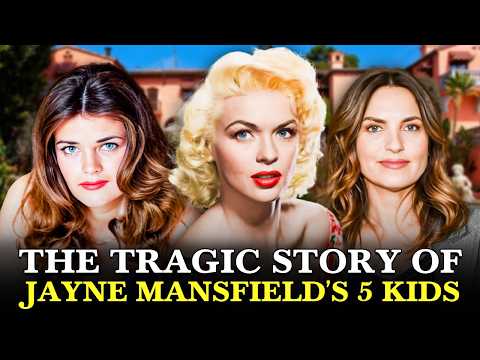
This is the story of those five children, scattered across different fathers, different households, and different versions of the same mother. It spans nearly 60 years—from the pink palace to a 2025 documentary that finally broke the family’s longest silence. It is a story about what children inherit when what they lose is not just a parent but a myth.
To understand what happened to those three children in the back seat—and to the two who were not in the car at all—you have to go back to a girl named Vera Jane Palmer, born on April 19, 1933, in Bryn Mawr, Pennsylvania. Her father, Herbert Palmer, was a lawyer. He died of a heart attack when Jane was three years old. That detail is not incidental. It is the first line of a pattern that would run through three generations of this family: a child, a sudden absence, and a life reorganized around a loss no one fully explains.
Decades later, Jane’s own daughter would be three years old when she lost her mother on a Louisiana highway. The echo is not symbolic. It is structural. The family’s defining wound repeated itself almost exactly, a generation apart.
After Herbert’s death, Jane’s mother, Vera, remarried a man named Harry Peers, and the family moved to Dallas, Texas. The girl who arrived in Dallas was already restless in a way that went beyond ordinary childhood energy. She studied piano seriously. She studied violin. She took up dance. She learned languages—German, Spanish, French—absorbing them with the appetite of someone who understood instinctively that the more skills she accumulated, the harder she would be to dismiss. She entered a beauty contest as a teenager, not because she lacked other ambitions, but because the stage—any stage—answered something inside her that ordinary life could not.
There is a particular kind of child who responds to early loss by becoming impossible to overlook, who decides—consciously or otherwise—that if she makes herself bright enough and loud enough, the world will not be able to look away. Jane Palmer was that child. Whether she was running toward ambition or away from the grief of a dead father is a question the record does not fully answer. It was almost certainly both. Most self-creation stories begin in loss.
What Jane wanted from a remarkably young age was not just to be seen, but to be studied, admired, discussed, and remembered. She would later tell interviewers she had an IQ of 163, that she spoke five languages, that she could play piano and violin with serious technical skill. The specific numbers have never been independently verified—Britannica notes that the documented basis for those exact scores remains uncertain—but the impulse behind the claim is worth sitting with. Jane Mansfield needed the world to understand that the woman inside the body was not the woman the body advertised. She was more deliberate than she appeared, more calculating, more intelligent. The dumb blonde was a character she had invented and then performed with extraordinary precision. And the performance was the product. She was not a victim of the image. She was its architect. And that distinction would matter enormously to her children, who would spend their adult lives trying to excavate the real woman from underneath the character she had so successfully built.
She became a mother before she became famous. At 17, still living in Texas, she married Paul Mansfield, a public relations man she had met in high school. On November 8, 1950, Jane gave birth to a daughter, Jayne Marie Mansfield. The baby arrived while Jane was still a teenager, still unknown, still married to her first husband in a quiet domestic life that bore no resemblance to the one she would later construct. That timing gives Jayne Marie a position in the family story that none of the other children share. She is the only one who existed before the machinery of fame started turning. She had a mother—not a persona, not a brand, not a cultural product—just a mother. A young woman in a small Texas marriage who held her firstborn and had not yet decided to remake herself into someone the entire country would recognize. The others, born later into increasingly public circumstances, would inherit something far more complicated. Jayne Marie had the real thing, however briefly, which would make her grief, when it came, a different animal entirely.
The marriage to Paul Mansfield did not survive Jane’s ambition. She moved to Los Angeles. She enrolled in drama classes at UCLA. She posed for photographers who could see what the camera already knew: that Jane’s body and face and platinum hair were built for a medium that rewarded visual spectacle above almost everything else. She worked her way into the entertainment industry with a ferocity that startled even the people who were used to ambition.
By the mid-1950s, Jayne Mansfield had become one of the most photographed women in America—a blonde with a 40-inch bust, a breathy voice she could weaponize at will, and a publicity instinct so sharp it sometimes outpaced the career it was supposed to serve. Broadway came first. The play was Will Success Spoil Rock Hunter?, and it was a sensation. Not because Jane was the greatest actress of her generation, but because she understood something about audiences that many of her peers did not. She knew that the woman who plays dumb while being smart creates a tension the viewer cannot resolve, and that unresolvable tension is what keeps people watching. The play ran through 1955 and 1956 and made Jayne Mansfield a name. 20th Century Fox took notice and signed her to a contract—the kind of studio deal that in the 1950s still meant something close to a guarantee of stardom.
Playboy featured her multiple times, with Jane’s enthusiastic participation, because she recognized the magazine as another stage in a career built entirely on stages. She was not embarrassed by the exposure. She courted it. She understood, before most of her contemporaries did, that visibility was currency and that the body the public wanted to see was the same body that could negotiate for better roles, better billing, better pay. She starred in The Girl Can’t Help It, a 1956 musical comedy that exploited the contradiction she had already perfected: the woman who looks like a caricature and knows she looks like a caricature and plays the caricature better than anyone else because she is in on the joke—and the audience is never quite sure whether they are in on it too.
She followed it with the film version of Will Success Spoil Rock Hunter?, which brought her stage triumph to movie screens nationwide. For a brief window—perhaps two or three years—Jayne Mansfield looked like a star who might last. The box office was strong. The publicity was relentless. The name was everywhere. The press called her the new Marilyn Monroe. The comparison was both a compliment and a trap. It meant Jane existed not on her own terms, but as a reflection of someone else’s template—a copy, a rival, a second choice. Marilyn Monroe was already the most famous woman in the world. The studio system did not need another version of her. It wanted one anyway, because the comparison generated headlines, and headlines sold tickets, and the entire machinery of mid-century Hollywood ran on the principle that a woman’s commercial value lay not in what she could do but in what she could represent.
Jane understood this game with a clarity that bordered on ruthlessness. She played it with discipline. The photo opportunities were engineered for maximum impact. The wardrobe choices were calibrated for maximum controversy. The public appearances that were beneath their apparent spontaneity meticulously staged events. She once told an interviewer that the real stars were not good actors or actresses, but personalities. She was not being modest. She was describing her own strategic framework. She had decided that fame itself was the product, and she manufactured it with the consistency of an assembly line.
But there was a cost to making herself a brand, and the cost compounded over time. The brand needed constant feeding. It needed new stories, new images, new reasons for the public to keep paying attention. And the family—the growing, complicated, increasingly fragmented family—became raw material for that machine.
Mickey Hargitay entered the story on a nightclub stage in the mid-1950s. He was Hungarian-born. He had been Mr. Universe. He was a bodybuilder with a broad chest, a thick accent, and hands that had done real physical labor long before they ever touched the spotlight. When Jane first saw him, he was performing in Mae West’s stage act—another strong man in a show built around another blonde who had made a career out of sexual provocation and comedic timing. The line that survived in family mythology was Jane turning to a companion at her table and saying, “I’ll have a steak and the man on the left.” Whether she said exactly those words, or whether the family polished the memory over decades, matters less than what the line reveals about the dynamic from the beginning. Jane chose Mickey the way she chose everything: with instinct, with speed, and with an eye for the image. He was strong. He was loyal. He was visually spectacular. He was willing to be part of the show. And he could build things with his hands—which would matter more than anyone realized at the time.
They married on January 13, 1958. The ceremony was itself a media event—photographed, publicized, and folded into the ongoing production that was Jayne Mansfield’s public life. Mickey Hargitay Jr. was born that same year, 1958. Zoltan Hargitay followed in 1960. Mariska Hargitay arrived on January 23, 1964. Three children in six years, each born into a household where the boundary between family life and publicity campaign had long since dissolved. Each born under flashbulbs, announced in columns, and absorbed into an image of domestic abundance that was in its own way as carefully constructed as any film set.
And then there was the house. After the marriage, Jane and Mickey bought a Mediterranean-style estate at 10100 Sunset Boulevard in Los Angeles. The price was $76,000. The property had 25 rooms. It sat on 3½ acres of land in one of the most photographed neighborhoods in America. It was already a significant home. But Jane, who understood better than almost anyone in her industry that the private life was simply another set waiting to be dressed, set about transforming it into something no one in Hollywood had ever quite seen before.
Every wall was painted pink. The carpets were pink. The curtains were pink. The bathtubs—plural—were heart-shaped and pink. The swimming pool was heart-shaped, too, inscribed at the bottom with the words, “I love you, Janie.” There were cupids mounted on the walls, dozens of them, arranged with the density of a theme park. There were chandeliers that dripped with excess. The doorknobs were pink. Guests reported that as many as 40 Chihuahuas padded through white shag carpet so deep and so thick that visitors were asked to remove their shoes at the front door to keep from tracking in the outside world. Jane herself, giving a tour to a reporter, called the house “like living in a wonderful powder box.”
The Pink Palace was not simply a house. It was the family mythology made physical—an architectural argument that this marriage, this family, this life was defined by love so abundant it had to overflow into every surface and every room and every object. Mickey, who was genuinely skilled with his hands and who had done construction work before Hollywood, built much of the renovation himself. He laid tile in the bathrooms. He shaped wood for the shelving and the trim. He poured the concrete for that heart-shaped pool with his own labor, working in the Los Angeles sun while Jane directed the aesthetics from inside. His craftsmanship was in the walls, the floors, the structural bones of the building—the parts nobody photographed. Jane’s vision was on every visible surface—the parts everybody photographed. Together, the house told a truth about the marriage that neither of them would have stated aloud: it was built on real attraction and real physical effort, but it was also built for an audience that was always, always watching.
The Pink Palace did not just shelter a family. It proved to the world that the family existed, that the love was real, that the children were happy, that the bombshell was also a devoted wife and mother, and that the entire glittering package was available for public admiration. Architectural Digest would later document the house in detail, preserving the sheer excess of the decor as a kind of cultural artifact—evidence of a time when celebrity domesticity was its own performance art.
During the peak years—the late ’50s and the first years of the ’60s—the image held. Jane took her children everywhere and said so publicly, often enough that the claim itself became part of the brand. She brought the children to premieres. She brought them on set. She brought them into television studios. A 1966 appearance on The Merv Griffin Show captured the family performance at its most vivid and its most strained: Jane seated with children around her, joking her way through small-scale chaos, managing the unpredictability of young kids on live television with the practiced ease of a woman who had been performing since adolescence. At one point, she made a joke about having lost Jayne Marie. Somewhere along the way, the studio audience laughed and the moment passed. It was a throwaway line, delivered with a smile. But the joke had an edge the audience could not have caught. Jayne Marie was not lost. She was the child from before the fame—the daughter whose relationship with Jane had been formed in a quieter, more private era, before the Pink Palace, before Mickey, before the full weight of the publicity machine descended. Jayne Marie had been, for a brief time, the only child. She had her mother to herself. And then the family expanded around her, and the myth hardened, and the woman she had known as simply “Mom” became a figure the world thought it owned.
In the trailer for Mariska’s 2025 documentary My Mom Jayne, Jayne Marie said, “In the beginning, I had her to myself.” That is a devastating sentence—not because of what it says, but because of what it implies about everything that came after. The gradual loss. The delusion. The realization that the mother she remembered was being replaced, in the public record and in the family’s own mythology, by a character.
And that family, at its widest, contained five children spread across three marriages and three fathers. Jayne Marie from Paul Mansfield—the oldest, the one with memories. Mickey Jr., Zoltan, and Mariska from Mickey Hargitay—the Pink Palace children, the ones born into the spectacle at its peak. And Tony Cimber, born in 1965, from Jane’s third husband, director Matt Cimber, whom she had met during a stage production and married with the speed that characterized nearly every major decision she ever made. Each child occupied a radically different position inside the family’s emotional architecture. Jayne Marie remembered a private mother and carried that memory like a photograph nobody else could see. Mickey Jr. grew up watching his mother perform and understood, even as a boy, that she was smarter than the act. Zoltan was the physical child, the one who absorbed the family’s proximity to danger in his own body. Mariska was born into the fracture itself—the baby who arrived as the marriage was ending and who carried a biological secret she did not yet know. Tony came last, into a third marriage already fraying—the child with the least access to the woman in the center and the most distance from the mythology that had formed around her. They were not a unit. They were a constellation, held together by the gravitational pull of one woman’s fame and destined to scatter violently when that gravity disappeared.
By the early 1960s, the cracks had already started spreading beneath the pink paint. Jane’s career, which had peaked with the Broadway success and the Fox contract, was losing altitude in ways that were visible to the industry even if the public had not yet fully registered the shift. The major studio roles had dried up. Fox had not renewed her contract with the enthusiasm it once showed. And the parts coming in now were increasingly low-budget, increasingly exploitative films shot on tight schedules in foreign countries—projects that traded on her body and her name without offering much artistic substance in return. She made films with titles that told their own story: Too Hot to Handle, Promises! Promises!, The Loves of Hercules. She was still famous. She was still recognized in public and photographed at events and openings and premieres. She still drew crowds when she showed up. But the fame had changed in character, and the change was irreversible. It was sustained now by publicity stunts and tabloid appearances rather than by the kind of studio prestige that builds a lasting career.
The gossip machine around her intensified during this period—rumors linking her name to powerful men, including John F. Kennedy, though the strongest sourcing frames such connections as things Mansfield claimed rather than things that have been independently confirmed. The tabloid atmosphere around her name was itself evidence of the career’s new center of gravity: less art, more scandal; less ascent, more maintenance. The woman who had once headlined on Broadway and starred in studio comedies was navigating a slow public slide into the world of B-movies and nightclub road dates. And the gap between what she projected and what she was actually living had never been wider.
At home, the marriage to Mickey Hargitay cracked open. Their divorce was finalized in 1964—the same year Mariska was born. The timing is almost unbearably precise. Mariska entered the world at the exact moment the family’s foundational partnership was being legally dissolved. The Pink Palace still stood on Sunset Boulevard. The heart-shaped pool still held water. The cupids still hung on the walls. But the marriage that had built all of it was finished, and the children were being redistributed into the kind of custody arrangement that transforms a household into a logistics problem. Mickey Senior moved out. The home that had been built to prove love existed was now evidence that the love—or at least the marriage—had ended.
And beneath the divorce, invisible to everyone outside the innermost circle of the family, lay a deeper secret. One that would take decades to surface. And when it finally did, would rewrite the emotional history of the family from the inside out. Mariska’s biological father was not Mickey Hargitay. He was Nelson Sardelli, a nightclub entertainer and singer with whom Jane had been involved during the final disintegration of her marriage. Mickey raised Mariska as his own from the moment she was born. Whether he knew the truth from the beginning or came to understand it later, he never publicly acknowledged any distinction between Mariska and his biological children. He never treated her differently. He never withdrew his claim on her. The family closed around the secret the way families do—not with a formal agreement or a spoken pact, but with the collective, unspoken understanding that some truths are more dangerous spoken aloud than they are kept buried beneath the daily mechanics of raising children, paying bills, and getting through the week. Mariska would not learn the full story until she was an adult, long after the childhood that the secret had shaped was already behind her. When she finally spoke about it publicly in interviews surrounding her 2025 documentary, she framed the revelation as the end of a silence that had defined her relationship to her own identity for 30 years. She said she had been living a lie. She also said—with unmistakable and deliberate force—that Mickey Hargitay was her real father. That biology told one kind of story, but the man who chose her, who raised her in his house and never once made her feel like anything other than his daughter, told a story that mattered more. Both statements were true. Both had to be true, because the only alternative was a family built on nothing at all. And the fact that they could both be true at the same time tells you everything about the family Jayne Mansfield created: the public story and the private truth were rarely the same thing, and the children were always the ones left holding the gap between them.
Jane married Matt Cimber soon after the divorce. Tony was born in 1965, and the family portrait reshuffled once more—one teenager from the first marriage, three young children emotionally bonded to a father no longer in the house, and an infant belonging to a new husband in an arrangement already showing strain. The instability did not begin with the crash. By the mid-1960s, it was the family’s default condition.
Then came the prophecy. On November 23, 1966, Jane took six-year-old Zoltan to Jungleland USA for a publicity photo. A lion attacked the boy from behind, biting into his neck and head hard enough to require emergency brain surgery. Zoltan survived. But the child of spectacle had been mauled inside another spectacle—the family’s mythology of visibility nearly killing one of its own.
For a while, the damage remained survivable. The threads had not yet fully given way. Then, in the summer of 1967, the road ran out.
By late spring, Jane’s life had narrowed to a circuit of nightclub dates and road gigs that kept her name in lights even as the wattage dimmed. She was 34, in divorce proceedings for the third time, involved with Sam Brody—a volatile lawyer whose presence created constant turbulence. The work still came, in places like Biloxi, because the engagements paid and because Jane had never learned how to stop performing.
The last night followed a pattern so ordinary it is unbearable to reconstruct. On June 28, 1967, Jane performed a late show in Biloxi. She had a television appearance in New Orleans the following morning. Rather than wait for dawn, she and Brody and a 20-year-old driver named Ronnie Harrison loaded into the Buick. In the back seat lay Mickey Jr., Zoltan, and Mariska, asleep. They had been folded into this rhythm so many times that sleeping in a moving car was as routine as sleeping in a bed.
They headed west on US Route 90. The highway was dark and flat. Some accounts say the truck ahead was obscured by a cloud of mosquito-abatement spray hanging over the road. Whether the spray was decisive or whether darkness and speed and exhaustion were sufficient on their own, the result was the same. The Buick struck the trailer without slowing. The roof was sheared completely off. Harrison, Brody, and Jane were killed instantly. In the back seat, lowered below the line where the roof had been torn away, the three children survived—cuts, bruises, and a zigzag scar above Mariska’s lip that she would carry for the rest of her life.
The crash became a national story within hours. And almost immediately, a rumor began circulating that Mansfield had been decapitated. What actually happened was this: the force of the collision displaced her blonde wig, which was found lying on the road near the wreckage. Photographs of the wig on the asphalt fused with the horror of the crash and became a myth so durable that no correction has ever fully dislodged it. The children did not only inherit the grief of their mother’s death. They inherited a public narrative about that death that was, in one of its most persistent details, a fabrication they could never escape.
Jayne Marie was not in the car that night. She was 16, living her own life, already at a physical distance from the family’s daily operations. Her loss arrived differently. She did not wake up inside wreckage. She did not carry the physical scars of the impact. But she carried something none of the others had: actual memories of her mother as a private person, as a young woman before the mythology hardened. “In the beginning, I had her to myself.” That sentence contains an entire childhood and its dissolution.
Mickey Jr. and Zoltan became the brothers who carried the physical fact of the crash inside their bodies. They had been there. They had survived. Mariska had nothing. She was three years old. She would later say—and say again, with increasing openness as the decades passed—that she had no memory of the accident and no memory of being told that her mother had died. The defining event of her life existed as a blank in her own experience, filled in gradually over the years by other people’s accounts, by photographs she studied like evidence, by a cultural record that preserved her mother as a pinup and a punchline but almost never as a parent. Tony, at two, was the youngest and most remote—not in the car, not awakened by the impact, not carried from the wreckage. He lost his mother at an age when loss does not register as narrative. But as architecture, his entire life was built around a missing foundation.
Jayne Mansfield’s death was the famous part. The headline, the myth, the cultural shorthand. But the crash was not the end of the story. It was the hinge. Everything before it belonged to one family. Everything after it belonged to five separate people, each carrying a different fragment of the same shattered inheritance, none of them able to see what the others held.
After the funeral, the family that had once been photographed as a single glamorous pink-saturated unit became something quieter and more difficult to see. Mariska, Mickey Jr., and Zoltan went to live with Mickey Hargitay Senior and his wife Ellen. Tony went to his father Matt Cimber. Jayne Marie, at 16, was the oldest and most complicated case—old enough to understand fully, too young to be independent.
It was Ellen Hargitay who became, in every practical and emotional sense, the mother who remained for the three middle children. She had not given birth to them. She had not been part of the Pink Palace mythology. She had entered Mickey’s life after the divorce, after the spectacle, and did the unglamorous, unphotographed work of putting a broken family back together. She made meals. She drove children to school. She managed the daily logistics of a household containing three kids who had lost their mother in the most public and horrifying way imaginable and who needed, more than anything, someone who would simply be there in the morning. Mariska later said she called Ellen “Mom.” And the way she said it—with a directness that did not invite pity—made it clear the word was not a substitution or a consolation prize. It was accurate. It was earned.
Mickey Senior himself became a different kind of figure after the crash. During the marriage, he had been the strong man beside the bombshell, the supporting player in someone else’s production. After Jane’s death, stripped of that role, he became something quieter and more essential: a father. Not a celebrity father performing fatherhood for cameras—just a father. By most accounts, he raised the children with steadiness, physical affection, and without ostentation. He did not push them toward show business. He did not trade on Jane’s name. He provided the kind of domestic stability that does not photograph well and does not generate magazine features, but that traumatized children need more than almost anything else: the stability of a man who gets up every day and does the same thing, who is where he says he will be, who does not disappear.
And he carried, throughout the decades that followed, the knowledge that the youngest of the three children in his care—the daughter he loved as completely as any parent can love a child—was not biologically his. If Mickey knew about Sardelli, he never let it change his behavior. Mariska was his daughter. The birth certificate said so. The daily reality said so. The way he treated her said so. And when Mariska, as an adult, finally learned the truth and had to decide what to do with it, the fact that Mickey had never wavered became the foundation of her response. She did not reject him. She did not rewrite the story. She said he was her father, and she meant it.
The children grew up. They diverged. And the paths they chose, considered together across five lives and five decades, read like five separate arguments about what to do with the inheritance of a famous, tragic, complicated mother.
Mickey Hargitay Jr. made the most deliberate break from the family pattern. In 1980, at 22, he opened a plant business in Los Angeles. He called it Mickey Hargitay’s Plants. The name was his father’s, not his mother’s, and the business was rooted—in every literal and metaphorical sense—in the ground. He grew things. He sold things that grew. He spent his days with soil and sunlight and the slow, patient rhythms of vegetation, which is about as far from the accelerated, image-driven, flashbulb-punctuated world of Jayne Mansfield’s career as a person can get while still living in Los Angeles. His family, he said, had always reached for the stars, and he had wanted to keep his feet on the earth. That is not a condemnation of Jane. It is a renegotiation. The child of spectacle choosing substance. The son of a woman who lived for visibility choosing a life that grows quietly and does not need an audience to justify its existence.
Zoltan Hargitay took a path adjacent to the family’s world but deliberately behind the camera rather than in front of it. Like his father—the man who had built the Pink Palace with his own hands, who had laid tile and shaped wood and poured concrete for a heart-shaped pool—Zoltan worked with physical materials. He went into film and television production, accumulating credits as a set carpenter and construction crew member. He built the physical structures on which other people’s stories were told. There is an almost too-perfect resonance in that career choice: the child of Jayne Mansfield, a woman who built the most elaborately constructed facade in Hollywood, spending his adult life literally building facades for a living. Whether Zoltan saw the parallel or would have found it interesting is unknown. He did not give many interviews. He did not seek attention. He showed up, did the work, and went home—a rhythm his mother, for all her talents, had never been able to sustain.
Jayne Marie Mansfield, the oldest of the five, lived most of her adult life at the greatest possible distance from the family’s public mythology. She did not pursue fame. She did not write a tell-all memoir. She did not sell her story to tabloids, though the story she could have told—the oldest daughter of the most famous sex symbol of the 1950s, the child who had her mother to herself before the world took her away—would have commanded enormous public interest. She chose instead a kind of resolute privacy that lasted decades. She lived quietly in Los Angeles. She raised her own family. She did not trade on the Mansfield name for commercial advantage or public sympathy. When she surfaced in the 2025 documentary material, the line she gave was the one that cut deepest: “In the beginning, I had her to myself.” It was a sentence about childhood. It was also a sentence about loss—not just the loss of the crash, but the earlier, slower loss of a mother who had chosen fame over intimacy and then died before the choice could ever be revised.
Tony Cimber, the youngest, built his adult life at the farthest remove from the Mansfield mythology of any of the five children. He was raised by Matt Cimber, his father, in a household entirely separate from his half-siblings. He did not grow up with Mickey Jr., Zoltan, and Mariska in Mickey Hargitay’s home. He did not have Ellen as his daily mother figure. He did not share bedrooms or dinner tables or holidays with the children who had been in the car that night. He had a different father, a different household, a different daily rhythm—and therefore a fundamentally different relationship to the loss. Where the Hargitay children had each other, even if they did not talk about the deepest things, Tony had the particular solitude of the youngest child from a dissolved marriage, raised at a distance from the siblings who shared his mother but not his daily life. He spent much of his adult life working in Las Vegas in real estate, at a considerable distance from both Hollywood and the entertainment industry that had created and consumed his mother. When the documentary project emerged in 2025, Tony participated, but with visible caution. He said he was not sure he wanted to know the ugly things. That sentence reveals a particular kind of inheritance: the child who senses there is something painful at the center of the family story and who has made a decision, conscious or not, to keep his distance from it. The fragments were manageable. The full picture might not be.
And then there was Mariska, whose trajectory became the most publicly visible of all five children. She grew up in Mickey’s household with Ellen as her daily mother and the ghost of Jane as the mother she could not remember. She had no memories of Jane’s voice, no memories of being held, no memories of the mundane intimacies that constitute a child’s experience of a parent. What she had was a scar above her lip, a famous last name, and a cultural archive that presented her mother as a body and a punchline rather than as a human being.
She became an actress—the same profession her mother had pursued with such ferocity and such complicated results. But Mariska’s career unfolded in a completely different register. Where Jane had traded on visibility and provocation, Mariska built her career on craft and durability. She auditioned. She took small roles. She put in years of work that nobody outside the industry noticed. And then, in 1999, she was cast as Detective Olivia Benson on Law & Order: Special Victims Unit, a role she would play for more than 25 consecutive years, making her one of the most recognized and most respected figures on American television. The role transformed her public identity. Mariska Hargitay was no longer primarily known as Jayne Mansfield’s daughter. She was known as Olivia Benson—an investigator, a protector, a woman defined by competence and moral seriousness rather than by her appearance. The distinction between mother and daughter was not accidental. It read to anyone paying attention as a lifelong correction. Jane had been famous for how she looked. Mariska became famous for what she did. The two kinds of fame existed in a quiet, unspoken dialogue across the decades, and the daughter’s version was in some sense an answer to the mother’s—not a rejection exactly, but a revision, a demonstration that a Mansfield woman could be known for something other than her body.
But professional success did not resolve the personal inheritance. The questions Mariska carried—Who was her mother really? What had Jane been like in private? What did the siblings remember that she could not?—remained unanswered through decades of career success and public recognition. It was not until after Mickey Hargitay Senior died in 2006 that the silence began to crack. With the father gone—the man who had held the family together through steadiness and the unspoken agreement not to discuss the hardest things—Mariska began slowly to reach toward the past she had been living beside without ever examining directly. She started asking her siblings questions. She started looking at photographs and films and interviews not as artifacts of a cultural icon, but as evidence left behind by a mother she had never known.
The result of that process was My Mom Jayne, the documentary that premiered at the Cannes Classic program on May 17, 2025, had its North American premiere at the Tribeca Festival on June 13, and debuted on HBO and Max on June 27, 2025—almost exactly 58 years to the day after the crash that killed Jayne Mansfield on a Louisiana highway. The film was not a conventional biographical documentary. It was a family reckoning. Mariska and her siblings gathered together for the first time in a deliberate way, doing the thing they had never done in nearly six decades of shared loss: talking about their mother openly, honestly, and in each other’s presence, with the understanding that the conversation would be seen by millions.
The documentary’s most significant revelation was Mariska’s public acknowledgement that Nelson Sardelli, not Mickey Hargitay, was her biological father. She did not present this as gossip or scandal or tabloid ammunition. She presented it as the last and deepest layer of a family system that had been built, from its very origins, on the gap between performance and reality. The final secret in a family that had been organized around secrets and omissions and carefully maintained appearances from the moment Jane first decided to make herself into someone the public would pay to watch. The secret of Mariska’s paternity was not separate from the story of the Pink Palace and the heart-shaped pool and the 40 Chihuahuas. It was the purest expression of the same principle: the family’s public story was always, in some essential way, different from the private truth, and the children were always the ones who paid the price of that difference.
Mariska said she had been living a lie for 30 years. And then she said that the lie had coexisted all along with a truth she would never abandon: that Mickey Hargitay was her father, that his love was not diminished by biology, that the man who got up every morning and raised her and never once made her feel like anything other than his own daughter was more real to her than any DNA test could be.
The documentary brought the siblings together in public for the first time in years—not as props in someone else’s publicity event, but as participants in their own story, telling it for the first time on their own terms. At Mariska’s 2013 Hollywood Walk of Fame ceremony, the family had gathered briefly, and the photograph from that day showed the five children of Jayne Mansfield standing together as adults—older, weathered, separate, carrying different versions of the same loss. The 2025 premieres brought them together again, this time as collaborators in the difficult and necessary act of reclaiming their mother from the myth the world had constructed around her death.
As of 2025, the children of Jayne Mansfield are spread across different lives, different cities, and different relationships to the name they share. Mariska Hargitay is 61 years old. She lives in New York, still working, still carrying the scar above her lip from a car crash she does not remember. Mickey Hargitay Jr. is 67. He still runs the plant business he opened more than four decades ago, still keeping his feet on the ground. Zoltan Hargitay is 65, still working behind the scenes in the industry his mother once tried to conquer from the front. Jayne Marie Mansfield is 74, living quietly, holding the oldest memories. Tony Cimber is 60, private, based in Las Vegas, still deciding how much of the story he wants to carry.
This story is not about the death of a bombshell. It is about what happens when a woman builds herself into a public spectacle so complete that it nearly erases the private person underneath—and then dies before she can decide which version of herself she wants her children to remember. Jayne Mansfield was brilliant, ambitious, self-made, and deeply flawed. She was a better musician than most people knew and a worse judge of men than she ever admitted. She built a mythology of love and domesticity on Sunset Boulevard, and the mythology outlived the love and the domesticity by decades. What her children inherited was not fame or money or the Pink Palace. It was fragmentation—different fathers, different memories, different distances from the same woman—and 58 years of trying to assemble a complete picture from the pieces each of them held.
The tragedy is not only that Jayne Mansfield died young on a dark highway. It is that her children spent the rest of their lives discovering that even the family story they thought they knew had been, in part, a performance—and that the real woman, the one they each needed in a different way, was buried somewhere beneath the image, waiting to be found.
Now that you know the full story, which of the five children do you think carried the heaviest inheritance—and which one found the most peace? Tell us in the comments below.
Report this article
Select a reason for reporting:






