For over a century, the photograph hung in obscurity—a faded image of a wealthy Southern planter seated in a wooden chair, a young enslaved woman standing beside him. No one questioned it. No one looked closely enough. But in 2024, a restoration expert zoomed in on a tiny detail hidden behind the woman’s shoulder, and the entire story unraveled.
The image arrived at the Southern Historical Conservation Center in Richmond inside a cracked wooden frame. A small card read: “Found in the attic of a house slated for demolition. Date 1859 on the backdrop. I believe someone hid it deliberately.” That was enough to intrigue archivist Elena Brooks, who had spent nearly fifteen years working with nineteenth-century photographs. Most old images seemed mysterious simply because time had erased the people who could explain them. But this one felt different.
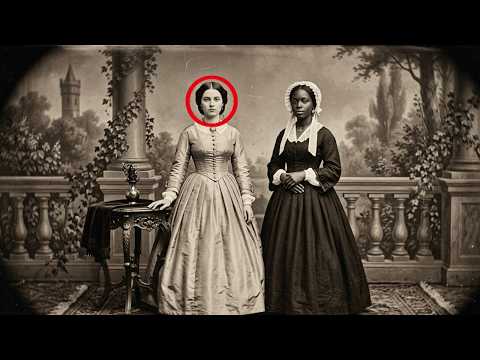
Elena had seen hundreds of portraits arranged exactly this way—the owner seated, the enslaved woman standing, the social hierarchy unmistakable. Then she noticed the woman’s left hand. Something small was visible between two fingers. She couldn’t identify it, so she placed the photograph under a high-resolution scanner. The magnified image appeared on her screen, and suddenly the object became clearer. It looked like a narrow strip of paper—not jewelry, not fabric, but paper. Elena zoomed in further. There seemed to be writing on it. Only three or four letters were visible.
She called her colleague Marcus Hill, an expert in nineteenth-century photograph restoration. Marcus stared at the screen for several seconds. Then he said something that made Elena stop typing. “That’s not the strangest part.” He pointed toward the painted backdrop. At first, Elena thought he was indicating a shadow. He wasn’t. Near the bottom corner of the backdrop, completely hidden behind the woman’s skirt, was a small painted door. It wasn’t part of the mansion scene. It looked like an ordinary door. But beside it was a symbol—a small white mark shaped like a triangle with a horizontal line through it.
Marcus had seen it before, not in a photograph but in a collection of plantation-era documents. He believed it might be connected to a network of people who secretly helped enslaved individuals move between safe locations. But there was a problem. The symbol didn’t appear anywhere else in the photograph, and the door itself wasn’t part of the studio backdrop. It had been painted separately. Someone had added it. Why?
That question shifted the investigation. Elena began digging into the history of the plantation. The only clue was a faint inscription on the back: October 1859, Belmir. “Belmir” was the name of a large plantation outside Natchez, Mississippi, owned by a man named Thomas Raine. Raine appeared in tax records as a wealthy cotton planter with several hundred acres. He also appeared in family records alongside his wife, two sons, and a large number of enslaved people. But there was one problem. The young woman in the photograph was unidentified. Her name wasn’t listed. She was described simply in one surviving inventory as: female, house servant, approximately 24 years old.
That single line bothered Elena because the photograph was clearly carefully arranged. The planter had chosen to have her stand beside him. That wasn’t unusual. But if she was just a house servant, why was there writing in her hand? And why had someone hidden a strange symbol inside the studio backdrop?
Elena searched regional newspapers. Nothing. She reviewed estate inventories. Nothing. She examined the surviving correspondence of the Raine family. Nothing either. Then Marcus discovered something. The photograph itself was taken by an itinerant photographer named Samuel Pike. Pike traveled through Mississippi and Louisiana during the late 1850s. His surviving business ledger contained dozens of names. Most were wealthy white families. But one entry caught Marcus’s attention. On October 17, 1859, Pike wrote: Raine family, three portraits, private session, three portraits. Yet only one photograph survived. Elena wondered what happened to the other two.
They searched museums, auction records, private collections, and digital archives. Nothing. Then, about three weeks into the investigation, a package arrived. It came from an elderly collector in Tennessee who had seen an image of the Raine portrait online. Inside was a worn envelope. The collector claimed it had been purchased from a plantation estate auction decades ago. There was no photograph inside—just a folded piece of paper. The paper contained a list of names. Most were illegible, but one name was clear. Elena compared the handwriting to plantation records. The name didn’t appear in any official household list, but it did appear in a private family diary. The diary belonged to Margaret, Thomas Raine’s wife, and an October 1859 entry simply read: “Clara knows what to do.”
That sentence changed everything. Who was Clara? Elena returned to the photograph. She looked again at the young woman’s face, then at the paper between her fingers. A possibility began to form slowly. Perhaps the photograph wasn’t a celebration of plantation life. Perhaps it was a message. But for whom?
Marcus began digitally enhancing the tiny strip of paper. The original photograph captured only a few dots of writing. Yet after hours of restoration, several letters became visible. They seemed to read “river,” then “third bell,” and finally “north point.” It wasn’t enough to prove anything, but it looked like instructions. The team now began to consider a disturbing possibility. Perhaps the photograph had been deliberately arranged to conceal communication, and if so, perhaps the woman standing beside Thomas Raine was not merely a passive figure. Perhaps she was carrying information.
But the deeper mystery was why Thomas Raine would allow something like this—unless he didn’t know. Elena returned to the Raine family property records. She discovered that Thomas Raine owned a small warehouse on the river about six miles from the plantation. The warehouse was destroyed in an 1861 fire. Officially, the fire was accidental, but one local newspaper described it differently. The building had been broken into the night before the fire. Several crates were missing. No arrests were reported.
Then Elena found another clue: a letter written by Margaret Raine to her sister, dated November 1859. One sentence was so heavily crossed out that the paper nearly tore. Using infrared imaging, experts recovered fragments of the hidden writing. The sentence read: “If Clara is discovered, they will know about the room under the warehouse.”
Elena froze. There was a room under the warehouse. That meant the door painted in the photograph might not be decoration at all. It might represent a real location.
The team began searching historical maps. The warehouse itself had vanished, and the land had changed hands many times, but an old survey revealed something curious: beneath the warehouse foundations, a small underground storage room had once connected to the riverbank. The room had been sealed sometime before 1862. No records explained why.
At this point, Elena contacted a regional historian named Daniel Bryce. Daniel had spent years tracing enslaved communities along the Mississippi River. When he saw the photograph, he noticed something else immediately. The young woman wasn’t looking at the camera. She was looking slightly toward the painted doorway, her body angled toward it. Daniel believed it was deliberate. “People in formal portraits were usually told to face the lens directly,” he explained. “But this woman seems to be directing attention toward something outside the frame—something she wanted someone else to notice.”
The photograph was transforming from a simple portrait into something resembling a coded message. But who was meant to understand it?
Then came the discovery that shifted the investigation again. A descendant of the Raine family contacted the archive. They owned a small leather-bound notebook that had belonged to Margaret Raine. Inside were household expenses, recipes, personal notes, and several pages of names. Near the end was a strange list. It contained dates. Each date was followed by a short phrase: bell after midnight. River road, third tree, white cloth. The final entry was different. Clara’s star, safe. No date. No explanation. Just those two words.
Clara was safe. But safe from what?
Elena searched post-Civil War census records. She found several women named Clara in neighboring counties. Most couldn’t be linked. Then Daniel noticed a name in a church register from 1867. A Black woman named Clarabelle had joined a small congregation near the river. Her age matched the woman in the photograph. Her birthplace was listed simply as Mississippi. Beside her name was a handwritten note: formerly of Belmir. It was the first direct link.
But the story was still missing one piece. What was Clara carrying? The team returned to the photograph. The paper between her fingers was the key. Using new restoration software, they reconstructed more of the text. It wasn’t a full sentence. It was a series of directions. Third bell, north of the river, and one final word—Clara.
The photograph appeared to have been taken on October 17, 1859. That same night, according to Margaret Raine’s diary, someone left the plantation. Three days later, a new entry appeared. The room is empty. Investigators now believe the underground room had been used as a temporary hiding place, but there was no proof that Clara had helped anyone escape.
Then they found the second missing photograph. It had been sitting in a private collection in New Orleans for nearly eighty years. The image was damaged, but the same studio backdrop was visible—the same painted mansion, the same columns, the same strange doorway. But this time, Clara wasn’t standing beside Thomas Raine. She was standing alone, and she was holding something different. A small white cloth. In the lower corner of the photograph, the same symbol appeared. Triangle, horizontal line, triangle.
Daniel compared the symbol to several surviving marks from the era of abolition. It didn’t match any officially documented code, but that didn’t mean it was meaningless. It may have been an informal symbol used locally—something understood by a very small group of people.
The final breakthrough came from a family Bible. It had belonged to Clarabelle and was preserved by her descendants for generations. Inside the front cover, a handwritten inscription read: “I was called Clara at Belmir. I carried messages when no one thought I could read. I carried them because others could not.” For the first time, Clara’s own voice emerged.
She wasn’t simply standing in the photograph. She was participating in something—something dangerous, something that required her to hide messages in plain sight. Suddenly, the photograph made sense. Thomas Raine thought he was capturing a formal portrait showing his wealth and power. But Clara used that moment for another purpose. The paper in her hand contained directions. The painted doorway represented the hidden storeroom. The symbol marked the location for someone who knew how to read it. And the second photograph provided another clue: the white cloth. A signal, a message without words.
The evidence couldn’t prove every detail of the network. Historians still can’t identify everyone Clara helped, but they could prove something important. Clara survived slavery. She left Belmir after the Civil War. She married in 1866. She lived near the Mississippi River for decades, and her descendants still live in the area today.
The photograph was eventually placed in a permanent historical collection. But the museum curators made one important change. The original catalog description labeled it simply as “Thomas Raine with a house servant.” That description was replaced. The woman finally had a name: Clarabelle. And beneath her name, the archive added a short explanation: Her role in the events surrounding the photograph remains partially unknown, but surviving evidence suggests she may have participated in a secret communication network before emancipation.
Perhaps the most unsettling part of the story isn’t the hidden doorway. Not the mysterious symbol, not even the message hidden between Clara’s fingers. It’s that people, for over 160 years, looked directly at her and saw only what they expected to see. A wealthy planter, an enslaved woman, a formal portrait—nothing more. But Clara knew something they didn’t. She understood that sometimes the safest place to hide a message is in plain sight. And perhaps that was the real secret of the photograph. Clara was never hiding. She was standing there all along. History simply hadn’t learned how to see her. And when experts finally looked closely enough, the woman everyone overlooked became the one who changed the meaning of the entire image.
What other untold stories are waiting to be discovered in the photographs we’ve already seen a thousand times?
Report this article
Select a reason for reporting:






