On a rainy Norman night in June 1944, hundreds of tanks and thousands of shivering men huddled in waterlogged trenches, anxiously awaiting the roar of artillery—a signal that would raise the curtain on the largest Allied offensive since D-Day. The air was thick with tension, the silence broken only by the drumming rain and the distant rumble of engines. For these men, the coming battle would test their courage, their training, and their very will to survive.
Among them was 22-year-old Lieutenant Robert Walcom, a third-generation soldier in the King’s Own Scottish Borders. As he checked his watch, the minutes ticked by with agonizing slowness. At precisely 7:30 a.m., 900 guns unleashed their fury, and the earth shook as if it would split open. “It was like a roll of thunder, only it never slackened,” Walcom recalled. The order came: “The Battalion will advance.” And with that, the men rose and walked into the maelstrom.
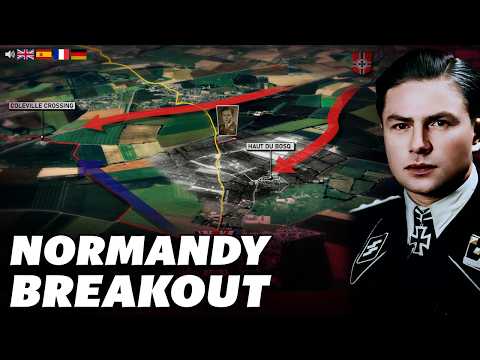
The plan, devised by General Montgomery, aimed to outflank the vital city of Caen by striking west across the Odon River. But the Germans had fortified every hedge and field, and among them were the hardened soldiers of the 12th SS Hitlerjugend Division. As the British advanced, they were met with a hail of machine-gun fire and mortar shells. “All hell had been let loose,” remembered SS Commander Kurt Meyer. “The earth seemed to open and gobble us all up.”
Despite the ferocious bombardment, the young SS soldiers fought with a desperate ferocity. On the western highway, Lieutenant Hans Siegel, a veteran of the Eastern Front, positioned his four Panzer IVs overlooking the British advance. “We let their attack come close and then at a short distance aimed concentrated fire,” he recalled. In minutes, the road was littered with burning tanks. The British push had stalled.
But the battle was far from over. To the east, the Argyll and Sutherland Highlanders had reached the Tourmauville Crossing, and the road to Hill 112—the key to the entire operation—lay open. Yet as the Germans rushed reinforcements to the sector, the British found themselves fighting for every inch of ground. Among the chaos, Major William McElwee led his company towards the Gavrus Crossing, only to be met by a relentless German counterattack. “The air was filled with the piercing sounds of AP shells clanging and small arms fire pinging off armor,” he later wrote.
As night fell on June 29th, the British had suffered over 4,000 casualties, and the operation was called off. The Allies had failed to break through, but the battle had cost the Germans dearly—3,000 men and 126 precious tanks. For the men who fought there, the memories would last a lifetime. Walcom would survive the war and become a playwright; Siegel would lose an arm but go on to lead battlefield tours. Their stories, and those of the fallen, remain a testament to the courage and sacrifice of Operation Epsom.
But the story of Operation Epsom does not end with the official cessation of hostilities on June 30th. In the days that followed, the battlefield around the Odon River remained a place of grim uncertainty, where the smell of cordite still clung to the hedgerows and the wreckage of burned-out tanks marked the high-water line of the British advance.
For the men of the 15th Scottish Division, the withdrawal from the Gavrus Crossing was a bitter pill. They had fought their way across the river, held the bridge under relentless fire, and then been ordered to give it up. “We had done everything asked of us and more,” one Argyll sergeant later wrote, “and yet it felt as though we had lost.” The crossing would remain in German hands, a constant reminder of what might have been.
Yet the Germans, too, were reeling. The 12th SS Hitlerjugend, which had fought with such fanatical determination, had been badly mauled. Kurt Meyer’s division had lost scores of tanks and hundreds of men, and the young soldiers who had once believed in an easy victory were now staring at a war of attrition they could not win. “The enemy’s artillery never stopped,” Meyer recalled. “We were bleeding to death in the Norman fields.”
As the British dug in on the heights they had managed to hold—Hill 112’s wooded crest, the village of Le Valtru—the frontline settled into a brutal stalemate. Patrols clashed in the darkness, snipers haunted the ruins, and the rain returned to turn the trenches into rivers of mud. For Lieutenant Robert Walcom, the days after Epsom were a blur of exhaustion and grief. He had lost friends in the cornfields outside Cheux, and the faces of the SS prisoners—so young, so bewildered—haunted him.
“We had been told we were liberating France,” he wrote in his memoir. “But all I saw was destruction, and all I felt was the weight of the men who would never leave this place.”
Yet even in the midst of this misery, there were moments of strange humanity. In a brief truce to recover the wounded, British and German soldiers met in no-man’s-land. They exchanged cigarettes, helped carry stretchers, and for a few hours, the war seemed to pause. “One of the SS boys asked me if I had a sister,” Walcom remembered. “I said yes. He said he did too, back in Bavaria. Then we went back to killing each other.”
For Hans Siegel, the failure of the British to exploit their gains was a source of grim satisfaction. His company had held the line, but at a terrible cost. Of the four Panzer IVs he had commanded at the start of the battle, only one remained operational. “We had won a defensive victory,” he wrote, “but we knew it was only a matter of time. The British could replace their tanks. We could not.”
As July approached, the focus of the Normandy campaign shifted. The Americans were preparing their own breakout in the west, and the British were left to hold the eastern flank—a task that would require yet more blood. Operation Epsom had failed to reach the Orne, but it had drawn in the German armor, wearing down the Panzer divisions that Hitler could ill afford to lose. In that sense, Montgomery’s costly gamble had achieved something, even if the men in the mud could not see it.
On the heights of Hill 112, the fighting would continue for weeks, earning the place a grim nickname: “the hill of death.” But for now, on the last night of June, the guns finally fell silent. The survivors of Epsom huddled in their slit trenches, listening to the rain, and wondered what tomorrow would bring.
The silence did not last. By the first week of July, the British command had not abandoned its ambitions. Hill 112, that blood-soaked crest, remained the key to the entire sector, and Montgomery was determined to take it. The 15th Scottish Division, exhausted and understrength, was reinforced by the 43rd Wessex Division, and a new operation—Jupiter—was hastily planned. “We were told to take the hill, no matter the cost,” recalled one Wessex officer. “The men were grim, but they went forward.”
On July 10th, the attack began with a thunderous artillery barrage, but the Germans had learned from Epsom. They had dug their tanks and anti-tank guns into the reverse slopes, and as the British infantry advanced, they were met by a storm of fire from concealed positions. “The hill was a fortress,” wrote a German defender. “Every hedge, every stone, spat death.” The Wessex and Scottish troops managed to reach the crest, but they could not hold it. By nightfall, they had been driven back, leaving hundreds of dead on the slopes.
Among the attackers was Lieutenant Walcom, who had been ordered to lead a platoon of reinforcements to the embattled hill. “The ground was littered with bodies, British and German, and the cries of the wounded were everywhere,” he remembered. “I saw a young soldier, no more than eighteen, lying against a tree, his eyes wide open, his hands still clutching his rifle. I knew he was gone, but I couldn’t stop staring.” Walcom’s platoon was decimated before they even reached the forward positions, and he himself was wounded in the shoulder by shrapnel. He was evacuated to a field hospital, where he would spend the next three weeks recovering.
For Hans Siegel, the fighting on Hill 112 was a different kind of hell. His remaining Panzer IV had been repaired, but his crew was a mix of inexperienced replacements and wounded veterans. “We were a shadow of what we had been,” he wrote. “But we still had our guns, and we used them well.” Siegel’s tank was positioned on the reverse slope, where it could ambush British armor as it crested the hill. In one engagement, he knocked out three Churchills in rapid succession, but the British kept coming. “They were brave men,” he admitted. “But bravery could not stop a shell.”
By mid-July, the hill had changed hands so many times that it was impossible to say who controlled it. The landscape was a moonscape of craters and burned-out vehicles, and the stench of death was overwhelming. “We called it the hill of death,” said a British medical orderly. “The wounded came down in a steady stream, and the dead were left where they fell. There was no time to bury them.”
Yet even as the battle raged, the strategic picture was shifting. The Americans had finally broken out of the Cotentin Peninsula and were driving south towards Avranches. Operation Cobra, the great breakout, was imminent, and the British efforts around Caen—however costly—had succeeded in tying down the bulk of the German armor. “We were the anvil,” Montgomery later wrote, “and the Americans were the hammer.” For the men on Hill 112, that knowledge offered little comfort.
On July 20th, the Germans launched their own counterattack, hoping to retake the hill and split the British lines. The fighting was savage, often hand-to-hand, and the British were pushed back to the outskirts of the village of Maltot. But the German effort exhausted their last reserves, and by the following day, they had no choice but to withdraw. “We had nothing left,” Siegel recalled. “Our tanks were gone, our men were exhausted, and the British kept coming. It was the beginning of the end.”
For Walcom, the end of his war came not on the battlefield but in a hospital bed in Bayeux. His wound had become infected, and he was sent back to England. “I felt a coward,” he wrote. “My men were still fighting, and I was safe. But the doctors told me I would have lost the arm if I had stayed.” He would never return to the front lines, but he would spend the rest of his life writing about the men who did.
As July turned to August, the battle for Normandy reached its climax. The Germans were in full retreat, and the road to Paris was finally open. But the cost had been enormous. The fields around Caen were a graveyard, and the men who had fought there would carry the scars—both visible and invisible—for the rest of their lives.
By late August, the guns had moved east, and the fields around Hill 112 fell quiet at last. Walcom, invalided home, received a letter from a fellow officer: “The hill is ours. The price was everything.” He read it twice, then folded it away.
Siegel, captured in the Falaise Pocket, spent years in a Soviet camp before the artillery took his arm. In his later tours, he would pause at the Odon and tell young soldiers: “We held this ground. It did not hold us.”
Today, the cornfields are green again, and the cemeteries are tended by quiet hands. The men of Epsom failed to cross the Orne—yet their sacrifice bled the Panzer divisions white and helped open the road to Paris. “We were the anvil,” Montgomery wrote. The hammer fell elsewhere.
Was Operation Epsom a failure, or a costly necessity? Let us know in the comments below.
Report this article
Select a reason for reporting:






