The photograph had sat untouched in the Alabama State Archives for over a century, its faded edges and worn corners betraying nothing of the secret it held. Dr. Ruth, a historian with a keen eye for the overlooked, had spent weeks sifting through unlabeled boxes when she paused at a family portrait from 1905. At first glance, it was ordinary: a Black family dressed in their Sunday best, standing before a wooden house in rural Hale County. The father, Abraham, stood tall; the mother, Nettie, sat with quiet dignity; their three children posed with solemn expressions. But Ruth’s gaze lingered on the youngest, a boy named Samuel, whose small hand clutched something metallic. “What are you holding, little one?” she whispered, reaching for her magnifying glass.
The object was dark and heavy—a key, far older than the photograph itself. Its crude design and thick teeth marked it as antebellum, a relic from before the Civil War. Ruth’s heart raced as she zoomed in further, uncovering two faded initials on the shaft: JW. The family name on the back was Williams. Could this key have belonged to an ancestor? Why would a child hold it so deliberately in a formal portrait? The answer, she would soon discover, lay buried in the pain and resilience of generations.
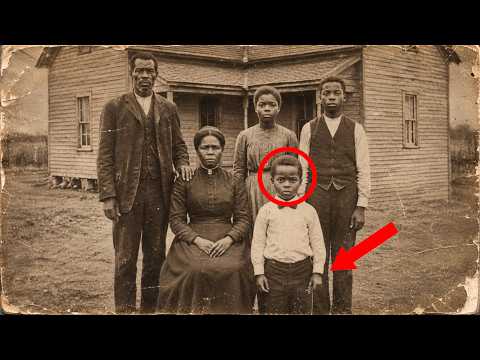
Ruth’s investigation led her to Hale County, where she met Miriam, a 90-year-old woman whose grandmother had been a Williams. Miriam’s eyes clouded with memory as she revealed the truth: the key had unlocked the chains of Joseph Williams, born into slavery on the Thornton plantation in 1832. “Joseph walked off that plantation with nothing but that key,” Miriam said, her voice trembling. “He kept it until the day he died.” The family had passed it down through five generations, a sacred symbol of freedom. In 1905, they placed it in young Samuel’s hand for the portrait—a deliberate act to ensure the story would never be forgotten.
But why Samuel? “He was the future,” Miriam explained. “The third generation born free.” The photograph was a message, hidden in plain sight, waiting for someone to see. Ruth felt the weight of history pressing upon her. She had to find the key, to document its journey, and to honor the family’s silent testament. With Miriam’s help, she arranged to meet George, the current keeper of the key, who guarded it as fiercely as his ancestors had. “The key stays with us,” he insisted, his eyes wary. “It’s proof we survived.”
As Ruth prepared to delve deeper, she knew this was only the beginning. The key’s story—of chains broken, of dignity preserved, of a secret carried across time—was about to be told. And she would be the one to finally listen.
George led Ruth into the back room without ceremony, his footsteps heavy on the worn floorboards. The wooden box sat on the desk exactly as Miriam had described it—old, carefully maintained, its hinges darkened by a century of handling. He lifted the lid and peeled back the faded cloth with the reverence of a man uncovering an altar. “There it is,” he said, stepping aside. “Now you tell me what you see.”
Ruth leaned over the desk, her breath catching as the key emerged from its wrapping. It was heavier than she had imagined, the iron cold and pitted, the teeth still sharp enough to catch the lamplight. She lifted it carefully, feeling its weight settle into her palm. Two letters, JW, were stamped deep into the shaft, worn smooth by decades of thumbs and fingers. “It’s real,” she whispered. “After all this time, it’s really real.”
George watched her in silence, his arms folded. Then he did something unexpected. He pulled a chair close and sat down across from her. “My mother gave me this box when I turned sixteen,” he said quietly. “She told me the story once, the whole thing, and then she never spoke of it again. Said it was mine to carry now.” He paused, his jaw tightening. “I’ve kept it safe for forty years. Never showed it to a soul outside this family. So you understand what this means.”
Ruth nodded, setting the key down gently on the cloth. “I do. And I won’t betray that trust.” She reached into her bag and pulled out a folder of documents—the plantation inventory from 1855, the Union Army records, the land deed from 1869. She spread them across the desk one by one. George leaned forward, his guarded expression cracking as he read the faded script. His finger stopped on a line in the inventory: Joseph, negro man, valued at $800. He stared at it for a long moment, then let out a slow breath. “Eight hundred dollars,” he said, his voice flat. “That’s what they thought he was worth.”
Ruth had anticipated his anger, but what she saw in his face was something quieter and far more complicated. “They were wrong,” she said. “That’s what this key proves. It’s worth more than any price they ever wrote down.” George looked at her, and for the first time since she had arrived, his eyes softened. He reached into the box and lifted out a second object Ruth had not noticed—a small leather journal, its cover cracked and stained. “This was Joseph’s,” he said. “My mother kept it with the key. I’ve never been able to read much of it. The handwriting’s bad, and the ink’s faded.”
Ruth’s hands trembled as she opened the journal. The pages were brittle, the ink a ghost of what it had once been, but the words were there—a sparse, painstaking record kept by a man who had taught himself to write in secret. She turned to a page near the middle and read aloud. “The key is mine. I took it from the cabin the day the soldiers came. It opened the irons on my legs. I will keep it always. My children will know what it means.” She looked up. George had turned his face away, but she saw his shoulders rise and fall.
When he spoke again, his voice was rough. “I’ve had that journal in this house my whole life and never knew what it said.” He shook his head slowly. “All those years, and I couldn’t read my own great-great-great-grandfather’s words.” Ruth closed the journal and slid it back toward him. “Then let’s change that,” she said. “Page by page. I’ll help you read every word.”
They worked through the afternoon, the lamplight growing golden as the sun dropped behind the pecan trees. The journal was not long—Joseph had written only intermittently, in brief, hard-won sentences—but each entry was a window into a life Ruth had only glimpsed through records. He wrote of his mother’s name, which the plantation inventory had never recorded. He wrote of the day the soldiers came and the overseer fled. And on one page near the end, in a hand shakier than the rest, he had written a single line that Ruth knew she would carry with her forever. “I was a man before they knew it. I am a man now they cannot deny.”
George read the line twice, then closed the journal and placed his hand flat upon its cover. “My mother used to say the key was the most important thing we owned,” he said. “But she never told me about this.” He looked at Ruth with an expression she could not quite read—grief, perhaps, or wonder, or both. “You came here looking for a photograph’s secret,” he said. “But I think you found something bigger.”
Ruth nodded, her throat tight. Outside, the last light was fading, and somewhere in the distance a dog barked once and fell silent. She gathered the documents and slid them back into her folder, then paused. “George,” she said carefully, “the museum will want to know about the journal too. But it’s your family’s story. You decide how much of it the world gets to see.” He was quiet for a long moment, his hand still resting on the journal’s cover. Then he looked up, and his eyes were steady. “I’ll think on it,” he said. “But you should know—there’s one more thing my mother told me. Something she made me promise to do when the time was right.”
Ruth waited, her heart pounding. George stood and walked to the window, his silhouette dark against the fading sky. “She said the key had to go home,” he said quietly. “Back to the place where Joseph took it. She said that’s where the story ends—and where it begins again.” He turned to face her. “I’ve been putting it off for forty years. But I think maybe now, with you here, it’s time.”
Ruth felt the weight of the moment settle over the room like a held breath. The key on the desk, the journal beneath George’s hand, the photograph waiting in her bag—all of it was pointing toward one place. The old Thornton plantation. The ground where Joseph Williams had worn chains, and where, on a morning in 1865, he had walked free. “Then we’ll go together,” Ruth said. “When you’re ready.” George nodded slowly, and in the lamplight his face looked younger somehow, as if a burden he had carried alone for decades had finally been shared.
The drive to the old Thornton place took them down a rutted track that the county had long since stopped maintaining. George drove his truck slowly, the key in its wooden box on the seat between them, and Miriam sat in the back with her hands folded, her eyes fixed on the passing fields. “It’s just past that stand of oaks,” George said. “The big house burned in ’38. Nothing left but the chimney and the old foundation.”
They walked the last hundred yards on foot. The chimney rose from the weeds like a broken tooth, and beyond it the land sloped down to a shallow creek. George stopped at the edge of the foundation and looked around slowly. “The cabin where they kept the chains was over there,” he said, pointing. “My mother knew it from her grandmother. Said Joseph described it a hundred times.”
He opened the box and lifted the key out. For a long moment he simply held it, the iron dark against his palm. Then he knelt and pressed it flat against the earth, the way a man might touch a grave. “You’re home now,” he said quietly. “You did your job. We’re still here.” Miriam began to sing, low and steady, an old hymn Ruth did not know, and the sound carried across the empty field like something the land itself had been waiting to hear.
When the singing ended, George stood and wrapped the key again. “It goes back in the box,” he said. “But now I know where it came from. That’s different.” He looked at Ruth. “Write it down. All of it. The journal, the photograph, this place. Let people read it and decide for themselves what it’s worth.”
Ruth’s article ran the following spring, and the photograph of little Samuel holding the key traveled farther than any of them could have imagined. But the key itself never left Hale County. It stayed with George, and one day it would pass to his daughter, and the story would go on being told. What do you think—should a family’s secret history stay private, or does it belong to all of us?
Report this article
Select a reason for reporting:






