The roar of engines shattered the silence of the battlefield. Through the smoke and dust, a monstrous steel beast emerged—its armor gleaming, its gun aimed with deadly precision. This was no ordinary machine; it was the embodiment of a nation’s industrial might, a weapon that would change the course of history. In the chaos of World War II, tanks became the ultimate arbiters of power, and the race to build the perfect fighting machine would determine the fate of millions.
As Hitler’s armies swept across Europe, the world watched in horror. But across the Atlantic, a sleeping giant stirred. The United States, once an isolationist backwater, transformed into an industrial juggernaut, churning out tens of thousands of tanks to challenge the Axis forces. Yet, this wasn’t just a battle of numbers—it was a clash of ingenuity, tactics, and sheer willpower.
The story begins not with the mighty Shermans or the fearsome Tigers, but with the humble origins of tank warfare itself. In 1916, the British unleashed a secret weapon on the fields of France—the first tanks. Dubbed “the devil’s coaches” by the German press, these armored behemoths were heralded as the key to victory. But for the United States, the journey to tank supremacy was far from straightforward.
By 1917, America had neither developed its own tanks nor experienced the terror of armored warfare. The lessons from the Western Front were clear: tanks existed to support the infantry. This doctrine became so ingrained that in 1920, the US Army abolished its tank corps entirely, handing over tank development to the infantry. With limited funds diverted to air power and the Great Depression crippling military spending, American tank design stagnated for two decades.
Meanwhile, across the ocean, the Germans were perfecting a new kind of warfare. When they invaded Poland in 1939, the world was stunned by the speed and efficiency of their Blitzkrieg. But the secret to their success wasn’t superior tanks—it was superior tactics. The Germans knew how to use their tanks as part of an integrated force, coordinating with infantry and air support to devastating effect. This lesson was not lost on the Allies, particularly the British, who passed it on to the Americans.
As the shockwaves of Dunkirk reverberated across the Atlantic, it became clear that America needed a tank capable of matching the German Panzer Mark III. The M2, America’s first real tank, was woefully inadequate. With its thin armor and peashooter gun, it was no match for the German war machine. But America had something the Germans didn’t: massive industrial capacity. Funds were poured into designing a successor, and by April 1941, the M3 Lee was rolling off production lines.
The M3 was a stopgap, a seven-man crew crammed into a tank with a 75mm gun mounted in a sponson on the side. It was awkward, tall, and difficult to maneuver, but it packed a punch. Under the Lend-Lease policy, the British bought 600 of them, calling them the General Grant. They proved crucial in North Africa, earning the title “Egypt’s last hope.” But the M3 was never meant to be the final answer.
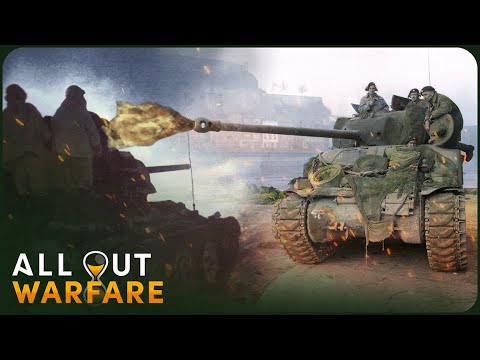
By 1942, the Allies needed a tank that could be built in large numbers by a civilian workforce, easy to operate and maintain, and effective in battle. The answer was the M4 Sherman. With its 75mm gun, reliable engine, and simple design, the Sherman was a marvel of mass production. It wasn’t the most heavily armored or the most powerfully armed tank of the war, but it was available in overwhelming numbers—nearly 50,000 were built, more than the entire German wartime production.
The Sherman made its combat debut with the British Eighth Army at El Alamein in 1942. The arrival of 300 Shermans could not have been more timely. Demoralized and exhausted, the British troops finally had a tank that could match the German armor. “Whoopy, at last we’ve got a decent tank,” was the universal reaction. But as crews soon discovered, the Sherman had its flaws. Its high silhouette made it an easy target, and its thin armor was vulnerable to the dreaded 88mm anti-tank gun.
The Germans called it the “Tommy cooker,” and the Allies called it the “Ronson” after the lighter—because it lit first time. The Sherman’s ammunition storage was too high, and a penetrating hit could easily ignite the cordite propellant, turning the tank into a fiery death trap. Yet, despite these weaknesses, the Sherman had one undeniable advantage: there were always more of them.
As the war raged on, the Sherman adapted. The Firefly variant, armed with a British 17-pounder gun, could take on the Panther and even the Tiger. The Jumbo, with its thickened armor, led tank formations into ambush-prone areas. And the Crab, with its flail, cleared minefields on D-Day. The Sherman was more than a tank—it was a versatile platform that could be modified for any task.
But the story of World War II tanks is not just about the Sherman. Across the vast expanses of Russia, another tank was making its mark—the T-34. With its sloped armor, diesel engine, and wide tracks, the T-34 was a shock to the German invaders. It was fast, well-protected, and easy to produce. By 1941, it was the most advanced tank in the world, and it would become the backbone of the Soviet armored forces.
The T-34’s debut in Operation Barbarossa was a rude awakening for the Germans. Their 37mm and 50mm anti-tank guns bounced off its sloped armor, and only the 88mm anti-aircraft gun could reliably destroy it. Otto Benser, a German infantryman, recalled the horror: “The T-34 was virtually shellproof.” But the Soviets had their own problems—Stalin’s purges had decimated the officer corps, and tank crews were rushed into battle with minimal training.
Despite these challenges, the T-34 evolved. The T-34/85, with its larger gun and improved turret, could finally take on the Tiger and Panther on equal terms. It was produced in vast numbers—over 11,000 in 1944 alone—and it spearheaded the Soviet push to Berlin. The T-34 was not just a tank; it was a symbol of Soviet resilience and industrial might.
As the war drew to a close, the battlefields of Europe were littered with the wreckage of thousands of tanks. The Sherman and the T-34 had proven their worth, not because they were the best tanks individually, but because they were part of a larger system—a system that could produce, deploy, and sustain them in overwhelming numbers. The Germans may have had the Tigers and Panthers, but the Allies had the factories.
In the end, the war was won not just on the battlefield, but in the heartlands of America and Russia, where civilian workers toiled day and night to build the machines that would crush the Nazi war machine. The tank had come of age, and its legacy would shape the future of warfare for decades to come.
Yet for all the industrial triumph, the human cost inside those steel hulls remained staggering. Tank crews on both sides fought in claustrophobic, deafening conditions, breathing cordite and exhaust, knowing that a single well-placed shell could end everything in an instant. For every tank that rolled off the line, there were men who had to climb inside it and trust that the machine—and their training—would bring them home.
By the summer of 1944, the Allies had learned to stop measuring tanks in isolation and start measuring them as systems. A Sherman was only as good as its crew, its supply chain, and the commanders who directed it. The Germans, by contrast, fielded magnificent machines that were increasingly starved of fuel, spare parts, and trained crews. The Tiger could destroy any Allied tank it met—but it could not be everywhere at once, and it could not be built fast enough to matter.
This imbalance played out most brutally in the bocage country of Normandy, where narrow lanes and high hedgerows turned every field into a killing ground. Shermans that strayed into the open were cut down by hidden anti-tank guns, while Panthers and Tigers lurked in ambush. It was here that Allied crews improvised, welded, and adapted their vehicles with a desperation that no factory manual could teach.
Back in the factories, the engineers who had designed these tanks watched the reports with growing unease. They understood that the war had become a race not of perfection, but of adequacy at scale. “We don’t win because our tank is better,” one Allied officer reportedly admitted. “We win because we have far more of them—and we can keep them running.”
That philosophy extended to the crews themselves. American mechanics, many of whom had never seen a tank before 1940, became masters of field repair, swapping engines and transmissions in muddy depots across France. British fitters perfected the art of up-gunning, while Soviet workshops rebuilt T-34s from the wreckage of three destroyed ones. The tank was no longer a single weapon—it was an entire ecosystem of production, logistics, and repair.
As autumn turned to winter, the Allies pushed toward the German border, and the nature of the fighting shifted once more. Open tank battles gave way to sieges, urban combat, and the grinding attrition of the Siegfried Line. Shermans and T-34s, designed for sweeping maneuver, now found themselves fighting street by street, house by house, where their advantages in speed and numbers counted for less than ever.
It was in these final months that the sheer breadth of tank design—from the Sherman’s adaptable hull to the T-34’s brutal simplicity—revealed its true purpose. These were not just machines of war; they were industrial statements, proof that a nation’s factories could shape the fate of continents.
And still, the question lingered in the minds of every commander and every crewman: had they built the right tank, or merely enough of the wrong one? The answer would only become clear as the last great offensives of the war gathered on the horizon.
The final offensives came with a fury no factory could have predicted. Across the Rhine and the Vistula, Shermans and T-34s rolled forward in columns that stretched to the horizon, their crews grimly aware that the end was near. “One Panther might equal five Shermans,” a British tank commander recalled, “but we always had the five.”
In the ruins of Berlin, the last German armor made its final stand—Tigers and Panthers fighting hull-down in the rubble, exacting a terrible price before being overwhelmed. Soviet crews, hardened by four years of war, simply maneuvered around each strongpoint and kept moving. The city fell, and with it, the Reich.
When the guns finally fell silent in May 1945, the tally was staggering. Nearly 50,000 Shermans and over 55,000 T-34s had been built, dwarfing Germany’s entire wartime output. The victors were not the nation with the finest tank, but the nations whose factories never stopped.
Yet the men who crewed them remembered something more personal. They remembered the deafening roar, the smell of cordite, the terror of a penetrating hit—and the comrades who never climbed out. The tank had won the war, but it had been paid for in steel and blood.
What do you think—was the Sherman truly the war’s workhorse, or was the T-34 the greater machine? Share your thoughts below.
Report this article
Select a reason for reporting:






