Gloria Swanson’s $65 bank balance. Errol Flynn’s two-way mirrors. Buster Keaton’s villa sold out from under him. These are the stories of Hollywood’s most extravagant estates—and the stars who watched them slip away.
Behind the gilded gates and marble fountains, a darker truth lurks. The same mansions that hosted legendary parties and housed Tinseltown royalty became the silent witnesses to financial ruin, bitter divorces, and personal demons that devoured even the brightest fortunes.
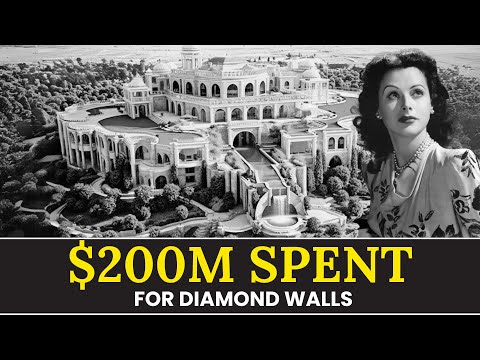
What truly caused these dreams to crumble? The answers are as scandalous as the parties that once echoed through their halls.
Take Gloria Swanson, the silent film queen who lived like royalty in a 24,000-square-foot Mediterranean revival estate nicknamed Gloria Crest. With Tiffany glass skylights, gilded moldings, and a man-made lake sprawling across five gated acres, it was a palace fit for Hollywood royalty.
But by 1927, Swanson was already in dire financial straits—reduced to a mere $65 in her bank account despite her extravagant lifestyle. The mansion slipped away as bills mounted and her secret lover, Joseph P. Kennedy, cut ties amid mutual suspicions of fraud and betrayal.
Then there’s Errol Flynn, the swashbuckling star who built Mulholland Farm as his personal playground. The 4,000-square-foot California colonial featured a separate casino house for high-stakes gambling and hidden passageways behind the walls.
Most infamously, Flynn fitted certain rooms with two-way mirrors and peepholes, allowing the rogue actor to spy on female guests. These salacious features cemented the mansion’s infamy—and foreshadowed his downfall.
After a scandalous statutory rape trial (he was acquitted) and mounting tax debts, Flynn fled to Europe in 1953, never to return. His ex-wife Lily ultimately won a court judgment and took possession of the beloved farm to satisfy unpaid alimony.
Flynn literally lost the roof over his head to the ex-wife he tried to shortchange.
Marion Davies fared no better. Her Ocean House—a 110-room seaside compound on Santa Monica’s Gold Coast—was William Randolph Hearst’s grand gift to her, costing a staggering $7 million. Tennis courts, a 110-foot heated saltwater pool lined with Italian marble, and a staff of 32 servants kept the fantasy alive.
But by 1947, with Hearst’s publishing empire battered by the Depression and his health declining, Davies made the painful decision to sell for $600,000—a fraction of its original cost. Within a decade, the mansion was demolished entirely.
Even Rudolph Valentino’s Falcon Lair couldn’t escape the curse. The silent film heartthrob poured his romantic soul into the 16-room Beverly Hills estate, filling it with Italian marble statues and imported European antiques.
But when Valentino died suddenly in 1926 at just 31 years old—reportedly in debt—his prized estate was auctioned off within weeks to satisfy creditors. The dream home was lost to both financial necessity and the cruel absence of its creator.
Zsa Zsa Gabor’s Bel Air mansion met a similar fate. The canary-yellow French Regency estate hosted Queen Elizabeth II, Ronald Reagan, and Elizabeth Taylor within its gilded walls. But by the 2010s, mounting medical bills and a hip injury left the glamour icon bedridden and financially strained.
In 2013, the mansion was sold to investors for $11 million—under the condition that Zsa Zsa could live out her life there. She died in 2016 in the home she had lavished with attention but no longer owned.
Johnny Weissmuller’s Tarzan-inspired paradise featured a 300-foot serpentine swimming pool that meandered around the house like a tropical lagoon. But when his second wife Lupe filed for divorce in 1932, she walked away with virtually everything—including the estate, which had been put in her name.
Weissmuller lost his jungle palace with the stroke of a pen.
Hedy Lamarr, dubbed the most beautiful woman in the world, chose simplicity over splendor at Hedro Farm—a rustic retreat where she kept chickens and tended a vegetable garden. But by the mid-1960s, the brilliant inventor was effectively broke, unable to pay utility bills and often going hungry.
Howard Hughes abandoned his 30-room Hancock Park mansion not through financial ruin, but through psychological retreat. As his mental health deteriorated, the eccentric billionaire sealed himself in darkened hotel rooms, leaving his Spanish colonial estate to caretakers before selling it in the early 1950s.
And Buster Keaton’s Italian villa—a 35-room palace with a Roman-style swimming pool and a bubbling marble fountain—was lost in a devastating divorce. His wife Natalie not only took custody of their sons but also the entire estate, which had been placed in her name.
Keaton was barred from setting foot on the property he had designed and loved.
These are the stories of Hollywood’s most extravagant estates—and the stars who watched them slip through their fingers. But what happened to the mansions themselves after their famous owners departed? Some were demolished. Others fell into decay. And a few became haunted by the ghosts of their former glory.
The fates of these forgotten palaces reveal as much about Hollywood’s ruthless nature as the stars who built them. Because in Tinseltown, even the grandest dreams have a price—and sometimes, that price is everything.
Consider Gloria Crest, the Englewood mansion that once blazed with Tiffany glass and gilded moldings. After Swanson retreated from its halls, the estate passed through a revolving door of owners, each less able than the last to shoulder its crushing upkeep. By the 1960s, the man-made lake had gone stagnant and the aviary stood empty, its rare birds long since flown.
The house that once hosted Hollywood’s elite became a white elephant—too grand to maintain, too expensive to love. It lingered in a strange twilight, subdivided and repurposed, its European manners slowly stripped away by decades of neglect.
Mulholland Farm met a stranger end. After Lily took possession and sold it off, the notorious ranch passed through a series of owners who seemed eager to erase Flynn’s ghost. The two-way mirrors were removed. The hidden passageways were sealed shut. By the 1980s, the property had been carved up entirely, and the house itself—that pleasure palace of secret improvements—was bulldozed to make way for new construction.
Today, a quiet residential street winds through what was once Flynn’s playground. No plaque marks the spot. No ghost of the rogue actor haunts the manicured lawns. The scandal simply evaporated, leaving only asphalt and hedges where the casino house once stood.
Ocean House suffered a more public execution. When Joseph Drown converted Marion Davies’s seaside fantasy into a hotel and beach club, the Venetian marble bridge was the first casualty—hauled out of the pool and carted away, much to Davies’s quiet fury.
For a few years, paying guests sipped cocktails in the mirrored parlors where Chaplin and Garbo had once danced. But the 110-room mansion was a dinosaur, impossible to heat, impossible to cool, impossible to keep. In 1956, amid mounting complaints and ruinous upkeep, the wrecking ball came.
When the dust settled, only a guest house and the marble pool remained—ghosts of the grandeur that was. The site eventually passed to the state of California and became a public beach facility, where sunbathers now sprawl across the ground that once held Hearst’s seven-million-dollar gift.
Falcon Lair proved equally restless. After Valentino’s possessions were auctioned off piece by piece, the mansion began its long afterlife as a curiosity. Owners came and went—some drawn by the romance, others by the bargain. The concrete wall Valentino built to keep out obsessed fans eventually crumbled, and the terrace gardens he planted with imported cypress went wild.
By the 1950s, the house had acquired its reputation as a haunted place. Neighbors reported lights flickering in the empty salon. Some claimed to hear music drifting from the hilltop late at night. Whether or not the ghost of the great lover truly roamed its halls, Falcon Lair’s fate was sealed—a monument to a dream that died with its creator.
Decades later, the estate was demolished entirely, its hillside parcel subdivided into modern homes that bear no trace of the silent film heartthrob who once watched the city lights from his terrace.
And Zsa Zsa’s Bel Air palace? After her death in 2016, the new owners wasted little time. The canary-yellow walls came down. The ballroom level—that Monte Carlo nightclub where she had entertained presidents and queens—was gutted. The mansion that had hosted a century of glamour was reduced to rubble in a matter of months.
What rose in its place was something sleeker, colder, stripped of Baroque excess. The golden piano was gone. The closet that held 5,000 dresses was gone. Only the address remained, a whisper of the feisty Hungarian transplant who had once swum naked in the pool each morning.
But not every estate vanished so completely. Some lingered in strange half-lives, caught between demolition and preservation, their fates still uncertain.
Johnny Weissmuller’s serpentine pool, once fed by an electric waterfall and large enough to paddle a boat, now sits empty and cracked behind boarded windows. The estate was declared a historic monument, yet left to decay—an eerie shell where Tarzan’s jungle dream slowly rots in the California sun.
Hedy Lamarr’s Hedro Farm slipped away so quietly that few noticed. The chickens, the vegetable garden, the braided cottage rugs—all sold off as the brilliant inventor’s fortunes bled dry. By the 1960s she couldn’t pay her utility bills, often going hungry except when friends brought food. The farmhouse that had been her refuge from stardom simply changed hands, no headlines attached.
Howard Hughes’s Hancock Park mansion outlived its owner’s presence by decades. After he sealed himself in darkened hotel rooms, the Spanish colonial sat attended by caretakers—empty halls, drawn shades, a mute witness to madness. It was sold and passed to new owners, while Hughes died in 1976 surrounded by tissue boxes and codeine vials, far from any home at all.
And Buster Keaton’s Italian villa, with its Roman pool and bubbling marble fountain, was demolished in the 1950s—its land subdivided for new houses. Today only the street name Pamela Drive and archival photos hint at its one-time glory. The physical erasure of a dream, long after Buster lost it.
So what truly caused these dreams to crumble? Divorce. Debt. Demons. The cruel arithmetic of fame that gives lavishly and takes everything back. Some mansions were sold to satisfy alimony, others auctioned to pay creditors, a few simply abandoned by owners who could no longer bear to be seen.
The pattern repeats with almost mechanical precision: extravagant construction, legendary parties, a sudden reversal, and then—silence. The wrecking ball. The subdivision. The public beach where a palace once stood.
Hollywood’s grandest homes were never just houses. They were monuments to ambition, built on the assumption that fortune is permanent. But in Tinseltown, even the grandest dreams have a price—and sometimes, that price is everything.
Which of these lost estates would you most want to step inside—if only for one ghostly cocktail party before the walls came down? Tell us in the comments below.
Report this article
Select a reason for reporting:






