Melbourne, winter 1954. The national census counts every person living in Australia, and among 9 million souls, only 25,862 were born in Greece. It is a tiny number, a crowd that could barely fill one side of the Melbourne Cricket Ground. Yet within just seven more years, that number would nearly triple, and most of those newcomers would head to a single city. What did they find when they stepped off the gangway?
Where did they sleep? And with whom did they share a room? How does a man who cannot read the letters on a factory sign keep his job, feed himself, and send money to a village on the other side of the world? And how did a scattered crowd of workers, strangers even to each other, become one of the strongest communities this country has ever known?
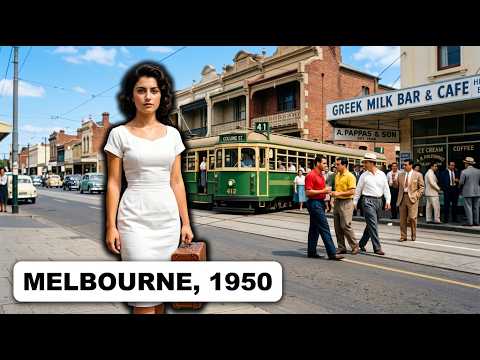
To understand that, we have to go back to the moment the doors were opened. In 1952, the Australian government struck an agreement with the Greek government and a new body called the Intergovernmental Committee for European Migration. The deal was simple on paper. Australia needed workers. Greece, exhausted by occupation and then civil war, had more hands than jobs. So travel costs would be subsidized. In return, the migrant signed a contract. For two years, the Australian government could send him anywhere labor was needed.
For those who landed at the station pier in the Port of Melbourne, the first days were chaos. Many were loaded onto trains and sent north to Bonegilla, near Albury-Wodonga. The camp had opened in 1947. By the time it closed in 1971, over 300,000 migrants had passed through it. It was the largest and longest-lasting reception center in post-war Australia. The huts were old military buildings. Timber frames, corrugated iron walls. Many were unlined and built to sleep 20 people in one open space.
Winter nights in the Murray region were bitterly cold. Men received a small allowance while they waited for a job assignment. Most waited three or four weeks. Some waited much longer. In July 1952, Italian migrants at Bonegilla, desperate after months without work, rioted and set fire to buildings. Everyone in the camp learned the lesson. The contract was a promise of work, not a guarantee.
And the economy they arrived into was about to turn against them. In 1952 and 1953, Australia slid into a sharp recession. Newspapers carried stories of overcrowded reception centers and unemployed men. Then, in the second half of 1953, the Arbitration Court stopped the automatic quarterly adjustment of the basic wage to the cost of living. The basic wage for an adult man froze at 236 shillings a week. That was 11 pounds and 16 shillings. That figure would not change until June 1956.
Eleven pounds and sixteen shillings. They had to pay rent, food, tram fare, and clothes for a Melbourne winter that no man from a village in the Peloponnese had ever prepared for, plus debts back home. Because from 1954, travel costs were no longer fully free. Migrants were now required to contribute part of their fare, payable within 3 to 6 months of arrival.
So the men accepted whatever the contract offered, which meant the jobs Australians did not want. Some were sent to the Snowy Mountains, where over 100,000 people from more than 30 countries tunneled through granite between 1949 and 1974. Greeks worked there alongside Germans, Italians, Irish, and Yugoslavs. The mountains claimed 121 lives before the project was completed. Others were sent to the railways, laying and repairing tracks under sun and frost. Others went to sugar cane fields, fruit farms, and quarries.
But the real magnet was Melbourne itself and its factories. In Fishermans Bend, General Motors Holden had been making cars since 1948, when the first Holden rolled out of the plant that opened in 1936. Demand for the new Australian car was so strong that in 1956, the assembly line moved to a new plant in Dandenong. Around the city, there were textile mills in Collingwood and Brunswick, clothing factories in Richmond, rubber works, tanneries, foundries, and abattoirs. Every one of them ran shifts. Every one of them needed men to stand at a machine for 8 hours and come back the next morning.
Researchers who later studied the 1961 census found exactly what the contract had built. A dense concentration of Greek-born workers in manufacturing, and their near-total absence from high-status jobs. Qualifications obtained in Greece were rarely recognized. A teacher could end up sweeping the floor of a foundry. A clerk could end up on the kill floor of an abattoir.
And when the shift ended, the question was always the same. Where would you sleep tonight? For most single men, the solution was to rent a room in the inner suburbs, like Richmond, Fitzroy, Carlton, Collingwood, Prahran, Brunswick, and later Northcote. These were Melbourne’s old working-class suburbs, with their narrow terraces and single-fronted cottages that Australian families were abandoning for new brick houses on the city’s edge. The Greeks moved into the spaces they left behind.
Oral histories collected over the following decades describe the same pattern again and again. Four, five, or six men sharing a single room. Beds were rented on a shift basis; one man slept by day while another worked, then they swapped. One kitchen for the whole house, one outside toilet in the yard, a copper tub for washing clothes, and rent paid weekly to a landlord who often lived elsewhere. It was crowded. It was cold. And it was deliberate. Every shilling not spent on a better room was a shilling that could be saved.
Outside the front door, the country was not always kind. Non-British migrants were classified as aliens. They had to register with the authorities and report every change of address or employer. They could not hold permanent positions in the public service. In the street, on the tram, on the factory floor, they heard the same word again and again. Dago. By the end of the decade, another word joined it. Wog. Records collected by researchers at the Australian National University show Greek workers and their children being taunted with these two words in schoolyards and on streets.
Then there was the language itself. Greek uses a different alphabet. Many new arrivals had left school early in poor rural villages, and English was a wall. Signs, safety notices, pay slips, rental agreements, and tram destinations had to be memorized by their shape rather than read. Men learned to point with their hands. They learned the handful of words that kept them in their jobs. And on their side, many Australians made little effort to meet them halfway. The official policy of the time was assimilation. Newcomers were expected to blend in quickly and quietly. When Greeks gathered together, spoke their own language, and held on to their church, some Australians saw it as ingratitude. Greeks saw it as survival.
And survival for a Greek in Melbourne began at one address in East Melbourne. On the corner of Victoria Parade and Lansdowne Street stood the Church of the Annunciation, known to every Greek as Evangelismos. It had opened on 23 June 1901, built by a community that had first gathered in August 1897, when the entire Greek population of Melbourne was fewer than 150 people. It had stood alone for half a century. According to the Encyclopedia of Melbourne, Evangelismos remained the only Greek church in the city until 1950. Now, thousands of new arrivals poured through its doors. Baptisms, weddings, funerals. Letters read aloud by those who could read. Advice about workplaces, and which landlords to avoid.
The Greek Orthodox Community of Melbourne and Victoria, which ran the church, was changing too. In February 1952, its two community schools were merged into one. In August of the same year, women were granted full membership rights for the first time. But the decade was also shaped by the Cold War. In February 1952, the community dissolved its sports team, Olympiacos, citing leftist leanings. By 1953, its leaders were raising concerns about communist propaganda in migrant hostels. The civil war that many of these men had fled did not stay in Greece. It traveled with them, and it would divide the Greek community in Melbourne for years.
For news, they turned to newspapers. Fos, meaning Light, had been published since 1936. In 1951, the first Greek-language radio broadcast in Australia went to air. Not in Melbourne, but in the rural town of Wangaratta. For men who could not follow English papers, these were windows on the world and on home. And home was never far from their minds, because home was where their money went.
Sending money to Greece was not a choice. It was the reason many had come. Often the village had borrowed money to cover the fare. There were parents to support, sisters who needed dowries, younger brothers waiting their turn to leave. So a portion of that 11 pounds a week was saved. Postal orders and bank checks crossed the oceans. Men worked overtime, then a second job, then weekends. The rooming houses, the long shifts, the shared beds, all of it becomes understandable only when you realize this. They were not living for themselves. They were living for people 15,000 kilometers away.
That weight did not lift until families began to follow. And for many men, the first family member to join them was a wife they had never met. The imbalance was stark. Assisted migration programs had previously favored single men, and by the mid-1950s, Greek Melbourne was a city of bachelors. Marriage within the community was crucial. And so an old custom came back to life. Proxy marriage. In 1957, the ship Begona carried over 900 Greek women to Australia. It docked first in Fremantle, then sailed for Port Phillip Bay. Many of these women were already married. Not in person, but through photographs.
Researchers who studied the voyage describe the process simply. Photos of young women were sent to Australia. The man chose one from about ten photos. Then his photo was sent back. The couple was married in a church in Greece in the absence of the groom, before the bride ever set foot on the ship. Some of these marriages lasted a lifetime. Some did not survive even the first meeting on the pier. And some of the women who stepped ashore were young girls who had come not for marriage, but for work and to build a future.
Many young Greek women underwent domestic training courses at reception centers, because officials expected them to work as servants in homes and hospitals. Coming from villages without running water or electric appliances, they learned to use machines they had never seen. Soon many worked in the same textile and clothing factories as the men, at a female wage that was roughly half the male rate. And in the midst of all this, the eyes of the world suddenly turned to Melbourne.
On 2 November 1956, the Olympic flame was lit in Olympia, Greece. Greek runners carried it to Athens. It was flown across the world to Darwin, then to Cairns, and from there carried south through Queensland and New South Wales to Melbourne. On 22 November, the Duke of Edinburgh opened the first Olympic Games ever held in the Southern Hemisphere at the Melbourne Cricket Ground. Sixty-seven nations marched into the stadium that evening, and according to the oldest tradition of the Games, the first team to enter was Greece. For the Greeks of Melbourne, it was a moment many would never forget.
The Greek team was small, 13 athletes, all men, in five sports. The Greek Orthodox Community organized events to welcome them. Men who were called dagos in the factories now watched their nation lead the world into the heart of their new city. On 26 November, pole vaulter Georgios Roubanis won a bronze medal. It was Greece’s only medal of those Games. It did not matter. For a few short weeks, being Greek in Melbourne was a source of public pride. The Games ended on 8 December. And the next morning, the factory shifts began again. But something in the community had changed.
In 1956, a new Greek Orthodox parish, the Church of St. George, began holding services in Carlton. It had no building of its own. It rented space from the Methodist Church at the corner of Lygon and Queensberry streets. Greeks were now numerous enough that one church in East Melbourne could no longer hold them. In 1957, a new newspaper appeared. Neos Kosmos, meaning New World, was founded by Dimitri Gogos, Bill Stefanidis, and writer Alekos Doukas. It had an openly leftist orientation, was considered radical by many in the community, and carried issues that mattered to workers’ lives: union membership, wages, safety, and labor rights. For the first time, the Greek factory worker in Melbourne had a newspaper that spoke about his shift, not just about his homeland.
And increasingly, Greeks were no longer just working in the economy. They were beginning to own a piece of it. This pattern had been established long before. Since the early century, Greeks across Australia had run cafes, fish and chip shops, and milk bars. Melbourne’s first Greek cafe, the International Cake Shop, known as Daffney’s, opened in the 1940s. Now, new arrivals followed the same path. A few years of factory wages pooled with a brother or cousin could buy the lease on a corner store. The hours were brutal. Open early for newspapers and milk, close late after the cinema crowds, 7 days a week. The family lived behind or above the shop. Children stacked shelves, served customers, and wrapped fish in newspaper after school. It was not glamorous work, but it was theirs.
In the city itself, a small Greek world was forming along Lonsdale Street and around the corner in Russell Street. Clubs opened on the upper floors above restaurants and cafes, and names like Amonia, Xenia, and Kypseli, meaning beehive, became meeting places. The kafeneio, the Greek coffee house, was where men gathered after work and on Sundays. Over thick coffee, cards, and backgammon, they exchanged news of jobs, rooms, who had arrived from which village, and who was selling a house. It was an employment office, a post office, and a parliament, all in one smoke-filled room.
And talk of houses was the most important talk of all. For Greeks in the 1950s, a rented room was only a stage. The goal was a home, their own home with their names on the title deed. And they approached it with a discipline that astonished their neighbors. Two or three brothers pooled their savings. A husband and wife worked full time, one on day shift and one on night shift, so that one was always home with the children. They lived on almost nothing. They bought old houses and workers’ cottages in Richmond, Fitzroy, Collingwood, and Brunswick, the very houses other Australians considered slums. Then they filled them with relatives. Boarders’ rent helped pay the mortgage. And when one house was paid off, the savings went to the next house or to bring another family member from Greece.
In the decades that followed, Australians of Greek background became known for home ownership rates far higher than the general population. It did not happen by accident. It was built in the 1950s, penny by penny from every paycheck.
The children who grew up in those houses carried a burden of their own. They were the first to speak fluent English in their families. They learned it in the schoolyard, often under a hail of the same insults their fathers heard at work. Then they came home to become the voice of the family. A ten-year-old sat at the kitchen table to translate a letter from the local council. A twelve-year-old stood at the doctor’s desk to explain what his mother was feeling. Children negotiated with landlords, read bank forms, opened doors for officials, and translated at parent-teacher interviews about themselves. They grew up fast between two languages and two worlds, often belonging fully to neither.
By the final years of the decade, the pressure of numbers was changing everything. In May 1957, the basic wage rose to 256 shillings. In May 1958, it reached 261. In June 1959, it rose again to 276 shillings, or 13 pounds and 16 shillings a week. Jobs were becoming more stable now. And in 1959, a huge new plant opened on the northern edge of the city. Ford’s car assembly plant at Broadmeadows. Over the following decades, it became one of the greatest workplaces for migrants in Melbourne. And its Greek workers would one day find themselves at the heart of its most famous labor disputes.
The community faced loss as well. In 1958, Bishop Theophylactos, head of the Greek Orthodox Church in Australia, died from injuries sustained in a car accident. Archbishop Athenagoras traveled to Australia for the funeral. But even in mourning, the community kept building. In mid-1959, discussions began about a new church to serve Greeks in Footscray and the western suburbs. And in 1959, the Greek Orthodox Community took its boldest step of the decade. It bought the Tower Hotel on Lonsdale Street for 33,000 pounds to convert into a community center. Think about that number. At the basic wage of the time, 33,000 pounds was equivalent to a man’s wages for more than 2,300 weeks, or nearly 46 years of work. And it was raised by a community of factory workers, cleaners, railway workers, and shopkeepers. The center opened in September 1961. Lonsdale Street became the Greek heart of Melbourne, and it has remained so ever since.
Then, on 14 December 1959, a new ship sailed from the port of Piraeus. The Patris, the first passenger ship of the Greek Chandris line, carried 1,076 passengers. It arrived in Melbourne on 7 January 1960. Over the next 16 years, it made 91 voyages to Australia, and its name became part of the vocabulary of Greeks in Australia. But that is the story of the next decade.
The men of the 1950s paved the way that ship would follow, bringing us back to the numbers we started with. In 1947, the census counted 12,291 people of Greek origin in all of Australia. In 1954, the number was 25,862. In 1961, it reached 77,333. Six times the figure of 14 years earlier. And Melbourne, more than any other city, was where they chose to stay.
They came with a two-year contract and debts to repay. They slept four to a room and worked double shifts at frozen wages. They were insulted in the streets and pointed at on trams. They married by photograph, sent their pay to villages they might never see again, and learned the language of the country word by word. And from this, they built churches, newspapers, clubs, shops, and streets of houses with Greek names on the title deeds.
Go back to the winter of 1954, and to that small number in the census. 25,000 people, scattered, poor, and voiceless. By the end of the decade, they had laid the foundations of what would become one of the largest Greek cities on earth. And today, every Greek family in this country still lives in the house that those first survivors built.
They came with nothing but a contract and a debt, and they built a world. The kafeneio, the church, the corner shop, the house with a Greek name on the deed — each one was a brick in a wall that no insult could knock down.
By 1961, the census told the story plainly: 77,333 Greek-born souls in Australia, most of them in Melbourne. The scattered crowd of 1954 had become a community with a voice, a press, and a heart on Lonsdale Street.
And the children of those first arrivals? They translated at kitchen tables, then grew up to become the doctors, lawyers, and shopkeepers their parents scrubbed floors to create. The house was built. The next generation moved in.
But the story doesn’t end there. What happened when the factories closed, the ships stopped coming, and the third generation asked who they really were?
What did your family sacrifice to build their first home in a new country?
Report this article
Select a reason for reporting:






