Texas, summer of 1943. The desert stretched endless under a merciless sun, heat rippling off sand and scrub brush like molten glass. Somewhere in that vastness, a German prisoner of war named Johann Kramer ran, his feet bleeding, his throat raw with thirst. Behind him, camp commander Colonel James Maxwell tracked his path, following boot prints that told a story of desperation.
Maxwell had chased escaped prisoners before. He expected to find a man hiding, defiant, clinging to Nazi ideology even in the wilderness. What he found instead would shake everything he understood about the enemy, about humanity, and about the strange war being fought in the heartland of America.
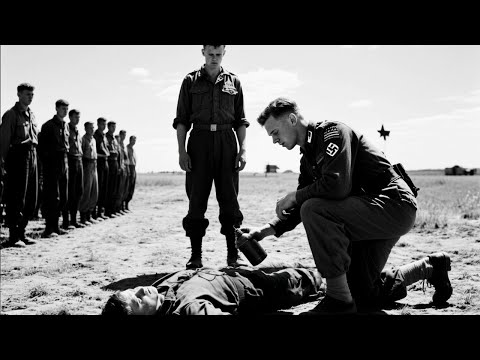
Camp Bowie sat in the West Texas desert like a scar on the landscape, a sprawl of barbed wire and wooden barracks where temperatures reached 115° by midday. Dust devils danced between guard towers. The horizon swallowed distance and hope in equal measure.
The camp housed over 3,000 German prisoners of war, most captured in North Africa after Rommel’s Afrika Korps collapsed. They arrived by train, cramped in POW cars, their grey-green uniforms stained with sand and sweat, their eyes hollow with defeat.
Johann Kramer arrived in May of 1943—23 years old, a corporal from Stuttgart. He had been captured at Tunis when his supply convoy was overrun by American armor. The propaganda had promised him that Americans were brutal, that prisoners faced torture and execution. The reality proved stranger.
The guards carried rifles but rarely pointed them. The barracks had screens on the windows. The mess hall served portions larger than anything Johann had eaten in two years. At night, the prisoners could hear music drifting from the American quarters—jazz, that degenerate negro music the party had forbidden—and sometimes laughter.
“They feed us like kings,” Karl Weber whispered in the barracks that first night, his voice uncertain. “Why?”
Johann had no answer. The Geneva Convention required adequate food, but this felt like something beyond obligation. The bacon at breakfast was real, the coffee was hot, the bread was white and soft, not the sawdust-mixed rations they had survived on in Africa.
Colonel James Maxwell ran Camp Bowie with a philosophy that bewildered both his guards and his prisoners. 47 years old, a veteran of the First World War, Maxwell believed that cruelty bred resistance while humanity dissolved it. He had seen what bitterness could do, had watched it poison men’s souls in the trenches of France. He refused to let his camp become another breeding ground for hate.
“These men are soldiers, not monsters,” he told his staff during the first week. “Treat them with the dignity their uniforms deserve, and most will respond in kind.”
The other officers thought him soft. The prisoners thought him cunning, suspected psychological warfare, waited for the trap to spring. But weeks passed, and no trap came.
The prisoners worked the farms surrounding the camp, picking cotton under the vast sky, repairing fences, hauling irrigation equipment. The farmers paid the US government, which paid the prisoners in camp script—worthless paper money good only at the camp canteen, where they could buy cigarettes, candy, writing paper.
Johann worked the fields six days a week. The labor was hard but honest, nothing like the degradation he had expected. The American guards watched but rarely interfered. The farmer who owned the land, a weathered man named Tom Hutchins, sometimes brought cold lemonade to the work crews, his teenage son helping to distribute tin cups.
“Drink up,” Hutchins would say, his accent thick as molasses. “Plenty more where that came from.”
Johann drank, the tartness cutting through the dust in his throat, and felt confused by this kindness from a man whose country he had tried to destroy.
By midsummer, the heat became unbearable. Men collapsed in the fields. The guards called for water, for shade breaks, for medical attention. This too confused Johann. He had been taught that Americans valued efficiency over humanity, that capitalism made men into machines. Yet here they were, stopping work to care for prisoners who meant nothing to them.
At night, Johann wrote letters home to his mother in Stuttgart. The censors read everything, so he kept his words careful, neutral. He described the heat, the endless sky, the strange food. He did not describe the confusion growing in his chest, the slow erosion of everything he had been taught to believe.
The other prisoners noticed it, too. In the barracks after dark, men whispered about the contradictions, the kindness that didn’t align with propaganda, the humanity that shouldn’t exist in the enemy.
“They’re weakening us,” Klaus Bauer insisted, a hard-eyed sergeant from Munich who still wore his party pin hidden in his boot. “Making us forget who we are, what we fight for. This is psychological warfare.”
But Weber shook his head. “Or maybe we were lied to.”
The words hung in the darkness like smoke. No one responded. The idea was too dangerous, too destabilizing. If they had been lied to about this, what else was a lie?
August brought no relief from the heat. The desert shimmered like a fever dream, mirages pooling on the horizon, promising water that didn’t exist. Inside the camp, tensions simmered beneath the surface courtesy.
Johann noticed it first in the letters that arrived, or didn’t arrive. His mother’s correspondence had been regular until July, then stopped. Other prisoners reported the same. The censors provided no explanations. The Red Cross packages that usually came monthly were delayed.
Then came the newspapers. Maxwell allowed the prisoners to receive German-language papers from New York, heavily censored but still containing news from home. The July edition spoke of increased bombing raids on German cities—Hamburg, Stuttgart, Cologne. The pages showed photographs of ruins, of ash, of survivors walking through rubble.
Johann stared at a photograph of a Stuttgart street he recognized, now reduced to broken walls and twisted steel. His mother lived three blocks from there. The letter he had been waiting for would never come.
He sat on his bunk that night, the newspaper crumpled in his fists, and felt something break inside him. Not his loyalty to Germany—that remained—but his ability to accept his imprisonment peacefully. His mother might be dead. His city was burning, and he was here, in this strange, comfortable cage, picking cotton for farmers who smiled and offered lemonade while his world ended.
Klaus Bauer sensed the shift. He moved through the barracks like smoke, whispering to men whose eyes had gone hollow with grief, whose hands shook with impotent rage.
“We are soldiers,” he hissed to Johann, “not cattle. We have a duty to resist, to escape, to return to the fight.”
“There’s nowhere to go,” Johann replied, but his voice lacked conviction. “We’re in the middle of a desert hundreds of miles from either coast.”
“Mexico,” Bauer said, “300 miles south, the border. From there we can make contact with sympathizers, find passage back to Germany.”
It was fantasy, desperation masquerading as strategy. Mexico had joined the Allies. There were no sympathizers waiting with open arms. The distance was impossible on foot through desert that killed experienced travelers. But Johann’s mother was dead, or dying, or trapped in ruins while he ate bacon and picked cotton under the endless Texas sky. The logic didn’t matter anymore—only the need to act, to do something, to be a soldier again instead of a comfortable prisoner.
Three others joined the plan. Werner Schultz, a quiet farm boy from Bavaria; Hans Dietrich, a tank commander from Berlin; and Karl Vogel, a pilot shot down over Tunisia. Five men bound together by grief and desperation, and the illusion that they could cross a desert and somehow make a difference.
They planned for two weeks, saved bread from meals, stole extra canteens from the work details, studied the guard rotations, the fence weaknesses, the blind spots in the searchlight patterns.
Maxwell noticed something changing in the camp. He couldn’t pinpoint it exactly—just a tension in the air, conversations that stopped when guards approached, eyes that wouldn’t quite meet his.
“Keep alert,” he told his sergeant, “something’s brewing.”
But he didn’t increase patrols or tighten restrictions. Maxwell believed in his philosophy, trusted that the humanity he showed would prevent exactly this kind of desperate act. He was about to learn how wrong he could be.
September 11th, 1943. The moon hung thin as a blade, offering barely enough light to see by. Johann waited in his bunk until the guard completed his midnight round, counted to one hundred, then rose silently.
The others were ready. They had worn their boots to bed, had their stolen supplies hidden under thin blankets. No one spoke. Communication happened through gestures, through years of military training that made words unnecessary.
The fence was weak near the laundry building, where the ground dipped and water erosion had loosened the posts. They had noticed it three weeks earlier, had been carefully working the wire loose during work details, bending it back just enough to create a gap.
Werner went first. He crawled under the fence like a snake, his body pressed flat against the sand. The wire caught his shirt and for one terrible moment Johann thought it would snag, would tear, would alert the guards. Then Werner was through.
Hans followed, then Karl, then Klaus Bauer, who turned back and locked eyes with Johann.
“For Germany,” Bauer whispered.
Johann nodded, though he wasn’t certain anymore what Germany meant. The rubble of Stuttgart or the kindness of Tom Hutchins, the propaganda he had believed or the reality he had lived.
He crawled under the fence. The wire scraped his back. The sand was cool against his palms. And then he was free, standing in the desert darkness, breathing air that felt different outside the wire, even though it was the same air.
They ran. The camp fell behind them, lights growing smaller until it was just a dim glow on the horizon, and then nothing at all. The desert stretched endless in all directions, darker than any darkness Johann had known in Europe.
They ran south, using the North Star behind them as their guide, their boots crunching on hardpan and scattered stones. The temperature dropped as night deepened. By two in the morning, Johann was shivering despite the exertion, his breath visible in the starlight.
At dawn, they found shelter in a dry wash, a depression in the earth where erosion had carved a shallow cave beneath an overhang of rock. They drank water sparingly, ate the bread they had saved, and tried to sleep while the sun climbed and the temperature soared.
Johann couldn’t sleep. He lay in the shade watching heat waves ripple across the desert and thought about his mother. If she was alive, would she want him to die in this wilderness? If she was dead, what was the point of any of this?
By late afternoon, Maxwell knew they were gone. The evening head count came up five short. The fence breach was discovered. The trail of boot prints led south into the wasteland.
Maxwell stood at the fence gap, his hat in his hands, and felt the weight of failure settle on his shoulders. He had believed in humanity, in kindness, in the power of decent treatment to transform enemies into men worthy of trust. Five Germans had just proven him wrong.
“Gather a search party,” he told his sergeant. “Horses, water, medical supplies. They have maybe thirty hours before the desert kills them.”
“Sir.” The sergeant hesitated. “Should we alert the state police? The military police?”
Maxwell shook his head. “This is my responsibility, my prisoners. I’ll bring them back.”
He knew what would happen if the military police found them first. They would be labeled dangerous, treated as threats, possibly shot if they resisted. Maxwell wanted to give them a different ending, wanted to prove that his philosophy could survive even this betrayal.
The sun was setting when Maxwell rode out with six men, following the boot prints that told a story of desperation. Five sets of tracks heading south in a straight line—no attempt at deception or misdirection. These were soldiers, not criminals. They ran with purpose, with discipline that made them more dangerous and more tragic.
The second day broke hot and merciless. Johann woke with his tongue swollen, his lips cracked and bleeding. The water was half gone. They had covered maybe forty miles, barely a tenth of the distance to Mexico. Werner was in bad shape, his farm-boy complexion burned red, his breathing shallow and rapid. Hans supported him as they walked, but both men were weakening fast.
“We need to find water,” Karl said, his pilot’s practicality cutting through the desperation. “Or we’re dead by tomorrow.”
They searched for hours, following dry stream beds that promised water but delivered only dust. The landscape was alien—Joshua trees and prickly pear, rattlesnakes coiled in the shade of rocks, vultures circling overhead like patient death.
By noon, Klaus Bauer was raving. His Nazi ideology bubbling up in fragmented speeches about destiny and duty and the superiority of the German spirit. Johann ignored him, focused on putting one foot in front of the other, on keeping Werner upright, on surviving the next hour.
That’s when he saw the windmill.
It rose from the desert like a miracle, its blades turning lazily in the hot breeze, pumping water from deep beneath the earth. A wooden trough sat at its base, filled with clear water for cattle.
They ran. What was left of their discipline shattered in the face of that water. They plunged their faces into the trough, drank until their stomachs cramped, splashed water over their burned skin. Johann lay in the mud beside the trough and felt tears mixing with the liquid on his face—not of joy, but of shame.
“We rest here,” Klaus decided. “Wait for night, then continue.”
But Maxwell had seen the windmill from a mile away. He approached slowly, rifle across his saddle but not pointed.
“Don’t,” Maxwell said. “Please, don’t make me shoot you.”
Johann met his eyes. “You came alone.”
“Not alone. But not with an army. You’re soldiers, not criminals.” He nodded at Werner, trembling in the shade. “Your friend won’t survive another day. You can die here as heroes or live as men. Your choice.”
Johann thought of his mother, of Tom Hutchins and his lemonade, of every small kindness that had eroded the propaganda.
“We surrender,” he said quietly.
Klaus cursed and bolted into the desert; Maxwell’s men caught him within fifty feet, without cruelty. They rode back slowly, the sun setting gold and amber behind them.
Johann watched the landscape he had tried to escape through and understood at last: the true battle was between cruelty and compassion. In this desert, compassion had won.
What would you have chosen at that trough—pride, or the harder grace of surrender?
Report this article
Select a reason for reporting:






