The red flare arced into the night sky, a signal meant to unleash a charge that would sweep the airfield and seal an empire’s victory. Instead, it marked the beginning of a catastrophe. Heavy machine guns tore through the darkness. Trench mortars thumped. Grenades threw jagged shadows across the mud. And a Japanese Marine, crouched in the hell of Milne Bay, would later write in his diary: “There didn’t seem to be any place where we could put ourselves, but nevertheless, we advanced. We were like rats in a bag and men were falling all around.”
These words, never meant for enemy eyes, captured the unthinkable: a landing force discovering under fire that the enemy in front of it had been counted wrong—terribly wrong. In August 1942, on the eastern tip of Papua, the Japanese war machine met its first undoubted defeat on land. The men who threw them back into the sea were not the hardened divisions the world watched. They were militia battalions from Queensland—young, thin on training, mocked by some of their own countrymen—alongside desert veterans fresh from Tobruk and a handful of fighter pilots flying from airstrips carved out of a swamp.
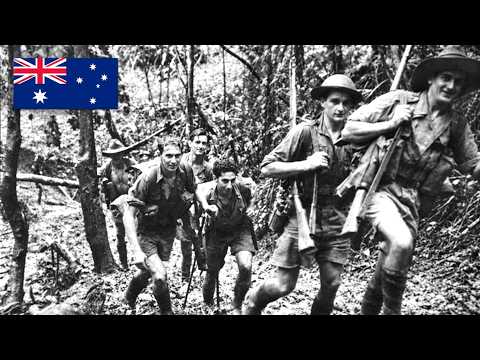
Outside Australia, few could place Milne Bay on a map. Yet British Field Marshal William Slim, who fought the Japanese across Burma, later wrote that it was Australian soldiers who “first broke the spell of the invincibility of the Japanese Army.” A spell—that was the word Slim chose. But how does a force that had not been pushed off a single beach in nine months come to describe itself as rats in a bag? The answer lies in the documents both sides left behind, and in a gap between what Tokyo believed and what waited in the mud.
Milne Bay was a place nobody would fight over for its own sake. Rain fell 5,100 millimeters a year. Tracks turned into glutinous quagmires. Malaria bred in standing water. But it was flat—and in 1942, flat ground at the tip of New Guinea meant airfields. By late August, 8,824 Allied soldiers held the bay, including 4,500 infantry. Japanese planners believed the airfields were defended by 300 to 600 men. That miscalculation would cost them everything.
On the night of 25 August, the first Japanese Marines came ashore in darkness and rain, landing 3 kilometers east of their intended spot—a small error that in that mud was a long way. They brought two light tanks. The Australians, desert veterans of the 2/10 Battalion, reached for sticky bombs that failed to stick in the humidity. The fighting was short and confused. The Australians lost 43 killed and were forced back. First night, first retreat.
But then the jungle and the weather turned against the invaders. The tanks pushed toward the airfield and sank into the mud, abandoned by their crews. Japanese Marines learned to move by night and hide by day, lying in wet grass while Kittyhawks hunted them from dawn to dusk. “Enemy planes attacked us in turns, about three aircraft at a time,” wrote First-Class Stoker Shimokawa. “We hid in the jungle all day.” The men who had swept through Southeast Asia now shivered in the scrub, listening for engines.
On the night of 31 August, the Japanese attacked No. 3 Strip—a long, open clearing in the scrub. Across it, in pits and behind wire, waited the militiamen of the 25th and 61st Battalions, many of whom had never fired at an enemy before that week. Behind them, the guns of the 2/5 Field Regiment and American engineers with machine guns. At 3 a.m., out of the dark, the Japanese came across open ground. The red flare went up. Every Australian gun opened at once. The first charge broke. The second broke. The third broke. Commander Shojiro Hayashi was killed. Dawn came up gray over the strip, and the Australians did the thing the Japanese plan never imagined: they went forward.
Among them was Corporal Jack French, a 28-year-old from Crow’s Nest, Queensland. On 4 September, near Goroni, his company ran into three interlocking machine-gun posts. French gave one order—“Take cover”—and then crawled forward alone with grenades. The first post went silent. He came back for more grenades, forward again. The second post went silent. There was a third. He stood up with his Thompson submachine gun and walked toward it, firing from the hip. The gun fired back. He kept walking. The gun stopped. His men found every crew member dead—and Jack French dead in front of the third pit.
That same day, a patrol found the wreck of a Kittyhawk and the remains of Squadron Leader Peter Turnbull, shot down on 27 August. The pilot and the corporal never met, but their stories closed on the same day, a few kilometers apart in the same mud. The next day, Tokyo ordered Milne Bay abandoned. The survivors slipped away at night, in the rain, as they had come.
The cost was staggering. Australia lost 167 killed or missing. The Japanese lost at least 600 dead—a quarter of the force. Vice Admiral Matome Ugaki blamed his own men, calling their fighting spirit inferior. He wrote nothing about the 7,459 Australians his planners had reduced to a few companies. Brigadier John Field, whose militiamen held the strip, put it in one line: “Our troops have proved the Japanese is not a superman.”
Yet the victory faded into shadow. Kokoda gave Australia its legend. Guadalcanal gave the Americans theirs. Milne Bay lasted less than a fortnight, and the men who fought it went straight on to the next battle, rarely speaking of it. General Cyril Clowes, who won the battle, was criticized by MacArthur and Blamey for lack of vigor in pursuit—moved to commands far from the fighting and never thanked. Silent Cyril to the end.
But the trace survived. It survived in unit diaries, in captured documents, in a stoker’s account of planes coming three at a time, and in the pages of a Marine who never thought his diary would be read by his enemies. The fear in that diary was not a legend. A man wrote it down in the dark under a red flare. That flare went up over No. 3 Strip as a signal to attack. Today it reads as a marker for the place where the Japanese advance on land first stopped and went back.
The enemy wrote this history down first. It is our turn to keep reading it—and to read it carefully, because the documents do not always agree, and the disagreements themselves tell a story.
Consider what the Japanese planners believed when they sailed. Their intelligence, such as it was, described two or three companies of Australian infantry. Perhaps 600 men. What they found was a garrison of nearly 9,000, dug in behind wire, with artillery ranged across open ground and fighter aircraft operating from strips they had been told were barely defended. The gap between the estimate and the reality was not a small error of counting. It was a failure of imagination, born of eight months of easy victories.
And yet, the Australians were not the force the world watched either. MacArthur’s cable to Marshall, sent three days into the battle, betrayed the doubt at the top: “I am not yet convinced of the efficiency of the Australian troops.” The men holding No. 3 Strip were militiamen—part-time soldiers, many still in their teens, who had never heard a shot fired in anger before that week. Their own countrymen had mocked them as “chocolate soldiers,” fit for garrison duty but not for the front.
What changed their story was not a general’s speech or a grand strategy. It was the mud, the wire, and the simple refusal to run. When the first charge came out of the dark, the militiamen held their fire until the flare went up. Then they fired straight down the cleared strip where there was no cover at all. The Japanese Marines—veterans of Shanghai, of Singapore, of the Philippines—went to ground, got up, charged again, and broke against that line like surf against a seawall.
One of those militiamen, a Queensland farm boy who left no diary and no name in the surviving records, later told an interviewer only this: “We just kept shooting. You didn’t think about it. You just kept shooting.” That was the whole of his account. He went back to his unit, to the quinine and the patrols, and never spoke of it again.
The Japanese side, by contrast, recorded everything—and their records are the most revealing of all. Stoker Shimokawa’s diary, captured later, described the days of hiding in the jungle with a flatness that is almost worse than complaint: “We hid in the jungle all day. Enemy planes attacked us in turns, about three aircraft at a time.” No drama. No outrage. Just the mechanical rhythm of fear, repeated until it became routine.
Vice Admiral Ugaki, chief of staff of the Combined Fleet, reached for a different explanation. Too many of the landing force’s men, he noted, were 30 to 35 years old, not fully fit, and showed what he called inferior fighting spirit. He blamed his own soldiers. He wrote nothing about the 7,459 Australians his planners had reduced to a few companies. The arithmetic of that silence is the arithmetic of the whole campaign.
On 5 September, the order came to abandon Milne Bay. A larger force, the Aoba Detachment, had been due to land on 11 September. It never came. That evening, Japanese ships slipped into the bay and took off the survivors from the shore. They left as they had arrived—at night, in the rain. On 6 September, the cruiser Tenryu and the destroyer Arashi entered the bay and opened fire on the freighter Anshun at the wharf. About ten hits. The ship rolled onto her side. The hospital ship Manunda lay nearby, lit up by Japanese searchlights. They did not fire on her.
Then, on 7 September, two Japanese warships shelled the shore for fifteen minutes and steamed away. After that, nothing. The battle was over. What remained was the counting—and the counting has never fully settled.
The Australian count came to 167 killed or missing, 206 wounded in one tally and 205 in another, most of them from the veteran battalions of the 18th Brigade. The Americans lost 14, nearly all engineers of the 43rd Engineer Regiment. For the Japanese, the figures split: one reconstruction gives 625 killed and 311 wounded, the Australian War Memorial has spoken of about 750 dead out of some 2,800 who landed, and elsewhere gives about 600—a quarter of the force. No record closes the gap.
Then came what the pursuit uncovered. Thirty-six Australians were captured during the fighting. None survived. The War Memorial has recorded 59 cases of local Papuan people murdered by the landing force. Even here, the Japanese side reached for explanations—Ugaki judged his own men, and wrote nothing about the thousands his planners had reduced to a few companies.
Brigadier John Field, whose militiamen held No. 3 Strip, was blunt: “Our troops have proved the Japanese is not a superman.” General Sydney Rowell was more careful: “This was the first time the Japanese had been defeated at a time and on ground of their own choosing. They had picked the place, the date, and the landing beach. They had brought tanks, and they had been forced back into the sea.”
No parade followed. The battalions went back to digging, to quinine, to patrols, and to the next campaign already underway on the Kokoda Track. In June 1944, on the airfield where the night charges had broken, the men stationed there put up a memorial. No. 3 Strip had been renamed Turnbull Field. Near it, a marker carried this line: “83 unknown Marines lie buried here.” The defenders had buried the men who came to kill them, and written down how many.
Jack French was buried in Bomana War Cemetery near Port Moresby, and received the Victoria Cross after his death for what the citation called cool courage and disregard of his own personal safety. Dulcie McKeown never married him. His brother Gordon, the airman, was killed in August 1943, eleven months later; in Crows Nest a memorial library bears his name, and in September 2019 a bridge on the Toowoomba range he crossed as a schoolboy was named for him.
Peter Turnbull was first buried at Milne Bay, then moved to Bomana. The airfield on which the Japanese attack broke still carries his name in the records of that war. Albert Abraham went home with his medal and a leg the enemy had tried to take from him. And Cyril Clowes, the general who won the battle, was not thanked for it—criticized by MacArthur and Blamey for lack of vigor in pursuit, moved to commands far from the fighting, retired as a lieutenant general in 1949, and died in Melbourne on 19 May 1968. Silent Cyril to the end.
So why does this victory sit in the shadows? Partly timing—Milne Bay was fought in the same weeks as the retreat on Kokoda and the first great struggle for Guadalcanal. Partly the men themselves, who went straight on to the next battle and rarely spoke of this one. And partly the general who would not promote himself, sidelined by superiors who doubted him from the first days. Yet the trace survived—in unit diaries, in captured documents, in a stoker’s account of planes coming three at a time, in the pages of a Marine who never thought his diary would be read by his enemies.
The fear in that diary was not a legend. A man wrote it down in the dark under a red flare, and that flare went up over No. 3 Strip as a signal to attack. Today it reads as a marker for the place where the Japanese advance on land first stopped and went back. The enemy wrote this history down first. It is our turn to keep reading it.
So here is the question for you: if a handful of Queensland militiamen, mocked as “chocolate soldiers,” could break the spell of an unbeaten army in a swamp at the end of New Guinea—why do we still remember Kokoda and Guadalcanal, and forget Milne Bay? Tell us in the comments: whose story deserves to be told next?
Report this article
Select a reason for reporting:






