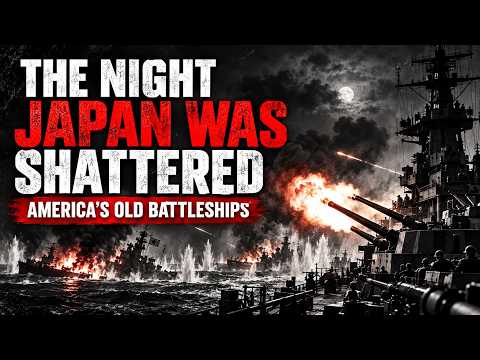
At 3:51 on the morning of October 25, 1944, the heavy cruiser Louisville fired the first salvo into the darkness at the northern mouth of Surigao Strait. Two minutes later, the battleship West Virginia hurled eight 16-inch shells at a target 22,800 yards away. No one on board could see the enemy. Radar could. The first salvo hit. The target was the Yamashiro, flagship of Vice Admiral Shoji Nishimura. In less than twenty minutes, the Yamashiro would roll over and sink, taking Nishimura and nearly her entire crew with her. Seven ships followed Nishimura into the strait that night. One came out.
Five of the six American battleships waiting in the dark had been at Pearl Harbor on December 7, 1941. Two of them had been sunk there. The Imperial Japanese Navy would never again fight a battleship action. Neither would anyone else. What happened in Surigao Strait decided more than one night—it decided whether the American landing on Leyte would survive the week.
Five days earlier, on October 20, more than 100,000 American soldiers had begun coming ashore on Leyte. Behind them in Leyte Gulf sat the transports, the supply ships, and the escort carriers that kept the entire invasion alive. Japan’s answer was a plan called Sho-Go. It was the last great gamble of the Imperial Japanese Navy, and it needed every ship Japan still had. The plan had three moving parts: a decoy force of carriers would pull Admiral William Halsey’s Third Fleet north; a powerful center force under Vice Admiral Takeo Kurita would come through San Bernardino Strait; and a southern force would come through Surigao Strait. The two jaws were meant to close on Leyte Gulf at dawn on October 25. The southern jaw was Nishimura’s. If it closed, the transports in Leyte Gulf would face battleship guns at point-blank range. If it failed, the entire plan would arrive with one arm missing.
There was a reason the southern door was guarded by the oldest battleships in the fleet. The newest ones were gone. On October 24, Halsey took the Third Fleet north after the Japanese decoy carriers, and with it went the fast battleships—the ships built for exactly this kind of fight. The escort carriers and transports in Leyte Gulf were left with the Seventh Fleet, and the Seventh Fleet’s heavy guns were the old bombardment battleships. Whatever came through Surigao Strait that night would meet the ships the Navy had once counted as lost.
That is the thesis of this night: the ships Japan believed it had destroyed at Pearl Harbor were the ships that destroyed the Japanese battle line in Surigao Strait. Revenge is the word most people reach for. The record points somewhere more precise—to a sequence of decisions, most of them made in shipyards and classrooms rather than at sea, that turned the oldest battleships in the fleet into the deadliest night gunnery platforms on Earth. There is a second thing the record shows. Two American sailors watching from the battle line that night reported something about the battleship Fusō that went into the history books and stayed there for seventy years. It went in wrong.
But the Battle of Surigao Strait did not begin at the mouth of the strait. It began thirty-four months earlier in the oil-covered mud of Pearl Harbor with a decision nobody recorded as important.
At 7:55 on the morning of December 7, 1941, eight American battleships sat at Pearl Harbor. By 10:00, Arizona had exploded. Oklahoma had capsized. California, West Virginia, and Nevada were sinking or aground. Tennessee, Maryland, and Pennsylvania were damaged. 2,403 Americans were dead. The West Virginia took the worst of it. Aerial torpedoes tore open her port side—most counts say seven of them—and two bombs struck her. Her captain, Mervyn Bennion, was mortally wounded on the bridge and kept command until he died. He was awarded the Medal of Honor. His crew counter-flooded the ship so she settled upright instead of rolling over like Oklahoma. More than a hundred of them died. The California was hit by two torpedoes and a bomb. She did not go down at once. She sank slowly over three days until she rested on the bottom with her main deck underwater.
By any reasonable standard of 1941, both ships were finished. They were already more than twenty years old. They were slow, and the attack itself had just demonstrated that the airplane, not the battleship, now ruled the sea. Writing them off would have been rational. It would have freed dockyards, steel, and men for carriers. The Navy did not write them off.
Under Captain Homer Wallin, the Pearl Harbor Salvage Organization went to work. The work was slow, filthy, and dangerous. The flooded compartments were full of fuel oil, wreckage, and rotting stores. Gas built up in the sealed spaces, and men working inside the hulls were overcome by it. Every compartment had to be searched, pumped, cleaned, and made watertight before the next could be opened. Divers made thousands of dives into black oil-filled compartments full of the dead. Engineers built coffer dams around the torn holes and pumped the harbor out of them. California was refloated in March 1942. West Virginia came up in May. Both were patched, towed to dry dock, and eventually sent to Puget Sound Navy Yard in Bremerton, Washington. The Tennessee had her own problem. When the West Virginia sank beside her, the stricken ship pushed the Tennessee hard against the concrete mooring caissons. She was pinned in place. To free her, the salvage crews had to blast away the caissons themselves. She sailed for the West Coast before the end of December—damaged but afloat.
None of this was recorded at the time as a strategic decision. It was recorded as salvage: tonnage raised, compartments cleared, hours logged underwater. Nobody in 1942 wrote a memo predicting that these hulls would one day fight the last battleship action in history. What went into Puget Sound was a wreck. What came out years later was a different ship. It would take nearly three years to find out what that decision meant.
To understand why that mattered, look at what the United States Navy was facing in the dark. In 1942, the Imperial Japanese Navy was the finest night-fighting force in the world. That was not an accident. It was a doctrine built deliberately over twenty years. The Washington Naval Treaty of 1922 had limited Japan to fewer battleships than the United States. Japanese planners accepted that they would begin any Pacific war outnumbered. Their answer was to fight at night, when numbers counted for less and skill counted for more. They would wear the American battle fleet down with destroyer and cruiser attacks in the dark before the decisive daylight battle was ever fought.
To do it, they built the best torpedo of the war. The Type 93, which Americans later called the Long Lance, was 24 inches wide and ran on pure oxygen. It left almost no wake. It carried nearly half a ton of explosive. At high speed it could run about 20,000 meters; at lower speed, close to 40,000. The best American destroyer torpedo of 1942 had roughly a quarter of that range. It also often failed to explode.
The Japanese trained their lookouts for years in the dark until men could pick out a ship at ranges American crews did not believe were possible. They fitted their ships with large, superb night binoculars. They practiced night torpedo attacks at full speed, in formation, in bad weather, again and again, and accepted the collisions and the dead that such training cost.
The results arrived in August 1942. On the night of August 9, off Savo Island near Guadalcanal, Vice Admiral Gunichi Mikawa took seven cruisers and a destroyer straight past two American radar picket destroyers. Neither saw him. In a little over half an hour, his ships sank four Allied heavy cruisers—Quincy, Vincennes, Astoria, and the Australian Canberra. 1,077 Allied sailors died. Mikawa’s force lost no ships in the action. The Navy called it the worst defeat in its history at sea.
It happened again. On the night of November 30, 1942, at Tassafaronga, Rear Admiral Raizo Tanaka was leading eight destroyers on a supply run, their decks crowded with drums of cargo. An American force of five cruisers and six destroyers detected him first on radar and fired first. It did not matter. Tanaka’s destroyers turned, fired their Long Lances, and ran. The heavy cruiser Northampton was sunk. Minneapolis, New Orleans, and Pensacola were torn open. Minneapolis lost her bow. Nearly 400 Americans died. Tanaka lost one destroyer. Remember the name Minneapolis. She will be in Surigao Strait.
The pattern was consistent. American ships had radar and bigger guns. Japanese ships had better torpedoes, better optics, better training, and better doctrine. In the dark, doctrine won. And the battleships that Nishimura would lead through Surigao Strait were part of that tradition.
Fusō was commissioned in 1915. Yamashiro followed in 1917. Each carried twelve 14-inch guns in six turrets and displaced well over 35,000 tons fully loaded. They had been rebuilt in the 1930s with new engines, new armor, and towering pagoda masts crowded with fire-control stations. On paper, together they carried twenty-four heavy guns into the strait.
The man who would lead them was no stranger to the dark. Shoji Nishimura had spent much of his career in destroyers and cruisers. In the first months of the war he had commanded a destroyer squadron in the conquest of the Dutch East Indies, and he had fought in the night and day actions of the Java Sea campaign that destroyed the Allied naval force in those waters. He knew what a torpedo attack in the dark could do because he had carried them out himself.
And they would not come alone. Ahead of them were four destroyers, each carrying Long Lances, crewed by men raised on the doctrine that had won at Savo and Tassafaronga. Beside them was the heavy cruiser Mogami, with torpedoes of her own. Behind them, following by roughly forty miles, came a second force under Vice Admiral Kiyohide Shima: two more heavy cruisers, a light cruiser, and four more destroyers. On paper, that was a night-fighting force with a combat record the Americans had every reason to fear.
The numbers tell a different story—but in 1942, nobody on the American side could read them yet.
Now look at what the Americans did not have. On December 8, 1941, the Pacific Fleet had no operational battle line. The old battleships could make about 21 knots; the new carrier task forces ran at 30. A battleship that could not keep up with a carrier could not escort one. So the old ships were given the job nobody wanted: shore bombardment. Their crews called them the old ladies. The name was affectionate. It was also accurate.
American torpedoes did not work. The Mark 14 ran too deep and often failed to explode. Radar existed, but few commanders trusted it. At Savo, the two picket destroyers that missed Mikawa both had radar. By the autumn of 1942, the phrase the Navy used about night actions in the Solomons was simple: the Japanese owned the night.
What nobody in Washington understood yet was this. The answer to the Long Lance was not a better torpedo. It was a better way to see. While California and West Virginia sat in dry dock at Puget Sound, the Navy made a choice about what to put back into them. The easy path was to repair them as they had been. The Navy chose the hard path. It rebuilt them almost completely.
New torpedo bulges widened the hulls so much the ships could no longer pass through the Panama Canal. The old cage masts were gone. The mixed secondary guns were replaced with sixteen 5-inch dual-purpose guns in twin mounts—the same battery carried by the Navy’s new battleships. But the decision that mattered most was the smallest thing on the ship. The rebuilt battleships received the Mark 34 main battery director, and fitted to it was the Mark 8 fire-control radar.
The Mark 8 was not a search radar. It was a gunnery instrument. Its operator watched a scope that showed the target as a spike of light and also showed the splashes of the ship’s own shells landing around it. A gunnery officer could see where his salvo fell, correct, and fire again at 20,000 yards in total darkness without ever seeing the enemy with his eyes. That single capability erased the Japanese advantage in night optics. It did not matter how good a lookout was if the enemy was firing from beyond the range of any binocular ever built.
The difference would show up in the logbooks. At Surigao Strait, three of the six American battleships carried the Mark 8: West Virginia, California, and Tennessee. All three had been damaged at Pearl Harbor. Two of them had been sunk. The other three—Maryland, Pennsylvania, and Mississippi—carried the older Mark 3 radar. West Virginia fired sixteen salvos. Tennessee fired sixty-nine rounds. California fired sixty-three. Maryland, ranging on the splashes of the others, fired forty-eight. Mississippi fired a single salvo. Pennsylvania never fired at all. The three ships raised and rebuilt after Pearl Harbor did most of the killing.
The unnoticed decision was not to save the battleships. It was to rebuild them as instruments that could fight in the dark.
West Virginia was the last to return. She left Puget Sound in July 1944, two and a half years after she sank. She rejoined the fleet in time for the Philippines. By October, she was steaming toward Leyte with her crew still learning the ship. California had rejoined earlier that year and fought at Saipan and Guam. Tennessee had been bombarding islands across the central Pacific. None of them had yet fired a shot at another battleship. Since returning to the fleet, their rebuilt guns had fired only at beaches. None of them had been built to fight the way they would fight on October 25.
And the Navy had already learned at a terrible price what happened when radar and battleships met the Japanese at night. Two weeks before Tassafaronga, the Navy had already paid for a different lesson.
The first test came off Guadalcanal in November 1942, in two nights that remain among the most violent surface actions in naval history. On the night of November 13, a Japanese force built around the battleships Hiei and Kirishima came down to bombard Henderson Field. An American force of cruisers and destroyers under Rear Admiral Daniel Callaghan met them. The two columns ran directly into each other in the dark. Ships fired at ranges so short that the battleship guns could not depress far enough to hit the destroyers alongside them. It lasted about forty minutes. Callaghan was killed. So was Rear Admiral Norman Scott. The light cruiser Atlanta was wrecked and later scuttled. The light cruiser Juneau, damaged in the fight, was torpedoed by a submarine the next morning as she withdrew. Nearly 700 men died with her, among them the five Sullivan brothers. Several American destroyers were sunk, but the Hiei was crippled. Aircraft from Henderson Field found her the next day and she was scuttled that evening. She was the first Japanese battleship lost in the war.
Two nights later, on November 14 and 15, the Japanese came back with the Kirishima. This time, waiting for them were two American fast battleships, Washington and South Dakota, under Rear Admiral Willis Lee. Lee was a gunnery expert and one of the few senior officers in the fleet who understood radar in detail. What followed was partial, costly, and revealing. Costly because the four American destroyers leading Lee’s line ran straight into Japanese torpedoes and gunfire. Walke, Preston, and Benham were lost. Gwin was damaged. Then South Dakota suffered an electrical failure at the worst possible moment, lost her radar, and was caught in Japanese searchlights. She was hit by more than two dozen shells.
Revealing because the Washington was never seen. Lee tracked the Kirishima on radar while the Japanese concentrated on the South Dakota. At a range of about 8,400 yards, Washington opened fire with radar-directed 16-inch guns. In roughly seven minutes, she wrecked the Kirishima. The Japanese battleship was scuttled in the early hours of November 15. For the first time in the war, an American battleship had fought a Japanese battleship at night and destroyed it. The instrument that did it was radar.
It proved something. It did not prove enough. The Japanese still won most of the night battles in the Solomons that followed. Tassafaronga came two weeks later. The destroyers that died leading Lee’s line showed that radar alone could not protect ships from torpedoes they could not see coming. The Navy needed more than a better instrument. It needed a new rule.
And then the rule changed. The change began below decks. By 1943, American destroyers and cruisers were building a new compartment called the combat information center. It was a darkened room lit by radar scopes and plotting tables. Every report came into it: radar contacts, radio traffic, lookout sightings, the positions of friendly ships. Officers turned those fragments into a single picture and fed it to the captain. For the first time, an American captain in a night battle did not have to guess what was around him. He could see it on a plot.
The second change was in the rules for destroyers. For the first year of the war, American destroyers had been tied to the cruisers they screened. In the summer of 1943, that changed. Destroyer commanders were given the freedom to find the enemy by radar, close in the dark, and fire torpedoes on their own initiative before a single gun revealed their position.
The first proof came on the night of August 6, 1943, in Vella Gulf. Commander Frederick Moosbrugger took six destroyers in two divisions against four Japanese destroyers carrying troops and supplies. His ships approached along the dark shoreline of Kolombangara, tracked the Japanese on radar, and fired torpedoes before they were seen. Three of the four Japanese destroyers were sunk. Around 1,500 Japanese soldiers and sailors died. Not one American ship was hit.
In November 1943, off Cape St. George, Captain Arleigh Burke did it again. His destroyers caught a Japanese force at night and sank three destroyers. Again, no American ship was lost. The Americans had not built a better Long Lance. They had built a better way to fight with what they had. Find the enemy first by radar. Fire torpedoes before firing guns. Turn away while the torpedoes run. Then let the heavy guns finish what was left. It was in effect Japanese doctrine fought with American eyes.
By October 1944, that doctrine had a man in charge of it at Leyte. Rear Admiral Jesse Oldendorf commanded the bombardment and fire support group of Vice Admiral Thomas Kinkaid’s Seventh Fleet. On the morning of October 24, carrier aircraft sighted Nishimura’s force in the Sulu Sea heading for Surigao Strait. By that afternoon, Oldendorf had his orders: stop it.
His plan was built in layers. At the southern entrance of the strait and along its approaches, he placed thirty-nine PT boats in sections of three. Their first job was not to sink anything. It was to find the enemy and report. Farther north, on both flanks of the strait, he stationed destroyers. They would make radar-directed torpedo attacks from the sides in succession, one squadron after another. At the northern mouth of the strait, he placed his cruisers on both flanks. The left flank under his own command in the Louisville included the heavy cruisers Portland and Minneapolis. Minneapolis had lost her bow at Tassafaronga. Now she was back. And across the top of the strait, steaming slowly back and forth from east to west, he placed the battle line: six battleships under Rear Admiral George Weyler—Mississippi, Maryland, West Virginia, Tennessee, California, and Pennsylvania.
Any Japanese ship that survived the PT boats, the destroyers, and the cruisers would come up the strait in a narrow column heading north. The American battleships would be steaming across the head of that column at right angles. Every American gun could bear. Only the forward guns of the leading Japanese ships could answer. It was the oldest dream in naval gunnery. It was called crossing the T. Oldendorf later explained his thinking with a gambler’s phrase: “You never give a sucker an even break.”
There was one problem. His ships had been loaded for bombardment, not for battle. Most of the shells in the battleship magazines were high-capacity rounds designed to blow apart beach defenses, not armor-piercing shells designed to penetrate a battleship. After days of firing at Leyte, some battleships had fewer than 200 armor-piercing shells on board. The destroyers had no replacement torpedoes and were down to about a fifth of their 5-inch ammunition. So the orders were precise. Each battleship loaded enough armor-piercing rounds into its hoists for the first five salvos, and the battle line was told to hold its fire until the enemy had closed to between 20,000 and 17,000 yards, where the percentage of hits would be highest.
The plan had one more risk built into it. The destroyers attacking down the strait would be close to the Japanese column. When the heavy guns opened fire in the dark, a destroyer on a radar scope looks like a destroyer. It does not show its flag. One of them was about to learn exactly what that meant.
At 10:36 on the night of October 24, the radar of PT-131 patrolling near Bohol Island picked up a contact. It was Nishimura. For the next three hours, the PT boats went after him in the dark, section by section. The Japanese destroyers caught them in searchlights and drove them off with gunfire. Several PT boats were hit. Not one torpedo struck a Japanese ship. But the boats did their real job. Report after report reached Oldendorf. He knew how many ships were coming, where they were, and how fast.
Nishimura entered Surigao Strait at about 2:00 in the morning, steaming north at around 20 knots. He had not waited for Shima. He was under orders to reach Leyte Gulf at dawn, and he would not be late.
At the northern end of the strait, the battle line waited. The crews had been at general quarters for hours. In the turrets of the West Virginia, men who had joined the ship after she was raised from the bottom of Pearl Harbor sat beside men who had been on board the morning she sank. The ship steamed slowly east, then turned and steamed slowly west, then turned again, holding their line across the head of the strait at a speed of about five knots. Nobody fired. Nobody could see anything. The only picture of the enemy was the one on the radar scopes and the plotting tables of the combat information centers, where the reports of the PT boats had turned into a track moving north.
At about 3:00, the first destroyer squadron attacked. Captain Jesse Coward’s Destroyer Squadron 54 came down both sides of the strait. The eastern group—Remey, McGowan, and Melvin—fired twenty-seven torpedoes and turned away. The Japanese never saw them fire. At about 3:09, a torpedo from the Melvin struck the Fusō. The battleship slowed, sheared out of line to starboard, and fell behind. Nishimura in the Yamashiro ahead of her may not have known. Minutes later, the western group—McDermut and Monssen—fired their spreads. The destroyer Yamagumo was hit and blew up. The Michishio was hit and left dead in the water. The Asagumo had her bow blown off. A torpedo struck the Yamashiro.
In roughly ten minutes, one American destroyer squadron had cut Nishimura’s force nearly in half. Nishimura sent a signal to Kurita and Shima: “Two destroyers torpedoed and drifting. Yamashiro hit by one torpedo, still able to fight.” He kept going north. He did not ask permission to withdraw. He did not slow down. Whatever Nishimura understood about what was waiting for him at the top of the strait, the record shows only that he continued toward it at the speed his orders required.
At about 3:25, the second wave came in. Destroyer Squadron 24, including the Australian destroyer Arunta, attacked from the western side of the strait. A torpedo from the Killen struck the Yamashiro again. The crippled Michishio was finished off at about 3:35. Oldendorf sent in his third squadron. Captain Roland Smoot’s Destroyer Squadron 56 went straight down the middle of the strait. Now Nishimura had three ships still in formation: the Yamashiro, hit twice; the Mogami; the destroyer Shigure. Behind them, the Fusō lay burning. Seven ships had entered the strait. Three were still coming. Not one of them could see the six battleships waiting for them, and not one of the American battleships had yet fired.
At 3:51, the American cruisers opened fire. At 3:53, West Virginia fired her first salvo at 22,800 yards. It hit. At 3:55, California and Tennessee joined in. The Maryland, whose older radar could not find the Japanese ships on its own, found the splashes of the other battleships instead, and ranged her guns on those. The Pennsylvania searched and searched and never found a target she could fire on.
The night turned orange. For the Japanese sailors in the column, the enemy was invisible. They saw only the flashes on the horizon and then the shells arriving. The cruisers alone fired thousands of 6-inch and 8-inch rounds. Watchers in the American line described the arcs of tracer overhead as a stream of railway cars rolling over a hill.
The Yamashiro fought back. Her guns fired at the flashes of the American cruisers and at the destroyers closing on her. She was burning from bow to stern. Her secondary guns fired at the destroyers. Her main battery fired at the cruisers on the left flank. Several Japanese shells fell close aboard the American cruisers, and some landed near enough to drench their decks with spray, but none of the heavy ships was seriously hit. The Yamashiro was firing at flashes. The Americans were firing at her.
The Mogami was hit repeatedly, set afire, and turned away south. The Shigure was hit by one shell that did not explode. She turned and ran. At about 4:04, the destroyer Albert W. Grant, closing on the Yamashiro to fire torpedoes, was caught in the crossfire. She was hit by Japanese shells. She was also hit by American ones. At about 4:08, the Mississippi fired a single salvo of twelve 14-inch shells. It was the last salvo ever fired by one battleship at another.
At 4:09, eighteen minutes after the first cruiser salvo, Oldendorf ordered every ship in the line to cease fire to protect the Grant. The Yamashiro turned south, burning. She had steamed into American fire for more than a quarter of an hour, and not one man aboard her ever saw an American battleship with his own eyes. Torpedoes from Smoot’s destroyers struck her. At about 4:19, she capsized and sank. Nishimura went down with her. So did almost everyone on board.
What happens in the next twelve minutes is the part most documentaries skip entirely. If you want the rest of this war told the same way—from the records, not the legends—subscribe before it starts.
Forty miles behind Nishimura, Vice Admiral Kiyohide Shima was coming up the strait with his own force. The two admirals had sailed toward the same target on the same night without ever coordinating. Strict radio silence and a divided chain of command meant that each was in practice fighting his own battle. The first sign of what lay ahead came before Shima reached the fighting. At around 3:25, PT-137 fired a torpedo at a Japanese destroyer. It missed the destroyer and struck the light cruiser Abukuma instead. She fell out of formation, slowed and damaged. It was the only torpedo hit the PT boats scored all night.
Shima pressed on. As he came north, his lookouts saw fire on the water. They were passing the burning wreckage of Nishimura’s force. Shima had no clear picture of what had happened, only that the ships ahead of him were dead or dying. At about 4:24, his two heavy cruisers, Nachi and Ashigara, fired torpedoes at radar contacts to the north. The contacts were small islands. Every torpedo missed. Minutes later, the Nachi collided with the burning Mogami, which was drifting south in the dark with her bridge wrecked and her captain dead. The collision tore open the Nachi’s bow. Shima had seen enough. He turned his force around and retreated south. He sent no report of a victory because there was none to send. By the standards of the Japanese Navy that sailed at Savo Island, that retreat would have been unthinkable. By the standards of October 1944, it saved Shima’s ships for a few more weeks.
At dawn, Oldendorf’s cruisers and destroyers came south to finish what was left. The crippled Asagumo, her bow gone, was found and sunk at about 7:20. The Mogami, still burning, was attacked by aircraft from the escort carriers. That afternoon, she was abandoned and scuttled by a Japanese destroyer. The Abukuma limped away and was sunk by Army B-24 bombers. The next day, the Shigure escaped. She reached Brunei on October 27, the only survivor of Nishimura’s seven ships.
That leaves the Fusō. For decades, the history books told one story. After the torpedo hit, a great explosion broke the battleship in two. American sailors reported seeing two burning halves drifting in the strait, each one floating on its own. That is the version most people know. It is also very probably wrong. Later research, drawing on the testimony of Japanese survivors and the careful reconstruction of the night’s events, concluded that the Fusō capsized and sank not long after the torpedo struck her. The two burning shapes the Americans saw were most likely great pools of burning oil on the surface of the water, spreading out above the place she went down. In 2017, the research vessel Petrel, funded by Paul Allen, surveyed the floor of Surigao Strait and located the wrecks of both Japanese battleships. The record corrected itself seventy-three years after the battle.
The loss that Japan could not rebuild was not the steel. Two old battleships, a heavy cruiser, and three destroyers were gone. But the whole southern jaw of Sho-Go had disappeared with them. When Kurita’s center force appeared off Samar that same morning and fell on the American escort carriers, it came alone. There was no second jaw. There was no force coming up from the south to close the trap.
Across the four days of fighting around Leyte Gulf, by the standard count, Japan lost three battleships, four aircraft carriers, ten cruisers, and at least nine destroyers. More than 10,000 Japanese sailors died. It also lost something harder to count. The night-fighting tradition that had won at Savo and Tassafaronga had met a force that could see farther in the dark. The trained men who carried that tradition were at the bottom of the strait.
The human count was near total. The Yamashiro and the Fusō together carried well over 3,000 men. By most counts, only around ten men from the Yamashiro survived, and the Fusō’s survivors were almost as few. Many Japanese sailors in the water refused to be pulled out by American ships. Of the destroyer crews, those of the Yamagumo and Michishio were almost entirely lost. Across Nishimura’s force, the dead numbered in the thousands. The Americans in the same action lost fewer men than a single Japanese destroyer carried.
After October 1944, the Imperial Japanese Navy never again fought a fleet action. Its surviving battleships sat in home waters or in Brunei, starved for fuel, waiting for missions from which few would return. By dawn on October 25, the southern jaw of the Japanese plan had been erased.
Now count the American side of the ledger. The Albert W. Grant, the destroyer caught in the crossfire at 4:04, was hit twenty-two times. Many of those shells were 6-inch rounds, and the Navy’s own damage analysis later concluded that most of the 6-inch hits it could identify were American. The friendly fire came from the light cruisers of the battle line, firing at radar targets in the dark, unable to tell one destroyer from another. When the shells began landing on her, the Grant radioed that she was being hit by friendly fire and asked the cruisers to stop. That message is why Oldendorf ordered the entire line to cease fire at 4:09. It is also why the eighteen minutes ended when they did. For a few minutes, the most one-sided gunnery action of the Pacific War paused so that one destroyer dead in the water between the two fleets would not be sunk by her own side.
Her fires broke out. She lost steering and all power. She was down by the bow and listing heavily to port. Thirty-eight of her men were killed. One hundred four were wounded. Her commanding officer, Commander Terrell Nisewaner, kept his crew at their stations. They controlled the flooding, brought the engines back, and got the ship out of the strait under her own power. Nisewaner was awarded the Navy Cross. The Grant was towed across the Pacific for repairs, and by the spring of 1945, she was back in action.
The PT boats paid, too. Several were hit by Japanese gunfire and searchlight-directed shells during their attacks. PT-493 was holed, driven onto a reef, and lost. Men aboard the boats were killed and wounded while doing the one job that made the rest of the battle possible: telling Oldendorf where Nishimura was.
In the battle line itself, not a single American battleship was damaged. Not a single cruiser was lost. The ledger for the night of October 25 is short. The ledger that led to it is not. It includes the 106 men killed on the West Virginia at Pearl Harbor and the roughly 100 killed on the California. It includes the 1,077 dead at Savo Island, killed because the picket destroyers missed Mikawa and the cruisers could not see in the dark. It includes the nearly 400 at Tassafaronga killed by torpedoes they never saw. It includes the nearly 700 men of the Juneau and the crews of Walke, Preston, and Benham, lost leading Lee’s battleships into the torpedo fire of Guadalcanal. Every one of those losses was a lesson. The Navy paid for each of them before it learned to fight at night.
Surigao Strait was the night the account was settled.
Lay the whole arc out in order, and the shape of it becomes clear. December 7, 1941: eight American battleships are caught at Pearl Harbor. West Virginia and California sink to the bottom. Tennessee, Maryland, and Pennsylvania are damaged. 2,403 Americans are killed. Most of the Pacific Fleet battle line is on the bottom or in need of a shipyard. Early 1942: the salvage teams begin. California is refloated in March. West Virginia comes up in May. Both are eventually sent to Puget Sound Navy Yard, where they will be rebuilt almost from the keel up and fitted with the Mark 8 fire-control radar. August 9, 1942: Savo Island. Mikawa sinks four Allied heavy cruisers in a little over half an hour. 1,077 Allied sailors die. The Japanese own the night. November 13, 1942: the cruiser night action off Guadalcanal. Callaghan and Scott are killed. The Juneau is lost the next morning. The Hiei is crippled and scuttled—the first Japanese battleship lost in the war. November 14 and 15, 1942: Lee’s Washington, directed by radar, destroys the Kirishima. It is the first proof that an American battleship can win a gunnery duel at night. The range is about 8,400 yards. Two years later at Surigao, the opening range will be almost three times that. Three American destroyers are lost proving it. November 30, 1942: Tassafaronga. Tanaka’s destroyers sink the Northampton and tear the bow off the Minneapolis. Radar saw them first. It was not enough. August 6, 1943: Vella Gulf. Moosbrugger’s destroyers, attacking by radar with torpedoes first, sink three Japanese destroyers without taking a hit. The rule has changed. November 25, 1943: Cape St. George. Burke does it again. Early 1944: the rebuilt California rejoins the fleet. Tennessee is back bombarding islands across the central Pacific. July 1944: West Virginia leaves Puget Sound, two and a half years after she sank. October 20, 1944: American forces land on Leyte. October 24, 1944: Nishimura’s force is sighted in the Sulu Sea. Oldendorf is ordered to stop it. That night at 10:36, PT-131 makes the first contact. October 25, 1944: at about 3:09, Melvin torpedoes the Fusō. Within minutes, three of Nishimura’s destroyers are sunk or crippled. At 3:51, the cruisers open fire. At 3:53, West Virginia fires. At about 4:08, Mississippi fires the last battleship salvo in history. At 4:09, eighteen minutes after it began, Oldendorf orders the cease-fire. At about 4:19, the Yamashiro capsizes and sinks. Shima turns back. By early afternoon, the Mogami is gone. That same morning, off Samar, Kurita’s center force falls on the American escort carriers and comes alone. October 26, 1944: the Abukuma is sunk by Army bombers. The southern force no longer exists.
From the mud of Pearl Harbor to the floor of Surigao Strait, it took two years, ten months, and eighteen days.
Four factors decided that night. Remove any one of them and the outcome changes.
The first factor was the raised hulls. The decision to salvage and rebuild the Pearl Harbor battleships was expensive, slow, and easy to argue against. In 1942, with the carrier proving itself the new master of the ocean, spending years of shipyard time on two sunken ships built around the end of the First World War looked like sentiment. It was not sentiment. It put six battleships at the mouth of Surigao Strait. When the Navy’s newest fast battleships were hundreds of miles away with Halsey, without the old ladies, there would have been no battle line in the strait at all. Nishimura would have met cruisers and destroyers and nothing heavier.
The second factor was the radar. The Mark 8 fire-control radar fitted during the rebuilding of West Virginia, California, and Tennessee turned twenty years of Japanese investment in night optics into an irrelevance. The logbooks prove it. The three battleships with the Mark 8 did most of the firing and most of the hitting. The three with the older Mark 3 fired far less or not at all. Pennsylvania, with one of the finest gunnery records in the fleet, never found a target. The difference between the ships that fought and the ships that watched was a single instrument. Sixteen salvos from West Virginia, one from Mississippi, none from Pennsylvania. Same night, same strait, same target.
The third factor was the layered gauntlet. Oldendorf’s plan took everything the Navy had learned in the Solomons and arranged it in order: PT boats to find, destroyers to strike with torpedoes from the flanks, cruisers and battleships to finish. Each layer depended on the one before it. The PT boats sank nothing, but they gave Oldendorf a picture of the enemy three hours before the guns fired. The destroyers of Coward’s squadron cut Nishimura’s force nearly in half before a single heavy shell was fired. By the time Nishimura reached the battle line, he had lost the destroyers that might have fired Long Lances at the American battleships. The Japanese had spent twenty years building a doctrine to wear down a battle line with night torpedo attacks before the main action. At Surigao, the Americans did it to them.
The fourth factor was the divided Japanese command. Nishimura and Shima were sent toward the same strait on the same night from different directions under different commands and never coordinated. Radio silence kept each from knowing what the other was doing. Nishimura, driven by orders to be in Leyte Gulf at dawn, did not slow down to combine with Shima’s force. Shima arrived after Nishimura was already destroyed, fired his torpedoes at islands, collided with a burning ship, and turned back. Two forces that together might have made the Americans pay were beaten one after the other.
Four factors. Remove the raised hulls and there is no battle line. Remove the radar and the battle line fights blind. Remove the gauntlet and Nishimura arrives with his Long Lances intact. Remove the divided Japanese command and the Americans face both forces at once.
Strip away the maps, the tonnage, the flag-planting, and what remains is a single reversal. The battleships Japan sank in the mud of Pearl Harbor sank the battleships Japan sent through Surigao Strait. The ships written off on December 7, 1941, were raised, rebuilt with eyes that could see in the dark, and placed across the head of the strait. In eighteen minutes, they did to the Imperial Japanese Navy what it had done to the Americans at Savo Island. The night belonged to Japan in 1942. By 1944, it belonged to someone else.
And folded inside that reversal was a second one, quieter, that nobody noticed until it was already finished. The last battleship action in history was won by battleships. But on the same morning, a few hundred miles away, the war moved past them. Off Samar, the Japanese center force was stopped not by a battle line, but by destroyers, escorts, and aircraft from small carriers. And off Leyte, Japanese pilots began deliberately crashing their aircraft into American ships. The first organized kamikaze attacks of the war sank the escort carrier St. Lo that same day. The battleship had won its final duel. The age of the battleship ended with that victory. Mississippi’s single salvo was the last one ever fired. No battleship has fired on another battleship since.
The West Virginia went on to Iwo Jima and Okinawa. On September 2, 1945, she was anchored in Tokyo Bay when Japan signed the surrender. She was decommissioned in 1947 and sold for scrap in 1959. Her main mast was saved. It stands today on the campus of West Virginia University in Morgantown, above a plaque with the names of the men who died on her. The Yamashiro lies on the floor of Surigao Strait, upside down in the dark water, where she was seen only by radar.
If you want to understand how America actually won its war—not the version in the highlight reels—subscribe. There’s a new one every few days.
Report this article
Select a reason for reporting:






