“You handed register money to a bum on my bench. You’re fired.” The words cut through the pharmacy like a scalpel, and Zaria Petway felt the floor drop out from under her. She had only been trying to help—a man with cracked hands and hollow eyes, shivering on the bench outside. Now, her manager, Todd Ganly, was stripping her of her vest, her dignity, and her only source of income.
But the money wasn’t his. It was her own—$140, her grandmother’s rent, pulled from the ATM that morning. She tried to explain, but Todd wasn’t listening. To him, she was just another “liability,” another bleeding heart who didn’t belong behind his register. “Go find your bum on the bench,” he sneered. “Maybe he’ll pay your rent now.”
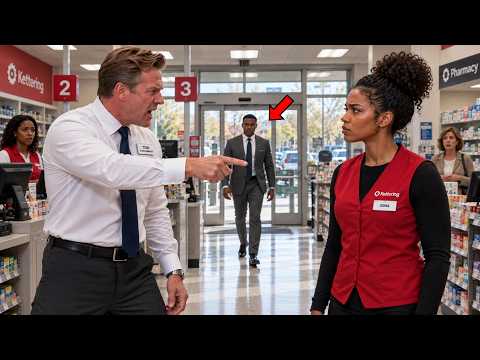
Zaria walked out into the cold, her world crumbling. Her grandmother, Henrietta, was waiting at home—a stroke survivor who relied on her for everything. The rent was due Friday. Without it, Henrietta would be evicted. Zaria had no backup plan, no savings, nothing but a fierce love for the woman who raised her.
Meanwhile, the man on the bench—Julian Avery—had witnessed everything. He was no ordinary vagrant. Once a trucking magnate with 600 trucks to his name, Julian had lost his way after his father’s death, spending months sitting on benches, trying to understand the life his father had lived. Zaria’s kindness—a simple “good morning” and an envelope of cash—had shaken him to his core.
Days later, Zaria was selling her textbooks to scrape together the rent when a miracle happened. Bernice, the building manager, told her that a stranger in an army jacket had paid Henrietta’s entire bill—$3,860 in cash and a cashier’s check. Zaria was stunned. Who would do such a thing? The answer came at the Griddle on 5th Street, where Julian Avery sat waiting for her, a plate of eggs and wheat toast growing cold.
“You came,” he said, as if her presence was the only thing that mattered. Zaria demanded answers: Who was he? Why had he paid? Julian explained his past—the trucks, the bench, the father who walked out and died alone. He had been sitting on that bench to see what his father saw. “Shoes,” he said. “Mostly shoes. Good shoes walk faster. The cheap ones sometimes stop.”
Zaria was still reeling when Julian offered to pay for her last year of pharmacy school. She refused. She had been raised to never take handouts. But Julian persisted, and Zaria realized that maybe, just maybe, accepting help wasn’t the same as giving up.
Meanwhile, Todd Ganly wasn’t done with her. He had written her up for theft, a permanent stain on her record that could keep her out of pharmacy school forever. Zaria had ten days to clear her name—and she knew just how to do it.
She spent the night in the campus library, printing every page of the handbook she had once memorized for a quiz. Section four, conduct. Section nine, separation records. She highlighted the lines in yellow, then in pink, then read them aloud to herself until the words stopped shaking.
“Theft doesn’t need warnings,” Todd had said. But theft needs paper. A shortage report. An incident report. A signature on a drawer log. Zaria had signed nothing, because she had taken nothing.
By morning, she had a folder three inches thick and a plan that felt like walking into a storm with a paper umbrella. Julian met her outside the diner at seven, wearing the suit he’d bought for the occasion and the same quiet face he’d worn on the bench.
“You don’t have to do this,” she told him. “You already paid the bill. You don’t owe me a Monday.”
He buttoned his jacket. “I sat on that bench for four months and nobody stopped. You stopped. I’m not going to be late twice.”
They walked to the store together, past the bench, past the carts. Destiny was at the front register, her eyes wide over a customer’s coupon. Mrs. Pruitt stood by the gum rack, pretending to compare prices and clearly waiting.
At ten sharp, the regional manager’s car pulled into the lot. Lucinda Bishop was a small woman with a clipboard and the flat, patient eyes of someone who had heard every excuse twice. She walked the front end first, then the pharmacy, then stopped at the bench and looked at it for a long moment before going inside.
“Miss Petway,” she said, when they were all gathered in the back office. “Your termination is coded theft. I don’t like a theft code without paper behind it. Walk me through it.”
Todd started talking before Zaria could open her mouth. The envelope. The front door. The liability. The optics. He used the word optics three times, and each time Lucinda wrote something down without looking at him.
When he finished, Zaria opened her folder. The drawer log. The bank bag manifest. Her ATM receipt, time-stamped 8:31. The Willow Crest statement with her grandmother’s name on it. The receipts from the Griddle and the Lantern Inn, $65.99 and $6.99, itemized down to the coffee.
“Register three never left the safe,” she said. “I clocked in at 8:58. I was in his office by 9:04. The money in that envelope came out of my account, not his drawer. And his drawer balanced to the penny that night—he signed the count himself.”
Lucinda turned the page slowly. Then she looked at Todd. “Where’s the shortage report?”
“There wasn’t one. She knew how the account works—”
“Where’s the incident report?”
“With regional coming, I made a judgment call—”
“Where’s the warning, Mr. Ganly?”
The room went quiet. Mrs. Pruitt’s voice came from the doorway, small and steady. “There wasn’t one. He told me what to say. He told me to say stuffed.”
Todd’s face went the color of the fluorescent lights. “Mrs. Pruitt, you’ve shopped here eleven years—”
“And I’m not going to lie for your bonus.”
Lucinda set down her pen. “Falsifying a separation record is grounds for termination, effective now. Keys and badge on the counter.”
For a moment, nobody moved. Then Todd pulled his keys from his belt, slow and deliberate, and set them down like a man laying a losing hand on the table. He didn’t look at Zaria. He looked at the bench through the front window, as if it had betrayed him personally.
“The correction goes to your school today in writing,” Lucinda said. “Back pay for every week you missed. And I need a shift lead in this store.”
Zaria blinked. “Me?”
“You have class in January. Then I’ll see you on the other side of that counter one day, in a white coat.” Lucinda almost smiled. “If Miss Bishop agrees.”
“Miss Bishop agrees,” Lucinda said, and gathered her clipboard.
Outside, the morning had turned thin and bright. Julian stood by the bench with his hands in his pockets, and Zaria stopped beside him, and for a while neither of them said anything at all.
Then she reached into her bag and pulled out a folded sheet of paper—her terms, written down this time, in her own hand. “One,” she read. “Nothing gets paid for me or Nana behind my back. Ever. Two. I pay you back one envelope a month, starting next month. Even if it’s twenty dollars. Three. You meet my grandmother. She plays spades for money.”
Julian read it twice. “Can I add a line?”
“No.”
“You know I’ve signed contracts for six hundred trucks.”
“Then nobody ever cared what you thought you were buying.”
He looked up at her. “What am I buying?”
“A pharmacist who owes you,” Zaria said. “That’s a dangerous thing to own, Mr. Avery.”
“I’ll take it anyway.”
She handed him the pen. He signed his name in the careful, upright letters of a man who had once signed for six hundred trucks and never once for tuition. Then he folded the paper into his jacket and said, quietly, “Your grandmother’s expecting me Sunday. I hear she plays for money.”
“Bring small bills,” Zaria said. “She’ll take the ones out of your hand before you sit down.”
Julian smiled—the first real one she’d seen—and they walked back toward the store, past the carts, past the bench. Destiny was propping the front door open with a brick, and Mrs. Pruitt was standing at the register with a pack of gum and a story already half-told.
Zaria stopped at the doorway and looked back at the bench. Empty now. But she knew it wouldn’t stay that way, and she knew that the next person who sat down on it would get a good morning, whether Todd Ganly liked it or not.
Inside, the phone rang. Destiny answered, listened, and held the receiver out with a strange look on her face. “It’s for you. Doctor Whitcomb’s office. Something about your seat, and a wait list, and—” she swallowed. “She says she got the correction letter already.”
Zaria took the phone. Her hand was steady. “This is Zaria Petway.”
The voice on the other end was brisk and warm at once. “Miss Petway, we received a very interesting fax this morning. I’d like to talk about your rotation placement—and one other thing. The board wants a statement from you. About the bench. About what you did. They’re considering it for a case study in the ethics seminar.”
Zaria looked through the front window at Julian, who was standing by the carts, saying good morning to a woman who had not been spoken to in weeks.
“Tell them I’ll write it,” she said. “But I’m going to need more than ten days.”
The voice on the other end laughed—a short, surprised sound. “Take all the time you need, Miss Petway. Ethics is a slow subject. It took this store nine years to learn it.”
Zaria hung up and stood very still, the receiver warm in her hand. Destiny was watching her, chewing the inside of her cheek the way she did when she wanted to ask something and didn’t know how.
“Shift lead,” Zaria said, before Destiny could ask. “You. If you want it. But the first thing you learn is the handbook, cover to cover. The second thing is you never let anybody tell you what to say.”
Destiny nodded, once, hard, and went back to her register with her chin up.
Sunday came gray and cold. Henrietta had the table set by noon—cards, coffee, a plate of peach pie that nobody had asked her to bake and that she would not admit she had baked. Julian arrived at one with small bills folded in his shirt pocket and a pie of his own, which Henrietta eyed like a rival.
“You’re late,” she said.
“Yes, ma’am. I’ve been late before. I’m trying not to be.”
She dealt. He lost. He lost four hands in a row, and on the fifth he laid down a card she hadn’t seen coming, and Henrietta sat back and laughed until she had to wipe her eyes. “There he is,” she said. “I was wondering when you’d show up.”
Zaria watched them from the kitchen doorway, the two of them arguing over a card like they’d known each other for years, and she thought about the bench, and the shoes that stop, and the ones that don’t.
Monday morning, she walked to the store early. The bench was empty. She sat down on it anyway, just for a minute, and said good morning to the first person who passed—a man in a hurry who almost didn’t stop, and then did.
“Morning,” he said, surprised at himself.
She smiled and went inside to open the register.
And somewhere down the street, a bus shelter on Market Street waited for whoever came next—because every city is only as kind as the people who bother to say good morning. So tell me: the next time you see someone on a bench, will you stop?
Report this article
Select a reason for reporting:






