Elena Vásquez had catalogued thousands of forgotten photographs in her twenty-three years as a senior archivist at the Pennsylvania Historical Society. But the moment she lifted the faded sepia print from its water-stained envelope, something cold coiled in her chest. The image showed a Black family of four—a stern-faced man in work clothes, a woman in a simple cotton dress, and two children—standing before a modest wooden house. The studio stamp read Monongah, West Virginia. The name alone made her pause. Every student of American labor history knew that name. It was synonymous with tragedy, with loss, with the darkest chapters of the Industrial Age.
At first glance, the family seemed ordinary. The father’s hands were rough and darkened—a miner’s hands, she knew instantly. Coal dust had permanently stained his skin like a tattoo. The mother clutched a worn Bible, her knuckles tight with a tension that even a century-old photograph couldn’t hide. But it was the boy who held her gaze. In his small hands, he cradled what appeared to be a carved wooden bird. She could make out the shape of wings, a curved beak, and feathers etched with exquisite skill. A canary. The word echoed in her mind. In mining communities, canaries weren’t just birds. They were warnings. They were the difference between life and death.
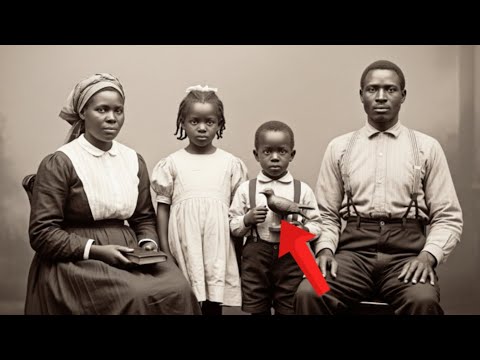
Elena adjusted her magnifying glass and leaned closer. The father’s name, she would later discover, was Isaiah. Born in 1876 in rural Alabama, just eleven years after slavery ended. His parents had been enslaved on a cotton plantation, freed by the Emancipation Proclamation, only to fall into the trap of sharecropping. Isaiah fled north in 1901, part of the first wave of the Great Migration, seeking work and dignity in the heart of industry. He found neither—only a different kind of oppression waiting in the darkness underground.
The mining town of Monongah, West Virginia, in 1912 was built on coal and sustained by desperate hope. Immigrants from Italy, Poland, Hungary, and dozens of other nations poured into the narrow valley, drawn by the promise of steady work in the Fairmont Coal Company mines. Alongside them came Black workers from the Deep South, men fleeing the terror of Jim Crow, the traps of sharecropping, and the constant threat of lynching. They sought freedom in the coal fields, only to find a different kind of subjugation.
Elena spent three days researching the town’s history before she found the first connection to the photograph. The 1910 census records showed a Black family matching the description. Isaiah, thirty-four, born in Alabama, listed as “Negro.” His wife, Bessie, twenty-nine, born in Georgia. Their daughter Ruby, eight, and son Samuel Jr., four. Isaiah’s occupation was listed as a coal loader—one of the most dangerous jobs in the mines, disproportionately assigned to Black workers. They were responsible for shoveling freshly blasted coal into cars while rock dust filled the air and methane gas seeped invisibly from cracked walls.
She found a company record that hinted at Isaiah’s unexpected skill. The foreman had written: “Good worker. Unusually literate for a colored man. Makes carvings in his spare time. Other coloreds buy them.” The note, dripping with the racism of its era, confirmed what Elena had suspected about the wooden bird. Isaiah had carved it himself—a canary, a symbol of every miner’s daily gamble with death. But why would a father give such a grim gift to his young son?
The answer lay in the darkest chapter of American industrial history. Isaiah’s name appeared on the work roster for December 6, 1907—the morning of the Monongah mine disaster, when an explosion killed 362 men in the worst mining accident in American history. He was supposed to be inside Mine No. 6 when the blast tore through the tunnels at 10:28 a.m. He was supposed to be among the bodies, many unidentified, some never found, buried in mass graves that still mark Monongah’s cemetery. But he wasn’t. According to the records, Isaiah was marked absent that day. Beside his name was written simply: “Did not show. Trouble maker.”
Elena’s hands trembled as she reached for the phone. She called the West Virginia Mine History Association, hoping for more information. Two days later, a retired mining engineer named Harold Patterson called her back. His voice was gravelly with age, but his memory was sharp as an axe. He explained that his grandfather had worked as a supervisor alongside Black and immigrant miners in the Monongah tunnels. And he remembered stories passed down through generations—stories of the days before the disaster when strange and terrifying things began happening underground.
“The canaries,” Harold said, his voice barely a whisper. “My grandfather said the canaries started dying three days before the explosion. One by one, in different sections of the mine. The company replaced them, but they kept dying. Some of the old-timers wanted to stop work, to investigate the ventilation systems, but the company refused. Coal had to be loaded. Quotas had to be met. Christmas bonuses depended on production numbers. The dead canaries were dismissed as coincidence, bad luck, or anything but what they truly were—desperate warnings from creatures who couldn’t speak but tried to save human lives.”
A chill ran down Elena’s spine despite the warmth of her office. “And Isaiah? Do you know why he wasn’t at work that day?” Harold paused for a long moment. When he spoke again, his voice carried the weight of a century of suppressed truth. “My grandfather told me about a Black carver who tried to warn the others. He tracked the dead canaries, measured the air himself using methods he’d learned from an old Welsh miner. He carved wooden canaries and gave them to anyone who would listen, telling them to remember what the real birds were saying. Most of the men mocked him. Some called him a superstitious fool. The foreman labeled him a troublemaker who was trying to slow production. But on the morning of December 6, a handful of men stayed home, trusting the warning of a Black carver when the company told them to ignore it.”
Elena couldn’t stop thinking about the wooden canary. If Isaiah had carved it as a warning, as a symbol of the disaster he survived, then perhaps it held more secrets than she had imagined. She returned to the photograph with new eyes, studying every detail under her magnifying glass. The bird was about ten centimeters long, carved with a skill that seemed impossible for a man who worked twelve-hour shifts in near-total darkness, loading coal. The wings were folded against the body in a resting position, the beak slightly open as if frozen mid-song, the tail feathers etched with meticulous precision. Then she saw it. Along the bird’s breast, where the feathers were carefully carved into the wood, there were markings that didn’t belong to any natural pattern. They were too regular, too deliberate to be mere decoration.
Her heart pounded as she adjusted the magnification to its highest setting. Letters, numbers, dates. Someone had engraved a message on the wooden canary. Hidden among the feathers, visible only to a careful observer with the right tools. She could make out fragments. “DC-3 vent fault, 47 ppm reported, ignored.” The numbers meant nothing to her, but she knew someone who might understand their terrifying significance. She called Harold Patterson again, reading the fragments over the phone in a trembling voice. The old engineer was silent for so long that Elena thought the connection had dropped. When he finally spoke, his voice cracked with emotion.
“Forty-seven parts per million,” he said slowly, as if explaining something sacred. “That’s the methane concentration. The silent killer. At that level, you’re approaching the explosive threshold. Any spark—a pickaxe striking rock, a lamp flame flickering, metal scraping metal—could trigger a catastrophic explosion. If someone measured 47 ppm three days before the disaster and reported it to the company…” He trailed off, unable to finish. Elena understood with horrifying clarity. The wooden canary wasn’t just a symbol or a warning to fellow miners. It was evidence. Isaiah had documented the dangerous methane levels he discovered in the mine, carving the proof into a child’s toy where the company would never think to look.
He had tried to warn the other miners through official channels, tried to save their lives by following proper procedures, and when the company ignored him and dismissed his concerns as the superstitions of an uneducated Black worker, he had preserved the truth in the only way available to a man whose voice held no value to those in power. The Fairmont Coal Company ceased to exist in 1928, absorbed into a larger conglomerate that itself fractured and reformed several times over the following decades. Tracking the company’s internal records required weeks of phone calls, archive requests, legal inquiries, and frustrating dead ends. Elena was about to give up when a junior librarian at the West Virginia State Archives called with unexpected news. A box of unindexed documents had been found during a basement renovation.
Inside were yellowed pages of ventilation reports, safety inspections, and internal correspondence from the Fairmont Coal Company, dated November and December 1907. Elena’s fingers flew through them, scanning for any mention of methane, of complaints, of a Black miner who wouldn’t stop talking about dead birds. Then she found it—a memo from a section foreman to the mine superintendent, dated December 3, 1907. “Re: nuisance complaints by colored loader Isaiah. Claims gas levels unsafe. Measured with improvised device. Recommend dismissal if persists. Production must not be interrupted.” Below it, in different handwriting, a single word: “Noted.”
No investigation. No evacuation. No acknowledgment that a man’s warning might have saved lives. Just a dismissal, a shrug, and three days later, 362 men were dead. Elena sat back in her chair, the weight of a century pressing down on her. Isaiah had survived not by luck but by courage—by trusting his own measurements, his own carved birds, his own judgment when every authority told him he was wrong.
She turned back to the photograph one last time. The boy, Samuel Jr., held the canary with both hands, his small face serious. He couldn’t have known then that his father’s gift would outlive them all, carrying a message no one wanted to hear. She thought of the family’s fate after the disaster. The census of 1920 showed Bessie as a widow, living in Pittsburgh with Ruby and Samuel. Isaiah had died in 1918—not in a mine, but of influenza, the same pandemic that swept the world. He had survived the worst mining disaster in American history only to be taken by a virus. But his secret had endured.
Elena carefully placed the photograph and the wooden canary in an archival box, labeled it with trembling hands, and added a note to the catalog: “Warning ignored. Truth preserved.” She knew what she had to do next. The story of Isaiah and his canary belonged in a museum, in a book, in the light. Not buried in a basement, not forgotten in a water-stained Bible.
She picked up the phone to call the state archives again. There was more work to be done. There were descendants to find, records to digitize, a community to honor. And somewhere, perhaps, another wooden bird waited in another attic, carrying another silent warning.
What would you do if you found a message hidden in plain sight—would you listen, or would you dismiss the voice that carved it?
Report this article
Select a reason for reporting:






