Imagine you are six years old. You still cling to your mother’s hand. You still fear the dark. And then one sweltering morning in August 1943, men in dark suits bow before you and whisper that your father is dead—that his kingdom is now yours. This is no fairy tale. This is the true story of Simeon II of Bulgaria, the last child to ever sit on a European throne.
A boy who inherited a crown soaked in conspiracy, lost it to a Soviet-backed coup before his tenth birthday, and then, in a twist no historian saw coming, returned 55 years later to run the very country that had thrown him out. His life connects Hitler’s bunker, Stalin’s secret police, the Spanish Royal Court, Wall Street boardrooms, NATO, the European Union, and the European Court of Human Rights. And strangely enough, almost no one outside the Balkans knows his name.
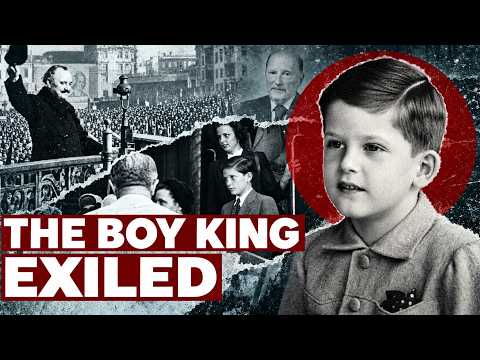
Our story begins with Boris III, Simeon’s father. A reluctant monarch, a lover of trains and butterflies, Boris inherited the throne in 1918 after Bulgaria’s catastrophic loss in World War I. For two decades he walked a tightrope—surviving coup attempts, assassination plots, and the rising tide of extremism. In 1930 he married Princess Giovanna of Italy, daughter of King Victor Emmanuel III, in a Catholic ceremony attended by Benito Mussolini himself. Within a few years they had two children: Princess Maria Louisa, and then, on June 16, 1937, a boy named Simeon, born in the Vrana Palace outside Sofia.
Simeon’s early childhood was warm and strange in equal measure. He was raised by nannies and governesses, surrounded by uniformed guards, shuttled between palaces and mountain retreats. His father doted on him, showing him the royal gardens, the royal trains, and the royal butterflies—Boris collected them obsessively. His mother poured love into both children while quietly worrying about the storm clouds gathering over Europe.
Because by 1939, the storm was no longer a metaphor. Hitler had torn through Czechoslovakia. Mussolini, Simeon’s own grandfather by marriage, was now Hitler’s junior partner. Bulgaria, surrounded on every side, was being squeezed to pick a side. Boris delayed the choice as long as he could. But in March 1941, after months of unbearable pressure, Bulgaria formally joined the Axis powers. German troops began using Bulgarian territory to invade Greece and Yugoslavia.
And here is where Boris did something that would echo through history—and which almost certainly cost him his life. In early 1943, Nazi officials demanded that Bulgaria hand over its roughly 50,000 Jewish citizens for deportation to the death camps. Boris refused. He allowed the deportation of around 11,000 Jews from the newly occupied territories in Thrace and Macedonia—a decision that remains a dark stain on his record. But he dug in his heels when it came to Bulgaria’s own Jewish population. Thanks to that refusal, backed by parliamentarians, Orthodox bishops, and ordinary citizens who filled the streets in protest, nearly all of Bulgaria’s Jews survived the Holocaust.
Boris also refused to send Bulgarian troops to fight the Soviet Union, telling Hitler bluntly that his people were deeply Russophile—that they had been liberated from the Ottomans by Russian soldiers—and that putting Bulgarians on the Eastern Front would spark a mutiny. Hitler was furious.
On August 9, 1943, Hitler summoned Boris to his Wolf’s Lair at Rastenburg in East Prussia. Boris boarded a plane and arrived on August 14. What exactly happened inside that meeting is still debated, but every historian agrees on this much: the meeting was stormy. Boris refused again to send troops east. He refused again to deport the Jews. He flew home to Sofia on August 15, exhausted and unwell.
Within days, he was in bed with a fever, a rash, convulsions, and what doctors would later describe as liver dysfunction. On August 28, 1943, at the age of 49, Boris III of Bulgaria was dead. The official cause was coronary thrombosis—a heart attack. The whispered cause was poison. Conspiracy theories exploded almost before the body was cold. Some pointed at the Nazis, alleging that Hitler had ordered a slow-acting poison administered during the Rastenburg meeting. Others pointed at the Soviet NKVD, arguing that Moscow had an interest in destabilizing the Bulgarian throne. The autopsy was inconclusive. His liver showed strange damage. More recent investigations, including a 2024 journalistic project that examined British National Archives, have raised the possibility of a nerve agent, but no proof has ever surfaced.
What is undisputed is this: Boris was buried at the Rila Monastery in Bulgaria’s sacred mountains, the streets of Sofia filled with weeping crowds. His six-year-old son was now the Tsar of Bulgaria.
Imagine the scene inside the Vrana Palace. Simeon, barely able to tie his own shoelaces, is dressed in a black suit. He is told gently that his father has gone to heaven. He is then told less gently that he must stand very still while elderly men in uniform swear oaths of loyalty to him. He is Tsar Simeon II by the grace of God, sovereign of a kingdom locked in a war he does not understand, allied to a dictator he has never met, with a Red Army already pushing toward his borders.
Because he was too young to rule, the constitution demanded a regency council. Three men were chosen: his own uncle, Prince Kiril of Preslav, Boris’s younger brother; the sitting prime minister, Bogdan Filov, an archaeologist turned politician; and Lieutenant General Nikola Mihov, a former war minister. These three men would now run Bulgaria in the little king’s name—and they would make catastrophic choices. Choices that would, within 18 months, see all three of them standing in front of a firing squad.
For the next year, Simeon’s life was deceptively normal. He went to lessons. He played in the gardens of Vrana. He saw less of his mother than he wanted because Queen Giovanna was now a widow managing a court, a nation, and two frightened children. But outside the palace walls, Bulgaria was unraveling. The regents clung to the German alliance even as it became obvious that Hitler was going to lose. By mid-1944, Soviet troops were advancing through Romania and were about to crash into Bulgaria.
In a desperate attempt to switch sides, the Bulgarian government declared war on Nazi Germany in early September 1944. It did not matter. On September 5, the Soviet Union declared war on Bulgaria anyway. On September 8, Red Army units crossed the Danube. They met almost no resistance. And then, in the early hours of September 9, 1944, came the night that would reshape everything.
A coalition called the Fatherland Front—dominated by the Bulgarian Communist Party—launched a coup d’état backed by Soviet intelligence and the physical presence of the Red Army. The sitting government was overthrown without a shot. Soviet-aligned troops occupied the capital. A new prime minister, Kimon Georgiev of the Zveno officer circle, was installed as a front for the communists who held the real power from behind the scenes.
The three regents—Prince Kiril, Bogdan Filov, and Nikola Mihov—were arrested within days. Many historians today describe September 9, 1944 as the single greatest national catastrophe of twentieth-century Bulgaria. The entire political, military, and intellectual class of the country was about to be systematically destroyed. And at the center of it all was a seven-year-old boy who still somehow technically wore the crown.
The communist regime had a problem. It could not simply execute a child. International opinion still mattered, even to Stalin. The Western Allies were watching. The British and the Americans were pressing for democratic elections in liberated Eastern Europe. Even the Red Army could not openly murder a seven-year-old monarch without consequences. So the communists did something more clever and more cruel. They let Simeon keep the crown as a figurehead while they methodically dismantled every pillar that held the monarchy up.
The courts, the parliament, the military leadership, the clergy, the free press—every one of them was captured, purged, or liquidated. And the main instrument of that destruction was the so-called People’s Court. Established by the Fatherland Front government on October 6, 1944, it was an ad hoc tribunal modeled on Soviet revolutionary justice, with no right of appeal, no proper defense, and sentences carried out immediately. In four short months, it would try 135 cases involving 11,122 accused. It would sentence 9,155 people. Of those, 2,618 were sentenced to death. Around 200 more were killed before trial even began.
And in the single most devastating session, on the night of February 1, 1945, the People’s Court sentenced to death all three regents of young King Simeon—including his own uncle, Prince Kiril—along with 22 former cabinet ministers, 67 members of parliament, 47 generals and senior officers, and eight royal advisers. The sentences were carried out that same night at the Sofia Cemetery.
Simeon was seven years old when a firing squad killed his uncle. The man who had held his father’s hand at family dinners, who had taken him on walks in the garden, who had sworn before God to protect him as regent, was shot in the dark and buried in an unmarked trench. One of the executioners, a man named Ferdinand Kozovski, reportedly walked around central Sofia the next day wearing the dead prince’s boots.
The families of the condemned—4,325 households, nearly 12,000 people—were forcibly relocated. Their property was confiscated. Their names were erased from public records. The Bulgarian state had, in the words of one modern historian, been beheaded. And standing in the ruins was a child king who could not fully process what was happening around him, except that his family was disappearing one by one, and his mother was growing quieter every day.
A second Regency Council was hastily installed to replace the executed one. But this time it was staffed entirely by communist appointees. Simeon’s role was now purely ceremonial. He signed nothing. He decided nothing. He was wheeled out for state occasions and photographed—a small, serious-looking boy in a dark suit, flanked by the men who had killed his uncle. The monarchy itself was now a museum piece being prepared for public execution.
The final blow came on September 8, 1946. The communist-controlled government staged a national referendum on whether Bulgaria should remain a monarchy or become a people’s republic. The official results were almost comically lopsided. According to state protocol, 4,132,921 people voted. Of those, 3,833,183 supposedly voted in favor of abolishing the monarchy. That was 95.6 percent. Only 175,231 voted against. Historians today are nearly unanimous that the referendum was manipulated through intimidation, ballot fraud, and the simple fact that the opposition had already been eliminated or terrorized into silence.
On September 15, 1946, Bulgaria was officially proclaimed a people’s republic. Sixty-eight years of monarchy had ended. The nine-year-old king was no longer king. Simeon, his sister Maria Louisa, and their mother Queen Giovanna were given days to pack and leave. They were not allowed to abdicate formally, which meant Simeon would carry his royal title for the rest of his life without a throne beneath it.
The communist regime wanted them gone, not martyred. They were put on a train with a small number of personal belongings. The palaces, the forests, the art collections, the royal residences at Vrana, Tsarska Bistritsa, Sitnyakovo, Saragyol, and Krichim—hundreds of thousands of decares of land, every scrap of royal property—were all nationalized by the 1947 law that would torment Simeon’s lawyers for the next seven decades.
The family’s first stop was Alexandria, Egypt—where fate had a particular sense of irony. Simeon’s maternal grandfather, King Victor Emmanuel III of Italy, was also living there in exile, forced out after Italy abolished its own monarchy that same year. Two deposed monarchs, grandfather and grandson, under the Egyptian sun.
Simeon enrolled at Victoria College, learned English, and grew up fast. In 1951, Francoist Spain granted the family asylum. He studied in Madrid, became fluent in six languages, and at 18 swore an oath to the Bulgarian people as their monarch—he had never abdicated.
In 1962 he married the Spanish aristocrat Margarita Gómez-Acebo. Decades passed as a discreet international businessman. Then, on May 25, 1996, after fifty years, Simeon landed at Sofia airport—and half a million Bulgarians poured into the streets, weeping and chanting his name.
In 2001, his party won a landslide. He was sworn in as prime minister of the republic that had deposed him. On his watch, Bulgaria joined NATO in 2004 and signed its EU accession treaty in 2005. The boy king had delivered what a decade of politicians could not.
Today, in his late eighties, Simeon lives again in the Vrana Palace—the same walls where his father died in 1943. History, it turns out, has a long memory and a dry sense of humor.
So what do you make of a king who returned not to reclaim a throne, but to run a republic? Would you have voted for him?
Report this article
Select a reason for reporting:






