The night of September 18, 1931, near the city of Mukden in Manchuria, a small explosion shattered the silence. The blast was so minor that a train passed over the damaged track minutes later without incident. Yet this spark would ignite a firestorm of conquest, brutality, and horror that would engulf Asia for the next fourteen years.
Japanese officers had orchestrated the attack themselves, blaming Chinese insurgents as a pretext for invasion. Within hours, the Kwantung Army began its occupation, setting in motion a chain of events that would lead to the creation of a puppet state, the assassination of Japan’s prime minister, and ultimately, the most devastating war the Pacific had ever seen.
But to understand how a nation could descend into such calculated cruelty, we must look back further—to a time when Japan was a closed feudal society, and to the forces that transformed it into a modern military power with a twisted sense of destiny.
For over two centuries, Japan had deliberately isolated itself from the world. Under the Tokugawa shogunate, a rigid social order prevailed: samurai at the top, followed by peasants, artisans, and merchants. The emperor, though revered, held only symbolic power. This carefully controlled system, known as sakoku, kept foreign influence at bay and preserved a warrior code called Bushido—a moral guide emphasizing loyalty, honor, and self-sacrifice.
That all changed in 1853 when American Commodore Matthew Perry’s fleet sailed into Japanese waters, forcing the country to open its ports. The shock of this intrusion triggered a rapid transformation. In just one generation, Japan dismantled feudalism, adopted Western industry and weaponry, and built a centralized state under the restored Meiji emperor.
The speed of modernization was astonishing. Factories, shipyards, railways, and a national army emerged. By 1895, Japan had defeated China in the First Sino-Japanese War, gaining Taiwan and the Liaodong Peninsula. A decade later, it stunned the world by defeating Russia in the Russo-Japanese War, securing dominance in Korea and Manchuria.
These victories bred national pride and a growing sense of superiority. But they also planted the seeds of resentment. At the 1919 Paris Peace Conference, Japan proposed a racial equality clause—only to see it rejected by Western powers. The Washington Naval Treaty of 1922 further humiliated Japan by limiting its fleet to a fraction of American and British tonnage. Anti-immigration laws in the United States targeted Japanese citizens, reinforcing a collective conviction: Japan would never be treated as an equal by the West.
The 1920s brought economic turmoil. The Showa Financial Crisis of 1927 collapsed dozens of banks, and the Great Depression that followed deepened public distrust in civilian government. Ultra-nationalist factions within the military, particularly the Kwantung Army, saw an opportunity. They believed Japan needed to assert itself through expansion, securing resources and respect through force.
On that fateful September night in 1931, their ambitions became reality. The Mukden Incident—a false-flag operation—gave the military the excuse it needed. Despite the civilian government’s objections, the Kwantung Army occupied all of Manchuria and established the puppet state of Manchukuo.
The military’s insubordination reached its peak on May 15, 1932, when young naval officers assassinated Prime Minister Inukai Tsuyoshi. The public’s sympathetic reaction and the lenient sentences for the assassins signaled the end of civilian control. From then on, the military dictated policy, and Japan’s march toward total war became unstoppable.
By July 1937, the simmering tension between Japan and China erupted into full-scale war. A minor skirmish at the Marco Polo Bridge near Beijing became the pretext for a massive invasion. The Imperial Japanese Army poured into China, capturing Shanghai after brutal urban combat and pushing inland toward the capital, Nanjing.
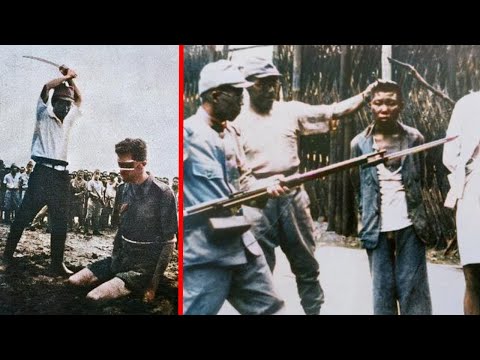
What happened next would become one of the most documented atrocities of the twentieth century. On December 13, 1937, Japanese troops entered Nanjing and unleashed six weeks of systematic violence. Soldiers executed prisoners of war, slaughtered civilians, and engaged in widespread rape, looting, and arson. Women of all ages—young girls, adults, even the elderly—were subjected to repeated sexual assaults. Many were mutilated or killed afterward.
Newspapers in Japan at the time even reported a so-called beheading contest between two officers, competing to see who could kill more people with a katana. This grotesque spectacle was treated as a matter of national pride. Estimates of the death toll range from 100,000 to over 300,000, depending on the source.
But Nanjing was not an isolated incident. It was the template. As Japanese forces expanded across China, Korea, and Southeast Asia, they carried with them a doctrine known as the Three Alls: kill all, burn all, loot all. Entire villages were wiped out. Crops were destroyed. Wells were poisoned. Civilians were executed on suspicion of aiding resistance fighters. The goal was not merely conquest—it was annihilation of the will to resist.
Within this machinery of violence, the Imperial Army established a network of military brothels euphemistically called comfort stations. Tens of thousands of women—mostly from Korea, China, and the Philippines—were coerced, deceived, or kidnapped into sexual slavery. Many died from disease, abuse, or execution. Those who survived carried physical and psychological scars for life, only to face decades of official denial from the Japanese government.
Yet even this was not the darkest chapter. That distinction belongs to a covert facility hidden in the Manchurian countryside, where the line between science and horror was erased entirely.
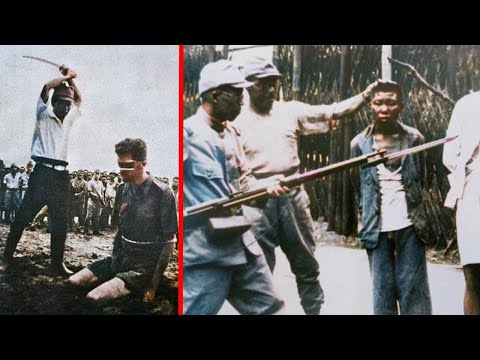
Unit 731, established in 1936 under Lieutenant General Shiro Ishii, operated behind the façade of an epidemic prevention and water purification department. In reality, it was a biological warfare research center where human beings were subjected to experiments that defied comprehension. Prisoners—mostly Chinese civilians, but also Koreans, Mongols, and Soviet captives—were referred to not as people but as maruta, meaning logs.
Inside the Pingfang complex, doctors performed vivisections without anesthesia, opening living bodies to observe organs in real time. Limbs were frozen and struck to study tissue damage. Prisoners were injected with bubonic plague, anthrax, cholera, and typhus. Some were placed in pressure chambers until their organs ruptured. Others were exposed to chemical weapons or subjected to flamethrowers to measure burn resistance.
Beyond the walls of the facility, field experiments were conducted on Chinese villages. Ceramic bombs loaded with infected fleas were dropped over populated areas, triggering outbreaks of plague that killed tens of thousands. Japanese researchers meticulously recorded the spread of disease, the speed of infection, and the effectiveness of each pathogen—data intended to perfect weapons of mass destruction.
As the war turned against Japan in 1945, the order came to destroy all evidence. Facilities were blown up, records burned, and surviving prisoners executed. Ishii himself escaped capture and later negotiated a secret deal with American officials: full immunity in exchange for the experimental data. None of the Unit 731 leadership faced trial at Tokyo. Some continued their medical careers in postwar Japan.
The contrast with Nazi Germany was stark. While Nazi doctors were prosecuted at Nuremberg, their Japanese counterparts walked free. The United States prioritized scientific knowledge over justice, and the crimes of Unit 731 were buried for decades.
Meanwhile, Japan’s war in the Pacific had reached its own crescendo. The attack on Pearl Harbor in December 1941 had awakened American fury. The Bataan Death March, the Manila massacre, and countless other atrocities hardened Allied resolve. As American forces island-hopped toward Japan, the Japanese military embraced suicide tactics—kamikaze pilots, banzai charges, and the indoctrination of civilians to die rather than surrender.
By 1945, Japan’s cities lay in ruins. Incendiary bombings had reduced Tokyo to ash, killing over 100,000 in a single night. The atomic bombs on Hiroshima and Nagasaki delivered the final blow. On August 15, Emperor Hirohito’s voice crackled over the radio, announcing surrender—the first time most Japanese had ever heard their sovereign speak.
The Tokyo Trials that followed convicted some leaders, but many responsible for the worst crimes escaped accountability. The legacy of Japanese militarism—its fusion of distorted Bushido, racial superiority, and absolute obedience to the emperor—left deep wounds across Asia. Nations like China, Korea, and the Philippines bore the brunt of a brutality that rivaled, and in some cases exceeded, that of the Nazi regime.
Yet the full story of what happened in Manchuria, in Nanjing, in the comfort stations, and in the laboratories of Unit 731 remains contested. Textbooks are still debated. Apologies remain incomplete. And the question of how ordinary people became instruments of such extraordinary cruelty continues to haunt history.
The roots of this transformation ran deeper than any single event. They lay in a deliberate rewriting of the samurai code—a distortion of Bushido that replaced restraint with blind obedience and elevated death above survival. In military academies and schools, children were taught that the individual life held no value compared to imperial duty. This ideology did not emerge overnight; it was cultivated over decades, layer by layer, until it became the air a generation breathed.
International humiliation provided the fuel. The rejection of Japan’s racial equality proposal in 1919, the naval quotas of 1922, and the anti-immigration laws in America were not forgotten. They were nursed, reinterpreted, and weaponized. What had begun as a legitimate grievance against Western hypocrisy curdled into a justification for conquest—a belief that Japan must become the master of Asia to earn the respect of the West.
When the Great Depression struck, the civilian government buckled. Political parties were seen as corrupt and impotent. Radicalized officers, many from rural backgrounds and steeped in nationalist fervor, presented themselves as the saviors of the nation. They assassinated politicians, plotted coups, and gradually dismantled the last vestiges of democratic control.
Once the military held absolute power, violence became policy. Decisions no longer passed through parliaments or cabinets but through military commands answering only to their own hierarchy and to a mystical interpretation of the emperor’s will. The absence of civilian oversight meant that atrocities could be planned without institutional friction—carried out with bureaucratic precision and institutional approval.
Racial dehumanization completed the machinery. Imperial doctrines taught that the Japanese were destined to lead over inferior races. This ideology permeated every level of the army, justifying massacres, sexual slavery, forced labor, and human experimentation as necessary steps toward a greater Asia. Brutality was not seen as excess—it was duty.
The Kwantung Army, operating with near-total autonomy in Manchuria, developed a particularly cruel military subculture. Its officers exported practices of extreme violence to the rest of the Asian front. Their insubordination, contempt for civilian life, and systematic use of terror became the norm, shaping conduct across an entire theater of war.
When the war ended, the reckoning was partial and uneven. The Tokyo Trials convicted some leaders—former Prime Minister Koki Hirota was executed for crimes against peace. Officers like Tasuku Okada, who ordered the execution of American prisoners, faced the gallows. But the architects of biological warfare walked free. Shiro Ishii never stood trial. The United States, hungry for the data his team had collected, granted immunity to the scientists who had vivisected living humans and dropped plague bombs on villages.
The double standard was glaring. Nazi doctors were hanged at Nuremberg. Their Japanese counterparts resumed careers in universities and private laboratories. Soviet courts convicted twelve members of Unit 731 in 1949, but the key commanders escaped punishment entirely. Justice, it seemed, had a price—and scientific data was worth more.
Across Asia, the wounds remained open. China counted its dead in the millions—estimates range from ten to twenty million, including massacres, induced famines, forced labor, and medical experiments. Korea, under thirty-five years of direct rule, suffered cultural erasure and the systematic abuse of tens of thousands of comfort women. The Philippines lost over 100,000 civilians in the Manila massacre alone. Indonesia’s romusha system conscripted between four and ten million workers, with mortality rates that defied belief.
In Japan itself, memory became a battleground. Conservative groups revised textbooks to soften descriptions of aggression. Prime ministers issued apologies that were immediately contradicted by others. Visits to the Yasukuni Shrine, where war criminals are enshrined, provoked outrage in Beijing and Seoul. The question of responsibility—individual, institutional, national—remained unresolved.
Historians continue to debate how a nation capable of such meticulous modernization could also produce such meticulous cruelty. Some point to the fusion of absolute obedience with racial ideology—a combination that stripped soldiers of moral agency. Others emphasize the structural autonomy of the military, which allowed extremist factions to hijack state policy. Still others argue that the very speed of Japan’s transformation from feudal isolation to industrial power created a society that valued order and hierarchy above all else, making it vulnerable to authoritarian capture.
What remains undeniable is the scale of suffering. The comfort stations, the Three Alls policy, the death marches, the biological weapons program—these were not aberrations but the logical output of a system designed to dehumanize both the enemy and the soldier. The Japanese Empire proved that modernity and atrocity could coexist, that technological progress could serve the most ancient impulses of conquest and cruelty.
The story of Japan’s descent into militarism is not merely a chronicle of a distant past. It is a warning—about the fragility of civilian control, the seduction of nationalist myth, and the ease with which ordinary people can be transformed into instruments of extraordinary violence. The question that haunted postwar Japan, and continues to haunt the world, is not whether such things could happen again, but whether we would recognize them if they did.
In the decades that followed, Japan rebuilt itself as a pacifist nation, its constitution renouncing war forever. Yet the ghosts of the empire linger—in the unmarked graves of Manchuria, in the silenced voices of comfort women, in the declassified files that still shock historians.
Unit 731’s legacy is a scar on the conscience of science. The data obtained through torture informed American biological weapons research for years, a dark bargain that traded justice for knowledge. “We never had to face our crimes,” a former unit member admitted in a rare interview. “We simply buried them.”
Today, as survivors of the Asian Holocaust pass away, the struggle for memory intensifies. Some demand official apologies; others seek compensation; many simply want the truth taught in schools.
But the question remains: how do we ensure that the lessons of this brutal empire are not lost to time—and that the world never forgets what happens when humanity is stripped away?
Report this article
Select a reason for reporting:






