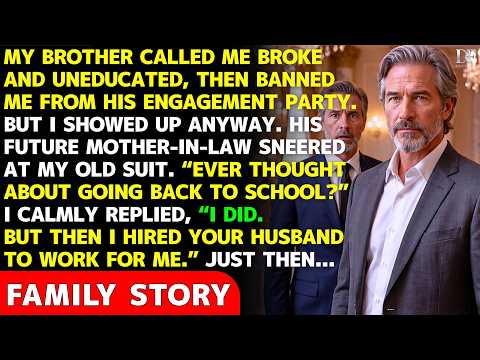
My brother told his fiancée’s family I was an uneducated, broke dropout. He banned me from his engagement party. But I showed up anyway—in a 19-year-old suit my wife had pressed like she was defusing a bomb.
His future mother-in-law looked me up and down, her gaze tallying every year of wear. “Have you ever considered going back to school?” she asked, loud enough for the whole room to hear.
I smiled. “I did think about it once. But then I hired your husband to work for me.”
Just then, her husband walked in. The moment he saw me, he froze.
“Chairman, what are you doing here, sir?”
Every conversation in that living room snapped off like a breaker had tripped. Winifred Ashworth’s pearls rose and fell with each breath as she turned to her husband, her face coming undone.
Horace didn’t hear her. He crossed the carpet in four long strides, shoved the roses under one arm, and seized my hand in both of his. His palms were cold and damp and shaking.
“Sir, I had no idea,” he said hoarsely. “I swear to you, I had no idea you would be here.”
Over his shoulder, I found my brother. The grin had melted off him like candle wax. Bourbon sloshed over his knuckles, and his face had gone the pale gray of wet cement.
My brother had spent weeks telling this family I was nothing. He had not known—could not have known—who signed the paychecks of the man who had just walked through that door.
But to explain how I ended up in that room wearing that suit, I have to go back to the phone call that told me to stay away.
It came at 2:10 on a Tuesday while I was thirty feet in the air, standing in the basket of a boom lift outside a strip mall in Lititz, a cordless drill in one fist and a cracked sign bracket in the other.
I almost let it ring. Then I saw the name on the screen and my stomach dropped the way it always does when my brother calls without a reason.
“Amos,” Lyman said. He never said hello. “I’ll make this short. The party on the 13th. Don’t come.”
The drill slipped out of my hand and bounced off the awning below. I watched it go.
“Say that again.”
“You heard me. Delphine’s family is accomplished. Her mother has a hallway full of framed diplomas. Her father spent his whole career in finance. I’ve already told them you’re not much for formal occasions.”
I could hear him pacing—his good shoes clicking on a hard floor.
“Be honest. What would you even talk about with those people? You never finished school. You’ve been scraping by on that little maintenance outfit for years. I told them you’re a dropout who can barely pay his own rent, and I am not going to stand there and watch you prove it.”
My face went hot, then cold. The wind off the parking lot suddenly seemed very loud.
“Lyman, I own that company. I employ eighteen people.”
“Eighteen people who mop floors. Don’t make this harder than it is.”
“You’re telling me not to come to my own brother’s engagement.”
“I’m telling you it’s better for everybody. Don’t make me say it twice.”
The line went dead.
I stood there with the phone against my ear, my hand trembling so badly that the basket gave a little shudder. My eyes stung, and I told myself it was the wind.
“Boss!” Tobias Renner’s voice floated up from the asphalt. He was my foreman—forty-four years old, built like a refrigerator—and he was holding my drill in one big hand. “That thing nearly took my hat off. You okay up there?”
I lowered the lift. My knees felt like wet rope when I stepped out.
“Somebody die?” Tobias asked.
“My brother called. Same thing most days.”
He handed me the drill and studied my face, and the teasing went out of his.
“That bad?”
“He doesn’t want me at his engagement party.”
Tobias swore low and with real feeling—and then apologized to the sky, which is how he apologizes for everything.
I wish I could say it was the first time.
The Sunday before, I had driven out to my father’s house in East Petersburg with one of Margot’s blueberry pies on my lap, and I had come in through the side door because the front one sticks.
Lyman was out on the back porch with his phone. I heard him through the screen.
“No, honestly, Dell, he never made it past a semester. Works with his hands. Never had two nickels to rub together.”
He chuckled—the easy chuckle of a man telling a story he has told before.
“It’s kinder not to bring him up.”
I stood in the hallway holding that pie like a shield until the oven timer in the kitchen made me jump.
A week earlier, over pot roast, my father had asked me when I planned to go back and finish my degree. I was fifty-five years old, and he was still asking.
Here is what I never told my brother—and what he never bothered to find out.
I did leave college after one semester because the money ran out. I swept floors at a building services company for six years. Then I learned HVAC, then electrical, then roofing. And at forty-three, I bought out my boss and built Keystone Building and Facility Services into a real business.
We maintain schools, medical offices, and shopping centers across three counties. Keystone is a corporation with a board of three. Margot is treasurer. Our office manager, Dessa Tilly, is secretary. And I am chairman and president.
That is why the men and women who work for me say chairman when they are joking—and why one retired banker said it when he wasn’t.
I drove back to the office that afternoon with both hands strangling the wheel. Dessa was at her desk—sixty-two years old, reading glasses, a cardigan the color of oatmeal—and she had run my paperwork for eleven years without ever once forgetting an invoice.
She took one look at me and pushed the glasses up into her gray hair.
“Hollis Brant called about the East Wing,” she said. “Meadowbrook wants the carpet crew back Thursday. That contract is eighteen-five a month, Amos, so we say yes with a smile. But you look like somebody ran over your dog. Sit.”
I sat. I told her everything—the whole ugly call—and somewhere in the middle my voice cracked and I had to stop and swallow.
Dessa’s cheeks went pink. “He said what about mopping floors?” She stood up so fast her chair rolled into the filing cabinet. “I would like five minutes alone with that man and a pair of hedge shears.”
In spite of everything, I laughed—and the laugh turned damp at the edges. “He’s still my brother.”
“Then he can act like one.”
Margot held me in the kitchen that night with her cheek against my chest. “You don’t have to go to that party,” she murmured. “But don’t you dare let him decide it for you either.”
“I don’t know what I want, Margot.”
“Then sleep on it. You always know by morning.”
After supper, I did something I rarely do. I called my father.
Neil Hostetler is eighty-two, with a voice like a gravel driveway and a habit of defending whichever son is not on the phone. “Your brother’s under a lot of pressure,” he said at once. “Wedding nerves.”
“Dad, he is telling these people I’m a pauper and a dropout.”
“He’s not telling them anything terrible. He only said you live out of state, that you two hardly speak. He told them you’re out in Ohio, and he didn’t want them asking you all kinds of—”
My father stopped. I heard the little wet click of him closing his mouth.
“Ohio,” I said. “I shouldn’t have said that.”
Behind him, a woman’s voice rose sharp as a tack. It was my aunt Lorna—seventy-nine, my father’s baby sister, who drops in with casseroles and opinions. “Neil Hostetler, what exactly did you just say to that boy?”
I stood in my own kitchen, in the county where I was born, with the phone going slippery in my hand.
Ohio. My brother had moved me to another state—and my father had known.
I didn’t sleep much that night. Margot lay beside me in the dark, her hand flat on my chest, and every time I shifted she said my name like a rope thrown into deep water.
By morning I knew. I was going to that party. Not to burn the house down—I’m not that man. But because a stranger named Delphine had asked after me, and my own blood had erased me from the map.
Margot pressed the charcoal suit while I stood in the garage and sanded a walnut serving tray I’d been making for weeks. I burned the date into the underside with a soldering iron. It was the sort of gift a man gives when he owns very little except what his hands can make.
Or so my brother believed.
We walked up the flagstone path together. Lyman yanked the door open before I could knock, stepped onto the porch, and pulled it nearly shut behind him.
“What are you doing here?” he hissed.
“Hello to you too. We brought a gift.”
“I told you not to come.” His eyes flicked past me to the street as though a camera might be rolling. “Take that thing, put it in your truck, and go home.”
Then the door opened behind him, and a dark-haired woman with tired, kind eyes stepped out—Delphine. She looked at me, then at Margot, then at the tray, and her whole face lit up.
“Oh, you must be Amos.”
Behind her, Lyman looked like a man standing in front of a train.
She pulled us over the threshold. Forty guests, crystal, a long dessert table. And then Winifred Ashworth turned, and her eyes made another slow lap of my suit.
“Mr. Hostetler,” she said, loud enough that the nearest guests angled toward us like sunflowers. “Lyman mentioned you never finished college. Have you ever thought about going back to school?”
Somebody snorted. Heat climbed my neck. Beside me, Margot sucked in a sharp breath, ready to take Winifred apart, and I pressed her hand once to hold her back—because I wasn’t angry anymore. Somewhere between the front door and this moment, the anger had burned off and left something cold and clear behind it, like creek water in March.
“I’ve thought about it myself,” I said evenly. “But then I hired your husband to work for me.”
Winifred’s smile hung in place one second too long. Then her brows drew together. “I beg your pardon. My husband consults for a financial firm.”
“Keystone Building and Facility Services. Eighteen employees. Horace reviews our books on Tuesdays and Thursdays.”
A woman in lilac—Sloane Birch—whispered, “Winnie, isn’t that the maintenance company?”
“Don’t be absurd,” Winifred snapped, but a blotchy flush was creeping up out of her pearls.
That was when the front door opened. Horace Ashworth came around the corner with an armful of white roses, and his gaze landed on me, and he stopped so abruptly the stems crackled.
“Chairman, what are you doing here, sir?”
Every conversation in that living room snapped off as if a breaker had tripped. Over Horace’s shoulder I found Lyman. The grin had melted off him like candle wax. His bourbon sloshed over his knuckles, and his face had gone the pale gray of wet cement.
He had spent weeks telling this family I was nothing. He had not known—could not have known—who signed the paychecks of the man who had just walked through that door.
Horace crossed the carpet and seized my hand in both of his. “Sir, I had no idea. I swear to you.”
I looked at my brother, and I did not raise my voice. “Lyman, you told this room I never finished school. You were right. I left after one semester because the money ran out. What you left out is that I swept floors for six years, learned the trades, and at forty-three I bought the company. I employ eighteen people. I sign their paychecks.”
Delphine had gone very still, the cake knife loose in her fist. “Lyman,” she said slowly, “you told me your brother couldn’t hold down a job.”
He opened his mouth. Nothing came out.
I set the walnut tray on the table between the candlesticks. “I’m not here to take anything from you, Delphine. I’m here because you asked after me when nobody else did. That’s a rare thing in any family.”
She looked at the tray, ran her thumb along the grain, and her eyes went shiny. “Nobody has ever made me anything.”
Winifred stood frozen, one hand at her pearls, her whole face working like a lock with the wrong key. Then she did the last thing I expected. She inclined her head, stiff as a gate hinge, and said, “It seems I have been badly informed, Mr. Hostetler. I am not accustomed to being wrong. I find I dislike it.”
“Most of us do, ma’am.”
Margot’s hand found mine, and her fingers were ice cold, and I understood she was holding herself together as hard as I was.
We left an hour later. In the truck, Margot started to cry, then to laugh, then to do both at once. “Did you see Winifred’s face?”
“I tried not to.”
“I know you did. That’s exactly why I’m so proud of you.”
My phone buzzed before we reached the highway. Four words from my brother. You will regret this.
I read it twice, then set the phone face down on the seat between us. Margot took my hand.
I don’t know yet what he’ll do with that promise. But I know what I’ll do. I’ll keep the receipts, answer the letters, and stand beside the people who stood beside me.
What would you have done—stayed home and kept the peace, or walked up that path in the old suit? Tell me in the comments.
Report this article
Select a reason for reporting:






