When you think of Gold Coast wealth, you picture beachfront towers, super yachts on the Broadwater, and penthouses rising above Surfers Paradise. But those are just the visible signs of money—not where the fortunes were actually made. Behind the skyline are families who built empires through property, retail, and private businesses woven into the city itself. Today, we’re following 12 of those families and the money machine sitting underneath the lifestyle.
Everyone can see the luxury on the surface. The real story is underneath.
Number 12: the Foo family. The shopping center family. More than 12 million people pass through Australia Fair each year. Behind that traffic sits a shopping center empire built by the Foo family. Australia Fair is one of the Gold Coast’s major shopping centers. It has nearly 200 retailers, more than 55,000 square meters of leasable space, and attracts more than 12 million customer visits a year. Current annual sales across the center and its adjoining retail precinct are above 280 million Australian dollars.
But the family behind it began a long way from Australian shopping centers. Gordon Fu was born in Taiwan, the son of a street vendor. He worked painting cinema posters before building a property development business of his own, then moved to Queensland in 1992. From there, Fu began assembling a privately-owned portfolio of shopping centers across southeast Queensland.
The Gold Coast deal came in 2001. Fu paid 162 million Australian dollars for Australia Fair, an asset that had changed hands for 142 million only a few years earlier. More than two decades later, YFG Shopping Centers remains connected to the property and that is where the money machine becomes clear. The Foo family does not need to predict which clothing brand, supermarket or restaurant will dominate the next decade. Those businesses take that risk. The family owns the space they need to reach customers, collecting income across dozens of tenants at the same time.
Australia Fair is only one part of a broader portfolio that includes major shopping centers elsewhere in Queensland. So the visible business is retail. The deeper business is much simpler. Own the place where retail happens.
Number 11: the MRI family. The rent collectors. Con Mris did not start in property. He started with chicken shops. After arriving in Australia from Greece as a teenager, Mris worked long hours in a foundry before moving into small businesses. Eventually, he built a chain of seven chicken shops across Victoria and South Australia. Then, in the early 1980s, he sold the operating business and used the money to buy his first shopping center. That decision changed everything.
Instead of earning money one meal at a time, Mris began owning the places where other businesses paid to operate. Over the following decades, the family built one of Australia’s largest private property investment groups with shopping centers and commercial assets across several states. Khan’s son, Jason, later joined the business and established its Queensland operation, helping expand the family onto the Gold Coast.
One of their biggest moves came with Marina Mirage. For years, it operated as a well-known waterfront shopping and dining destination. But the MRIS family saw considerably more value in the site than the existing center could produce. Now they are putting around 500 million Australian dollars into rebuilding it. The plan includes a 126-room luxury resort, 38 waterfront residences, restaurants, wellness facilities, and an upgraded marina designed around the super yacht market.
And that redevelopment reveals how the family thinks about property. The luxury apartments are new, the hotels are new, the underlying strategy is not. For decades, the MRIS business has centered on owning income-producing property, keeping tenants in it, collecting rent, and holding the asset long enough for another opportunity to emerge. Even Conris has described tenants as the lifeblood of the business. So, Marina Mirage may soon look completely different, but the machine underneath it is the same one that began with a simple decision decades ago. Stop selling the product and start owning the place where other people sell theirs.
Number 10: the Gerner family. The lifestyle developers. Tim Gerner’s first major move on the Gold Coast was not exactly cautious. In 2019, his group acquired a roughly 1.3-hectare site previously controlled by collapsed developer Rand Group. The block already carried approval for around 1,000 apartments, but Gerner had something very different in mind. The result became La Pelago. The original scheme was valued at around 1.75 billion Australian dollars and imagined as a four-tower precinct combining hundreds of apartments with a hotel, restaurants, retail, and a major wellness component. By 2025, changing constructions had pushed the group to revise the proposal down to three towers.
That adjustment is actually useful for understanding how Gerner built his business. He founded Gerner in 2013, but the company has never really tried to compete by selling ordinary apartments. Instead, it turns property into a branded lifestyle product. Pools, private clubs, wellness facilities, hospitality, and hotel-style services are not simply extras added at the end. They are part of the reason buyers are prepared to pay a premium in the first place.
And over time, that model has expanded beyond development itself. The group now operates across property management, hospitality, private clubs, and wellness, allowing it to stay involved after a residence has been sold. That is the real machine here. Most developers make their money by turning land into apartments. Gerner tries to turn the entire experience around those apartments into something that can be branded, managed, and monetized.
On the Gold Coast, that approach makes particular sense. The city already sells lifestyle better than almost anywhere else in Australia. The Gerner family’s bet is that they can package that lifestyle and sell more than just the view.
Number nine: the Lewis family. The waterfront landlords. Harbourtown looks like a shopping center. For the Lewis family, it became something much bigger—an anchor around which they could keep building for decades. Bernard Lewis founded Lewis Land in 1957, starting with residential development and gradually expanding into large-scale property projects. Over the decades, the family has developed more than 20,000 residential lots across Australia.
On the Gold Coast, one of its defining moves was Harbourtown. Opened in the late 1990s, it became Australia’s first purpose-built outlet shopping center. By 2025, the Gold Coast complex was generating more than 600 million Australian dollars in annual retail sales and attracting over 10 million shoppers a year.
But the shopping center was only one layer of the strategy. The family kept its position in the area, and that decision is now paying off through Harbor Shores, a 16-hectare waterfront development planned beside Harbourtown. The project is valued at roughly 2.5 billion Australian dollars and is expected to eventually house more than 4,500 residents. Lewis Land also controls additional land around Harbourtown, giving the family room to keep developing the precinct rather than simply cashing out after the original shopping center succeeded.
That is the real pattern here. Develop the destination, keep the land, then use the success of the first asset to increase the value of everything around it. The family used a similar long-term approach at Sovereign Islands, where two small islands were transformed into six residential islands with hundreds of home sites, a marina, and commercial space. So while shoppers see outlets and waterfront homes, the Lewis family sees something else: land that becomes more valuable because of what they built around it.
Number eight: the Math family. The hospitality empire. Bruce Math built his fortune in a business Australians understand very well—pubs. But the real scale came from owning far more than the bar itself. Over several decades, Math expanded from individual venues into one of the country’s largest hospitality groups, building a portfolio that eventually included hundreds of pubs and hotels. Gaming, food, accommodation, and the property beneath those venues all became part of the same machine.
The crucial move came through Australian Leisure and Hospitality, better known as ALH. Math built the business through acquisitions, combining venues into a much larger network and creating the sort of scale a single pub could never achieve. The group later became closely tied to Woolworths before ultimately sitting within what became Endeavor Group. That gave the family exposure to an enormous hospitality operation, but it also gave Bruce Math the capital to keep moving into other assets.
And on the Gold Coast, one of the clearest examples is Manta Ray Marina and Residences. The roughly $400 million waterfront project is being developed with Gordon Court and combines a private marina with just 24 luxury residences. That small number matters. This is not a project designed around volume. It is designed around scarcity. Waterfront land, marina access, and a limited number of high-end homes allow the developers to push far beyond the economics of an ordinary apartment project.
And that is a useful way to understand the Math family’s broader strategy. The pub was never just a pub. It was a property asset, a hospitality business, a gaming venue, and a source of recurring cash flow sitting under one roof. Now on the Gold Coast, the family is applying capital built from those everyday businesses to one of the city’s most expensive commodities—waterfront land that cannot simply be recreated somewhere else.
Number seven: the Laundy family. The hotel operators. Arthur Laundy built his fortune in pubs, but the family business was never really about beer alone. Over decades, the Laundys assembled a portfolio of hotels and hospitality venues, turning individual pubs into a much larger private operating business. The model worked because each property could generate money in several ways at once—food, accommodation, functions, and the value of the underlying property itself.
That combination gave the family something more valuable than a single successful venue. It gave them repeatable cash flow. And eventually that cash began moving into much larger assets. In 2023, the Laundy family joined the Karedis family to buy the Sheraton Grand Mirage Gold Coast for 192 million Australian dollars. The resort had previously been acquired for 140 million, meaning the new buyers were paying a substantial premium for one of the Gold Coast’s best-known beachfront hospitality properties.
And that purchase makes sense when you look at how the Laundys have operated for years. They do not simply buy businesses—they buy places people return to. A pub can serve the same local customers week after week. A major resort can do something similar at a completely different scale, collecting revenue from rooms, restaurants, events, and tourism while sitting on highly valuable coastal property.
That is the part people often miss. The visible business is hospitality. The deeper business is owning assets capable of producing income again and again. On the Gold Coast, the Sheraton Grand Mirage gave the Laundy family a much larger version of the same basic machine they had spent decades building elsewhere. Different guests, much bigger property, but the logic underneath it had hardly changed.
Number six: the Le family. The land bankers. Bob Le’s Gold Coast story is really a story about buying land before the city catches up with it. He founded Leader Holdings in the 1970s after starting out as a carpenter. And over time, the business expanded from smaller property deals into shopping centers, industrial estates, and large residential developments.
But the Gold Coast is where one of the family’s clearest strategies comes into view. In 2023, Bob Le and his son Robert paid 177 million Australian dollars for around 161 hectares at Coomera. It was one of the biggest land deals the city had seen. The site came with approval for roughly 4,200 homes in several neighborhood centers, giving the family control over an enormous future development pipeline in one of the fastest-growing parts of the Gold Coast.
And that is where the scale starts to matter. The family is not making money from one apartment tower or one shopping center. It is buying enough land to shape what an entire district can eventually become. The group has repeatedly acquired large parcels, moved them through planning and infrastructure stages, and held them long enough for population growth to increase their value.
The real advantage is time. When thousands of new residents arrive, roads expand, and surrounding suburbs fill in, land that once looked distant suddenly becomes part of the city. By then, the Le family is already there.
Number five: the Van Le family. The property switch. John Van Le made his name selling furniture. But the decision that really changed the family fortune came when he realized the buildings underneath the stores could be worth just as much as the retail business itself. He built Super Amart into one of Australia’s largest furniture chains, expanding aggressively across large blocks of land.
When he sold the retail business in 2006, he did not walk away from everything attached to it. He retained a substantial amount of the property. Instead of relying on furniture sales, the family could now collect rent, hold land, and redevelop sites as their surrounding areas became more valuable. The stores created the cash flow, but the land created permanence.
Number four: the Arnote family. The dealmakers. Sam Arnote built Iris Capital by buying businesses with cash flow, holding valuable property underneath them, and moving into large developments when the opportunity appeared. On the Gold Coast, that transition is playing out through Victoria and Albert—a major Broadbeach development with two residential towers, retail space, and hospitality built into the same precinct.
That is what makes Iris Capital different from a developer that depends entirely on selling apartments. The family built wealth through operating businesses first, particularly pubs and hotels where revenue arrives every day. Use cash-producing hospitality assets to buy more property, then turn that property into something worth far more than the original asset.
Number three: the Harvey Page family. The franchise landlords. For two weeks each year, Magic Millions turns the Gold Coast into one of the biggest stages in Australian racing. But Gerry Harvey and Katie Page did not build their fortune in horse racing. They built it in retail.
Many Harvey Norman stores are operated by franchises. The wider group earns revenue from the franchise system while also controlling a substantial property portfolio behind many of those retail locations. Then came Magic Millions. By 2011, Harvey and Katie Page had taken full ownership. In 2025, the Gold Coast Carnival generated more than 100,000 visitor nights and was estimated to contribute over 50 million Australian dollars to the local economy.
That is what makes the Harvey Page story fit the Gold Coast so well. The horses are the spectacle. The money machine is the ecosystem around them. Auctions, events, tourism, property, and a much larger retail fortune funding the whole operation.
Number two: the Lin family. The trophy asset buyers. In 2026, the Lin family made one of the biggest property moves the Gold Coast had seen in years through Forest Endeavor. The family paid roughly 346 million Australian dollars for Paradise Centre and the Novotel Surfers Paradise. That single deal gave them control of a huge mixed-use asset, combining retail, hospitality, and some of the heaviest tourist foot traffic on the Gold Coast.
The family behind it did not build its fortune here. Lin Chenhai made his money in Taiwan through Powar Group, one of the country’s major residential property businesses. The Gold Coast acquisition shows what that wealth can buy. Paradise Centre sits underneath one of the city’s busiest tourism corridors, while the attached Novotel contains more than 400 rooms. Together, the assets occupy roughly 2.3 hectares and can see millions of visitors move through the precinct each year.
That is the money machine here. Powar created wealth by developing property at scale. The next step is different—use that capital to acquire mature, high-traffic assets in markets where land is scarce and tourism keeps feeding the property.
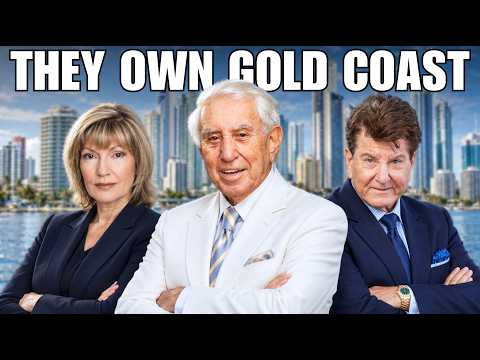
Number one: the Triguboff family. The apartment machine. Harry Triguboff did not arrive on the Gold Coast to build one landmark tower. Meriton is building a system. Triguboff founded the company in the early 1960s, starting with apartment development in Sydney. Over the decades, Meriton grew into one of Australia’s largest private property groups, responsible for more than 80,000 apartments.
But the important part is what happens after the building goes up. Most developers make their money by selling apartments and moving on. Meriton does that, too. But it also keeps thousands of apartments, manages rentals, operates service accommodation, and controls much more of the property cycle itself. That means one development can generate money several different ways.
Meriton already has a major presence in Surfers Paradise, but its newer projects are pushing the scale much further. Iconic is being developed across two towers, while Cypress Palms is planned with towers reaching up to 90 stories. The tallest is expected to rise to around 300 meters, placing it among the most dominant residential buildings on the Gold Coast skyline.
These are not isolated projects. They are part of the same machine Triguboff has spent decades refining. Buy the site, build at scale, sell enough apartments to recycle capital, keep part of the stock, then continue earning from rent, management, and accommodation long after construction has finished. That is what people often miss about Meriton. The tower is only the visible product. The real advantage is controlling what happens before, during, and after the sale.
That’s the Gold Coast through 12 very different family empires. Some built their fortunes through property, others through retail, hospitality, events, or long-term ownership. But what they all understood was how to turn the Gold Coast’s growth into something they could keep building on.
Which Australian city, state, or family should we investigate next? Leave your suggestion in the comments below.
Report this article
Select a reason for reporting:






