On July 1, 1916, the British Army suffered the deadliest day in its history. By nightfall, nearly 60,000 men were casualties—19,000 of them dead. For every 4.4 seconds of that long, horrific day, a man fell. The Battle of the Somme, one of the most infamous campaigns of the First World War, has come to symbolize the futility and slaughter of trench warfare. But was it really just a senseless waste of life? The truth, as always, is more complex.
By 1916, the Western Front stretched over 400 miles from the English Channel to the Swiss mountains—a continuous line of trenches where millions of men faced each other in a deadly stalemate. The Germans had invaded Belgium and northern France, capturing 90% of Belgium and a large chunk of French territory. The Allies—Britain, its empire, Belgium, and France—were determined to push them out. But the war had become a grinding battle of attrition.
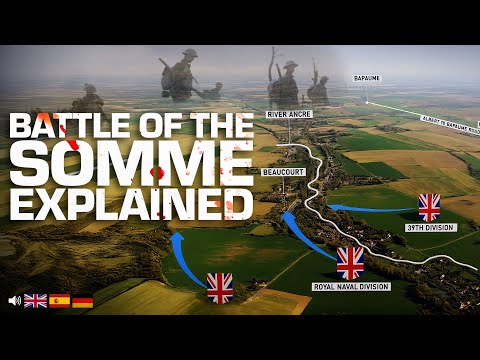
In February 1916, the Germans launched a massive assault on the French fortress city of Verdun, aiming to “bleed the French army white.” The French were on the brink of collapse. To relieve the pressure, the Allies planned a major offensive along the Somme River. Originally a joint French-British operation, the French commitment shrank drastically due to Verdun, leaving Britain and its empire to take the lead. The objective was not to win the war outright, but to inflict heavy losses on the Germans, regain territory, and force them to divert reserves from Verdun. The plan: a massive artillery bombardment followed by an infantry assault across an 18-mile front.
But how to break through? The technology of war had advanced, but tactics had not. Machine guns, barbed wire, and artillery made no man’s land a killing zone. There were no flanks to turn—the trench line was continuous. Armored vehicles didn’t exist, and tanks were only in their infancy. Previous attacks had failed disastrously. The solution seemed to lie in overwhelming artillery—the largest bombardment in history. If the Germans were all dead, there would be nobody left to shoot at the attackers. On paper, it made sense. In reality, it would prove tragically flawed.
The Germans had spent two years fortifying their positions. Their defenses were not a single trench line but a deep, complex web of trenches, support lines, and reserve lines, all protected by barbed wire and machine guns. Crucially, they had dug deep, reinforced dugouts—some up to seven lines deep—where defenders could shelter from artillery. When the British bombardment began on June 24, firing over 1.5 million shells over seven days, the ground was obliterated, but the Germans survived underground. They emerged to man their machine guns as the British infantry advanced.
On July 1, 1916, at 7:30 a.m., the British attacked. The results were catastrophic. In the north and center, the Germans were alive and ready. Even where massive mines were detonated—like the Lochnagar Crater, packed with 60,000 pounds of explosives—the attackers were met with murderous fire. The classic image of men walking into machine gun fire is not entirely accurate; most units tried to rush across no man’s land, but the defenses were too strong. Yet it wasn’t all failure. In the south, the French, with better artillery and weaker German defenses, achieved real success, advancing several miles. Some British divisions in the center also broke through the first and second German lines. But the overall cost was staggering: over 19,000 killed and 60,000 casualties. The battle could not be called off—Verdun was still under threat, and the Germans had to be kept under pressure.
Learning from the disaster, the British adapted. They launched night attacks, used hurricane bombardments, and even employed a “Chinese attack”—a feint to draw the Germans out of their dugouts before shelling them. The Battle of Bazentin Ridge on July 14 saw some success, but new problems emerged: fortified woods like Delville and High Wood became killing grounds. The South African Brigade alone lost 75% of its men at Delville Wood. Machine gun barrages and cavalry charges were tried with mixed results. The fighting around Pozières became a brutal slugfest, eventually captured by Australian troops at heavy cost.
By September, rain turned the battlefield into a quagmire. The Germans reinforced their lines and withdrew methodically, but they too were suffering. The British introduced a new weapon: the tank. On September 15, at Flers-Courcelette, tanks supported the infantry, achieving a advance of 2.5 km and nearly a breakthrough. But mechanical unreliability limited their impact, and it would be over a year before they appeared in large numbers again.
As autumn wore on, both sides were exhausted. The final major attack came on November 13 at the Battle of the Ancre. In fog, with improved artillery and remaining tanks, the British achieved some success, capturing the ruins of Beaumont Hamel—four months later than planned. But the breakthrough never came. The battle petered out in mid-November, leaving over a million casualties on both sides.
So what was the legacy of the Somme? The British and French suffered over half a million casualties, and the Germans perhaps 600,000. No breakthrough was achieved, but the battle forced the Germans to divert reserves from Verdun, likely saving the French army. It also taught the Allies vital lessons in tactics and coordination that would be used in later campaigns. As German General Erich Ludendorff wrote, “Our losses were very heavy, and on the Somme, our men lost confidence in the possibility of victory.” The Somme was a tragedy, but it was not futile. It was a brutal stepping stone to victory—a victory that would take two more years and cost millions more lives.
Yet the story of the Somme does not end with the guns falling silent in November 1916. The battle left scars that went far deeper than the churned earth of Picardy. For the British, it was a national trauma—a name that would be spoken in hushed, bitter tones for generations. Whole communities back home, the so-called “Pals Battalions” of volunteers who had enlisted together, were shattered in a single morning. Streets across northern England lost their young men in a single stroke.
But something else was stirring beneath the grief. The Somme had been a brutal teacher, and the British Army that emerged from it was not the same force that had marched into the attack on July 1. It had learned—painfully, expensively—how to fight a modern battle. The creeping barrage, the bite-and-hold tactics, the coordination of infantry, artillery, and aircraft: all of these had been forged in the fire of the Somme. What had failed in 1916 would, in time, succeed.
On the German side, the cost was equally profound. Ludendorff’s admission that his men had lost faith in victory was not mere rhetoric. The Somme had proved that the German army could be ground down. In early 1917, in a decision that stunned the Allies, the Germans withdrew to a newly prepared defensive line—the Hindenburg Line—giving up vast swathes of the territory they had fought so hard to hold. It was a tacit admission that the Somme had made their old positions untenable.
And Verdun? The great fortress city never fell. The French army, given breathing space by the Somme, held on. The German gamble to bleed France white had failed—and the Somme was a large part of the reason why.
Yet for the men who fought there, the grand strategic arguments meant little. What stayed with them was the mud, the noise, the smell of cordite and death, the faces of friends who never came back. A British officer, writing after the war, described the Somme as “the muddy graveyard of a generation’s innocence.” A German soldier put it more simply: “The Somme was not a battle. It was a slaughterhouse.”
Today, the battlefield is peaceful. Farmers plough fields that once were cratered moonscapes. Villages have been rebuilt. But the land still remembers. Every year, farmers turn up shells, bones, and rusted equipment in their harvests—the “iron harvest,” they call it. Cemeteries dot the landscape, row upon row of white headstones, each one a story cut short. The Thiepval Memorial, towering over the old front lines, bears the names of more than 72,000 British and South African soldiers who have no known grave.
And yet, the Somme is more than a monument to loss. It is a warning and a lesson. It showed the world what happens when technology outpaces humanity—when the tools of war become so deadly that tactics cannot keep up, and men are sent to die in their thousands for ground measured in yards. It showed the cost of stubbornness, of pride, of failing to adapt. But it also showed the resilience of the human spirit—the willingness to learn, to change, to keep going even when hope seemed lost.
The Battle of the Somme did not end the First World War. It did not achieve the breakthrough that Haig and the Allied commanders had dreamed of. But it did something perhaps more important: it ensured that the war could continue—and that, in the end, the Allies would have the strength and the skill to win it. The road to victory in 1918 was paved with the lessons of 1916, paid for in blood on the fields of Picardy.
As the historian John Keegan wrote, “The Somme was the battle that changed the British army—and the British people—forever.” It was a tragedy, yes. But it was also a turning point. And for the men who fought there, who survived and who fell, it was the defining experience of their lives—a chapter of history that must never be forgotten.
And so the Somme passed into memory—not as a victory, but as a wound. For the men who survived, the silence after the guns was louder than the bombardment itself. Many never spoke of it again, carrying the mud and the ghosts quietly through the rest of their lives.
Yet the fields of Picardy did not stay silent forever. The lessons bought so dearly in 1916—the creeping barrage, the bite-and-hold, the coordination of arms—would be applied with devastating effect in the campaigns of 1918. When the final Allied offensives broke the German army that summer, the Somme’s hard schooling was there in every well-timed barrage and every methodical advance.
Today, the Thiepval Memorial still stands over the old front lines, bearing the names of over 72,000 men who have no known grave. Farmers still turn up shells in the spring ploughing—the iron harvest that never ends. The land remembers what the history books sometimes smooth over.
So perhaps the truest verdict on the Somme is this: it was neither the futile slaughter of popular legend nor the necessary sacrifice of official histories. It was both—and something harder to name. A tragedy that taught an army how to win, paid for by a generation that never got to see the peace.
What do you think—was the Somme a senseless waste, or a brutal but necessary lesson that helped end the war? Let us know in the comments below.
Report this article
Select a reason for reporting:






