November 14, 1944. A cold Tuesday evening at Camp Breenridge, Kentucky. Fifty-eight German women, prisoners of war, stood in the mess hall line, their faces hollowed by months of retreat and starvation. They had been captured three weeks earlier near the Belgian border—radio operators, nurses, and clerks of the crumbling Wehrmacht. Now they waited for what they assumed would be meager rations befitting enemy prisoners. What happened next would haunt them for the rest of their lives.
Twenty-three-year-old Leisel Hartman stood third in line, her hands trembling as she clutched her metal tray. The former radio operator from Dresden had lost nearly thirty pounds during the final chaotic months of her service. Her gray auxiliary uniform, once fitted, now hung loosely on her frame. She had eaten nothing but watery turnip soup and black bread for four months. The last time she had seen real meat was in June at her sister’s wedding, when her family had sacrificed an entire month’s rations for a small pork roast.
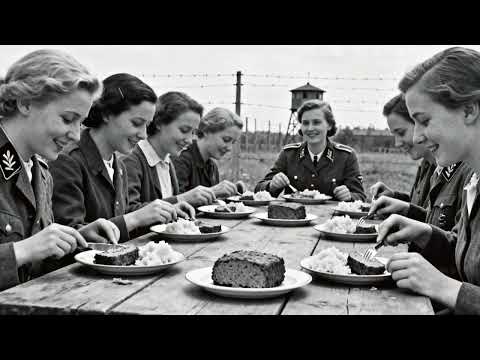
Behind her, twenty-seven-year-old Hildigard Zimmerman, a nurse from Stuttgart, whispered in German to twenty-one-year-old Schaefer. They were trying to guess what the Americans would serve. Potato peelings in water. Maybe some kind of grain mush. Certainly nothing substantial. They had been taught that America itself was suffering from food shortages, that the capitalist system was collapsing under the weight of war production.
The line moved forward, and Leisel found herself standing before Corporal Eugene Miller, a broad-shouldered young man from Iowa who managed the camp kitchen. He wore a genuine smile as he lifted a serving spoon. On her tray, he placed a thick slice of meatloaf, its surface glazed and glistening. Beside it, he added a generous mound of mashed potatoes, creating a small crater in the top, which he filled with rich brown gravy. On the other side of the tray, he spooned out green beans glistening with butter.
Leisel stared at the tray in her hands, unable to move. Her mind struggled to process what she was seeing. This was more food than her entire family had eaten in a week back in Dresden. This was the kind of meal reserved for Christmas or Easter. This was Sunday dinner.
Behind her, she heard Irmgard gasp. Then Hannelore Richter, the youngest at nineteen, spoke the words they were all thinking. “But it’s Tuesday,” she said in German, her voice breaking. “Why are they giving us Sunday dinner on Tuesday?”
The confusion rippled through the line of German women like a physical wave. Several began to cry softly. Others stood frozen, staring at their trays as if the food might disappear if they looked away.
Six months earlier, in May 1944, Leisel Hartman had stood in a different line. This one stretched down the Prager Strasse in Dresden, women and elderly men waiting for their weekly rations. She held her family’s ration cards tightly, knowing that these precious stamps represented the difference between survival and starvation. The war had transformed her beautiful city into a place of perpetual hunger. Her younger sister, Margaret, had fainted twice that month from malnutrition. Their mother had given up her own portions so the girls could maintain strength for their work assignments.
Leisel’s position with the women’s auxiliary corps guaranteed slightly better rations, but even those had been cut three times since the beginning of the year. What they called bread was now more sawdust than flour. The margarine was gray and tasted of chemicals. Real butter had become a distant memory from childhood.
Hildigard Zimmerman’s experience in Stuttgart had been even worse. As a nurse at the city hospital, she had watched patients die, not from their injuries or illnesses, but from simple starvation. The hospital had no food to give them. Children arrived with swollen bellies and stick-thin limbs, their bodies consuming themselves to stay alive. She had held the hand of a seven-year-old boy as he died, not from the pneumonia that had brought him in, but because his body had nothing left to fight with.
The ersatz coffee they drank was made from roasted acorns and chicory. It tasted bitter and provided no real nourishment, but the hot liquid gave the illusion of sustenance. Sugar had disappeared entirely by March. The monthly ration of meat had shrunk to 100 grams per person, barely enough for a single small meal. Most families saved it for Sundays, the one day when they could pretend life was still normal.
Trudy Becker, the twenty-five-year-old communication specialist from Berlin, remembered her last real meal in Germany. It was her mother’s birthday in April, and the family had pulled their rations for two weeks to create something resembling a celebration. They had made potato pancakes with one precious egg divided among eight people. There had been no oil for frying, so they used water in the pan. Her mother had cried when they sang to her, not from happiness, but from grief at what their lives had become.
The women had been taught that their sacrifices were necessary for victory. The propaganda films showed them that Americans were suffering equally, that the entire world was starving because of British blockades. They were told that enemy prisoners in American camps were treated brutally, given barely enough food to survive, worked to exhaustion as punishment for their nation’s aggression. Schaefer, the young clerk from Munich, had believed every word. She had volunteered for auxiliary service, believing she was protecting her homeland from enemies who wanted to starve them into submission.
Now, standing in a Kentucky mess hall with more food on her tray than she had seen in months, every belief she held about America was crumbling.
The transport ship had departed from Le Havre on October 23, 1944. Fifty-eight German women, guarded by American military police, had crossed the Atlantic in the hold of a converted cargo vessel. They had expected the worst. Stories circulated among them during the voyage of prison camps where captured Germans were beaten, starved, and forced into slave labor. These stories had been reinforced by years of propaganda showing American soldiers as barbaric criminals.
Leisel had spent the eleven-day crossing convinced she was sailing toward her death. She had written final letters to her family, which she kept hidden in her uniform pocket. She memorized her sister’s face from the small photograph she carried, certain she would never see Margaret again.
The other women shared similar fears. They comforted each other in whispered German conversations, trying to maintain dignity in the face of what they believed would be their destruction.
When they arrived at Camp Breenridge in western Kentucky, they were met by Captain Dorothy Brennan, one of the few female officers assigned to oversee prisoner facilities. Captain Brennan was a thirty-four-year-old career military officer from Boston who had specifically requested this assignment. She had studied German in college and understood that these women were not hardened Nazi soldiers, but auxiliary personnel caught in circumstances beyond their control.
The camp itself surprised them. It was clean, organized, and far less threatening than they had imagined. The barracks designated for female prisoners were simple but weatherproof, with real beds and blankets. There were washing facilities with running water. The fences were there, certainly, and armed guards patrolled the perimeter, but there was none of the brutality they had been taught to expect.
Sergeant Thomas Kowalski, a Polish American from Chicago, had processed their arrival with mechanical efficiency but without cruelty. He had explained the camp rules in slow, clear English, while Alfreda Wagner, who spoke some English from her school days, translated for the others. They would have work assignments. They would follow a daily schedule. They would be treated according to the Geneva Convention standards for prisoners of war.
What he did not mention, what none of them could have anticipated, was Corporal Eugene Miller’s philosophy about food. The young Iowan had grown up on a farm where meals were abundant and hospitality was sacred. He had carried those values into military service, believing that how you fed people revealed your character. When he had been assigned to manage the camp kitchen, he had made a private decision that would change everything. He would feed the German prisoners exactly the same food he would serve to American soldiers, not because regulations required it, but because his conscience demanded it.
The mess hall fell silent as the fifty-eight women found seats at the long tables. They placed their trays down carefully, as if the food might vanish if handled roughly. Leisel sat between Hilda and Irmgard, all three staring at their plates with expressions that mixed disbelief with something approaching fear. Around them, American guards and camp personnel ate the same meal, treating it as completely ordinary.
Corporal Miller moved through the room, checking that everyone had been served. He noticed the German women’s reactions but misunderstood their stillness as hesitation about unfamiliar food. “It’s just meatloaf,” he said cheerfully to the table where Leisel sat, though none of them understood his English. “My ma’s recipe. Nothing fancy, but it sticks to your ribs.”
Nineteen-year-old Hannelore Richter was the first to pick up her fork. Her hands shook as she cut into the meatloaf, watching the way it held together, the way the glaze caught the overhead lights. She brought a small piece to her mouth and closed her eyes as she chewed. The taste of real meat seasoned with herbs she could not identify was so overwhelming that tears began streaming down her face.
The crying spread like a contagion through the tables. Trudy Becker sobbed quietly as she ate her mashed potatoes, each bite a revelation of butter and cream. Irmgard could not stop staring at the green beans, touching them with her fork to confirm they were real. Thirty-one-year-old Alfreda Wagner, the eldest and most composed of the group, found herself weeping into her napkin as she tasted food that reminded her of life before the war.
The American personnel exchanged uncomfortable glances. Private Raymond Chen, the guard of Chinese descent who had been assigned to watch the women’s section, approached Sergeant Kowalski with concern. “Sir, something’s wrong. They’re all crying. Should we call the medical officer?”
Sergeant Kowalski watched the scene with growing understanding. He had heard stories from his parents about hunger in Poland, about what it meant to go months without adequate food. He recognized what he was seeing. These were not tears of distress. These were tears of shock at abundance after prolonged deprivation.
Captain Brennan observed from her position near the door. She had read the intelligence reports about conditions in Germany, about the severe rationing and food shortages. But reading reports and witnessing the visceral reaction to a simple Tuesday dinner were entirely different things. She made a mental note to request medical evaluations for all the prisoners, suspecting that malnutrition was far worse than their initial assessments had indicated.
Leisel forced herself to eat slowly, though every instinct screamed at her to devour everything on her tray immediately. She had seen what happened when starving people ate too quickly after prolonged deprivation. She took small bites, chewing carefully, letting her body adjust to the richness of the food.
Weeks passed. The meatloaf became a Tuesday ritual, and the women learned to say “thank you” to Corporal Miller, who blushed and waved his spoon. They gained weight, color, and something harder to name: a fragile, guilty hope.
Then came May 1945. The war in Europe ended, and repatriation loomed. In their barracks, the women debated staying. “How can we go home and face them?” Leisel asked. “We will face them with strength,” Alfreda said. “That is what Corporal Miller gave us.”
On their last Sunday, he served fried chicken and apple pie. Leisel memorized every taste. Decades later, in Frankfurt, she taught her daughter the meatloaf recipe and the lesson beneath it: kindness to enemies is not weakness.
She slid the pan into the oven. What would you have chosen—stay, or go home?
Report this article
Select a reason for reporting:






