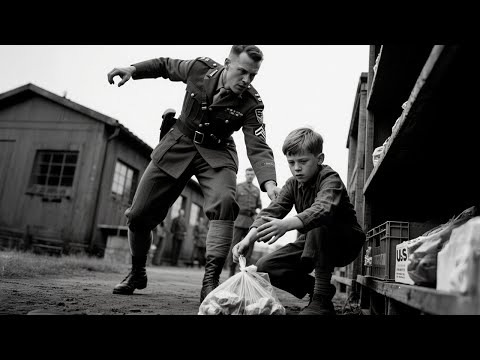
Frankfurt, December 1945. The night was bitter cold, frost coating the barbed wire that surrounded the American supply depot like crystallized warnings. Inside the fence, Corporal Thomas Brennan heard the sound—faint, deliberate—metal scraping against metal. He moved toward it with his flashlight off, boots crunching through frozen mud. Behind the mess hall, a figure crouched in shadows, hands stuffed with bread loaves, pockets bulging with canned goods. A boy, maybe ten years old, eyes wide with terror and defiance. Brennan raised his rifle, then lowered it. What happened next would violate regulations, defy logic, and save more than one life.
Frankfurt in the winter of 1945 was a study in devastation rendered in shades of gray. Allied bombing had reduced 80% of the city center to rubble—skeletal buildings standing like broken teeth against skies that seemed permanently overcast. The Dom Cathedral spire still rose above the destruction, a lonely monument to what had been and a question mark about what might come.
The American occupation forces had established themselves in the city’s least damaged sections. Military government offices operated from requisitioned buildings. Supply depots occupied former warehouses. Barracks filled spaces where German civilians had lived before their apartments became piles of brick and memory.
The contrast between occupier and occupied was stark and visible. American soldiers had heat, electricity, regular meals. German civilians huddled in basements and cellars, burning furniture for warmth, standing in bread lines that stretched for blocks, subsisting on ration cards that promised 1,500 calories daily but often delivered less.
Children suffered most visibly. Orphaned by bombing or battle, separated from parents by the chaos of defeat, they moved through the ruined city like ghosts—too thin, too quiet, eyes too old for their faces. Some begged near American checkpoints. Others scavenged in rubble. A few turned to theft.
The military police reported increasing incidents of pilferage from supply depots. Mostly food—bread, canned goods, anything portable and edible. The thieves were rarely caught. They knew the ruins intimately, could disappear into destroyed buildings where Americans feared to follow, had nothing to lose that hadn’t already been taken by war.
Security increased. Fences went higher. Patrols became more frequent. Guards received orders. Theft from military supplies was to be treated seriously, pursued aggressively, punished appropriately.
Corporal Thomas Brennan drew guard duty at supply depot seven on a Tuesday in mid-December. He was 23 years old, from Boston, had arrived in Germany six weeks earlier as part of the occupation forces. He had not fought in the war—his number had come up too late, after Germany surrendered. He was an occupation soldier, a peacekeeper, a representative of victorious America tasked with maintaining order in a defeated nation.
The duty was boring. Walk the perimeter, check the fence, ensure the padlocks held. Twelve-hour shifts in cold that seemed to penetrate every layer of clothing. Coffee helped. Cigarettes helped more. Imagining he was somewhere else helped most.
On the night of December 18th, halfway through his shift, Brennan heard something that wasn’t wind.
Stefan Keller was nine years old and had been stealing for three months. He had not started as a thief. Before the war ended, he had been a child—attending school when it was open, playing in streets that still had buildings, eating meals his mother prepared from increasingly meager rations. His father had died in France. Normandy, the letter said, though no details followed and no body returned. His mother had worked in a hospital until the bombing destroyed it in March 1944. After that, she worked wherever work existed—clearing rubble, sorting salvage, anything that paid enough for food.
Stefan remembered her hands becoming rough and scarred, remembered her coughing that got progressively worse, remembered the morning she couldn’t get out of bed. She died in October. Pneumonia, the overworked doctor said, though the underlying cause was malnutrition, exhaustion, and living in an unheated cellar where dampness soaked through everything.
She died quietly, apologizing to Stefan for leaving him, making him promise to survive, to find a way. Stefan kept the promise the only way he knew how.
The first time he stole, it was bread from a baker who left loaves cooling near an open window. Stefan had walked past, seen the opportunity, acted on instinct born of hunger that was physical pain. He ran with the bread clutched to his chest, expecting shouts, pursuit, punishment. Instead, silence. No one had seen. The bread fed him for two days.
The second theft was easier. The third easier still. By December, Stefan had developed a system—scout locations, identify vulnerabilities, strike when opportunity presented, disappear into ruins where pursuit was impossible. He shared what he stole. There were other children in the cellar where he sheltered—seven of them, ranging from six to thirteen, all orphaned or abandoned, all surviving on scavenging and theft and occasional charity from Germans who had barely enough for themselves.
The American supply depot represented the greatest risk and greatest reward. The fences were tall, the patrols regular, the consequences of capture potentially severe. But inside that depot, food in quantities Stefan could barely comprehend. Canned meat, bread, chocolate, powdered milk—enough to feed everyone in the cellar for weeks.
Stefan had been watching the depot for five nights, learning the patrol patterns, timing the gaps, identifying the weak point where fence met building in shadows pulled deep enough to hide movement. On the 18th, he made his move.
Stefan crossed the fence at 2140 hours during the fifteen-minute gap between patrols. He had wire cutters stolen from a construction site—small, barely effective, but sufficient to create an opening large enough for a nine-year-old body. Inside the compound, he moved with practiced silence. The mess hall was his target. He had watched kitchen staff loading garbage bins behind it, had seen the quantities they threw away, had understood that what Americans discarded would feed Germans for days.
The back door was locked, but a window stood slightly open for ventilation despite the cold. Stefan climbed through, dropped into the kitchen, froze—listening for footsteps. Nothing. Silence except for the hum of refrigerators and the tick of cooling ovens.
He moved quickly. Bread first—four loaves into a burlap sack he had brought. Canned goods next, anything he could carry, grabbed without reading labels. Cheese wrapped in wax paper, a box of crackers. His sack grew heavy. Too heavy. He would need to make two trips.
Stefan was reaching for a fifth loaf of bread when light flooded the kitchen.
He spun, saw the American soldier in the doorway, saw the rifle, saw his own death or imprisonment or whatever Americans did to German children who stole from them. For three seconds, nobody moved.
Brennan had heard the window, had approached expecting a cat or wind. Instead, he found a boy. Skinny to the point of emaciation, wearing clothes three sizes too large, holding bread like it was treasure.
The regulations were clear. Apprehend thieves, turn them over to MP headquarters, file reports. The military government had protocols for dealing with civilian lawbreakers. Brennan knew the protocols, had been briefed on them during orientation.
But the boy in front of him wasn’t a lawbreaker in any meaningful sense. He was a starving child stealing food that the mess hall would probably throw away tomorrow.
Brennan lowered his rifle.
“Hey,” he said quietly. “Kid, what are you doing?”
Stefan understood no English, but he understood the tone. Not angry. Almost gentle. Confused, maybe. He considered running. The window was still open. He could drop the sack, bolt, probably escape—but his legs wouldn’t move. Fear had frozen him in place.
Brennan took a step closer. Stefan flinched.
“Easy,” Brennan said. “Not going to hurt you.”
He set his rifle against the wall—a gesture that violated every security protocol he had been taught. Slowly, carefully, he approached the boy. Stefan backed against the counter, clutching the sack.
Brennan pointed to the bread visible in the sack. For you or for someone else?
Stefan stared uncomprehending. Brennan tried gestures. Pointed at Stefan, made eating motions, then gestured outward—other people. Stefan, operating on pure instinct, held up nine fingers. Nine people. Including himself.
Brennan felt something shift in his understanding. The boy wasn’t stealing for himself alone. He was feeding others. A family? Friends? Other orphans?
He made a decision that would define everything that followed.
“Wait here.” Brennan said. He mimed staying, held up a hand. “Don’t move.”
He left the kitchen, leaving Stefan alone with the stolen food and an open window. It was a test of sorts, though Brennan didn’t consciously frame it that way. If the boy ran, that would be that. If he stayed—
Brennan returned five minutes later, carrying a cardboard box. He set it on the kitchen counter and began filling it methodically. Bread—six loaves. Canned meat—a dozen tins. Powdered milk. Sugar. Chocolate bars. Crackers. Cheese. More food than Stefan’s sack could possibly hold.
Stefan watched with disbelief bordering on terror. This made no sense. Americans didn’t give food to German thieves. They arrested them. Punished them. This had to be a trick.
Brennan finished packing the box, folded the flaps closed, and pushed it toward Stefan.
“Here,” he said. “For you and whoever else needs it.”
Stefan looked at the box, at Brennan, at the box again. His mind struggled to process what was happening.
“Take it,” Brennan said, gesturing. “Go before someone sees.”
Stefan reached for the box with trembling hands. It was heavy—heavier than anything he had ever stolen. Too heavy to carry easily, but he would manage. He had to manage.
He looked up at Brennan and said the only English word he knew: “Thank you.”
Brennan nodded. “Go on. Get out of here.”
Stefan lifted the box, struggled to the window, somehow maneuvered himself and the food through the opening. He heard Brennan behind him. “Wait.” He froze again, certain the trap was finally springing. Brennan appeared at the window, holding Stefan’s burlap sack. “Almost forgot this,” he said, handing it through. Stefan took it, tucked it under his arm with the box, and ran into the darkness. Behind him, Brennan watched until the boy disappeared into shadows, then closed the window and tried to figure out how to explain the missing inventory.
Stefan reached the cellar at midnight, gasping from the weight of the box and the fear and the impossible reality of what had just happened. The other children swarmed around him as he came down the broken stairs into the underground space they called home. “What did you get?” Maria, age seven, asked in German. “Did anyone see you?”
Stefan set down the box and opened it. The children fell silent, staring at quantities of food they had almost forgotten existed. “Where did this come from?” asked Otto, thirteen, the oldest and self-appointed leader of their group. “You didn’t steal this much. You couldn’t carry this much.”
“An American gave it to me,” Stefan said quietly. The silence deepened. Then Otto laughed, harsh and disbelieving. “An American gave you food? You’re lying.”
Stefan pulled out a loaf of bread, handed it to Maria, then a can of meat for Otto. Chocolate bars distributed to the smaller children. He wasn’t lying. It was too real to be invention. “What did you do?” Otto demanded. “What did you trade?”
“Nothing. I was stealing. He caught me, and then he—” Stefan struggled for words. “He just gave me this. Told me to go.”
Otto examined the food with suspicion bordering on paranoia. “It’s poisoned. Has to be. Americans don’t help Germans.”
“It’s not poisoned,” Stefan said, though he had no way to be certain. “Why would they poison food and then give it to me? If they wanted me dead, the soldier had a rifle.”
The logic was sound but didn’t ease Otto’s suspicion. However, hunger overrode caution. They ate that night—carefully at first, then with increasing enthusiasm as no one got sick. Bread with real butter. Meat that wasn’t mystery scraps. Chocolate that tasted like a memory of better times. For the first time in months, the children went to sleep with full stomachs.
Stefan lay awake, thinking about the American soldier. He had been taught that Americans were enemies, occupiers, people to fear and avoid. The propaganda had been relentless. Americans would starve Germans, would enslave them, would take revenge for the war. But the soldier had given him food. Had let him go. Had helped when he could have punished. Stefan didn’t understand it, but he felt something shift in his understanding of what was true and what was lie.
Three nights later, Stefan returned to the supply depot. He told himself it was reconnaissance—just checking to see if the fence hole had been discovered, if security had increased. But he brought the empty burlap sack, just in case. He approached the fence at the same time as before, during the gap between patrols. The hole had been repaired, but loosely. Someone had wired it closed, but not welded it. Stefan could open it with minimal effort.
He didn’t. Instead, he waited in the shadows, watching. At 2145, the back door of the mess hall opened. The American soldier—the same one, Stefan was certain—stepped out carrying a box. He set it down near the fence, looked around as if checking for observers, then went back inside. Stefan waited five minutes, ensuring it wasn’t a trap. Then he crept forward. The box contained food—not as much as before, but substantial. Bread, canned goods, cheese, and a note, though Stefan couldn’t read English well enough to understand it. He took the box and disappeared into the ruins.
This became routine. Every third night, the box appeared. Stefan collected it, brought it back to the cellar, distributed the contents. The children stopped being so hungry. Maria’s ribs became less visible. Otto’s constant anger softened into something more manageable. Stefan never saw the American again, though he sometimes sensed him watching from the mess hall windows. The exchanges remained silent, anonymous—a strange compact between occupier and occupied that neither could fully explain.
In late December, Stefan decided to leave something in return. He didn’t have much—possessions were limited to what could be carried or hidden. But he had salvaged a small carved wooden figure from the rubble of his former home. A horse, intricately detailed, created by his grandfather, who had been a woodworker before the war. It was the most valuable thing Stefan owned. He placed it in the empty box before leaving.
The next exchange, the box contained extra chocolate and a note. Stefan still couldn’t read most of it, but he recognized one word that was similar in German: Friend.
Corporal Brennan’s arrangement remained undetected for six weeks. He falsified inventory reports, blamed discrepancies on rats and spoilage, rotated his guard shifts to ensure he was always present for the exchanges. It was systematic theft of military property, punishable by court-martial if discovered. He told himself he was preventing greater theft. If he fed the boy, the boy wouldn’t break in. It was pragmatic, strategic—a creative interpretation of his duty to maintain security. But really, it was simpler than that. He couldn’t stop thinking about the kid’s eyes—terrified but defiant, starving but sharing what he stole with others. Brennan had grown up in Boston during the Depression, had known hunger himself, had been helped by neighbors who shared when sharing meant going without. This felt like paying forward, a debt he owed to strangers who had kept his family fed when his father lost his job in 1933.
The wooden horse sat on Brennan’s footlocker. He didn’t know what it was meant to convey—gratitude, trade, friendship—but he kept it, looked at it sometimes when he was writing letters home, let it remind him that the enemy was an abstraction, but children were real.
In late January, Sergeant William Foster noticed the pattern. Foster was career army, had fought in the Pacific, had transferred to occupation duty in Europe after Japan surrendered. He was thorough, suspicious, and not inclined to overlook irregularities.
“Brennan, we need to talk.”
Brennan knew from Foster’s tone that the conversation would be difficult. They met in Foster’s office, a converted storage room that smelled of coffee and mildew. Foster closed the door. “The inventory reports from your shifts don’t match the other guards’ numbers. Consistent shortages—small amounts, but regular.”
Brennan had prepared for this. “Rats are bad in the mess hall, sergeant. We’re losing food to spoilage and vermin.”
Foster leaned back in his chair. “I’ve been doing this long enough to know when someone’s lying, corporal. What’s really happening?”
Brennan considered his options. Continued lying would fail eventually. Truth might result in court-martial. But Foster was direct, respected honesty, even when it was inconvenient.
“There’s a German kid,” Brennan said. “Been stealing from the depot. I’ve been—managing the situation.”
“Managing how?”
“By giving him food. Controlled amounts. Keeps him from breaking in. Reduces security risks.”
Foster’s expression was unreadable. “You’re feeding German civilians with military supplies.”
“One kid. And whoever he’s feeding. I figure it’s better than having them cut holes in fences and create actual security problems.”
Foster was quiet for a long time. Finally: “How long has this been going on?”
“Six weeks.”
“And you’ve been falsifying reports to cover it.”
“Yes, sergeant.”
Foster stood, walked to the window, looked out at the ruined city. Brennan waited for the order to report to the MPs, to face charges, to explain his actions to officers who would view them as theft rather than charity. Instead, Foster turned back and said, “Show me.”
That night, Foster accompanied Brennan on guard duty. They positioned themselves near the mess hall, waiting. At 2145, Brennan placed the box near the fence as usual. Then he and Foster withdrew to watch from inside. Ten minutes later, a figure approached—small, cautious, moving with practiced stealth. Stefan checked for observers, then grabbed the box and began to retreat.
Foster stepped out of the mess hall. The kid froze. Brennan moved quickly to Stefan’s side, positioned himself between the boy and Foster in a gesture that was partly protective, partly presentational. “Sergeant Foster, this is the kid I’ve been telling you about.”
Foster approached slowly, noting Stefan’s emaciation, his oversized clothing, his defensive stance. The boy watched Foster with eyes that had seen too much. “How old is he?” Foster asked.
Brennan shrugged. “Nine? Ten? Hard to tell.”
Foster knelt down, making himself less threatening. He spoke in slow, simple English. “What’s your name, son?” Stefan stared, uncomprehending. Foster tried German—he had picked up some during the war. “Wie heißt du?”
“Stefan,” the boy responded quietly.
Foster glanced at the box Stefan was holding. “How many people are you feeding with this?” Stefan held up nine fingers. “All children?” Stefan nodded.
Foster stood, considered, then looked at Brennan. “This is still theft of military property. You understand that?”
“Yes, sergeant.”
“But it’s also a security solution. Feeding nine starving kids keeps them from turning to more desperate measures.” Brennan nodded, uncertain where this was going. Foster pulled out a small notebook, wrote something, tore out the page, and handed it to Brennan. “This is authorization for regular distribution of surplus food to verified civilian dependents under supervised conditions. Effective immediately. You’re now running an official feeding program, corporal.”
Brennan stared at the paper. “Sir?”
“Can’t have you falsifying inventory reports. That’s a court-martial offense. But authorized distribution under my authority—that’s legal. Paperwork will need to be filed properly, but it’s within my discretion as depot NCO.” He turned to Stefan, switched back to German. “You come here every three nights, same time. Corporal Brennan will have food for you. But no more stealing. Understand? No breaking fences, no taking what isn’t given. We give, you take. That’s the new rule.”
Stefan nodded slowly, processing this impossible development. Foster reached into his pocket, pulled out a chocolate bar, handed it to Stefan. “For you. Not for sharing. Just for you.” Stefan took it with trembling hands. “Danke,” he whispered.
Foster waved him off. “Go on. Get out of here before you freeze.” Stefan grabbed the box and disappeared into darkness. Foster and Brennan stood in the cold, watching him go. “This doesn’t go in your service record,” Foster said. “And it doesn’t get discussed outside this depot. But it continues. Clear?”
“Clear, sergeant. And thank you.”
Foster shook his head. “Don’t thank me. Thank that kid for giving me an excuse to do something useful in this godforsaken occupation.”
What began as secret charity became unofficial policy. Foster authorized regular food distributions, created paperwork that looked legitimate enough to satisfy casual audits, and recruited two other soldiers who could be trusted with the arrangement. The program expanded gradually. Stefan brought other children—the seven from his cellar and others he knew from the ruins. Each was vetted, documented with false but plausible paperwork, and added to the distribution list. By February, they were feeding thirty-seven children. By March, sixty-two.
The food came from legitimate surplus—mess hall overage, damaged packaging, items approaching expiration. Nothing was stolen in the technical sense, though the distribution to German civilians bypassed official aid channels and military government protocols. Foster ran it like a military operation. Distribution schedules, attendance records, even basic health checks to ensure the children weren’t suffering from more than hunger. When one girl showed signs of tuberculosis, Foster arranged for her to see a medical officer, claiming she was a dependent of a German employee.
Brennan became the face of the program for the children. He learned basic German—enough to communicate with them. Learned their names, their situations, their stories. They called him der Brot Soldat—the bread soldier.
Stefan remained special to Brennan, though he couldn’t entirely articulate why. Perhaps because Stefan had been first, had been the catalyst. Or perhaps because Stefan reminded Brennan of his younger brother, who had been nine when Brennan shipped out, and whom he hadn’t seen in a year or two years.
In March, Brennan tried to find Stefan’s family. He asked through interpreters if the boy had relatives—anyone who could care for him properly. Stefan’s answer was simple. Everyone was gone. Father dead in France, mother dead from sickness, grandparents lost in bombing. He had only the other children, the cellar, and now the bread soldier who gave him food.
Brennan wrote to his mother in Boston. The letter was circumspect—military censors read everything. But he described meeting German children, helping with humanitarian distribution, feeling like he was doing something meaningful. His mother wrote back:
Your father would be proud. When we were hungry, Mrs. Kowalski shared her bread with us, even though she had barely enough for her own family. What you’re doing—helping hungry children—that’s what good people do, regardless of what side they fought on. The war is over, Tommy. Now comes the harder work of being human again.
Brennan kept the letter in his pocket, read it when the weight of what he was doing felt too heavy.
In April, the military government launched a routine audit of supply depots. An officer from Frankfurt headquarters arrived with a clipboard and suspicious attitude, determined to find waste, theft, or corruption. Captain Robert Hayes was thirty-eight, had never seen combat, had spent the war managing supply chains stateside. He approached occupation duty as an accounting problem. Inputs should match outputs. Discrepancies indicated fraud.
He noticed the pattern at depot seven within two hours. Unusual quantities of food marked as spoilage or damaged. Distribution records that didn’t match standard formats. Authorization signatures from an NCO rather than an officer. Hayes called Foster into the improvised audit office.
“Sergeant, explain these irregularities.”
Foster had prepared for this. “Sir, we’ve been running a humanitarian feeding program for orphaned German children. Surplus food distribution under my authority as depot NCO.”
Hayes flipped through paperwork. “Under what regulation?”
“Military Government Directive 23, which authorizes humanitarian aid to civilian populations under occupation authority supervision.”
“That directive requires officer approval. You’re an NCO.”
Foster didn’t blink. “The officer approval is retroactive. Pending assignment of a civil affairs liaison. In the interim, I exercised emergency discretion to prevent civilian starvation in our jurisdiction.”
It was bureaucratic jujitsu—using regulations against themselves. Creating justification from ambiguity. Hayes recognized it immediately. “How many civilians are you feeding?”
“Currently, sixty-two children.”
“All documented?”
“All verified as orphans or abandoned.”
“With how much food?”
“Approximately three hundred pounds per week. All from legitimate surplus that would otherwise be destroyed.”
Hayes set down his clipboard. “Sergeant, what you’re describing is an unauthorized aid program using military resources without proper oversight.”
“Yes, sir.”
“That’s a serious violation.”
“Yes, sir.”
Foster waited. He had known this confrontation would come eventually. The question was what Hayes would do with the information. Hayes walked to the window, looked out at Frankfurt’s ruins. After a long moment, he spoke without turning around.
“I have two options. I can shut this down, file reports, recommend disciplinary action. Or I can authorize it retroactively, establish proper oversight, and convert your improvised operation into an official program.”
Foster felt cautious hope. “Sir?”
Hayes turned to face him. “I came here expecting to find corruption. Instead, I find soldiers feeding starving children. That’s not corruption, sergeant. That’s the only decent thing I’ve seen since I arrived in this country.” He picked up his clipboard again. “I’m authorizing this program effective immediately. You’ll report to me monthly. All distributions will be properly documented. And we’re expanding it—other depots should be doing the same thing.”
Foster allowed himself to breathe. “Thank you, sir.”
Hayes waved off the gratitude. “Don’t thank me. Just keep feeding those kids.”
By May 1946, the feeding program had expanded to cover four depots and over three hundred children. What had started with Brennan giving food to one starving boy had become official policy—complete with budgets, oversight, and military government approval. Stefan continued coming to Depot 7. He had grown taller, filled out slightly, no longer looked quite so skeletal. The cellar now housed twelve children—the original seven plus five more who had nowhere else to go.
Brennan’s relationship with Stefan had evolved beyond simple charity. They talked haltingly, mixing German and English, filling gaps with gestures and context. Stefan told Brennan about his father, about watching Frankfurt burn, about his mother’s death. Brennan told Stefan about Boston, about his brothers, about playing baseball in streets that weren’t rubble.
In May, spring arrived properly—the first real warmth after brutal winter. Trees that had somehow survived the bombing began to leaf. In the ruins, flowers grew—small, defiant assertions of life continuing despite destruction. Stefan appeared at the depot on a Thursday, the regular distribution day. But instead of just collecting food, he waited until Brennan finished with the other children.
“I have something to show you,” Stefan said in careful English.
Brennan followed Stefan through the ruins—a journey that would have been forbidden under strict regulations but had become accepted practice. They walked for fifteen minutes, navigating destroyed streets that Stefan knew intimately. They stopped at what had been a school. The building was mostly rubble, but one classroom remained partially intact—walls standing, roof damaged but not collapsed. Inside, twelve children were sitting at salvaged desks. Otto stood at the front, using a piece of charcoal on a broken blackboard to teach mathematics.
“We made school,” Stefan explained. “Otto teaches math. Maria teaches reading. I teach English—what you taught me.”
Brennan looked around the makeshift classroom. The children had almost nothing—no proper books, no supplies, no heat—but they were learning, refusing to let war destroy their futures entirely.
“This is amazing,” Brennan said.
Stefan looked at him seriously. “You gave us food. Now we give ourselves education. We rebuild.”
Brennan felt his throat tighten. He thought about reporting this to Foster, to Hayes, to someone who could provide real supplies. Then he understood that bringing official attention might destroy what the children had built. This was theirs—autonomous, a reclamation of agency that charity couldn’t provide.
“You need anything?” Brennan asked. “Books? Paper?”
Stefan considered. “If you can find English books, that would help my teaching. But not as charity. We trade.”
“Trade what?”
Stefan reached into his pocket, pulled out a small carved bird. “Otto makes these. From rubble wood. We can make more—different animals, figures. You give books, we give carvings. Trade, not charity.”
Brennan took the bird, examining the detailed work. “Deal,” he said. “Trade.” They shook hands formally—two people negotiating across the divide of occupation, finding dignity in exchange rather than dependence.
In June, Brennan received orders. His unit was rotating home. Replacement troops would take over occupation duties. He had two weeks to process out, prepare for transport, and say whatever goodbyes needed saying. He told Stefan on a Tuesday distribution day. The boy’s face remained carefully neutral, but Brennan saw the flash of something in his eyes—fear, abandonment, the resumption of uncertainty.
“The program continues,” Brennan assured him. “Sergeant Foster is staying. The new soldiers will be briefed. Nothing changes except me.”
But Stefan understood that everything changes when the person you trust leaves.
Brennan’s last distribution was on June 20th. The children had organized something—a ceremony of sorts. They lined up formally, each one shaking Brennan’s hand and saying thank you in English. Some had made gifts—carved figures, drawings. One girl had written a poem in German that Brennan couldn’t read but accepted with the solemnity it deserved.
Stefan was last. He handed Brennan a package wrapped in brown paper. Inside, the wooden horse that Brennan had given him after that first exchange, now restored and polished.
“You gave it back,” Brennan said, confused.
“It was always yours,” Stefan replied in English. “I borrowed it. Now I return it.”
But Brennan understood the deeper meaning. Stefan was giving Brennan a piece of himself to take home—a reminder that would outlast occupation and distance and the inevitable fading of memory.
“I’ll keep it forever,” Brennan promised. “And Stefan—you’re going to be okay. You’re smart, you’re strong, you’re a survivor. Germany will rebuild, and you’ll be part of that.”
Stefan nodded, trying to believe it. “Will you come back? Visit?”
“Maybe. Someday.” They both knew it was probably a lie, but sometimes kind lies matter more than harsh truths.
Brennan left Frankfurt on June 23rd. The truck carrying him to the train station passed through the city center, through streets he had walked with Stefan, past the ruined school where children taught themselves. He looked back until the city disappeared from view.
Brennan returned to Boston—to a city that had never been bombed, where children played in streets that weren’t rubble, where hunger was an abstraction rather than a physical reality. He resumed civilian life, got a job at a factory, eventually married, started a family. But he wrote to Stefan—letters sent through military postal channels, forwarded through occupation authorities, hopefully finding their way to a boy in Frankfurt.
The first letter arrived three months after Brennan left. Stefan’s English had improved enough to read most of it, and Otto helped with the difficult parts. Brennan’s letters described America—so different from destroyed Germany that it seemed like fiction. He described his work, his neighborhood, the normalcy that Stefan could barely imagine. He asked about the children, about the school, about whether the feeding program continued.
Stefan wrote back. His letters described Frankfurt slowly rebuilding, electricity returning to some neighborhoods, schools officially reopening, his own enrollment in a proper gymnasium. He was learning English formally now—mathematics, history. He wanted to study engineering—to help rebuild Germany properly.
The correspondence continued for years. Stefan’s letters became more sophisticated as his English improved. He described his education, his first job as a draftsman’s apprentice, his growing understanding of what Germany had done during the war and his struggle to reconcile national guilt with personal survival. Brennan’s letters offered perspective without judgment. He had seen the ruins, had understood viscerally what war meant for civilians. He never lectured Stefan about Germany’s responsibility—just offered friendship across the distance.
In 1952, Stefan sent a photograph. He was eighteen, no longer the skeletal nine-year-old who had stolen bread. He was healthy, well-dressed, standing in front of a building that was clearly new construction. The letter explained he had been accepted to university, was studying civil engineering, wanted to build the new Germany. Brennan kept the photograph on his desk. His wife asked who the young man was. “A kid I knew in Germany,” Brennan said. “Smart kid. Going places.”
In 1965, Stefan visited America. He was thirty years old—an engineer working for a firm that had contracts rebuilding infrastructure across Europe. His company sent him to Boston for a conference on modern construction techniques. He called Brennan from his hotel. The conversation was surreal—two voices separated by twenty years and an ocean of experience reconnecting like the gap had been days instead of decades.
They met at a cafe near Boston Common. Brennan was forty-two, hair graying, carrying the weight of middle age. Stefan was tall, confident, successful—unrecognizable as the starving child except for his eyes, which still held memory of hunger.
“You look good,” Brennan said. “Really good.”
Stefan smiled. “You look old.” They both laughed, the tension breaking.
They talked for hours. Stefan described Germany’s reconstruction—the Wirtschaftswunder, the economic miracle that had transformed the country from ruins to prosperity. He described his career, his work on bridges and buildings, his contribution to the new Germany. Brennan described his life—factory work that was steady if unexciting, his three children, his quiet Boston existence that felt mundane compared to Stefan’s accomplishments.
But Stefan shook his head. “You saved my life. All those children—you saved us. That’s not mundane.”
“No, I gave you bread. That’s all.”
“You gave us dignity. You saw us as people worth saving. That mattered more than the food.”
Stefan reached into his briefcase, pulled out something wrapped in cloth. He handed it to Brennan—the wooden horse, the same one Stefan had returned when Brennan left Frankfurt. Polished to a shine, mounted on a small base with an engraved plaque. “To Thomas Brennan, who chose kindness when cruelty would have been easier. With gratitude, Stefan Keller.”
“I can’t take this,” Brennan said.
“You have to. It’s been waiting for this moment. I restored it again, had the plaque made. It’s a piece of history—your history and mine. The night you could have arrested a starving thief but chose to feed him instead.”
Brennan accepted the horse, feeling the weight of memory and meaning. They sat in the cafe until closing—two men whose lives had intersected in ruins and had carried that intersection forward through decades.
Before Stefan left to return to Germany, he asked, “Why did you do it? That first night—you could have arrested me. Before, why didn’t you?”
Brennan considered. “When I was nine, my family was starving during the Depression. A neighbor, Mrs. Kowalski, gave us bread even though she barely had enough for herself. My mother told me, ‘We help because we’re human, not because people deserve it.’ When I saw you that night, I didn’t see a German thief. I saw a kid who needed help. The rest was just logistics.”
Stefan nodded slowly. “Mrs. Kowalski would be proud of what you did.”
Brennan smiled. “I hope so. I hope she knows I passed it forward.”
Thomas Brennan died in 1998 at the age of seventy-five. Among his possessions: the wooden horse Stefan had given him, letters spanning forty-six years, photographs of a German boy transforming into a successful man. His obituary mentioned his service in occupied Germany but didn’t detail the feeding program. That remained a private history—documented in letters and memories but not in official records.
Stefan Keller retired from engineering in 2000. He had built bridges across Germany, had helped reconstruct a country from ruins, had lived a full life that began with stealing bread from an American supply depot. In his retirement, Stefan wrote a memoir. He described the war, the occupation, the freezing cellar where twelve children survived together. He dedicated a chapter to the bread soldier—the American corporal who responded to theft with kindness.
The memoir was published in German in 2003, translated to English in 2005. It sold modestly but reached audiences in both countries. Some readers recognized it as a story about post-war reconciliation. Others saw it as a testament to individual choices mattering more than national allegiances. But for Stefan, it was simpler. It was a thank-you letter to a man who had chosen to see a starving child instead of an enemy, who had given food without conditions, who had offered dignity through the simple act of helping.
The wooden horse sits in a museum in Frankfurt now—part of an exhibition about the occupation period. The plaque explains its significance: a symbol of the moment when one American soldier chose kindness, fed one German child, and set in motion a program that would feed hundreds. But the deeper meaning isn’t in museums or memoirs. It’s in the choice Brennan made that December night—the decision to give instead of punish, to help instead of harm, to see humanity before nationality.
Stefan survived because of bread, but he thrived because someone chose to treat him like a person worth saving. That choice rippled forward. The children Stefan shared food with survived. They rebuilt lives, had families, contributed to Germany’s reconstruction. The program Brennan started unofficially became official, fed thousands, provided a template for humanitarian aid in occupation that influenced policy for decades. All because one soldier heard a sound in the night, found a boy stealing bread, and lowered his rifle.
The war created enemies, but individual humans—choosing moment by moment to be better than circumstances required—created something else. Not quite friendship; the context was too unequal, too fraught. Not quite redemption; neither owed the other salvation. But connection—recognition across the divide that we are all just people trying to survive, to rebuild, to find meaning in ruins.
Stefan kept stealing food that winter, but he stole it from the boxes Brennan left—through an exchange that transformed theft into gift and occupation into something more complicated than power. And somewhere in that transformation, both the soldier and the boy learned that kindness isn’t weakness. Sometimes it’s the only strength that matters.
What would you have done if you were Brennan, staring at a starving child in the freezing dark—follow the regulations, or follow your conscience?
Report this article
Select a reason for reporting:






