The photograph was small—just six inches wide—and at first glance, utterly unremarkable. Two boys stood beside a wooden fence, dressed in dark jackets that hung loosely on their shoulders. Behind them, a narrow farmhouse, a water pump, and a stretch of bare ground fading into a line of trees. No dramatic expressions. No visible injuries. No strange figures lurking in the background. Just two boys staring into a camera more than a century ago.
But when the image was enlarged, a tiny detail near the younger boy’s collar began to whisper a different story. A small metal object was pinned beneath his collar. At first, it looked like an ordinary button. Then the image was sharpened. It was not a button. It was an identification tag—and the number engraved on it belonged to someone who was not supposed to be standing in that photograph.
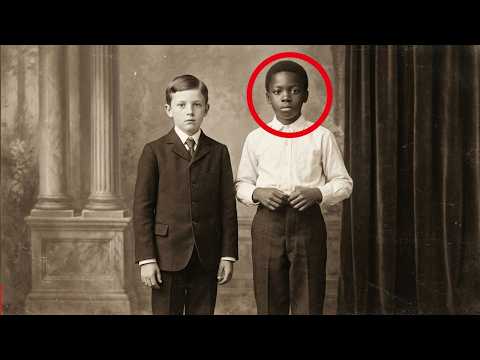
The picture had been found inside a damaged family album in 1987, after an old farmhouse in western Pennsylvania was sold and emptied. Most of the photographs had names written on their backs. This one did not. Only four numbers appeared in faded pencil: 1905 October. For decades, nobody knew who the boys were. The album had belonged to a woman named Margaret Hail, whose family had lived in the area for generations, but the two boys did not appear in the family records that were later assembled. They were simply there—two children, one photograph, one unexplained metal tag, and a question that became increasingly difficult to ignore.
Why was a boy wearing an identification number that belonged to somebody else?
The photograph itself offered the first clues. The older boy looked about 13. He stood straight, almost stiffly, with one hand resting against the fence. The younger boy appeared to be around eight. His clothing was cleaner than his surroundings suggested. His boots were polished. His hair had been carefully combed, but his expression was different. The older boy looked directly into the camera. The younger boy did not. His eyes were turned slightly toward the farmhouse, almost as though he was waiting for someone to come outside.
At first, historians examining the image thought the boys were brothers. That seemed reasonable. The shape of their faces was similar. Both had dark hair. Both were dressed in clothing that could have come from the same household. But when researchers compared the photograph with surviving census records, the assumption began to fall apart.
The Hail family had only one son living at the farmhouse in 1905. His name was Thomas Hail. He was 17. He was not either boy in the photograph. That meant the picture was not a simple family portrait. Something else was happening.
The next clue came from the farmhouse itself. A handwritten property description from 1904 listed the Hail residence as a small rented farm with three adults and one child. There was no mention of another boy, no mention of a boarding student, no mention of an adopted child, no mention of anyone carrying an identification tag. Yet there he was, standing outside the house, looking toward the door and wearing a number.
The number was difficult to read. Researchers enhanced the original negative and found three digits: 417. That number might have meant nothing, unless it belonged to another record. It took months to find the connection. In a county register from the same year, the number 417 appeared beside the name of a child. His name was Samuel Reed. Samuel was 8 years old, the same age as the younger boy. But Samuel Reed was not listed as living in Pennsylvania. He was recorded in a children’s institution nearly 200 miles away.
And the record contained another troubling detail. Samuel Reed had been reported missing from the institution in September 1905, one month before the photograph was taken.
Suddenly, the ordinary picture looked very different. The younger boy might not have been a Hail. He might have been Samuel Reed. If that was true, then the photograph had captured something far more serious than a family secret. It had captured a child who had disappeared.
But there was still a problem. Samuel Reed’s institutional record described him as having a noticeable scar above his right eyebrow. The boy in the photograph had no visible scar. And that contradiction became the first major obstacle. Maybe the boy was not Samuel. Maybe the number meant something else. Maybe researchers had simply found a coincidence.
Then another photograph surfaced. It was taken less than two weeks after the first. The boys were no longer standing outside the farmhouse. They were sitting inside a church hall. The image had been stored separately from the Hail album. And this time the younger boy’s coat was open. The metal tag was gone. But beneath his shirt collar was a narrow strip of fabric. Someone had sewn something into it. A name. Only three letters were visible: Sam.
That was the moment the investigation changed direction. Because if the boy really was Samuel Reed, the question was no longer simply where he had come from. The question was, why had a missing child ended up at the Hail farmhouse? And why had someone tried to hide his identity?
The first serious attempt to answer that question began with Samuel Reed’s institutional records. The surviving paperwork was incomplete. That was common for the period. Children entered institutions for many reasons. Some had lost parents. Others had been abandoned. Some came from families struggling with poverty. Others were placed there temporarily because relatives could not support them. Samuel’s file was unusually short.
His birth was recorded in Ohio in 1897. His mother’s name was Eleanor Reed. His father’s name was listed as Daniel Reed. Then, beside his father’s name, someone had written a single word: deceased.
Samuel entered the institution in 1902. According to the intake record, he was 5 years old. His mother had died two years earlier. There was no surviving close relative willing to take him. For the next three years, his name appeared regularly in the institution’s registers. Then in September 1905, everything stopped. One handwritten line read, “Transferred, October placement pending.” But there was no destination, no receiving institution, no guardian, no transportation record—nothing.
A month later, the photograph appeared at the Hail farmhouse. That was too close to ignore.
Researchers next examined the history of the Hail family. George Hail, the owner of the property, had been a mill worker before renting the farm. His wife Margaret was known locally for taking in sewing and laundry. They had one biological son, Thomas. Thomas was 17 in 1905. And this was where another strange detail emerged.
A church ledger showed that Margaret Hail had been involved with a children’s aid committee. Her name appeared beside several entries involving orphaned and displaced children. That did not prove anything. It did, however, establish that she had contact with organizations that handled children without families. The Hail household might have had a reason to receive Samuel, but why had he been photographed? And why had he been given another child’s identification number?
The answer seemed to be hidden in the number itself. Number 417 was not merely an institutional identification number. It was a transportation number. A surviving transportation ledger showed that children were sometimes assigned numbers when moved between institutions and temporary homes. The ledger listed Samuel Reed as number 417. But the date beside the number was wrong. It indicated that Samuel had been transported on September 18. The destination was left blank.
That single blank line became critical. Someone had moved Samuel. Someone had received him. But the official record had never been completed.
Then came the newspaper. A small local paper from October 1905 contained a brief notice that had been overlooked for decades. It did not mention Samuel Reed. Instead, it reported that a boy of approximately eight years had been brought to the area by a private charitable organization. The boy was described as quiet. He had no known relatives nearby. The notice said the child would remain temporarily with a farming family. No family name was printed, but the date was October 2—only days before the photograph.
The Hail name was not mentioned. Still, the evidence was beginning to form a pattern. Samuel disappeared from one institution. A child matching his age arrived in the Hail area. A photograph was taken at the Hail property, and the boy wore Samuel’s transportation number.
Yet the scar remained a problem. Researchers returned to the original institutional description. The scar was not above Samuel’s right eyebrow. It was above his left eyebrow. A transcription error had survived in later summaries. When the original intake document was examined, the handwriting clearly indicated the left side. The photograph showed a faint line above the boy’s left eyebrow. It was almost invisible, but it was there.
The contradiction disappeared. The boy was almost certainly Samuel.
Then came the most important discovery. A letter was found in a private family collection in Maryland. It had been written by Margaret Hail’s younger sister, Clara, in November 1905. The letter mentioned the little Reed boy only once, but the sentence was enough to change the entire story. Clara wrote that Margaret had taken the child because there was no one else willing. That sounded compassionate, but the next sentence was darker. Clara warned Margaret not to let the county people know where he truly came from.
Why? That question led researchers away from the photograph and into the history of children’s placement. In the early twentieth century, poor children were often moved between institutions and private homes with limited oversight. Some arrangements were loving, others exploitative. Children could become cheap labor. A farm needed another pair of hands. A household needed someone to clean, carry water, feed animals, or work in fields. A child without parents had very little power to refuse.
But Samuel’s case appeared different. He was not simply placed with the Hails. Someone had deliberately concealed his institutional identity. And the photograph now provided a possible explanation.
The two boys were not brothers. They were not even related. The older boy was Thomas Hail. The younger boy was Samuel Reed. So why were they photographed together?
A clue came from Thomas himself. In 1912, Thomas left Pennsylvania and moved west. Years later, he gave an interview to a local newspaper about his childhood. The interview was brief. Most of it concerned farm life, but near the end, Thomas remembered a boy named Sam. He described him as the little fellow who came in the autumn. Thomas said, “Sam slept in the small room above the kitchen.” He said Sam was frightened of strangers. And then Thomas mentioned something unexpected. He said Sam believed someone was coming to take him away. Thomas remembered telling him, “They won’t find you here.”
That sentence had survived for nearly half a century, and it suggested that the Hails were not hiding Samuel because they wanted to exploit him. They may have been hiding him because they were afraid of what would happen if he were found.
The question became: who was looking for him?
That answer appeared in a court record from Ohio. Daniel Reed, Samuel’s father, had not actually died before Samuel entered the institution. He had disappeared. His death had never been legally confirmed. And three years after Samuel’s placement, a man using the name Daniel Reed appeared in a county jail record in Indiana, arrested for fraud involving forged employment papers.
The name was common enough to raise doubt. But his age matched, his birthplace matched, and the record contained a scar description that matched Samuel’s father. Daniel Reed was alive.
That meant Samuel had not simply been an orphan. His father was alive when he was placed in the institution—and someone had told the institution otherwise. The Hailes might have believed Samuel was being pursued by someone who wanted something his father had hidden.
And that brought investigators back to the photograph, because Thomas was holding something in his right hand. Something so small that nobody had noticed it at first. A key—not a house key, but a narrow iron key with a distinctive round head.
The same type of key appeared in a property inventory from 1906. It opened a storage box belonging to George Hail. And that box contained a letter. The letter was written by Daniel Reed. It was addressed to Margaret Hail. The date was September 1905—the month Samuel disappeared.
The letter contained no confession, no dramatic explanation—only a request. Daniel wrote that he could not safely take Samuel with him. He asked Margaret to keep the boy until he could return. And then came the sentence that finally explained the photograph. Daniel warned Margaret that if anyone came asking about the child, she should say, “Samuel had never lived there.”
The boy’s identification tag had therefore not been left on his coat by accident. It had been used as proof of identity for someone who needed to know who he was.
But there was one more mystery. If Margaret wanted to hide Samuel, why photograph him at all? The answer came from the back of the second photograph. In faint handwriting were five words: “For his father, if he returns.”
The photograph was never meant for the public. It was evidence—a record of what Samuel looked like, a promise that he was alive. And suddenly, the ordinary photograph had become something much more painful. It was not a portrait made to remember a happy afternoon. It was a message to a missing father.
But Daniel Reed never returned—or at least not in the way Margaret had hoped.
The final part of the investigation depended on understanding what happened to Samuel after the photograph was taken. For years, historians believed he had remained with the Hail family. The record suggested otherwise. In 1908, the Hail property register listed four people living in the farmhouse: George, Margaret, Thomas, and a boy named Samuel Hail. That surname change was significant. It meant Margaret had formally brought Samuel into the household. But there was no adoption document. Instead, a church record from 1909 referred to him as “Samuel Hail, Ward of George and Margaret.”
The family had found a way to keep him. He was no longer an institutional child. He was no longer number 417. He had a home.
Yet the story did not end there. In 1914, Samuel disappeared from the Hail records. At first, researchers feared the worst. Then they found his name in a railway employment ledger. Samuel Hail, 17 years old, had taken work in Chicago. The employer’s record described him as quiet, reliable, and literate. More importantly, Samuel listed his father as unknown. His mother was listed as deceased. He had chosen not to use the name Reed.
That suggested something deeply personal. He had not simply been given a new surname. He had accepted it.
The next clue came from a letter written decades later. In 1941, Thomas Hail received a letter from Samuel. By then, both men were middle-aged. Samuel was living in Oregon. Thomas remained in Pennsylvania. The letter contained no dramatic confession. Instead, Samuel wrote about the photograph. He remembered standing beside Thomas. He remembered the cold October morning, and he remembered being told to look toward the camera. But he also remembered something else. He said Margaret had told him: “One day you may need to prove that you were here.”
That sentence explains why the photograph mattered so much. Samuel had been afraid his existence would be erased. He had already been separated from his mother. His father’s name had disappeared from official records. His own identity had been reduced to a number. And the photograph gave him something no ledger could provide: a face, a place, a witness. Proof that for one morning in 1905, he had stood beside someone who cared enough to preserve his existence.
But what happened to Daniel Reed? The answer was found in an Indiana prison record. Daniel had served several years under an assumed name. He was released in 1911. After that, the trail became uncertain. There were no confirmed records showing that he ever returned to Pennsylvania. But one document offered a final possibility. A letter from Margaret to Clara dated 1912 mentioned that “Sam’s father has written again.” There was no name, no address—just the sentence. Researchers compared the handwriting with Daniel Reed’s surviving letter from 1905. The handwriting was similar but not conclusive.
So the father’s return remains uncertain. Perhaps he wrote. Perhaps he never came back. Perhaps Margaret simply believed that someday he would.
What can be established is that Samuel survived. He lived into his seventies. He married. He had children. And according to his granddaughter, he kept one photograph in a wooden box beside his bed—the photograph of the two boys—for most of his life. He never explained it. His granddaughter later recalled that she once asked why the picture mattered. Samuel reportedly answered, “Because they knew my name.”
That simple sentence became the emotional center of the entire investigation. The dark secret hidden in the photograph was not a murder. It was not a supernatural mystery. It was the much quieter truth of a child whose identity had almost disappeared inside a system of paperwork, poverty, and fear. The metal tag had once reduced Samuel to a number. The photograph gave the number a face. The records gave the face a name. And the family that kept him gave that name a future.
When historians returned to the original photograph one final time, they noticed something else. Thomas was holding the key. Samuel was wearing the identification tag. At first, those two objects seemed unrelated, but together they represented the entire story. The key belonged to the box containing Daniel’s letter. The tag belonged to Samuel’s old identity. One represented the secret that had to be protected. The other represented the child who needed protection. And the boys stood between them. Thomas, the son of the household. Samuel, the child who had arrived without a place to belong. Two boys who, for a brief moment, were simply standing beside each other.
There is also something almost heartbreaking about the way Samuel looks in the photograph. He is not smiling, but he is not crying. He is looking toward the house. Perhaps he was waiting for Margaret. Perhaps he was nervous around the camera. Or perhaps he was simply eight years old and tired of being told where to stand. We cannot know. That uncertainty is part of what makes the photograph so powerful. A photograph can preserve a face. It cannot preserve a person’s thoughts. It can show us where someone stood. It cannot tell us what they feared. It can capture a child before a moment disappears. It cannot tell us whether that child understood how much his life was about to change.
But sometimes the surrounding evidence can speak. The transportation record tells us Samuel was moved. The newspaper places a boy near the Hail farm. The institutional tag connects him to the number in the photograph. The letter connects him to Margaret. The church record shows that the Hailes eventually kept him. And Samuel’s own later letter confirms that he remembered the photograph. No single piece proves the entire story. Together, they create something much stronger: a human history.
The photograph that once looked ordinary now tells a different story. It shows a boy who had been separated from his family. A teenager who had lost his original identity. A woman who chose to protect him. And another boy who stood beside him when almost nobody else knew where he belonged.
More than a century later, the farmhouse is gone. The fence has disappeared. The original wooden box has been damaged by time. The names have faded from the paper, but the photographs survived. That is the strange power of old photographs. They often preserve moments that the people inside them never believed would matter. Samuel probably did not know that someone would enlarge the image more than a hundred years later. He could not have known that historians would trace a number on his coat through institutional records, church books, court documents, and family letters. He could not have known that the small metal tag would eventually lead strangers back to his childhood. But perhaps that was the real purpose of the photograph all along—not to explain everything, only to prove that he had been there.
On that October morning in 1905, two boys stood beside a farmhouse. One belonged there. The other was still trying to understand whether he did. Between them was more than a wooden fence. There was a secret, a missing father, a forgotten identity, and a promise that one day the truth might be found. The photograph did not preserve the entire story of Samuel Reed. It preserved something more fragile: the moment when a lost child was given a place to stand and someone made sure the world could never completely erase him.
Report this article
Select a reason for reporting:






