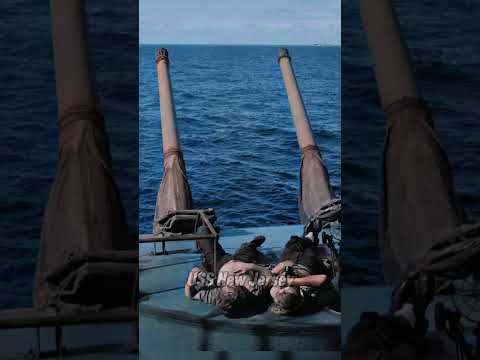
The Pacific Ocean, July 21, 1943. The sun beats down on the steel deck of the USS New Jersey, a floating fortress of iron and firepower. Somewhere in the vast blue expanse, far from the roar of combat, a handful of young sailors lie sprawled across the top of a 5-inch gun turret. Their bodies relax against the cold metal, eyes closed, faces turned toward the sky. For a fleeting moment, the war feels a million miles away.
This rare photograph captures a side of World War II rarely seen: the quiet humanity amidst the machinery of destruction. These men, barely out of their teens, are the heart of the battleship—the ones who load, aim, and fire the guns that shake the sea. But here, in this snapshot, they are simply boys catching their breath.
The USS New Jersey, an Iowa-class battleship designated BB62, was built for battle. Its nine 16-inch guns could hurl shells weighing as much as a car over 20 miles. The 5-inch guns, like the one these sailors rest upon, were the ship’s secondary battery—rapid-fire weapons designed to fend off enemy aircraft and surface threats. Yet in this moment, the turret is not a weapon; it’s a makeshift bed.
Life aboard a battleship was a paradox. Days could stretch into weeks of monotony, punctuated by bursts of terror. The men worked in shifts, slept in cramped quarters, and ate meals that tasted like cardboard. But they also formed bonds that only combat can forge. “You learn to treasure the small things,” one veteran later recalled. “A quiet hour on deck, a letter from home, a joke shared with a buddy.”
The sailor in the center, his cap pulled over his eyes, might be dreaming of his mother’s kitchen or a girl he left behind. The one beside him, arms folded behind his head, stares at the sky, perhaps thinking of the next watch. They are anonymous in the photo, their names lost to history, but their story is universal: young men thrust into a global conflict, finding solace where they can.
The New Jersey itself was a marvel of engineering. Commissioned in 1943, it would go on to earn nine battle stars in World War II, fighting in the Marshall Islands, the Marianas, and the Philippines. But on this July day, it was simply home. The crew of over 1,800 men lived and worked within its steel hull, a floating city with its own routines, hierarchies, and dramas.
“You could forget the war sometimes,” another sailor remembered. “Until the general quarters alarm sounded, and you remembered why you were there.”
The photograph, taken by an unknown photographer, is a testament to the resilience of the human spirit. In the midst of a war that claimed millions of lives, these men found a moment of peace. They lie on the very instruments of death, yet they are not afraid. They trust the steel beneath them, just as they trust each other.
As the sun begins its slow descent toward the horizon, the sailors stir. The brief respite is over. Soon, they will return to their posts, their faces masked by duty. But for now, they linger, holding onto the calm like a precious secret.
One of them, a lanky kid from Ohio named Frank, props himself up on an elbow and squints toward the horizon. “Sunset in an hour,” he mutters, more to himself than anyone. Beside him, a dark-haired sailor named Ruiz doesn’t open his eyes. “Then it’s an hour we don’t have to think about tomorrow.” A low chuckle ripples across the turret. They all know what tomorrow might bring.
The ship hums beneath them, a constant vibration that has become as familiar as a heartbeat. Somewhere below deck, the galley is firing up for the evening meal, and the smell of coffee drifts up through the vents. It is a small, ordinary thing—but out here, ordinary is a luxury.
Frank reaches into his pocket and pulls out a crumpled photograph, its edges soft from too much handling. A girl with a wide smile, standing in front of a white picket fence. He doesn’t say anything. He doesn’t have to. The others have their own photographs, their own girls, their own fences waiting somewhere across the water.
Then the moment breaks. A voice crackles over the ship’s intercom—routine, but firm. “Now hear this. Flight quarters in thirty minutes. All hands to general quarters stations at 1800.” The words hang in the salty air like a bell tolling.
Ruiz sits up first, swinging his legs over the edge of the turret. “Well,” he says, “there it is.” The others follow, one by one, sliding down the steel ladder with the practiced ease of men who have done it a hundred times. The turret, moments ago a sun-warmed bed, becomes once more a weapon of war.
Frank tucks the photograph back into his pocket, pressing it flat against his chest. He glances back at the spot where they lay, as if memorizing it. “Same time tomorrow?” he asks. Nobody answers. Nobody has to.
They disappear into the ship’s belly, swallowed by corridors of gray steel and the smell of oil and sweat. The Pacific stretches out behind them, indifferent and endless. And somewhere above, the sun continues its descent, casting long shadows across the deck of the USS New Jersey.
Below deck, the passageways narrow and the air thickens with heat. Frank follows Ruiz through a maze of bulkheads, past mess tables bolted to the floor and men hunched over letters home. The clatter of the galley fades behind them, replaced by the deeper rhythm of the ship’s engines—a sound you feel in your teeth more than hear.
At the 5-inch mount, the crew assembles with quiet efficiency. No one shouts; no one needs to. Each man knows his place, his task, the exact sequence of motions drilled into him a thousand times. “Load, aim, fire,” Ruiz mutters under his breath, a mantra as much as a routine.
The turret swings toward the horizon, its barrel tracking an imaginary target. The gun captain, a grizzled petty officer named Halloran, watches the sky with narrowed eyes. “Aircraft drill,” he says flatly. “Could be nothing. Could be everything. You treat it like everything.”
Frank grips the shell, feeling its cold weight in his hands. It is heavier than it looks, dense with purpose. He thinks of the photograph in his pocket, of the girl by the white fence, and wonders if she is looking at the same sun he is—setting somewhere over Ohio, far beyond this endless blue.
The drone of engines reaches them before the planes do. A distant hum, then a growing roar, and suddenly the sky is full of shapes—dark silhouettes cutting through the dusk like knives. The alarm bells shriek. Men scramble. The deck becomes a blur of motion and shouted orders.
“Steady!” Halloran barks. “Wait for it.” The barrels rise, tracking the incoming aircraft. Frank’s heart hammers against his ribs. The calm of the afternoon feels like a cruel joke now, a memory from another life.
Then the lead plane banks, and a signal lamp blinks from its wing—friendly. A drill, after all. A practice run to keep them sharp. The tension drains from the crew in a collective exhale. Someone laughs, a nervous, ragged sound. Halloran doesn’t laugh. “Good,” he says. “But next time it won’t be a drill.”
As the planes recede into the darkening sky, Frank loosens his grip on the shell. His knuckles are white. He hadn’t realized he’d been holding his breath. Ruiz claps him on the shoulder, a wordless gesture of solidarity. “You did fine,” he says. “You always do.”
The crew disperses, but the mood has shifted. The easy stillness of the afternoon is gone, replaced by a heightened awareness, a coiled readiness. The war is not a million miles away. It is here, waiting just beyond the horizon.
Frank climbs back up to the turret alone, the steel still warm from the day’s sun. He sits, knees drawn up, and watches the last light fade from the sky. The stars are beginning to appear, cold and distant. Somewhere below, the ship hums on, carrying them all toward whatever comes next.
He pulls out the photograph again, but this time he doesn’t look at it. He just holds it, thumb tracing the worn edge. “You ever wonder if they even know what we’re doing out here?” he asks the empty air. The question hangs unanswered, lost to the engine’s drone.
Below, Ruiz appears at the base of the ladder, his face half-lit by a distant deck lamp. “Frank. You coming down or are you planning to sleep up there?” Frank pockets the photo and slides down, landing beside him with a hollow clang.
They walk in silence toward the mess, where a thin stew and hard bread await. The line of sailors shuffles forward, trays in hand, voices low. “Tomorrow’s another drill,” someone says ahead of them. “Or maybe it ain’t.” No one replies.
Frank eats without tasting, his mind still on the turret, on the sun-warmed steel, on the hour of peace that felt stolen. He thinks of Halloran’s words: next time it won’t be a drill. The stew sits heavy in his stomach.
Later, in his bunk, he lies awake in the dark, listening to the breathing of dozens of men. The ship creaks and groans around them, a living thing. He touches the photograph through the fabric of his shirt and closes his eyes.
Morning comes gray and endless. The sea is calm, the sky empty. Frank climbs to the turret before his watch, finds Ruiz already there, and sits beside him without a word. The sun rises, burning off the mist. For a few minutes, there is only the two of them and the wide blue silence.
“You think we’ll ever go home?” Frank asks quietly. Ruiz squints at the horizon. “We’re already home, Frank. Just a different address.” He grins, and Frank laughs despite himself.
The intercom crackles. Another day begins. They slide down the ladder, two small figures against the vast steel of the New Jersey, and disappear into the machinery of war once more.
But somewhere in an archive, that photograph remains—a frozen hour of sunlight and brotherhood, proof that even in the darkest conflict, men find a way to rest. What would you have been thinking, if you were one of those sailors on that warm July afternoon?
Report this article
Select a reason for reporting:






