In the chaos of World War II, two figures emerged as symbols of Nazi horror: Amon Goeth and Oskar Dirlewanger. Goeth, commander of the Plaszow concentration camp, ruled with relentless cruelty, executing prisoners from the balcony of his villa with the same ease as he drank his coffee. In another scene of terror, Dirlewanger led the infamous 36th SS Grenadier Division, a squad composed of criminals and discarded soldiers who devastated entire villages, mercilessly massacring civilians on the Eastern Front.
But these were not the only monsters. The names Josef Mengele and Johanna Bormann would become synonymous with the most depraved acts of the Holocaust. Mengele, the Angel of Death, conducted unspeakable experiments on twins, while Bormann, the woman of the dogs, set her trained German Shepherds on helpless prisoners. Their stories reveal the depths of human cruelty—and the chilling fact that some escaped justice entirely.
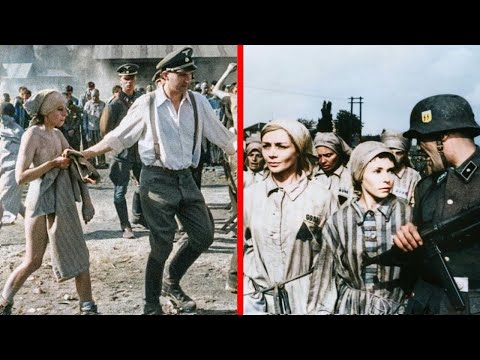
Oskar Dirlewanger was born on September 26, 1895, in Würzburg, Germany. His early life showed no signs of the monster he would become. His father was a wealthy sales agent, and his mother a housewife. Dirlewanger fought in World War I, earning the Iron Cross for bravery. However, a 1918 police report described him as a fanatic, violent, alcoholic, and mentally unstable man accustomed to practicing violence under the influence of drugs.
After the war, he joined the Freikorps and participated in suppressing communist uprisings. In 1923, he joined the Nazi Party but was expelled days later—only to be reinstated the following year. For a time, he managed a knitting factory until 1932, when he became the leader of the SA in Esslingen. But his depravity soon caught up with him: he was sentenced to 24 months in prison for kidnapping and sexually abusing a 14-year-old saleswoman. He lost his titles and decorations and was expelled from the Nazi Party again.
In 1936, Dirlewanger was released and soon repeated his crimes, landing him in a concentration camp. His friend SS-Oberführer Gottlob Berger secured his release, and Dirlewanger left Germany to join the Condor Legion in Spain. After the Spanish Civil War ended in 1939, he returned to Germany and joined the SS with the rank of lieutenant. With World War II looming, he saw his chance to unleash his darkest impulses.
In June 1940, Dirlewanger and Berger created a special SS detachment called Sonderkommando Dirlewanger, composed of murderers, convicted criminals, and poachers. Their brutality in fighting partisans and Jews in Poland and Russia shocked even some SS circles. Within the battalion, harsh discipline prevailed, but outside, Dirlewanger gave his men permission to kill, steal, and rape without consequence. Their favorite practice was locking civilians in churches or houses and setting them on fire, shooting anyone who tried to escape.
Despite their evil, their war skills were ineffective, and they were brutally defeated by the Red Army. But the unit continued to recruit, growing to a regiment by late 1943 and eventually to the 36th Waffen Grenadier SS Division. Dirlewanger received the Knight’s Cross and reached the rank of general. However, in 1945, he was bedridden in a hospital when Polish soldiers recognized him. They pulled him from his bed and beat him to death. His men were never convicted of war crimes, and he alone paid for his brutality.
Amon Goeth, born on December 11, 1908, in Vienna, was the sadistic butcher of Krakow. At 17, he joined the Hitler Youth and later the Nazi Party and SS. His involvement in the Nazi cause was noticeable, and he participated in the establishment of extermination camps like Belzec, Treblinka, and Majdanek. As commander of Plaszow, he loudly warned prisoners, “I am your God.”
Goeth’s methods were bloody and repulsive. He delighted in watching his dogs tear apart prisoners. He shot inmates from his kitchen window if they stopped to rest. He killed a cook because his soup was too hot and burned his tongue. He punished entire squads for one member’s mistake, and on one occasion, exterminated a whole squad after one escaped.
In September 1944, Goeth was removed from his position due to theft of Jewish property and excessive punishment. He was diagnosed with mental illness and admitted to a psychiatric hospital. After the war, he was tried by the Supreme Court of Poland. He argued he was following orders, but he was found guilty of homicide and sentenced to death. On September 13, 1946, he was hanged—though the first two attempts failed. His last words were “Heil Hitler!”
Josef Mengele, the Angel of Death, was born on March 16, 1911, in Günzburg, Germany. He studied medicine and philosophy, joining the SA in 1934 and the SS in 1938. He was convinced of German racial superiority and fascinated by genetics, especially twins. In May 1943, he became the doctor of Auschwitz-Birkenau, where he performed horrific experiments.
Mengele selected who would work and who would die in the gas chambers. He conducted experiments on twins, including amputations, injections of typhus, and blood transfusions between twins. If one twin died, he killed the other to compare organs. He killed 14 twins by injecting chloroform into their hearts and tried to sew two Gypsy twins together to create Siamese twins. He also attempted to change eye color with chemical injections and extracted eyeballs for analysis.
After the war, Mengele evaded capture for decades. He fled to Argentina in 1949 with a Red Cross passport under a false name. He lived openly, even traveling to Europe to visit his son. In 1959, he moved to Paraguay, then Brazil, under the name Wolfgang Gerhard. He died in 1979 from a stroke while swimming, never having faced justice.
Johanna Bormann, the woman of the dogs, was born on September 10, 1893, in Birkenfelde, Germany. Illiterate and from a poor peasant family, she worked as a floor cleaner in a mental asylum before the war. Seeking higher pay, she applied to work at Lichtenburg concentration camp, where she was promoted to guard. She was trained by Maria Mandl and Irma Grese, learning new torture techniques.
Bormann trained German Shepherds to kill humans. Her dogs killed between 50 and 500 prisoners a day. She set traps for prisoners, forcing them to run toward electrified fences for extra food, then shot them in a shooting contest with other guards. After the war, she was arrested and tried at Bergen-Belsen. Survivors testified to her brutality. She was sentenced to hang and executed on December 13, 1945. Her last words were, “I have my feelings.”
These four individuals represent the depths of human depravity during the Holocaust. Their stories serve as a chilling reminder of what happens when hatred and power go unchecked. But the question remains: how did ordinary people become such monsters? And what does their legacy teach us about the capacity for evil within us all?
To understand how such figures could rise, one must look at the system that nurtured them. The Nazi regime did not merely tolerate men like Dirlewanger and Goeth—it actively rewarded their cruelty. Himmler’s SS created a perverse incentive structure where brutality was a path to promotion. The more prisoners a guard killed, the more likely they were to receive commendations. The more villages a unit destroyed, the more resources it received.
This was not a case of a few bad apples. It was a deliberate policy. The SS leadership understood that men with criminal pasts and violent tendencies made ideal instruments of terror. Dirlewanger’s battalion of poachers and murderers was not an anomaly—it was a prototype. The regime sought out those who had already broken society’s rules and gave them uniforms, weapons, and absolute authority.
What is perhaps most disturbing is how these individuals viewed themselves. Not as monsters, but as loyal servants. Goeth’s final words were not an apology—they were a declaration of allegiance. Bormann’s last statement, “I have my feelings,” reveals a complete absence of remorse. She genuinely believed her suffering mattered while the thousands she murdered were simply obstacles to her wage.
Dirlewanger never faced a tribunal. His death at the hands of Polish soldiers was an act of raw justice, not legal proceedings. He was beaten to death in a hospital bed—a fate that denied him the platform to justify himself. Some historians argue this robbed the world of a full accounting of his crimes. Others see it as fitting that a man who showed no mercy received none.
Mengele’s escape remains the most haunting. For thirty-four years he lived under false names, raising a family, working ordinary jobs. He was never forced to answer for the children he murdered or the twins he mutilated. When investigators finally confirmed his death in 1985, they found a man who had died peacefully, surrounded by no consequences.
The legacy of these four figures extends beyond their individual crimes. They became archetypes—the sadistic commandant, the criminal soldier, the angel of death, the brutal female guard. Their names appear in survivor testimonies, in history books, and in the dark imagination of filmmakers. Ralph Fiennes won acclaim for portraying Goeth, but the real man was far worse than any script could capture.
What remains is the question of memory. Germany has spent decades confronting its past, but the stain of these individuals cannot be washed away. Their crimes were not aberrations—they were the logical conclusion of an ideology that dehumanized entire populations. And as the last survivors pass away, the responsibility to remember falls to those who never experienced it firsthand.
Their stories force us to ask uncomfortable questions about human nature. Were these four born monsters, or did the Nazi system create them? The evidence suggests both. Dirlewanger showed violent tendencies long before Hitler rose to power, while Bormann seemed an ordinary cleaner until given a uniform and a dog. The regime provided the stage, the permission, and the rewards.
But perhaps the most chilling lesson is how ordinary the machinery of murder became. Goeth drank coffee on his balcony between shootings. Bormann collected her wages after a day of setting dogs on women. Evil did not announce itself with horns and fire—it wore a uniform, followed orders, and went home to dinner.
Today, the sites of their crimes are memorials. Plaszow is a quiet field with scattered stones. Auschwitz draws millions of visitors each year. But memorials alone cannot prevent repetition. What prevents it is vigilance—the willingness to question authority, to protect the vulnerable, and to recognize the early signs of dehumanization before they harden into policy.
The four names in this story—Dirlewanger, Goeth, Mengele, Bormann—are not relics of a distant past. They are warnings. They remind us that the capacity for cruelty lives in ordinary people, waiting for the right conditions to emerge. And they ask us, across the decades: what would you have done?
Which of these four stories shocked you the most—and why? Share your thoughts in the comments below.
Report this article
Select a reason for reporting:






